
Key takeaways
In “Join The ICT Private Mentorship For Free”, posted 14 January 2024, ICT says he has uploaded his former paid private-mentorship and charter lessons to his own YouTube channel himself, so there is no need to buy copies from anyone.
Read the full summary
In “Join The ICT Private Mentorship For Free”, posted 14 January 2024, ICT says he has uploaded his former paid private-mentorship and charter lessons to his own YouTube channel himself, so there is no need to buy copies from anyone. For anyone asking how to join the ICT private mentorship for free, his answer in the recording is that there is nothing to join: the material is already on the channel, and the video is a study map for it. He walks through the order he says a student should work in – the 2016 core content Month One first, three months of eight videos each, then Month Four at 14 and Month Five at 18, continuing through the twelve months before touching the charter content – and argues against rushing, against stacking every concept into one model, and for pacing the work against a long horizon instead of a quick result. He also tells a performance story about a student he names as Kyle and a reported $1.1 million in payouts; that is his account of someone else’s outcome and is not verified here.
How we researched this article
BestProps used document-based research from primary firm sources, checked September 24, 2026. The complete source list, scope, limitations, and commercial-state record appear near the end of this article.
Where the Free ICT Private Mentorship Material Now Lives
ICT opens by saying he no longer takes private students and that, because people were reselling his former mentorship videos, he chose to upload them to his own channel. At 0:22 he says the point of that was that “there’s no need for you to buy them from anyone,” and he sends viewers to the playlists tab of the Inner Circle Trader channel rather than to a sign-up page. At 32:07 he adds that he is still uploading and intends to resume the charter membership content, and at 32:14 he attributes that release to the charter members agreeing to it. The recording itself is the only evidence presented here for the resale claim.
Two dates inside this video should not be collapsed into one. The watch page records the upload as 14 January 2024; the curriculum he describes spans 2016–2017 private-mentorship material and a 2022 series. Nothing in the recording is future-dated, and the video is not a market call for any particular session.
Where to Begin the ICT Private Mentorship
His suggested entry point depends on the learner:
- Forex-focused beginners: at 1:55 he points to the ICT Forex Market Maker Primer course as a good foundation for what he teaches about foreign exchange.
- Multi-asset beginners: at 2:14 he suggests the 2022 mentorship for traders who want futures, forex and commodities together, and at 2:43 he says that playlist holds 41 videos. At 2:31 he characterises it as very simple and highly visual.
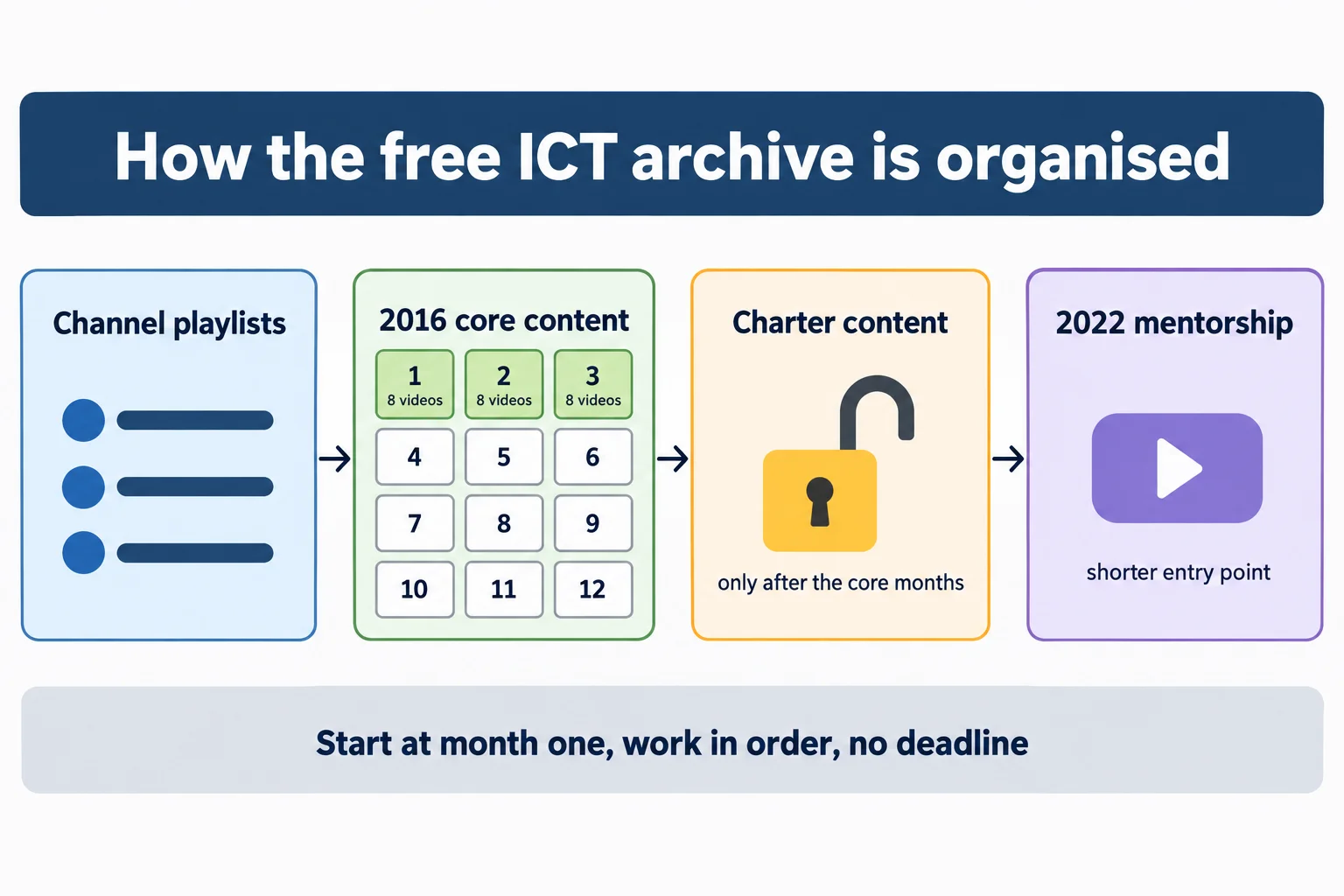
- The former paid sequence: at 3:40 he says the historical starting point is “2016 ICT Private Mentorship Core Content Month One,” that it holds eight videos, and that they are to be played in playlist order.
How to Study the ICT Private Mentorship in Order
He then gives the sequence as he says it should be worked through: Month One, then Month Two and Month Three at eight videos each (4:09, 4:20), Month Four at 14 videos and Month Five at 18 (4:25, 4:32), then continuing through Months Six to Twelve. The instruction matters more than the arithmetic: finish a month before starting the next one, and do not open with the later material. He also stresses at 4:32 that he is not removing anything, so there is no deadline to beat.
At 5:29 he describes the first twelve months as a primer – “just a language,” the equivalent of an encyclopedia – and at 6:10 he says there is no schedule, that a student should train at their own pace and take diligent notes, and that one viewing will not be enough to retain it. Only after the core months does he recommend the charter content, at 6:47; at 7:49 he says that content consists of twelve price action models, and at 35:13 he warns that treating them as a shortcut will frustrate a viewer rather than help them.
He also describes what a paid arrangement would have looked like, at 25:49 and 26:03: a monthly payment, with only that month’s videos released – eight at a time in the first month – which is his stated reason for seeing the free upload as giving away what others were charging for.
Use a Slower ICT Mentorship Study Process
The pacing argument is the most developed theme in the recording. At 14:49 he describes the ten-year plan he says he first taught publicly: starting with $1,000 and doubling it each year. At 15:13 he says a trader who could do that could turn it into a million dollars in ten years after tax, and at 16:18 he says his own first time horizon was twenty years and that rushing once he saw he could arrive sooner caused him mistakes. Read as a framing device for removing urgency, as he presents it, rather than as a projection of returns – the recording offers no data behind the doubling sequence.
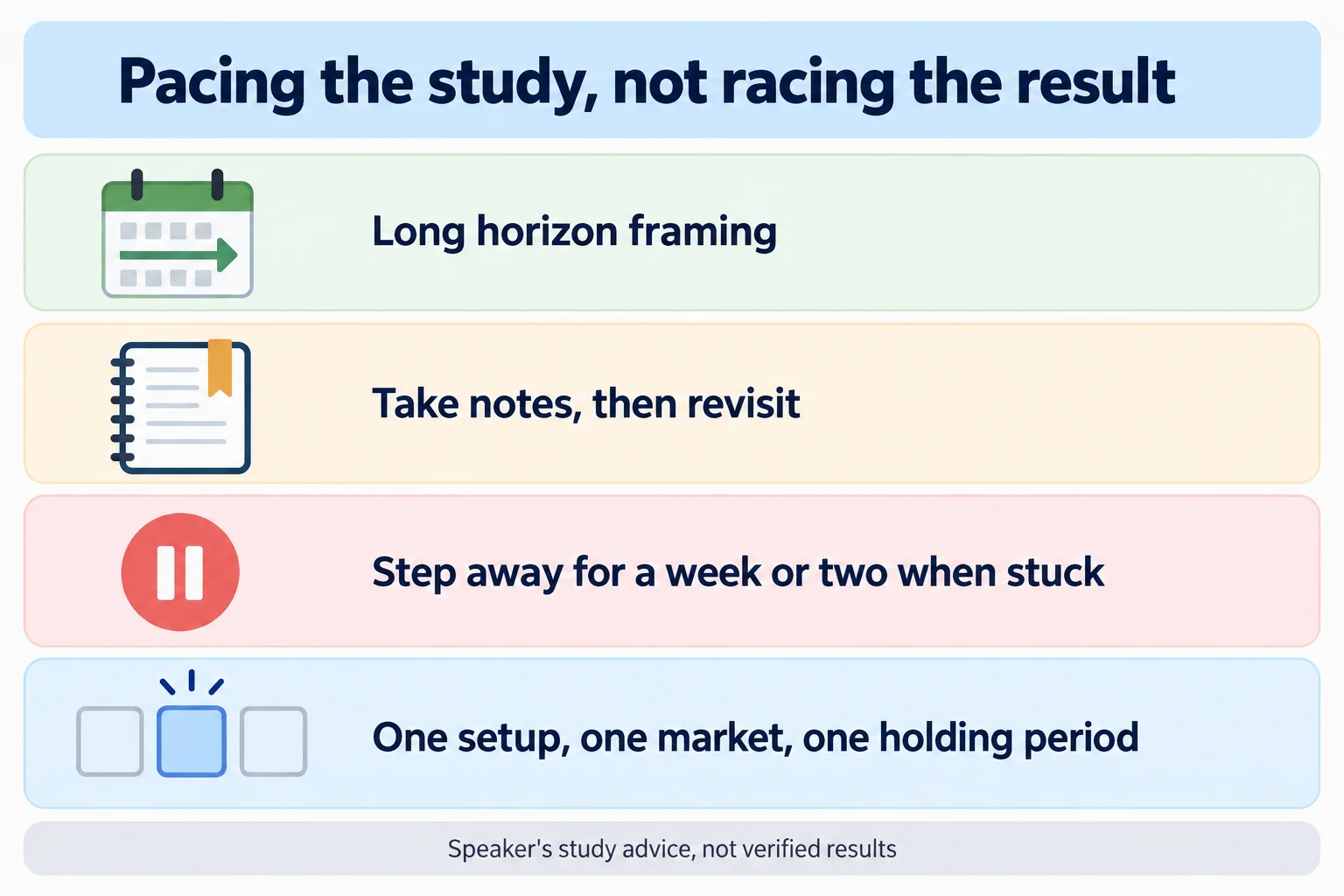
He returns to the same point late on. At 37:14 he says that when study and journaling start to feel like a brick wall, the response is to step away from the market and from trading content for a week or two; at 37:22 he frames that as a normal part of learning rather than a sign of failure. This is an argument about study pacing. It is not evidence that persistence produces profitability, and he does not claim that it does.
Study One ICT Mentorship Concept at a Time
At 13:04 he says the purpose of working through the material is to decide what to specialise in – one setup, one format of trading – rather than combining every model. He names the patterns a student might choose between, at 20:23 to 20:33: breaker patterns, mitigation blocks, fair value gaps, institutional order flow entry drills, inversion fair value gaps and reapers. At 20:40 he says he does not push students toward any single one, and he explains that as coming from his own early difficulty learning certain patterns.
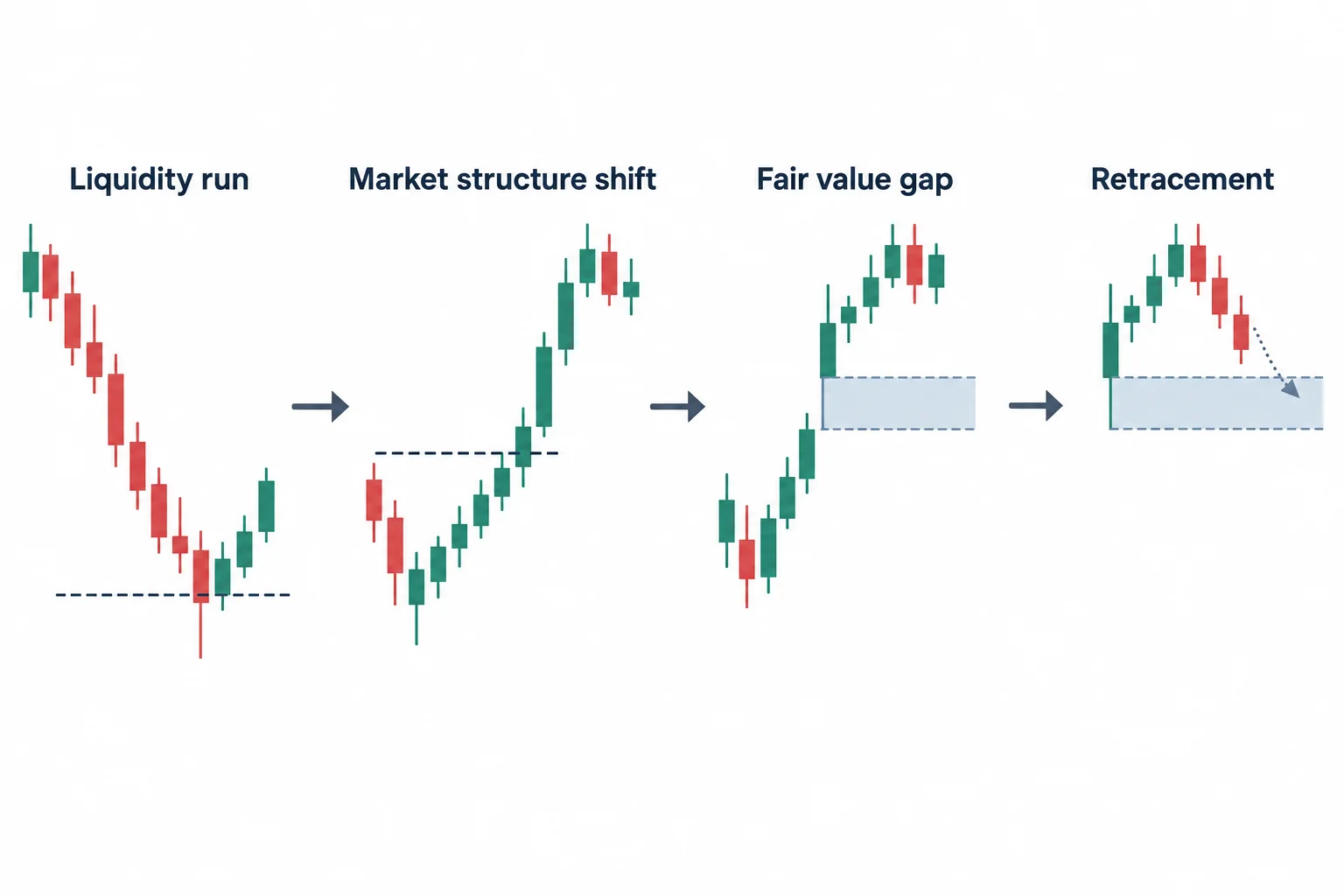
The only model he describes in any detail is the 2022 mentorship model. At 13:12 he summarises it as a fair value gap retracement after a liquidity run and a shift in market structure, and at 13:31 he characterises the timing of its setups as something a trader can predict within the day and then stop. This article cannot reconstruct its entries, stops or targets: the recording shows a screen he is annotating, and the source here is the spoken audio, so no chart detail is available to check that description against.
One word in the transcript needs flagging rather than quiet correction. The pre-condition is rendered as a “rate on liquidity,” which is almost certainly the concept usually described as a raid or run on liquidity, but the audio alone does not settle the wording. It is left as the automated transcript has it rather than repaired on the reader’s behalf, and the underlying concept is not verified here.
Choose an ICT Mentorship Style That Fits You
At 37:58 he asks the viewer a series of questions instead of answering them: intraday or not, setups that need less monitoring, or trades held for weeks and months. At 38:19 to 38:32 he ties each answer to a style – day trader, short-term trader, swing trader, position trader – and says a mentor should not impose the choice, because the learner’s own personality has to come into it. He makes the same point about review at 23:48 and 23:55: the students who did well, he says, did not simply watch everything once but returned to the lessons relevant to the style they had chosen.
He also claims broad applicability. At 28:18 he says that unless a lesson expressly names a market-specific characteristic, the material is meant to apply across assets. At 29:21 he extends this to his macro time windows, stating that apart from the last hour of index futures trading, 3 p.m. to 4 p.m., the windows sit in the ten minutes before and after the top of the hour, and at 29:40 he warns against sources that place them at other points in the hour. These are his stated conventions about his own framework. Nothing in the recording measures them, and no independent test of them is presented here.
What ICT Says About Mentorship Results
The video contains performance claims, and they should be read as claims only. At 9:01 and again at 33:07 he refers to a student he names as Kyle and says Kyle has taken over $1.1 million in trading payouts; at 9:29 he says he posted a link on the channel’s community post so the payouts can be checked, and at 33:17 he says he never told Kyle what to buy or sell. This article reports that as what the speaker said. No payout record, broker statement, prop-firm document or account was reviewed here, and no claim is made that the figure is accurate.
He makes a related claim about himself at 12:17, saying he has the highest number of documented payout students of the prop firms, and at 13:49 he refers to logging into a TD Ameritrade account during a period he describes as showing daily results and doubling an account with one contract; at 18:31 he puts that account at $25,000 turned into more than $50,000 in about five weeks, and describes part of it as deliberately randomised by coin flips to model a beginner. These are his recollections about recordings made afterwards. They are not audited records, no statements were reviewed for this article, and they are not presented here as proof of anything.
Two qualifications come from the recording itself. At 9:53 he says another person’s result is not a guarantee that a viewer will achieve the same, and at 10:03 he acknowledges students who started in 2016 and were never successful, or who quit. He says at 19:03 that he never tells a student when to begin trading real money and that the decision has to be personal. He even suggests, at 40:13, that a viewer who cannot apply the material alone might reasonably follow someone else, if that person can demonstrate the work first.
What This ICT Private Mentorship Recording Does Not Establish
Several things a reader might expect are absent. There is no chart walkthrough, no instrument, no price level, no entry or exit and no trade taken; this is a channel-and-curriculum lecture, not a market demonstration. There is no win rate, sample size, backtest, drawdown figure or audited account behind any performance claim, and no trade in the recording is identified as a real-money fill. The resale claim that motivates the video has no second source here beyond the speaker’s own statement.
The source for all of the above is the video’s own audio. No captions were available for this recording, so the transcript was produced by local automatic speech recognition of the full audio rather than human-verified captions, and terms and numbers may be misrendered. “Rate on liquidity” is flagged above, and the month-by-month video counts are reported as spoken rather than checked against the playlists themselves.
Practical Takeaways for Studying the ICT Private Mentorship
- Use the official Inner Circle Trader playlists rather than buying copies, which is the video’s own stated purpose (0:22).
- Start at the beginning of the sequence, not with the advanced material (3:40, 6:47).
- Pace the work deliberately; he argues the first year is a language to be learned, not a shortcut (6:10, 37:14).
- Choose one setup, one market and one holding period before adding anything else (13:04, 37:58).
- Treat every performance figure in the recording as an unverified claim by the speaker about someone else’s results.
Watch the original recording
The lecture runs about 44 minutes and is the only primary source used for this article. The channel is The Inner Circle Trader on YouTube.
Resources
These are the primary sources checked for this article. Anything else in circulation – notes, spreadsheets, re-uploads, indicator bundles or second-hand summaries of this material – is unofficial and untested here. The CFTC and Investor.gov pages are general regulator and investor-education material about systems sold online and about leverage; they are not assessments of ICT or of anything said in this recording.
- [1] Join The ICT Private Mentorship For Free – The Inner Circle Trader (primary source; watch page read 15 September 2026, 44M7S)
- [2] The Inner Circle Trader – official YouTube channel, including its playlists tab (read 15 September 2026)
- [3] CFTC – Fraud Advisory: Commodity Trading Systems Sold on the Internet (read 15 September 2026)
- [4] CFTC Learn & Protect – Forex Frauds (read 15 September 2026)
- [5] Investor.gov – Leverage (read 15 September 2026)
This is independent educational commentary on a single recording. It is not official ICT material, it is not a tested trading system, and it is not investment advice or a promise that any approach will produce profits. Leveraged and futures trading involves substantial risk and is not suitable for everyone. Results reported by other people are not evidence of what a different trader would experience.