
Key takeaways
ICT defines the daily range using New York time rather than MT4 period separators, with the Asian range starting at twelve a.m.
Read the full summary
ICT defines the daily range using New York time rather than MT4 period separators, with the Asian range starting at twelve a.m. and no recoverable end time, the London Kill Zone from one a.m. to five a.m., London lunch from roughly five a.m. to seven a.m., the New York Kill Zone from seven a.m. to ten a.m., the CME open at eight twenty a.m., and the London Close Kill Zone from ten a.m. to twelve p.m. His true day runs from midnight to three p.m. New York time regardless of daylight saving, although those endpoints span fifteen hours despite his 24-hour-cycle label. The April 3, 2017 example applies the power three open, high and low framework and retrospectively aligns turning points with these windows, including a New York-window low at the CME open and a daily low during London Close. ICT ends the day at three p.m. because bonds close then and expects most FOMC-related movement from two p.m. to three p.m. to be complete by that endpoint. The lesson supplies definitions and chart annotations only, with no instrument, prices, entries, stops, targets, fills, risk rules, performance statistics or tested evidence that price reliably behaves this way.
How we researched this article
BestProps used document-based research from primary firm sources, checked September 24, 2026. The complete source list, scope, limitations, and commercial-state record appear near the end of this article.
Why ICT Uses New York Time
The lesson opens by separating two ways of drawing a trading day. Holding control and tapping the Y key in MT4 draws the platform’s period separators for whatever time frame is loaded (0:37, 0:40), and the day those lines describe is what he calls the retail 24-hour trading day (0:24, 0:56). He says that is not the day he works from, and that traders who frame the session with those vertical lines are working from the wrong reference (1:44, 1:53).
His stated reason is consistency of reference. If the scenarios he is looking for are to be repeatable, he argues, the analysis has to start from the same clock he believes the interbank price delivery algorithm uses to reference time (1:11, 1:22, 1:28). That is a claim about how markets work, and it is presented here as his framework rather than as something demonstrated in the lesson. The only operational instruction that follows from it is practical: keep a New York clock, on a phone with world clocks or otherwise, and apply the hours below to that clock rather than to local time (3:33, 3:39).
He also answers the daylight-saving question in advance: the windows are stated in whatever New York time is at the moment, standard or daylight saving, and the hours themselves do not shift (4:57, 4:59).
ICT Daily Range Time Windows
He introduces this block as his definitive answer to the questions he gets most about time of day, and says that if viewers have seen different hours elsewhere, this is the set he uses (2:07, 2:08, 2:16, 2:26).
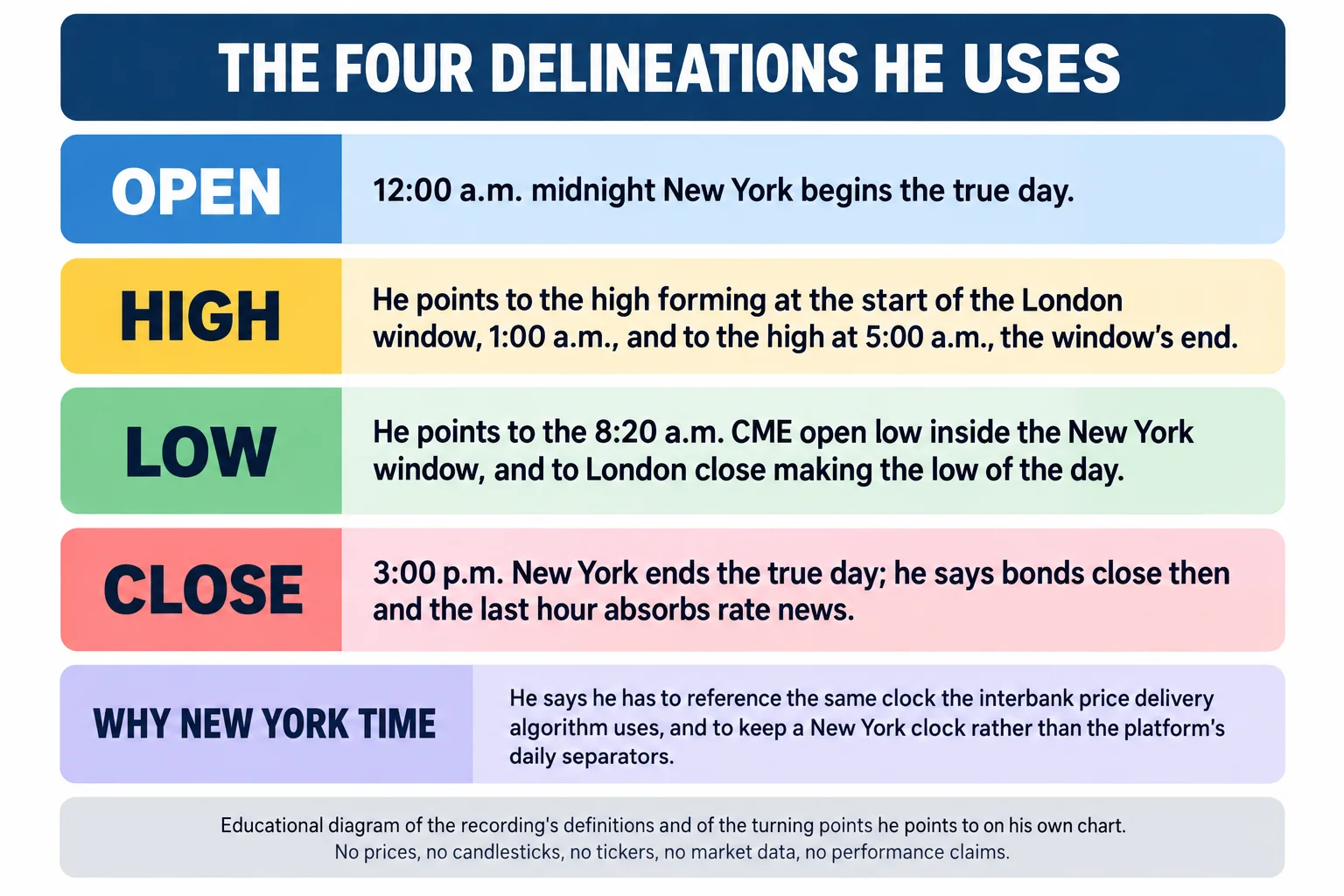
- Asian range begins every day at 12:00 a.m. midnight, Eastern Standard Time in New York (2:37, 2:43).
- London Kill Zone begins every day at 1:00 a.m. and ends at 5:00 a.m. New York time (3:08, 3:12, 3:20).
- New York Kill Zone begins every day at 7:00 a.m. and ends at 10:00 a.m. New York time (4:02, 4:06, 4:13). He calls these the actual hours he uses to hunt the setup (4:23).
- London Close Kill Zone begins every day at 10:00 a.m. and ends at 12:00 p.m. noon New York time (4:33, 4:43, 4:47).
- True day begins every day at 12:00 a.m. midnight and ends at 3:00 p.m. New York time; he calls this the beginning and ending of the interbank 24-hour cycle (5:16, 5:32, 5:47).
Two wording points are worth keeping straight. First, the caption track mishears the acronym he uses for the price-delivery model (it appears as “ipta,” “ifta” and “epta” within the same passage), so the expansion he actually speaks, the interbank price delivery algorithm (1:22), is the safe one to use. Second, he describes midnight-to-3:00 p.m. as a 24-hour interbank trading day while the two endpoints he states span fifteen hours; the recording does not explain the naming, so treat it as his label rather than as arithmetic.
One boundary of that first window does not survive the transcript. He is reading the on-screen text aloud in this passage, and the caption track garbles the wording and jumbles the order, leaving a fragment that reads “PM Eastern Standard Time” with no reliable statement of which boundary it belongs to (2:35, 2:37, 2:46). The midnight start of the Asian range is unambiguous; the other end of that window cannot be recovered from this recording alone.
ICT Time Windows for London Lunch and the CME Open
After walking through the April 3, 2017 Monday example (5:58, 6:02), he adds a reference he says he has not taught in earlier material: 8:20 a.m. New York, which he calls the CME open (7:21, 7:23, 7:39). He asks viewers to draw a vertical line from that time upward and says it lands on a short-term low from which price rallied away, calling that outcome something other than randomness (7:29, 7:32). The chart is not legible in the caption track, so that alignment is his read of his own annotation, not something a reader can check here.
He then names the gap between the London and New York windows, roughly 5:00 a.m. to 7:00 a.m. on the clock he has just defined, as London lunch. His description is that he is generally not looking for major moves there, and that the market either goes quiet or continues the path set at the London open (7:49, 7:51, 7:56). That is a behavioural generalisation he offers from experience; the recording provides no measurement of it.
ICT Daily Range Example From April 3, 2017
The worked example is framed with the three-phase open–high–low shape he calls power three: the 12:00 a.m. open, a small move down in the Asian range, then the upside break of Asian range resistance (8:06, 8:09, 8:12, 8:18). From there he points to a sequence of turning points and reads them against the windows he has just defined:
- The high of the day forms right at the start of the London Kill Zone, 1:00 a.m. New York (8:21, 8:23).
- Another high forms at 5:00 a.m., described as the very end of the London Kill Zone (8:40, 8:44, 8:48). He notes that traders using his free tutorials tend to wait for the 2:00, 3:00 or 4:00 a.m. hours, and repeats that 1:00 a.m. to 5:00 a.m. is the window he actually uses (8:29, 8:31, 8:35).
- Inside the New York Kill Zone he identifies a short-term high, and says the low of that window forms at the 8:20 a.m. CME open (8:53, 8:57, 9:02, 9:04). He defers the explanation of the CME open to a later lesson and asks viewers to keep it as a reference point in the meantime (9:09).
- A swing high in the New York session then trades down into the London Close window, which he says makes the low of the day, consolidates and trades off that low into the close (9:17, 9:19, 9:20, 9:25).
He also restates the vocabulary: when he says “New York close” he means the true-day close at 3:00 p.m., a shorthand he uses to save saying the full phrase (9:33, 9:37, 9:40, 9:42). Before that he describes framing the day with the time windows first and reading the turning points, the daily high, the daily low and the later swing points against them, and says there are logical reasons price reaches one level rather than another (6:19, 6:36, 6:56, 6:58, 7:01, 7:04, 7:08). He is explicit that this lesson is not going into the PD arrays and the institutional reference points, only the time windows (6:28, 6:47, 6:52).
What the example establishes is only what he sees on his own chart. The instrument, the price levels and the exact coordinates are not recoverable from a caption track, no entry, stop or target is given, and no outcome is reported for the day. The sequence he describes is an illustration of the annotation method, not a template that every session has to follow.
Why the ICT Daily Range Closes at 3 PM
His justification for the 3:00 p.m. endpoint is mechanical: bonds close then, and the influence interest rates have on the currency markets has ended by that point, so he stops extending the day (9:47, 9:50, 9:52, 9:55). The final hour, 2:00 p.m. to 3:00 p.m., is the part of the day he expects to absorb anything related to the FOMC, rate announcements and minutes released around the 2:00 p.m. hour, and he says that regardless of what happens with the FOMC the move, or the bulk of it, is generally finished by 3:00 p.m. (9:57, 10:00, 10:03, 10:09, 10:14, 10:17, 10:20). That is his working assumption about rate-driven flow, stated without measurement in this lesson.
Key ICT Daily Range Takeaways
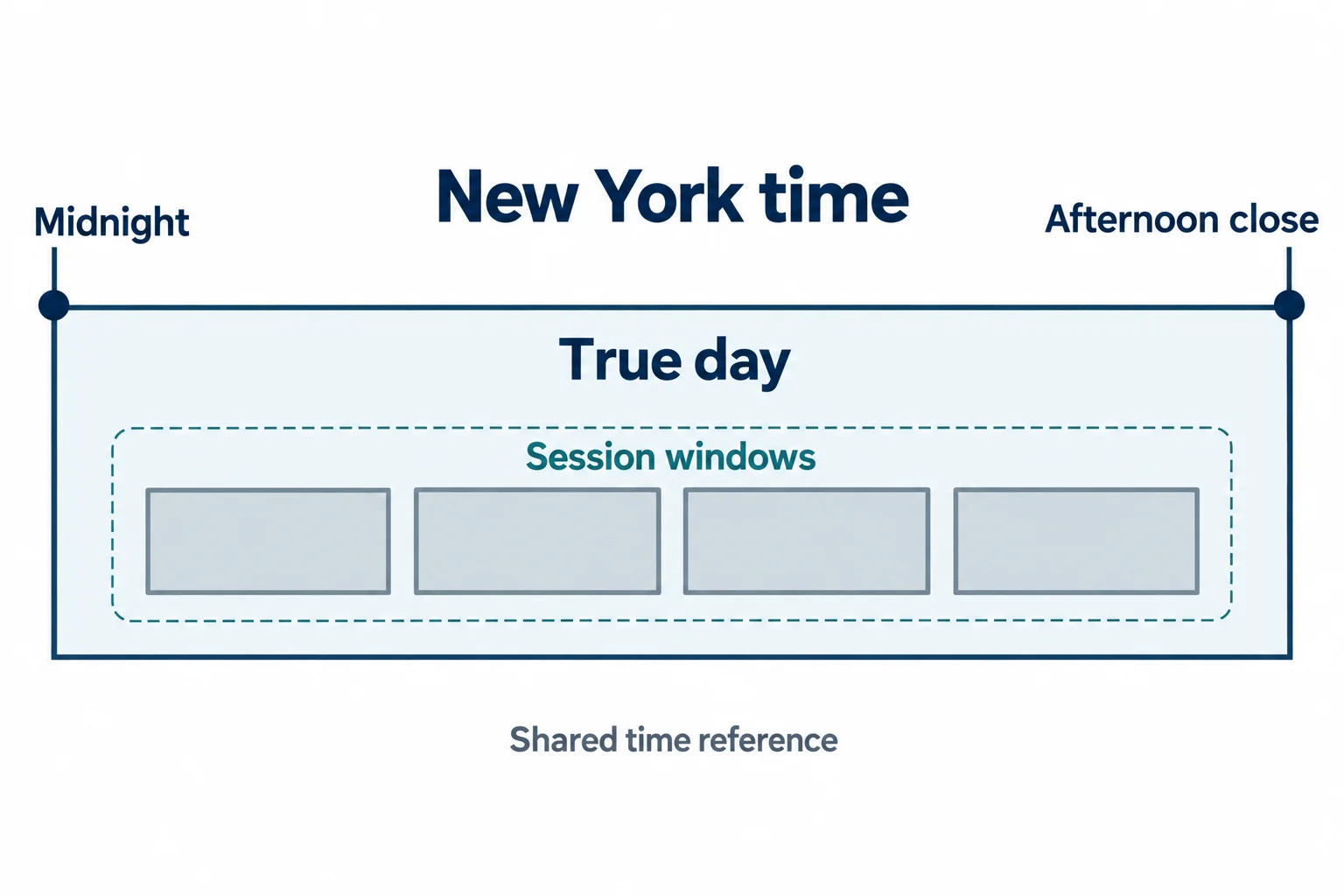
Read as a definition set rather than a strategy, the lesson does three useful things for anyone studying the material. It fixes a single time reference, New York, so that later sessions can be discussed without ambiguity (3:42). It separates the four session windows from the true-day boundaries, which are not the same thing: the true day starts at midnight and ends at 3:00 p.m., while the windows sit inside it (5:39, 6:10). And it labels the closing frame it is setting up: open, high, low and close, each with its own window (10:23, 10:26, 10:30).
What it does not provide is any basis for expecting a given hour to produce a given move. There are no entry rules, no risk parameters, no sample of days and no performance figures anywhere in the recording, and the single dated example is a chart he annotates in hindsight. A reasonable way to use the material is as a shared vocabulary for time of day, with the behaviour of each window treated as an open question to observe rather than a property to assume.
Notes on ICT Daily Range Captions
This article was written from the automatic YouTube caption track for the recording, which is machine-generated and mishears several things. The price-delivery acronym appears as three different spellings in one passage (1:22); “London close” appears once as “London clothes” (4:57); and the boundary line for the Asian range is corrupted, which is why only its midnight start is stated above and the other end is left out rather than guessed. Times spoken as hours are consistent throughout and have been reproduced as spoken. No chart image, price, order fill or net result has been invented to fill the gaps, and the speaker’s figures remain his own.
Watch ICT Define the Daily Range
ICT Mentorship Core Content – Month 08 – Defining The Daily Range
The Inner Circle Trader · published 2 October 2022 · about 10 minutes 44 seconds. This recording is the primary source for every timestamp link above.
The recording is not embedded here because the video owner has disabled playback on other websites. That was tested directly on 15 September 2026 from a BestProps page origin at both desktop and mobile widths: the embedded player loads, then reports “Playback on other websites has been disabled by the video owner” with no duration and no playback progress, while the video itself plays normally on YouTube. No empty or half-working player is left on this page.
The watch page was read on 15 September 2026 and is publicly listed as ICT Mentorship Core Content – Month 08 – Defining The Daily Range by The Inner Circle Trader: upload date 2 October 2022, not private and not unlisted, with the player reporting a duration of 644 seconds, about 10 minutes 44 seconds. The caption track used for this article runs to 645.0 seconds, so the transcript and the listed duration agree.
ICT Daily Range Resources
These are the sources checked for this article. The regulator and investor-education pages are general material about short-term trading and about how trading systems and advisory services sold to the public should be assessed; neither one evaluates this speaker, verifies any window, level or turning point described above, nor endorses anything said in the recording. Any ICT, smart-money or third-party indicator, script, note set, chart annotation, transcript pack or re-upload circulating outside the publishing channel’s own page is unofficial and has not been tested here.
- [1] ICT Mentorship Core Content – Month 08 – Defining The Daily Range The Inner Circle Trader (primary source; watch page read 15 September 2026, listed duration 644 seconds, about 304,000 views at the time of reading).
- [2] The Inner Circle Trader (official YouTube channel) (read 15 September 2026), the publishing channel for the April 2017 mentorship series.
- [3] Investor.gov (SEC): Day Trading (read 15 September 2026), investor education describing day trading as extremely risky and capable of producing substantial financial losses over a very short period.
- [4] CFTC: Fraud Advisory: Commodity Trading Systems Sold on the Internet (read 15 September 2026), the regulator’s guidance on assessing trading systems and advisory services sold to the public, including its warning that hypothetical results are typically simulations calculated over past prices.
Source: ICT, ICT Mentorship Core Content – Month 08 – Defining The Daily Range, The Inner Circle Trader, 2 October 2022. Automatic YouTube captions were the transcript used for this article; the terms the track mishears are noted above. This commentary is educational and is not investment advice.