
Key takeaways
ICT Mentorship Core Content lesson 7.2 from January 2017 teaches two mirrored long-term limit-order entry rules rather than a complete trading plan.
Read the full summary
ICT Mentorship Core Content lesson 7.2 from January 2017 teaches two mirrored long-term limit-order entry rules rather than a complete trading plan. For buys, monthly or weekly institutional order flow must target a PD array above the daily market price, a bearish daily candle must finish with a down close, and the buy limit is placed at that completed candle’s close. For sells, higher-timeframe flow must target a PD array below daily price, a bullish daily candle must finish with an up close, and the sell limit is placed at that candle’s close. An unfinished candle is invalid, and the candle alone is not a signal because the setup must align with a daily PD array such as an order block, traded-into gap, filled void, move beyond a recent high, or return to an historical low acting as support or resistance. In the Japanese yen example, a weekly bearish order block around 118 to 119 is the upside objective from the 100 area, with retrospective distances of 1,800, 980, 785, 600, 500, and 360 pips measured from successive bearish daily candle closes. These figures are chart measurements, not verified account results. The lesson gives no stop loss, invalidation rule, position sizing, risk per trade, exit, costs, or holding period, and reports no frequency, win rate, or drawdown, so it is an entry technique rather than a trading system or performance claim.
How we researched this article
BestProps used document-based research from primary firm sources, checked September 24, 2026. The complete source list, scope, limitations, and commercial-state record appear near the end of this article.
In ICT Mentorship Core Content – Month 05 – Limit Order Entry Techniques For Long Term Traders, he opens by identifying the lesson as 7.2 of the January 2017 content (0:10) and names the subject as using limit entry techniques for long-term traders (0:16).
The two rules he gives are built on the same idea: the higher timeframe says where price has to reach, and the daily chart supplies the price at which he is willing to be filled on the way there. He explicitly frames it as not needing the extreme: you do not have to catch the big turning point at the top or the bottom, you can meet in between and still trade long term (1:58). He adds that these trades take a long time to set up and a long time to come to fruition, and that swing trading techniques can be layered on later to get closer to the turning points on long-term entries (2:07).
ICT Buy Limit Order Entry Rule
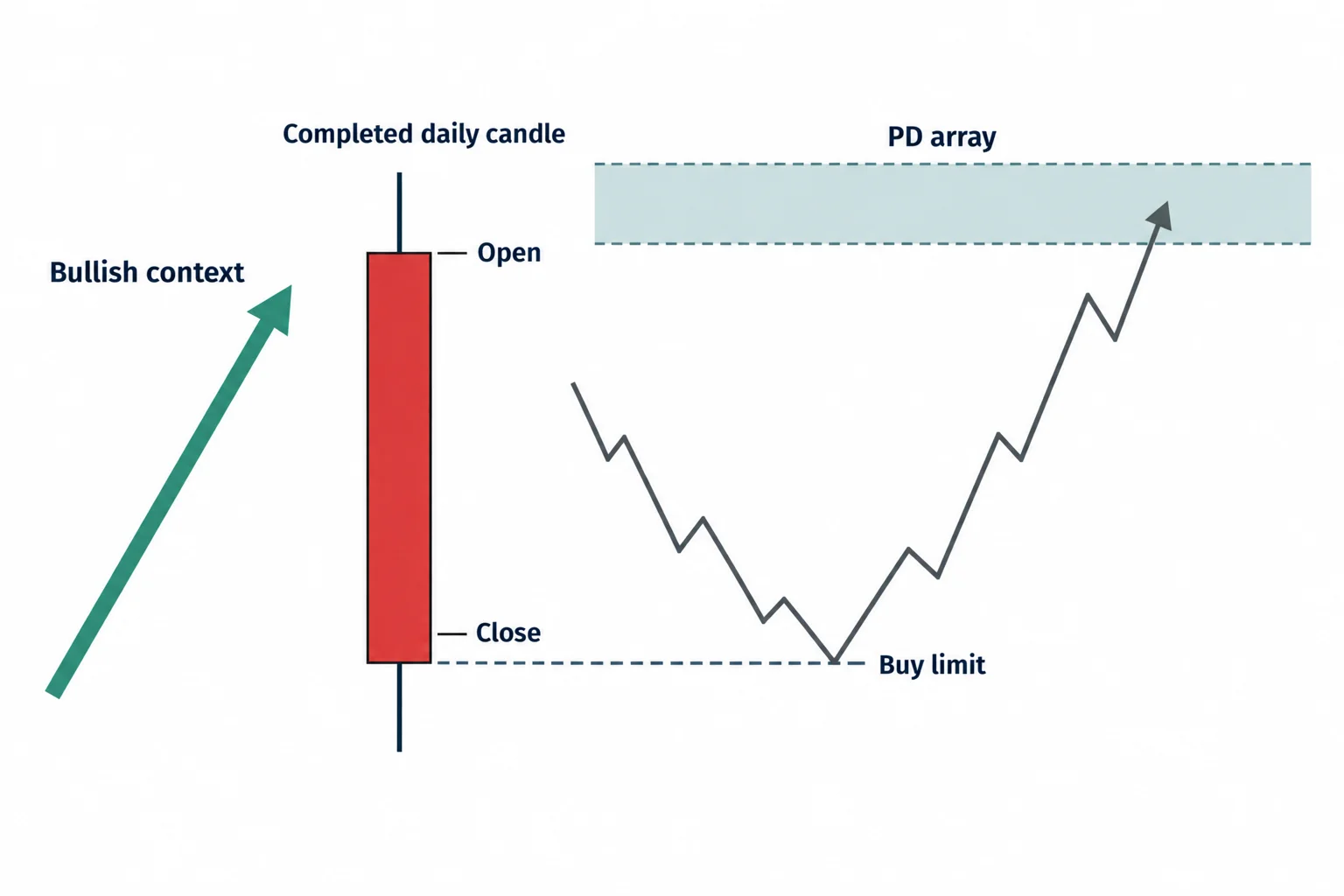
He starts with buying on a limit, a technique he says is much like the one he uses for buy stops (0:22). Three things have to be in place. The monthly and or weekly should suggest institutional order flow will be seeking a PD array above daily market price (0:29). The daily should post a bearish candle, and he is specific that the daily has to close the candle with a down close, and that it is not valid while the daily candle is still trading or forming (0:41). With those conditions met, the buy limit goes at the bearish candle’s close (0:50). In his words you are looking at the daily high, the daily low, the daily open and the daily close, and you enter a buy limit at the close of the daily candle that gapped down close while the market is bullish and a higher price move is expected (0:56).
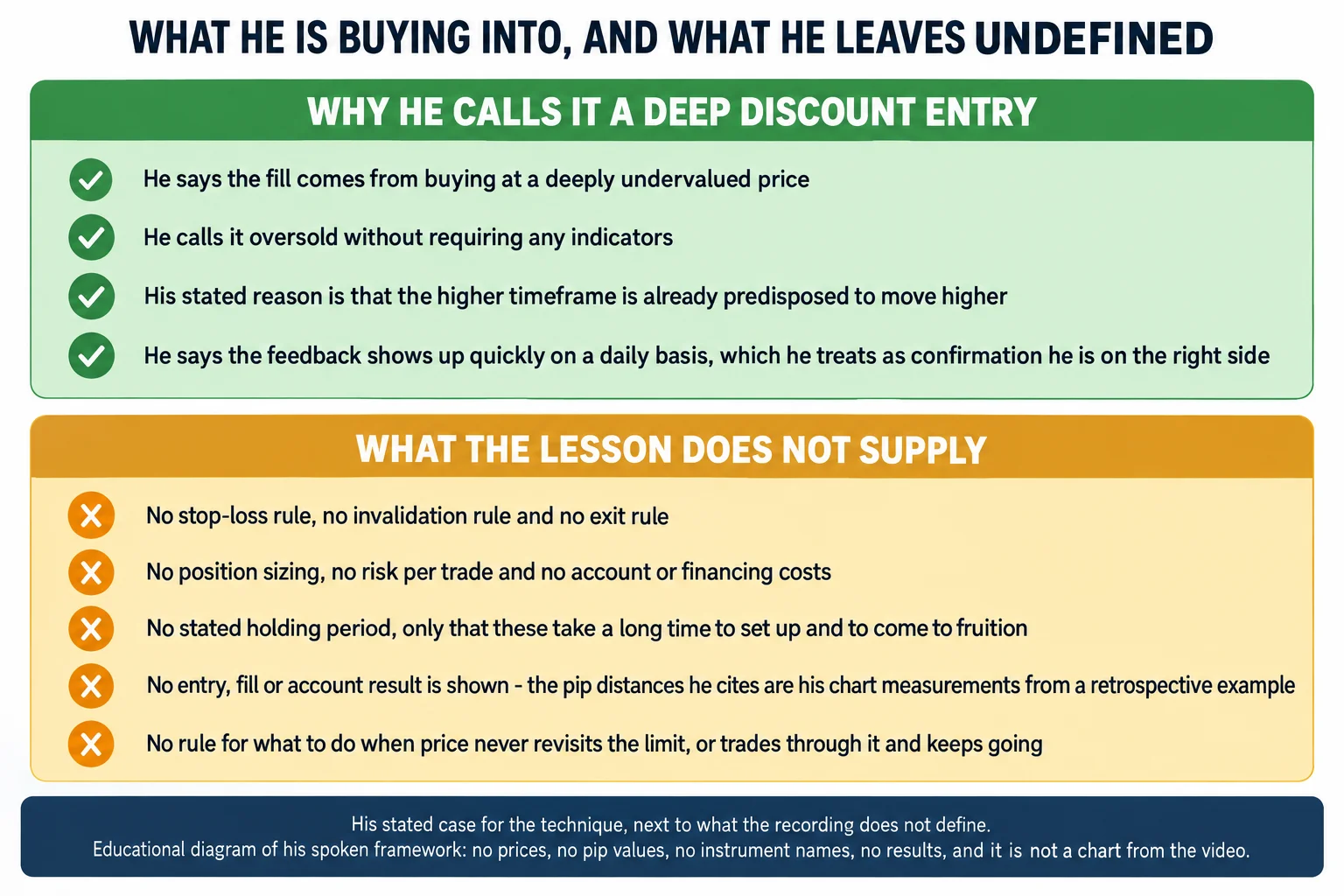
What that order is doing, in his description, is buying the next day or the next candle only if it opens and moves below that down candle’s close (2:12). He calls that a deeply undervalued price, says it is already going to be oversold without requiring any indicators (2:29), and describes it as buying at a deep discount in a market predisposed to move higher (2:33). He points to what he calls quick immediate feedback even on a daily basis, where you are on the right side almost immediately (2:48).
He also says this is best suited to a market that is already moving. His phrasing is that the markets will be undervalued in an already primarily bullish market condition, and that it is preferable when the market has already shown the willingness to have a market structure break and has already started to move higher (1:25).
ICT Sell Limit Order Entry Rule
Selling with limit orders is presented as the mirror of the buy side (2:58). The monthly and or weekly should suggest institutional order flow will be seeking PD arrays below daily market price (3:02); the daily should post a bullish candle and must close with an up close, with the same warning that it is not valid while that candle is trading or forming (3:13); and the sell limit goes at the bullish candle’s close (3:22).
He describes the trade as selling short in an overvalued or overbought condition in a market predisposed to go lower on the basis of monthly and or weekly PD arrays that will draw price lower (3:44). The scenario he describes is price rising for one day against the longer-term institutional flow, with the sell limit resting above that day’s close and only filling if the next day trades above it (4:10).
How ICT Qualifies a Limit Order Entry
He is blunt that the candle is not a signal on its own. He says they are not just selling on a limit on any up candle because they hold an opinion about being bearish (4:23), and that these conditions are best suited when aligned with a daily PD array (a bearish order block, a gap that price has traded into, a void that gets filled, a move above a recent high, or a retreat back into an old historical low that has become support or resistance) (4:34). He closes the loop explicitly: you are not simply going in based on the candle itself by itself, and it is not a system in and of itself. You have to blend the daily PD arrays with the monthly and weekly pulling price one way or the other (4:56).
The condition set he treats as the good combination is worth stating plainly, because it is the opposite of the obvious. When the monthly and weekly expect lower prices and their bearish PD arrays should draw price down into a discount, what he wants to see on the daily is up movement into a short-term premium, and that is where he says you have really low risk, high probability entry patterns (5:23). Selling short on a limit above the candle’s close is, in his description, about taking the last little piece of movement above, which he connects to a Judas swing that opens, makes the high in London and sells off as the start of a longer move (5:50).
ICT Limit Order Entry in the Japanese Yen
He returns to a Japanese yen example to apply the buy rule (6:17). On the daily chart he identifies a down candle and uses its close as the buy limit (6:26), then shows the pattern repeating: each down candle’s close, the next day trading below it, a fill on the long limit only, and immediate responsiveness in price afterwards. He counts five examples on that daily chart (6:43). He also says the point will matter more a couple of slides later, which is where the pip distances come in (6:55).
The weekly chart is what supplies the objective. He describes price moving away from a level he reads as 100, a bearish order block up around 118 to 119 which he treats as the weekly premium PD array that would draw price up long term, and a bullish order block down in the discount at 100 that showed a willingness to bounce (7:05). Back on the daily he notes the November move after the US election where price stabbed one more time down into that weekly bullish order block, and before that a September rally away from an order block formed in August 2016, with a retrade back down into it in September and a fill the very next day below the down candle’s close (7:31).
He then reads the pip distances off the chart, from each down-candle close up to that weekly bearish order block: 1,800 pips from the September low (8:29), then about 980 pips from the mid-November entry he places around the 17th (8:33), then 785 pips (9:04), then 600 (9:09), then 500 (9:14), and 360 pips on the last one before price reached the weekly PD array (9:20). On his reading the 980-pip move is essentially the equilibrium price bar, with further opportunities just below and above equilibrium (10:16).
He is using those distances as an argument about the opportunity set, not as a results ledger. He acknowledges that this is daily-timeframe work rather than hourly or fifteen-minute charts, that many people assume there are no opportunities on higher timeframes, and that he agrees there are not as many as in day trades or scalps but says there are plenty when a long-term trend has a clear indication it wants to move to a monthly or weekly level (9:43). He adds that you can get positioned without having to catch the high (10:11).
What the ICT Limit Order Entry Lesson Covers
What it settles is narrow and clear: two entry conditions, a definition of the completed counter-directional daily candle, the close as the limit price, and the requirement that a daily PD array agrees. What it does not settle is everything that comes after a fill. The recording states no stop loss, no invalidation condition, no exit rule, no position size, no risk per trade, no account size, no spread or financing cost and no holding period beyond his remark that these trades take a long time to set up and to come to fruition (2:07).
The pip distances are retrospective chart measurements from an example he chose, and the recording shows no entry tickets, fills, statements or account results. It also does not address the case where price never returns to the limit, where the limit fills and price immediately continues against the position, or what to do if the daily PD array he relied on is invalidated before the fill. Those gaps matter more on a technique intended to hold for weeks, because a limit order controls the entry price and nothing about the outcome.
He also makes a claim about the technique that is his assessment rather than a measurement: he calls these really low risk, high probability entry patterns, and says the fill comes at a deeply undervalued, deeply discounted price that is oversold without indicators (5:43). The recording offers no frequency, no win rate and no drawdown, and it does not distinguish his reading of the chart from independently verified outcomes. His closing question is whether the viewer still thinks intraday trading is needed to make pips (10:36), and his answer is that it is not needed (his educational conclusion, not a performance guarantee) (10:46).
ICT Limit Order Entry Caption Notes
This article was written from the video’s own auto-generated caption track, which is the primary source for every timestamp link above. That track is machine-generated and mis-hears the speaker’s wording in places. The clearest example is the label he gives the down candle in the buy rule, which the captions render as “while the daily chart candle is treating and or forming” where “trading” is meant (0:45); the same phrase recurs on the sell side (3:17). The daily candle he says has a “down close” is rendered once as “gapped down close” (1:08). “PDA”-style compressions of PD array appear throughout. Numeric references in the yen example also survive only as the captions heard them: the weekly level is spoken as “118 119” and the discount level as “100”, and the captions render “support broken analysis resistance” where a support-turned-resistance idea is meant (4:48). No price, level or pip distance has been reconstructed beyond what the track states, and the pip figures are presented as his chart readings. The transcript used here is the automatic caption track (source kind youtube_captions, SHA-256 a9ff58316f38f1073d833bfb1878cccb769a692901c2d48b56fb4130a05c0296).
Watch the ICT Limit Order Entry Lesson
ICT Mentorship Core Content – Month 05 – Limit Order Entry Techniques For Long Term Traders
The Inner Circle Trader · published to YouTube on 17 September 2022 · listed as PT674S, about 11 minutes 14 seconds. The recording identifies itself as lesson 7.2 of the January 2017 content. This video is the primary source for every timestamp link above.
The recording is not embedded here because the video owner has disabled playback on other websites. That was tested directly on 15 September 2026 from a BestProps page origin at both desktop and mobile widths: the embedded player loads and then reports “Playback on other websites has been disabled by the video owner”, with no playable stream in either case. The link above opens the recording on YouTube itself.
ICT Limit Order Entry Resources
These are the sources checked for this article. The regulator pages are general reference material about leveraged trading and systems sold to the public; neither assesses the speaker, verifies the PD array taxonomy, the two limit rules or any of the pip distances above, nor endorses anything said in the recording. Any ICT, smart-money or third-party indicator, script, note set, transcript pack, chart annotation or re-upload circulating outside the publishing channel’s own page is unofficial and untested here.
- [1] ICT Mentorship Core Content – Month 05 – Limit Order Entry Techniques For Long Term Traders The Inner Circle Trader (primary source; watch page read 15 September 2026, listed at PT674S).
- [2] The Inner Circle Trader (official YouTube channel) (page read 15 September 2026), the publishing channel for the ICT mentorship core content series this lesson belongs to.
- [3] Investor.gov (U.S. Securities and Exchange Commission), Day Trading (read 15 September 2026), the regulator’s material stating that day trading is extremely risky and can result in substantial financial losses in a very short period of time, and describing the leverage and margin context of short-term trading.
- [4] CFTC, Fraud Advisory: Commodity Trading Systems Sold on the Internet (read 15 September 2026), the regulator’s guidance on evaluating trading systems, including its warnings about hypothetical results and about performance figures that omit costs such as bid-ask spreads.
Source: ICT, ICT Mentorship Core Content – Month 05 – Limit Order Entry Techniques For Long Term Traders, The Inner Circle Trader, YouTube page dated 17 September 2022; the recording identifies itself as lesson 7.2 of the January 2017 content. Transcript SHA-256 a9ff58316f38f1073d833bfb1878cccb769a692901c2d48b56fb4130a05c0296. Every timestamp above points at the passage being described. This is an educational write-up of the speaker’s own stated rules: no entry, level, pip distance or performance figure above has been tested or verified here, and nothing in it is trading advice.