
Key takeaways
ICT’s 11 minutes 40 seconds January 17, 2024 Nasdaq futures commentary presents a late-session MOC macro expecting NQ to run above a prior high during roughly the final 10 to 3 minutes of trading.
Read the full summary
ICT’s 11 minutes 40 seconds January 17, 2024 Nasdaq futures commentary presents a late-session MOC macro expecting NQ to run above a prior high during roughly the final 10 to 3 minutes of trading. His entry reference is the consequent encroachment or midpoint of a candle wick, with a protective stop below the wick, followed by a second similar wick-based entry after earlier limit orders reportedly went unfilled. He cites a fair value gap, an order block, pre-market selling, steady regular-session buying and a potential short squeeze as reasons for expecting market-on-close orders to spool price higher, then says he will remove risk to cover commissions and take a partial exit as the close approaches. ICT also says he generally waits until about the second week of February before trading a new year, claiming early-year morning moves are cleaner while afternoons and summer months are more lethargic, though he provides no statistics. The recording had 106,569 views when checked on September 15, 2026, but shows no order ticket, entry price, stop distance, position size, verified fills, profit figure, account statement, audited track record or sample size, so it cannot establish whether the trade was live or simulated, profitable or repeatable.
How we researched this article
BestProps used document-based research from primary firm sources, checked September 24, 2026. The complete source list, scope, limitations, and commercial-state record appear near the end of this article.
In “ICT Final Hour MOC Macro – NQ Live Execution | January 17, 2024”, ICT narrates a late-session Nasdaq futures sequence in a recording that runs 11 minutes 40 seconds. He builds a case that price will run above a prior high into the close, explains a wick-based entry reference and a protective stop beneath it, and then talks through what he says he did as the session ended.
The recording is a first-person commentary over a chart. It contains no audited track record, no stated sample size and no account statement, and the commentary is delivered while the session is still resolving. Everything below is a transcript-grounded account of what he said, with his interpretations attributed to him. It is not investment advice and it is not evidence that the approach produces profits.
ICT Live Execution Setup Above the Prior High
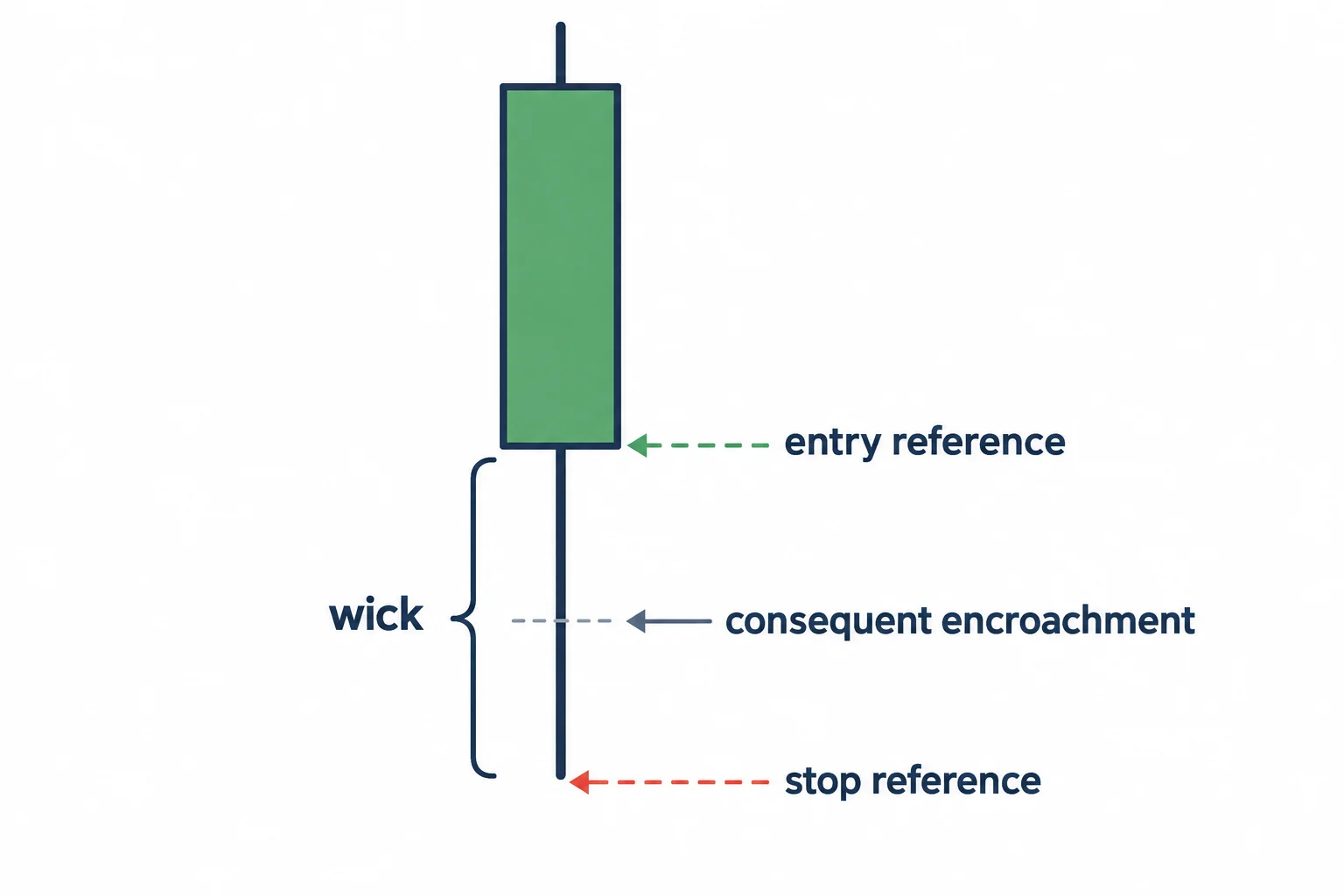
ICT opens with the problem he wants to solve: anticipating a run above a high when the earlier move has already happened (0:00–0:01). Rather than chase, he points at a candle wick and marks roughly its halfway point, saying he is “eyeballing it” (0:07–0:17). That midpoint is the entry reference, and the stop goes just below the wick itself (0:55).
He calls that midpoint the “consequent encroachment” of the wick, and at 0:57 he describes a stop below it as the basis for taking the trade. The automatic transcript renders the phrase loosely as “consequent encouragement” at 0:57 and correctly as “consequent encroachment” at 1:09; the surrounding language supports the second reading.
He then labels the whole idea: “This is a high frequency trading algorithm macro” (0:32). That is his own model vocabulary. The recording contains no order-book data and no method by which a listener could identify the algorithm he is referring to.
Final Hour Macro Timing and Unclear Price Levels
The thesis is explicitly time-bound. He says price should rip through the referenced high and keep going “into the last 10 to 3 minutes of trading” (1:23), and notes that the four o’clock close does not end trading but that his focus is the interval right before it (1:37). A shaded region on the chart, he explains, marks “the element of time” (the period when he expects the algorithm to begin spooling price) (3:09–3:17).
One passage resists transcription. Around 1:50 he says the words “there’s 350, and 357 right there,” and then refers back to “these two lines right here” as the area where price stops spooling (2:01). The transcript gives those digits without a unit, without a decimal and without the preceding level, and the words carrying them scored lower confidence during transcription than the surrounding speech did. They are therefore not reproduced here as price levels: the spoken words alone cannot establish which values they are, and reading them off the chart would be guesswork. The same caution applies to the other bare numbers later in the clip.
He is direct about the directional conclusion: “in short straightforward terms this is going to go higher” (2:14).
ICT Live Execution Entry After Unfilled Limit Orders
Between 2:23 and 2:43 ICT reports that limit orders were never reached. He says he had orders sitting in areas he had read as draws and that the market “didn’t offer it” each time. He says he therefore stopped waiting and took a position using his high-frequency trading algorithm entry instead. The recording does not show an order ticket, so the number of orders, their prices and their fate rest on his description.
A second entry reference appears at 4:21–4:36. As price digs into another wick he identifies a nearby swing low and again aims at the encroachment of that wick as the entry, then says he expects the move to “completely rip and go higher.”
Why ICT Reviews January 2024 Before Execution
The longest detour in the recording is seasonal. Starting at 5:30, ICT explains that he prefers to ease into a new trading year and deliberately waits until roughly the second week of February, because he wants the uncertainty and sentiment that build up around the year-end break to work themselves out first.
His argument is behavioural rather than statistical: traders returning after a holiday break are impatient and eager to do something, so they take risk without respecting it. He describes the result as “lottery” trading (putting on a position because price has been rising or falling and hoping it works out) (6:45–7:01). From that he draws two tendencies for this part of the year: the most straightforward price runs appear in the morning, and afternoon trading is comparatively lethargic until the year is further along, with the summer months especially subdued (7:23–7:34).
He anticipates the objection himself, saying that critics will hunt for the one day out of months that contradicts a seasonal statement and make a big deal of it, comparing that to the day it rains because you left the umbrella at home (7:49–8:10). Nothing in the recording quantifies the tendency.
ICT Final Hour Macro Thesis
Back on the chart at 8:20, ICT points to what he calls a fair value gap (the automatic transcript writes “value get”) and says price is positioned inside it and should expand higher. The specific driver he names is the market-on-close period: “we’re entering that sweet spot where the market on close orders will start spooling price higher” (8:38).
His reading of the day reinforces the direction. He notes that sellers pushed price down in pre-market and that the regular session then ground steadily higher, and concludes that traders who kept trying to short all day could be squeezed as the close approached. His phrase is that they would “ram it up” into the final minutes (8:46–9:05). That is his causal story about why the move should happen. The recording offers no evidence about who was positioned short or by how much.
This is also where the upload’s framing is broader than its content. The title advertises a “final hour” macro, while the commentary itself concentrates on the last handful of minutes before the close.
ICT Live Execution Risk and Partial Exits
Three management comments follow in quick succession. He says he wants to see whether price can reach a level he names (9:37); he says he will “remove the risk now” because the session is nearly over, which he says would cover commissions so that no loss would be incurred (9:52–9:59); and he mentions taking part of the position off above a stated level (10:07). Both of those level references are transcribed as bare, low-confidence numbers, and neither is reproduced here as a price.
The risk-removal line should be read as a statement of intent and of the arithmetic he is applying (that a partial exit at a particular point would cover the round-turn cost), not as a verified fill. Whether that order was filled, at what price, and whether the account was in fact free of risk afterwards cannot be established from the audio.
Final Hour Close and Retail Interpretation
At 10:24 he returns to the shaded window and asks viewers to watch what price does inside it. A drop toward an order block is framed as the trap: retail sees that and calls a top, while his model still expects higher prices (10:30–10:39). He reacts to the subsequent move with “just like that” and “it’s almost like I wrote it,” then closes the lesson (11:11–11:38).
The commentary runs alongside the move, so that reaction is contemporaneous rather than a later review of a completed trade. It also stops there: no result, no profit figure and no statement of what the position ultimately returned appears anywhere in the recording.
What the ICT Live Execution Recording Can Establish
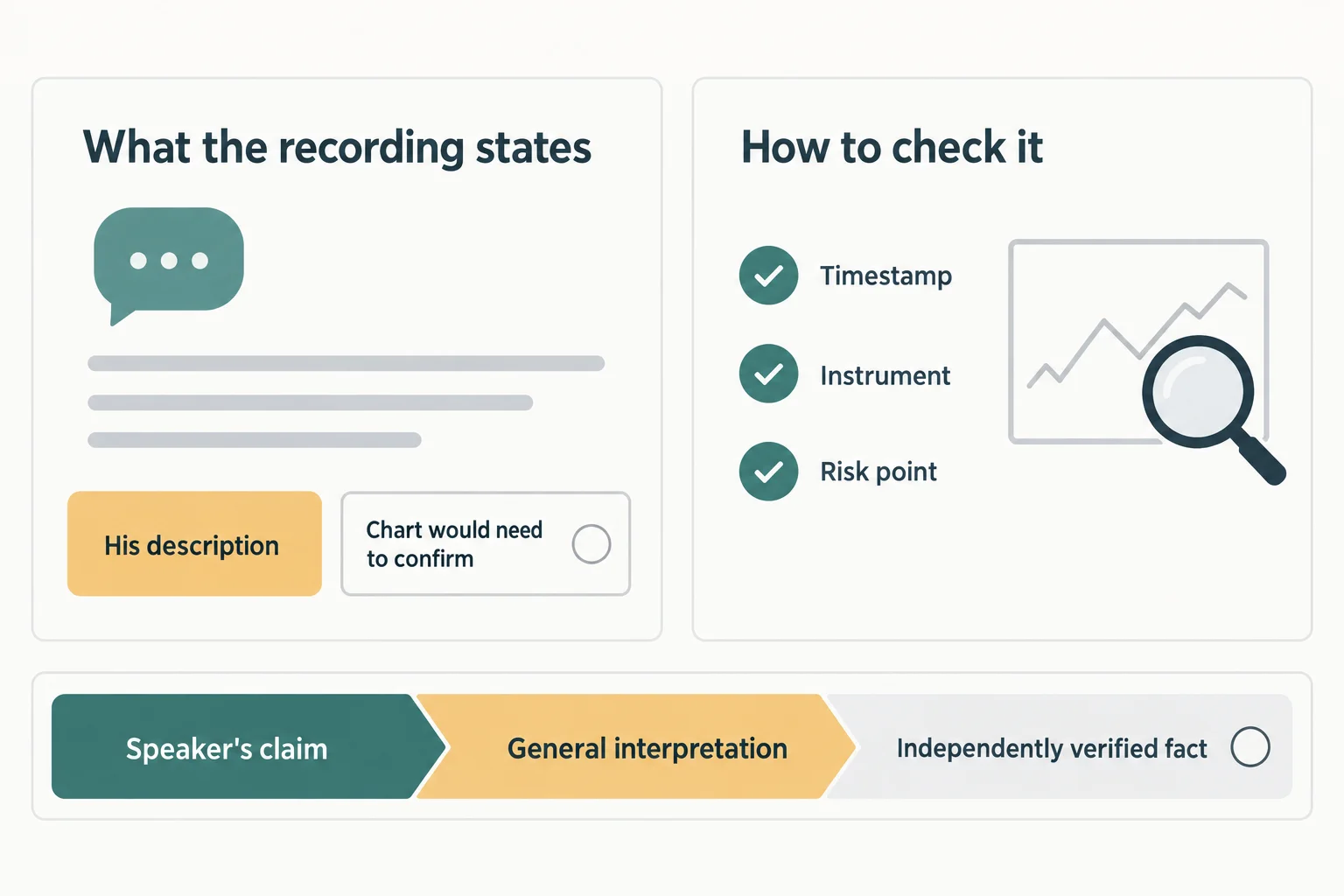
What it does contain is a stated plan: a directional reading, an entry reference built from a wick, a stop placed beyond that reference, a time window for the move, and a management sequence that reduces exposure as the close approaches. Those elements are internally consistent, and each is attributable to a specific passage.
What it does not contain is any of the following: an entry price, a stop distance in points or ticks, a position size, a risk figure, a target that can be reconciled with the transcribed numbers, a fill confirmation, or a result. A listener cannot verify from the audio alone whether the orders described were live or simulated, whether the partial exit filled, or whether the session ended in profit. Treating “remove the risk” as a completed, profitable management step would be reading the account into a remark rather than out of it.
Two source limitations belong here as well. First, the transcript used for this article is a local automatic speech recognition of the recording’s complete audio, not human-checked captions; it carries no per-word human review, and the passages cited above include its loose renderings of ICT’s terminology. Second, the recording’s chart was not visually reviewed for this article, so no level, coordinate or annotation visible on screen is asserted here. The shaded region, the wicks and the order block are described as things he pointed at, not as measured data.
ICT Final Hour Macro Lessons
- Plan for the entry you did not get. He reports unfilled orders before taking a different entry. Chasing an anticipated move and waiting for a defined retracement are different execution choices with different risk.
- Tie the idea to a clock. The setup was not only “price above a high.” His expectation was conditional on a particular late-session window, which also gives the thesis a natural expiry.
- Define invalidation before entry. The wick midpoint served as the entry reference and the area beyond the wick framed the stop, a structure that can be stated in advance.
- Separate model vocabulary from evidence. MOC macro, fair value gap, order block, draw on liquidity, algorithm spooling and high-frequency algorithm entry are all the speaker’s own labels. Using them does not by itself establish causation or an edge.
- Do not generalise from one narrated session. A single clip cannot establish how often the pattern works, its typical risk, or its results after costs.
Watch the ICT Live Execution Recording
The embed above is the upload’s own YouTube player. This exact iframe markup was loaded from a BestProps origin on 15 September 2026 and clicked: playback advanced to 5.1 seconds of the recording’s own 699.8-second duration with no error notice and no owner restriction reported by the player. The watch page records the upload as public, 700 seconds long and playable, published 17 January 2024 at 1:04 p.m. Pacific, 21:04 UTC on the same calendar day. The timestamp links throughout this article point into the same recording.
ICT Live Execution Sources and Further Reading
- ICT Final Hour MOC Macro – NQ Live Execution \\ January 17, 2024 The recording itself, 11 minutes 40 seconds. Watch page read 15 September 2026: 106,569 views, published 17 January 2024 at 1:04 p.m. Pacific (21:04 UTC), playability status OK.[1]
- The Inner Circle Trader The publishing channel’s own page and the first-party record of what it uploads and when. It takes precedence over any reupload, mirror or third-party archive of the same lesson.[2]
- Nasdaq glossary (Market-on-Close (MOC) order) An exchange operator’s definition: “an order to trade stocks, options, or futures as close as possible to the market close.” Useful for separating the ordinary meaning of MOC from the speaker’s “MOC macro” label.[3]
- CFTC fraud advisory (Commodity Trading Systems Sold on the Internet) the U.S. derivatives regulator’s warning that a stop-loss order may execute at a worse price or not at all, that commissions raise the break-even point, and that promoters can manufacture results by selecting favourable historical trades. Relevant to a clip whose numbers are spoken but not shown.[4]
- 17 CFR 4.41 the rule governing how simulated or hypothetical performance may be presented, cited because this recording presents an outcome in narrative form rather than as an audited record.[5]
Consequent encroachment, fair value gap, order block, draw on liquidity, price spooling and high-frequency algorithm entry are the speaker’s own vocabulary; this article reports his usage of them rather than endorsing them as verified market mechanics. Any ICT indicator, script, spreadsheet, note set, transcript or social-media summary circulating outside the publishing channel’s own upload page is unofficial and untested here.
- [1] ICT Final Hour MOC Macro – NQ Live Execution \\ January 17, 2024 (The Inner Circle Trader, watch page read 15 September 2026)
- [2] The Inner Circle Trader (official YouTube channel)
- [3] Nasdaq glossary (Market-on-Close (MOC) order, read 15 September 2026)
- [4] CFTC (Commodity Trading Systems Sold on the Internet, read 15 September 2026)
- [5] 17 CFR 4.41 (Advertising by commodity pool operators, commodity trading advisors, and the principals thereof, read 15 September 2026)
This is independent educational commentary on one speaker’s framework. It is not official ICT material, it is not a tested trading system, and it is not investment advice or a promise that the approach will produce profits. Futures are leveraged instruments, and described or reported outcomes are not a guide to future results.