Key takeaways
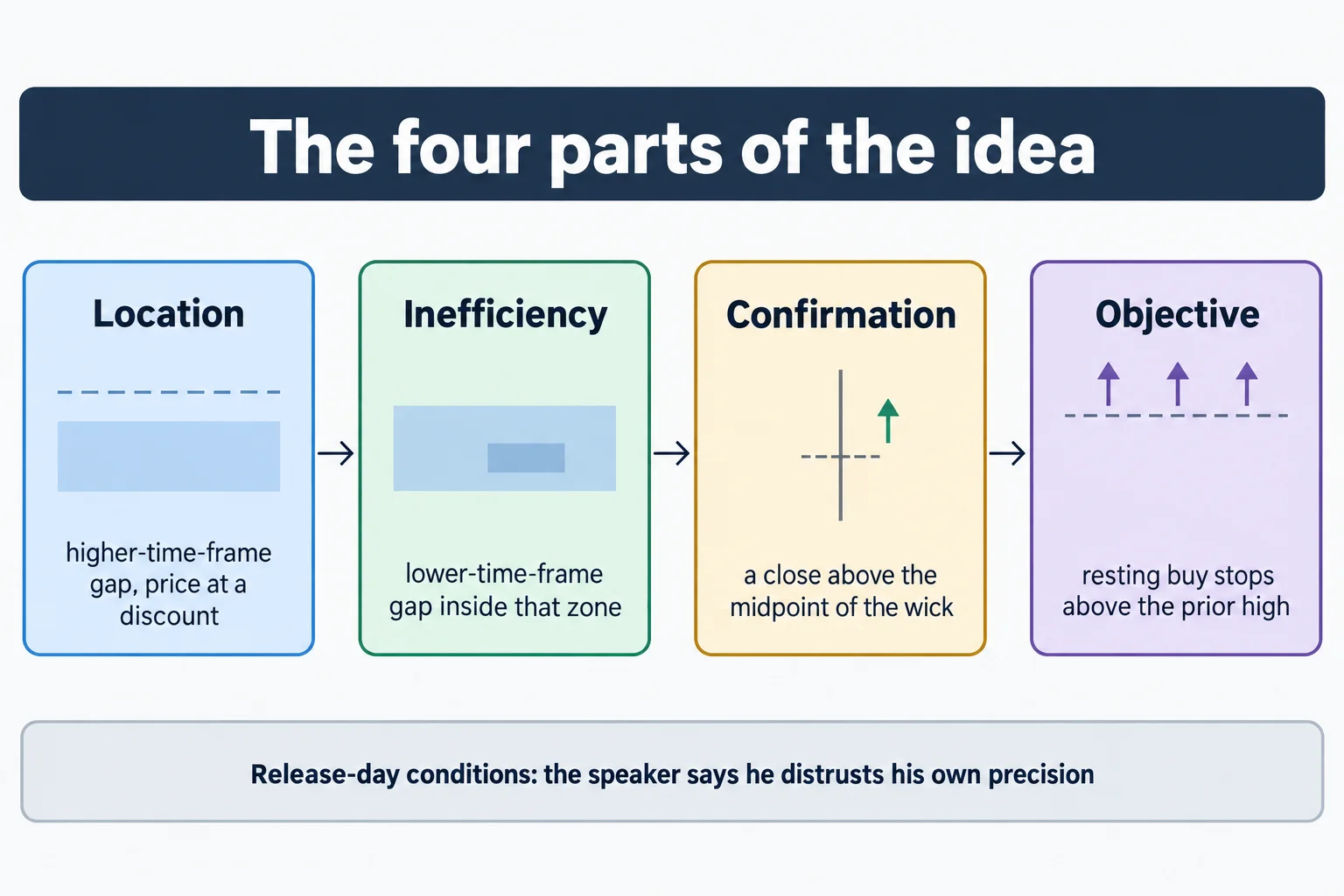
ICT’s December 2023 Non-Farm Payroll Live Execution & Explanations is a one hour 31 minute educational ES futures session published 8 December 2023 that narrates a bullish setup from a four-hour fair value gap, a five-minute inefficiency and a required close above wick midpoint consequent encroachment, targeting buy stops above a prior high.
Read the full summary
ICT’s December 2023 Non-Farm Payroll Live Execution & Explanations is a one hour 31 minute educational ES futures session published 8 December 2023 that narrates a bullish setup from a four-hour fair value gap, a five-minute inefficiency and a required close above wick midpoint consequent encroachment, targeting buy stops above a prior high. ICT cites a five-handle minimum target, places a one-contract limit order, moves the stop to break-even plus commissions and a small profit, removes three contracts after a five-minute candle fails to close above the midpoint, then plans to take one contract above buy-side liquidity and leave two runners. He avoids pyramiding because Non-Farm Payroll day offers his weakest precision, treats refusal to revisit a discount order block as stronger bullish evidence, and uses partials to reduce the need to be right. Price initially falls short with consecutive candles printing the same high, after which he raises the stop and reports two resting limit orders filling. The account type, fills, balances and claimed profits were not independently verified, so the article separates his confirmation and risk-management rules from unsupported performance claims.
How we researched this article
BestProps used document-based research from primary firm sources, checked September 24, 2026. The complete source list, scope, limitations, and commercial-state record appear near the end of this article.
ICT Payroll Bullish Setup and Higher Time Frame Gap
The recording opens on a four-hour ES chart. At 0:05 he says he will show that chart and at 0:07 that he is bullish and expects an attempt to press higher. At 0:54 he places the stop well below and says it is a little wide because of the release. At 1:16 he points to a four-hour fair value gap and says price is sitting inside it at a discount relative to the range he has marked.
At 2:02 he calls the early move a “Judah swing” in his own vocabulary, a move that, in his reading, teaches traders to trust the wrong side. He notes that the small rally did not take the buy-side liquidity sitting above the prior highs and treats those highs as the kind of level traders are being encouraged to trust as resistance.
ICT Payroll Fair Value Gap Explained
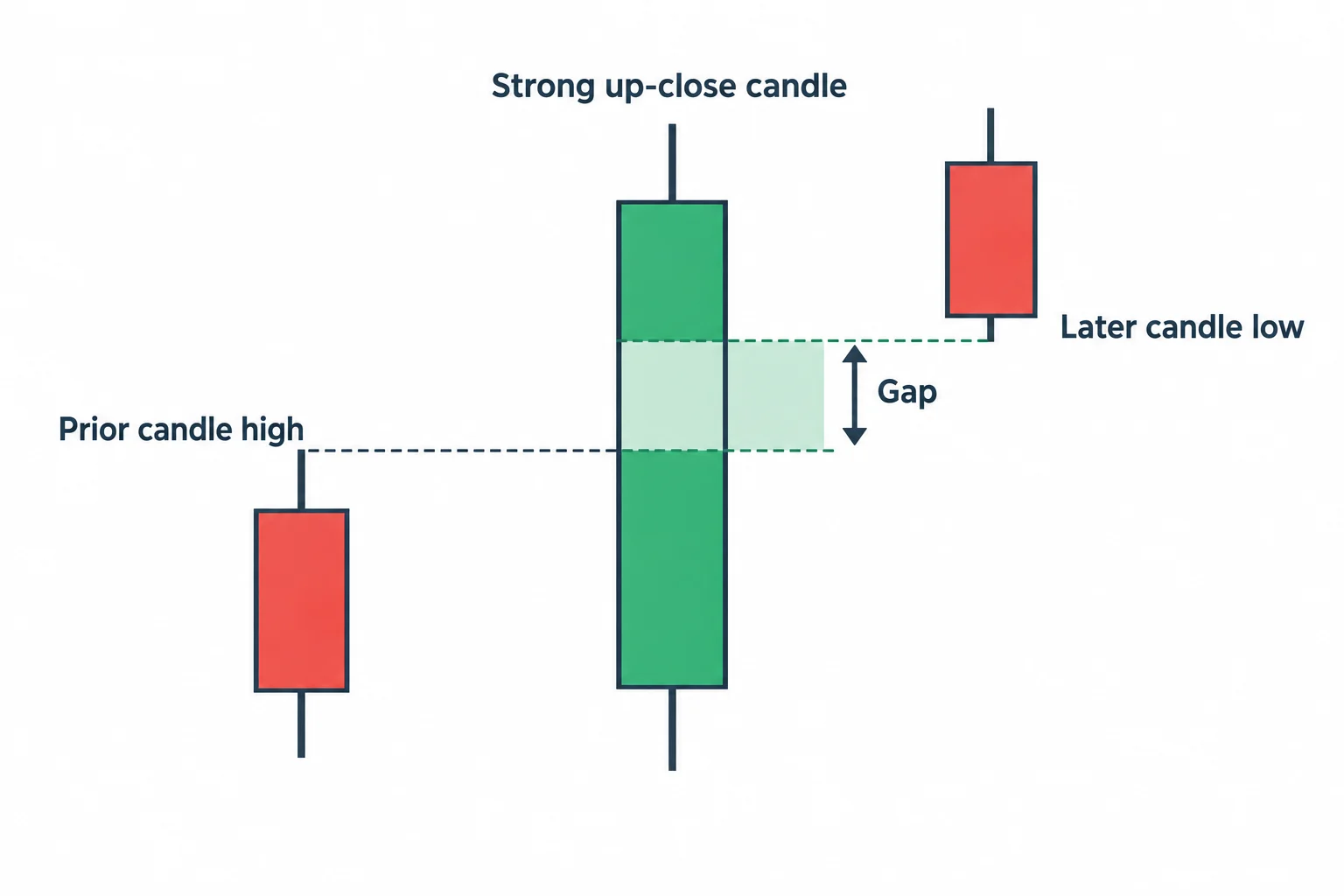
At 3:17 he explains the structure with the paint-roller analogy he uses for it: paint applied by a roller is distributed generously at first and thins out as the roller travels, leaving small dry patches. In his terms the gap is the single-candle slice where a strong up-close candle left no trade back down to at least touch the prior candle’s high, so price made only one pass through that area on the way up.
He ties it to the release. At 5:55 he notes that at 8:30, on Non-Farm Payroll Friday, price dropped back into that area and overshot it slightly, and he calls the surrounding zone a balanced price range at 6:07. He also uses the passage to reject the idea that the structure is one of the named level theories he does not use; the captions render the term he objects to and the theory he dismisses unclearly, so this article does not repeat either as fact. That is his position on terminology, not a finding established by the recording.
ICT Live Execution Confirmation Rules
The trade turns on one condition. At 11:17 he says he will sit and watch for a close above the consequent encroachment level (the midpoint of the wick), describing that close as the dealers showing their cards, and only then expecting price to run to his resting limit order. He explicitly leaves room to be wrong and says he will decide about further exits based on how price behaves at that level.
He also distinguishes between an area being valid and the market needing it. At 14:59 he identifies two consecutive down-close candles whose bodies could be treated as an order block, then says at 15:21 that he does not want price to need to come back down into it, because needing to do so is lower probability in his favour. At 17:10 he pushes the point further: if the market is strong enough to refuse that discount array, he reads it as especially bullish and wants to be holding for his targets. The educational separation is the useful part. Identifying a technical area and grading the market's response to it are two different jobs.
Why ICT Limits Non-Farm Payroll Risk
He is unusually direct about the conditions. At 18:58 he borrows a phrase from Linda Raschke to say the Non-Farm Payroll setting is “not for professionals”, and he says his precision and trust in the market are at their weakest on this day of the month. At 24:56 he describes it again as the day with the worst trading conditions of the month, and at 35:13 he says he will not pyramid into it because he cannot trust that a larger position would be built on sound footing there. He frames the recording as a requested demonstration of how he would otherwise trade, executed in conditions he normally avoids.
ICT Live Execution Partials and Stops
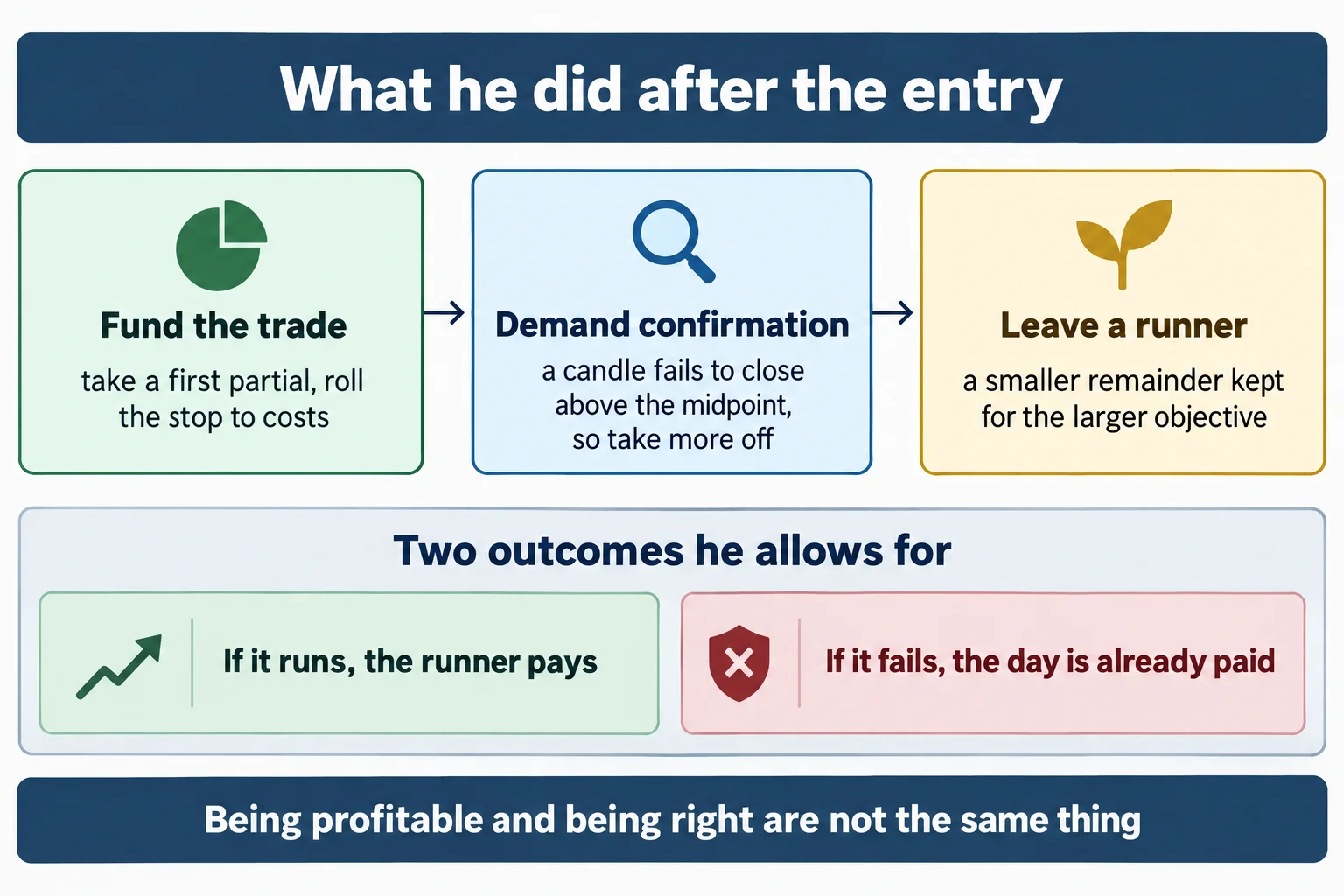
Most of the recording is position management rather than entry work. At 9:09 he places a single-contract limit order at the consequent encroachment level, saying he is not certain he will be able to pyramid, and at 10:41 he reports rolling the stop to break-even, adding at 10:49 that it covers break-even plus commissions plus a small profit. He also mentions a five-handle minimum target he says he teaches, at 8:49.
He reports reducing the position in two steps as his own conditions went unmet. At 24:35 he notes that a five-minute candle did not close above his midpoint and says he is taking three contracts off. From 36:23 he reviews the sequence in his own words: of the contracts available to him at the entry, he says he had taken one, then three more when price was not doing what he wanted. At 1:00:40 and 1:00:41 he describes planning to take one manually above the buy-side area and leave two contracts as a runner if the resting limit order fills.
His stated reason for scaling out is psychological as much as financial. At 45:32 he says partials remove the necessity of being right, and at 46:02, crediting Larry Williams for the idea, he says a trader is never “right,” only profitable or unprofitable. He adds the trade-off plainly: holding for a larger objective means accepting that open profit can disappear, so it is a choice about which risk to carry rather than a free upgrade.
ICT Live Execution Target and Near Miss
His stated objective is the cluster of stops he believes sits above an older high. At 54:20 he anticipates the opening bell, and at 56:46 he names the level he expects those stops at. At 59:35, as the bell rings, he says he wants to see it rip into that area and arranges his orders.
The move falls short. At 1:26:57 he points out how close it came, and at 1:27:00 and 1:27:11 he notes that one candle’s high and the next candle’s high printed the same level, which he presents as evidence for why he avoids trading this event aggressively. He had already said at 1:23:50 that he would accept price trading back into the order block, and at 1:24:02 that he would cancel the trade if price dug into that body rather than let it run to the low below. Later he reports rolling the stop up again at 1:28:24, and at 1:29:37 he says one of the resting limit orders has filled, with the second following shortly after.
ICT Payroll Instruction Versus Unsupported Claims
The recording mixes tradable instruction with claims the source cannot support, and the two should be read apart. He asserts results around the session, describing what he has already taken out as more than an average weekly wage at 24:51 He argues that critics cannot show a live account or live data at 44:11. Nowhere in the caption track does he state whether the account shown is live or simulated, and no balance, statement or fill record appears; those assertions are his own and are not verified here. He also states at 1:11:29 that he is not promising anyone will get rich. The session ends at 1:30:06.
ICT Non-Farm Payroll Trading Lessons
- Define the confirmation condition before the trade, then let the unmet condition change position size rather than the story.
- Distinguish a valid technical area from the market needing to visit it; needing the discount is weaker evidence than refusing it.
- Scale out on a stated rule and treat the remaining runner as an option, not an obligation.
- Grade event-day conditions separately: a plan built for normal sessions is not automatically suited to a data release.
- Separate a narrated outcome from a verified one; a recording of a session is not an account record.
ICT December 2023 Payroll Video Source
The timestamp links above point at the passages being described. The chart detail behind his annotations is only visible in the recording itself, which is the sole source for everything said about the session.
ICT Non-Farm Payroll Resources
These are the sources checked for this article. The Investor.gov and CFTC material is regulator background on the release day referenced in the recording, on futures and leverage, and on how simulated or hypothetical trading results are presented. None of it is an assessment of ICT, of this recording or of anything said in it.
- [1] December 2023 Non Farm Payroll Live Execution & Explanations – The Inner Circle Trader (primary source; watch page read 15 September 2026, 1H31M01S)
- [2] Investor.gov – Non-farm payroll employment report glossary entry (regulator description of the release the session trades around; read 15 September 2026)
- [3] Investor.gov – Futures glossary (regulator description of futures contracts and leverage; read 15 September 2026)
- [4] CFTC – Commodity trading systems sold on the internet (fraud advisory describing how hypothetical and simulated results are presented; read 15 September 2026)
This is independent educational commentary on one recorded session. It is not official ICT material, it is not a tested trading system, and it is not investment advice. Contract counts, levels and outcomes are the speaker’s own statements; the recording does not state the account type and no statement, fill or balance is verified here. Leveraged futures trading involves substantial risk and is not suitable for everyone.