Key takeaways
ICT’s missed-entry lesson is to let price reach a planned limit order rather than chase, accept that precise orders may not fill, and use a replacement entry only when it has fresh structure, its own stop and objective, and valid position sizing.
Read the full summary
ICT’s missed-entry lesson is to let price reach a planned limit order rather than chase, accept that precise orders may not fill, and use a replacement entry only when it has fresh structure, its own stop and objective, and valid position sizing. After the original short near consequent encroachment of a fair value gap missed, he used a later bearish order block with rebalance behavior and relative equal lows as the objective, while retaining the original invalidation logic. He reportedly took three contracts off, left six as runners, held risk equivalent to $19.20 until the first partial, reduced exposure in stages, peeled off before an event horizon area, and closed the remainder when the retracement became uncomfortable. He declined another short after the reversal, low-risk short, first-stage distribution, and second-stage redistribution sequence had already occurred, despite still expecting lower prices, because the model permits no further re-entry. He also treated failure to close below a wick as a warning of possible movement toward buy-side liquidity, cited holiday volume and platform lag, mentioned NinjaTrader, and said the 19 minutes 11 seconds demonstration did not use market replay. The account is based on an automatic transcript without the chart, instrument, verified fills, or independently confirmed levels, so it is educational rather than investment advice or evidence of a repeatable edge.
How we researched this article
BestProps used document-based research from primary firm sources, checked September 24, 2026. The complete source list, scope, limitations, and commercial-state record appear near the end of this article.
The recording presents ICT’s own interpretation of order blocks, fair value gaps, price delivery and trade management. Those concepts are elements of his framework, not proof of a repeatable edge. Because the transcript is automatic and the chart is unavailable here, exact levels and any visually dependent claim cannot be independently confirmed.
Approach a Missed ICT Entry Without Chasing
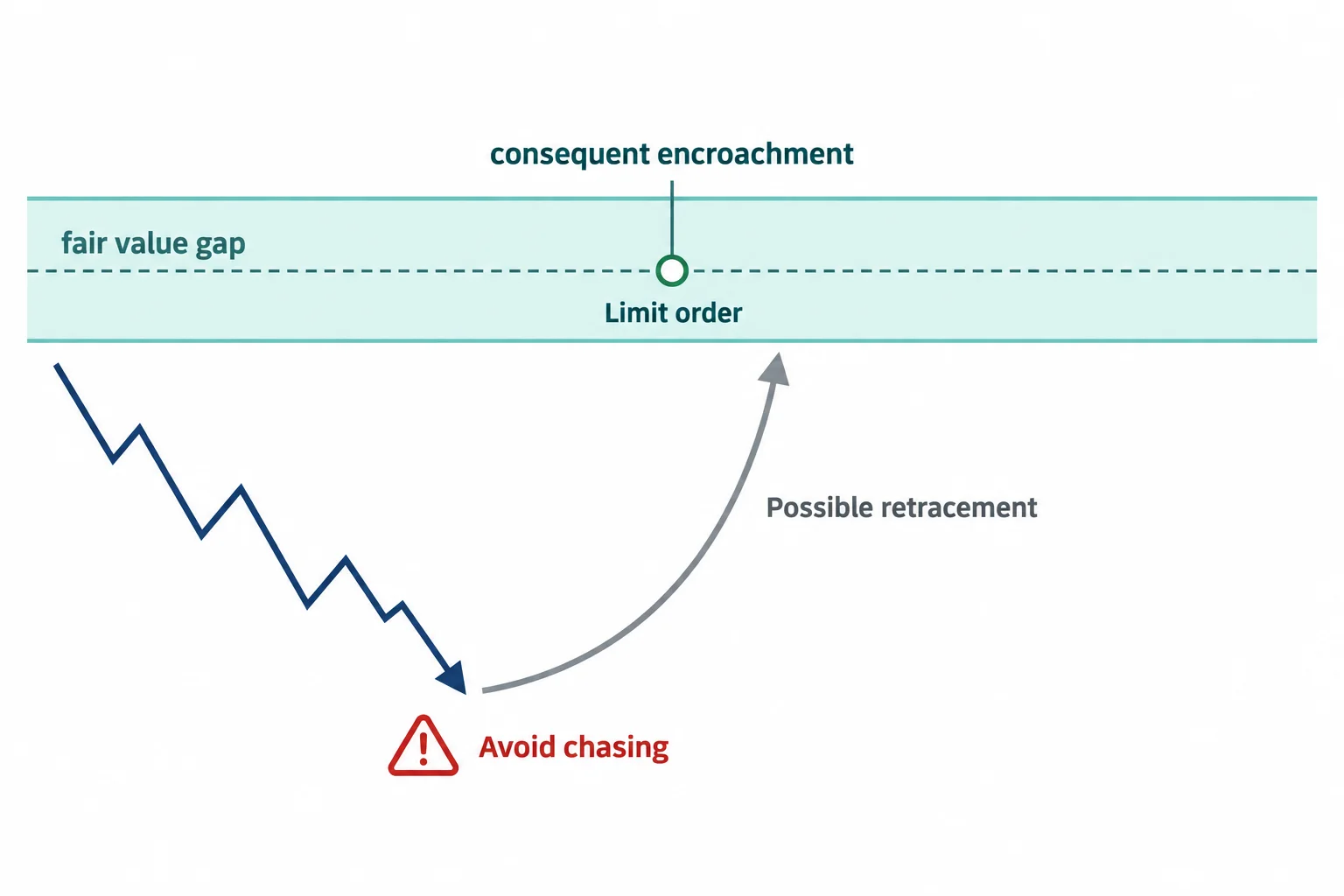
At the outset he describes looking for a short and placing a limit order near what the automatic transcript renders as the consequent encroachment of a fair value gap (0:10). His instruction is direct: let price come to you, do not chase it.
His reasoning is risk-based, and he spells it out at 0:47. Selling only after price has already moved lower means accepting an entry that he says produces needless drawdown if price retraces, even when a trader expects the move to continue. In his framing, the belief that price is likely to fall is not a reason to take a worse entry. He describes placing the stop above a chart feature that the automatic transcript renders as “volume of balance”, a phrase that is unclear and may be a recognition error.
Why a Precise ICT Entry May Miss the Trade
Price approaches the level he wanted but falls just short of his order. At 3:27 he calls excessive precision a curse: the market traded close to the level he had specified without reaching his fill.
This is the tension the recording is built around. A selective limit order can improve the planned entry price and simultaneously raise the probability of missing the trade. His response is not to enter indiscriminately afterwards; he looks for new evidence that could support another entry inside the same bearish idea.
Rebuild the Same Trade Idea After a Missed Entry
After the missed fill he points to what the transcript renders as a change in state of delivery, then to another area where he would consider a short (3:39). He goes on to discuss an immediate rebalance, a rejection block and relative equal lows as a possible objective. At 6:11 he notes that his fill came in the lower half of the order block rather than at the level he originally wanted.
One confirmation he was waiting for does not appear on the candle he required (6:40). That distinction matters: the bearish expectation can still stand while a specific confirmation criterion fails to print, and he later treats a candle closing below a wick midpoint as the kind of closer he was looking for (6:27).
Follow This ICT Entry Sequence
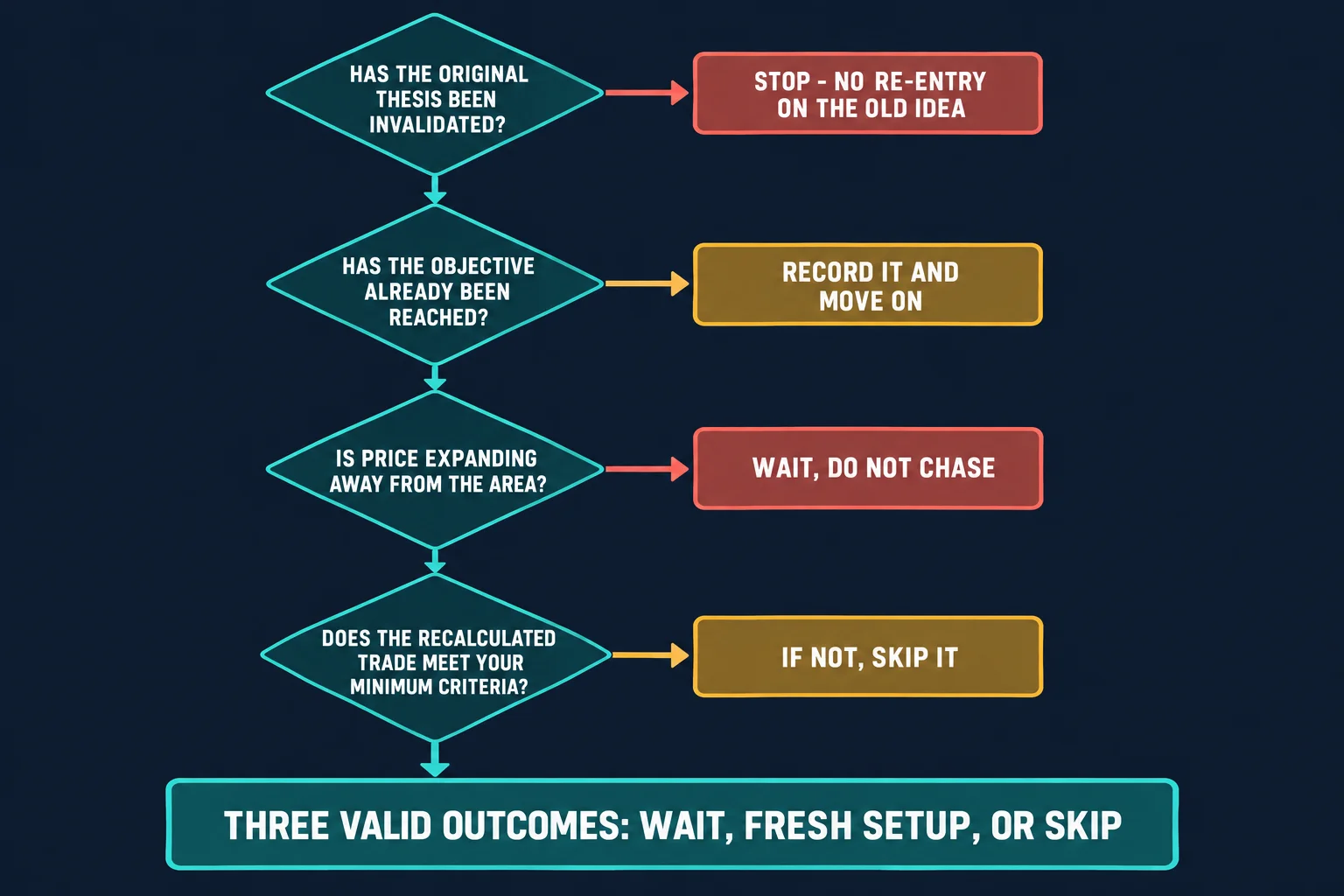
- Do not enter because price is leaving. He repeats that the entry should come to the plan rather than the plan chasing price.
- Keep the original invalidation logic. Missing an entry is not a reason to widen the stop in order to participate.
- Require a fresh structure. In this session the replacement came from a later order block with its own rebalance behaviour and objective.
- Let the substitute stand on its own. A second opportunity needs its own trigger, stop and target rather than being a delayed version of the first.
- Stop when the permitted sequence is exhausted. Near the end he declines to re-enter even though he still expects lower prices.
Manage the Revised ICT Trade Instead of Seeking Perfection
Once positioned he describes reducing stop exposure, taking partial exits and leaving contracts as a runner. The automatic transcript records him taking three contracts off and saying that leaves six for a runner, and holding his risk figure at the equivalent of $19.20 until the first partial (8:09, 8:20). Those quantities and the dollar figure come from speech recognition of his commentary, not from a verified order record, and the transcript does not independently establish fills or the instrument traded.
He also says the session has holiday volume and that conditions can get unpredictable (5:34). When price approaches an area he calls the event horizon, he plans to peel off part of the position just before it rather than waiting for it (12:21, 12:28). When the retracement becomes uncomfortable relative to the trade he was in, he closes what remains and says he will be content with that (13:59).
He attributes one of the partial exits to platform lag and says he will not renew that subscription, then mentions NinjaTrader (13:18). That is his own report about his platform, not a finding about any vendor’s execution quality.
Use an Unclosed Wick as an ICT Entry Warning
Reviewing the move afterwards, he points out that a drop did not close below a particular wick level and calls that a warning sign that the direction in force may be changing, adding that if price were to run from there it would be looking for buy-side liquidity (14:47). This is his own reading of the chart; the chart itself was not available here, so the specific level cannot be checked.
Know When to Refuse Another ICT Trade Entry
The clearest risk-control statement comes after he reviews how the replacement short was formed. At 16:48 he says the spread did not allow him to be filled on the limit order he wanted, which is why he used a later part of the bearish order block instead. Even though he still thinks price may continue lower, he says he cannot re-enter (17:09), and gives the reason plainly at 17:20: there have to be rules.
He then sets out the sequence he had already used (a reversal, a low-risk short, and stages he calls first-stage distribution and second-stage redistribution) and says that once those stages have unfolded, another late short would no longer qualify simply because the forecast remains bearish (17:23). He ends by noting he will not be able to stay with the trade to reach the relative equal lows he likes, and that leaving part of the move for others is acceptable to him (18:28).
Why This ICT Trade Idea Has No Practice Demo
He says early on not to use a market-replay mode (1:10), repeats that replay is for those who need it rather than for teaching with actual execution (8:26), and closes the session by saying the demonstration was never done with market replay (19:00). That is his own claim about how the recording was produced. An audio-only transcript cannot verify which platform mode was in use, so it is reported here as his statement rather than as an independently confirmed fact.
Use the Missed ICT Entry as Education Only
The broadly applicable takeaway is procedural rather than predictive. A missed trade does not create an obligation to find another entry. If a second setup appears it should be judged as a new execution opportunity inside the original thesis, with its own risk, rather than as compensation for being left behind.
That distinction can keep the fear of missing out from overriding predefined risk. Precision has a cost: sometimes a well-planned order will not fill, and the transcript shows one way a trader can respond without abandoning either the idea or the rules around it. This is an explanation of the recording’s teaching, not investment advice or a claim that the described approach is profitable.
Watch the Missed ICT Entry Trade Idea Video
The recording discussed above is Missed Entry How To Approach The Same Trade Idea on the channel The Inner Circle Trader; its watch page was read on 2026-09-13 and reported an upload date of 2026-07-02 and a runtime of 19:11. The upload date is a separate fact from the date of the session shown inside the recording, which the transcript does not establish. The source for every attributed statement on this page is the automatic transcript of that recording.
Watch the original recording on YouTube
This recording cannot be played inside another website. A playback test of the embed markup used on this page, run on 2026-09-13 from a BestProps page origin, returned the player’s own message “Playback on other websites has been disabled by the video owner”, so no player area is reserved here and no blank embed is left behind. The recording remains available directly on YouTube.
Watch Missed Entry How To Approach The Same Trade Idea on YouTube ↗
ICT Trade Entry Sources and Position Sizing
Four references support this article: the recording itself, the platform documentation that explains how limit and market orders behave, this site’s risk-per-trade planning tool, and this site’s RuleWatch page on consistency-style rules. None of them reports an outcome for any decision described above, states a price level, or endorses this page.
Start With the ICT Trade Recording
The mapped upload Missed Entry How To Approach The Same Trade Idea was read on 2026-09-13: the watch page was public, credited to the channel The Inner Circle Trader, and reported an upload date of 2026-07-02 and a runtime of 19:11.[1] That settles the attribution and playability status of the recording; this article’s account of what it says comes from its automatic speech-recognition transcript, which is the source of every timestamp link above.
A Missed Entry Reflects Order Mechanics Not Market Direction
The difference between a missed fill and a decision comes down to how the two main entry orders behave, which the platform documentation states plainly. Limit orders, it explains, “allow you to specify the price you want to be filled at” and “ensure you get filled at the price you specified or better”, but the same page warns that “limit orders are not guaranteed to execute and may cause only partial fills”.[2] Market orders are described on the same page as offering “the fastest execution speed” with a warning to “be wary about using them on low volatility securities with large spreads”, because “you might get filled at a much higher/lower price than you expected”. That is the mechanical reason a planned limit entry can be missed without anything having gone wrong, and the reason a market order placed out of urgency is a different trade from the one that was planned.
Resize the Trade Entry From the New Stop
Any replacement entry still has to be sized. This site’s risk-per-trade planning tool sets out how it builds a size: “Risk budget is the lowest enabled account-percent, drawdown-room, remaining-daily, or manual cap”, and its per-contract worst case is the “absolute entry-to-stop distance times point value, plus user-entered slippage stress and round-trip costs”.[3] The tool is presented on its own page as an “Educational calculator” whose output must be checked against current firm terms, and it is cited here as a worked example of the calculation, not as a recommended size for any account.
Check Firm Limits Before Another Trade Entry
Any limit on how many attempts an account may use sits inside rules this site does not control. The RuleWatch page on consistency-style rules shows how much the definitions differ between providers and explicitly declines to fill the gaps: it records a “Source gap” for firms where no dedicated rule was found in the checked official source and states, “Do not infer no consistency rule without a stronger official source”, while noting that “The firm or platform controls the current wording”.[4] Any attempt limit, daily loss allowance or best-day cap that applies to your account should be read from your own provider’s current documents and dashboard rather than from a summary, including this one.
The two third-party ICT commentary blogs that a previous version of this page linked to were removed rather than left unverified: neither was read first-hand for this article and neither is primary documentation. Nothing on this page depends on them.
On third-party ICT and SMC indicators: any indicator, script or tool that claims to detect fair value gaps, order blocks, displacement, market structure shifts or liquidity sweeps on this article’s behalf is an unofficial third-party interpretation. No such indicator is named, linked, tested or recommended here, no result is reported for one, and no claim is made that any of them repaints less, times entries better or would have improved any missed-entry decision described above.
BestProps is not affiliated with The Inner Circle Trader or with NinjaTrader, and no source listed here endorses this article, this site or any setup. ICT optimal trade entry, fair value gap, order block, displacement, market structure shift, draw on liquidity, dealing range, liquidity sweep and re-entry are used on this page only as descriptive study terms. Nothing here claims that any level predicts price, that any re-entry method was verified on a live or funded account, or that any approach produces a reliable result, and nothing here is individualized investment advice.
ICT Trade Sources
- [1] YouTube: Missed Entry How To Approach The Same Trade Idea – The Inner Circle Trader (source recording; watch page read and player tested 2026-09-13, automatic transcript used)
- [2] NinjaTrader 8 Help Guide: Order Types (limit orders not guaranteed to execute, partial fills, market-order fill warnings; quotes re-checked 2026-09-14)
- [3] BestProps: Futures Position Size and Risk Per Trade Calculator (risk budget and entry-to-stop arithmetic; quotes re-checked 2026-09-14)
- [4] BestProps: Consistency Rule: Prop Firm RuleWatch (documented rules, source gaps and account checks; quotes re-checked 2026-09-14)