Key takeaways
The Inner Circle Trader recording on YouTube, published July 17, 2026 and lasting just under eight minutes, treats the midnight Eastern Time open as a contextual fulcrum for daily range expansion and defines premarket as seven a.m.
Read the full summary
The Inner Circle Trader recording on YouTube, published July 17, 2026 and lasting just under eight minutes, treats the midnight Eastern Time open as a contextual fulcrum for daily range expansion and defines premarket as seven a.m. to roughly nine a.m., with tape reading sometimes beginning at six thirty a.m. The bearish Power of Three model opens at midnight, trades above that price, then expands lower, but ICT stresses that this path is not required. In the Nasdaq example, both overnight highs remained below midnight while Frankfurt and London selling reached a daily relative equal low objective, followed by a retracement into an inefficiency and renewed acceleration after seven a.m. Once London had cleared relative equal lows, ICT says traders should not hold for a full return to midnight because nearby relative equal highs are often the more relevant profit objective. On the one-minute view he references a fair value gap, consequent encroachment, an order block and a change in delivery, while stating that price need not close beyond an order block for his condition to apply. He focused only on Nasdaq rather than ES or the Dow and cited an approximate sell-side liquidity level of 28,512. NYSE reference hours are six thirty a.m. pre-opening, seven a.m. to nine thirty a.m. early trading and nine thirty a.m. to four p.m. core trading, though these cash-equity windows are participation markers rather than futures signals. The lesson is retrospective, chart details and the 28,512 reading were not independently verified, and no entry, exit, size, account result or tested performance is provided.
How we researched this article
BestProps used document-based research from primary firm sources, checked September 24, 2026. The complete source list, scope, limitations, and commercial-state record appear near the end of this article.
“Midnight ET Principles In Relationship To PreMArket Session” is a short recording (just under eight minutes) published by The Inner Circle Trader on Friday, July 17, 2026 (the inventory's upload date, which need not match the session date shown, though the recording's own references to Friday and to the weekend close are consistent with it). In it, ICT explains how he uses the midnight Eastern Time opening price in relation to the 7:00 a.m. premarket window, working from a Nasdaq example during the week that was then ending, when he says he had been outlining lower prices. This page reviews that recording from its own transcript: the audio was transcribed in full, the transcript duration matches the video, and each substantive point below is tied to the timestamp where it is made. A transcript captures speech rather than the screen, so chart markings, levels and candle detail are reported as he describes them and are not independently verified here.
Two cautions frame everything that follows. The recording is retrospective (he narrates a session that has already happened) and it ends with a promise of a fuller recap rather than a live plan. It also contains no entry, exit, position size or account result, so nothing here is evidence of performance.
ICT Midnight and Premarket Session Time References
ICT opens by naming the midnight open as one of several specific openings he teaches, and he anchors it to New York local time: “the midnight Eastern time… New York, midnight local time” (0:14, 0:17). The second reference is the premarket window, which in his description starts at 7:00 a.m. Eastern and runs until roughly 9:00 a.m. (0:28, 0:52). He adds that he will sometimes begin reading the tape from about 6:30 a.m., while distinguishing that preparation period from the official window (0:37, 0:45).
Those windows line up with published exchange hours rather than with ICT-specific rules: the NYSE documents a pre-opening session at 6:30 a.m. ET, an early trading session from 7:00 a.m. to 9:30 a.m. ET and a core session from 9:30 a.m. to 4:00 p.m. ET, all in Eastern Time. The exchange also publishes holiday and early-close dates, which is practical context for the idea that a “normal” premarket can look unusually quiet on those days. What the exchange documentation supplies is the clock, not a trading signal.
How the Midnight Principle Frames Daily Expansion
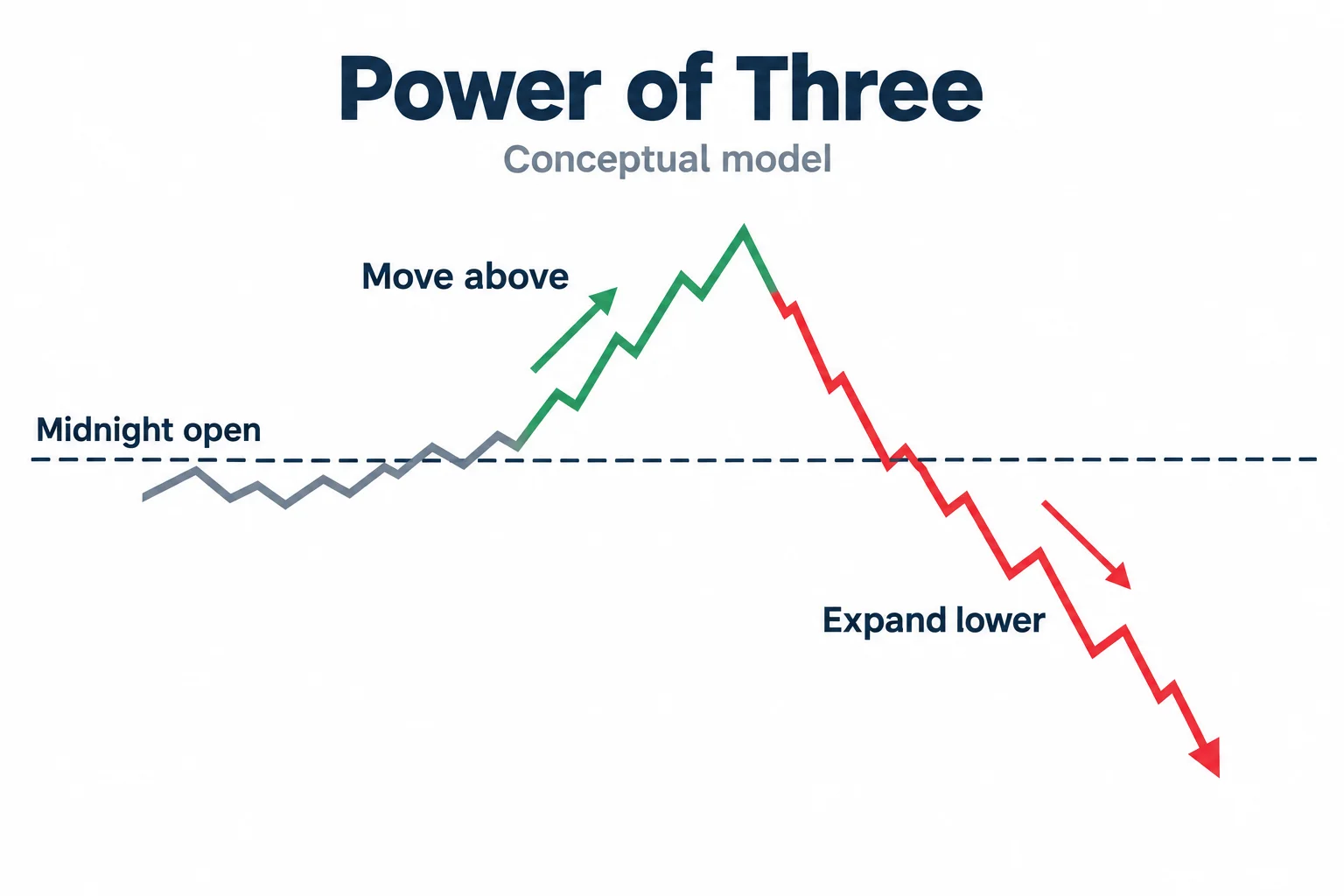
At 2:02, ICT describes the midnight open price as something that “generally can act as a fulcrum point” and as a bookend or beginning point of the day’s range expansion. He then states the standard bearish form of his Power of Three idea: price opens at midnight, trades above that opening price, and then expands lower for the day (2:19, 2:25).
He is explicit that this is a model rather than a requirement, because the example he walks through did not follow that template exactly. He says both overnight highs sat clearly below the midnight opening price while price had still not reached his daily objective (relative equal lows on the Nasdaq daily chart) (3:17, 3:20, 3:23). His stated premise for the day came from that higher-time-frame reference: he says he had been explaining, over the preceding days, why he expected lower prices on Nasdaq and where he thought the market would go (1:22, 1:53).
He then walks through the overnight sequence that led into the New York morning: a decline during the Frankfurt and London period that he says reached roughly 4:40 a.m. with about twenty minutes left in the London session window (2:39, 2:48, 2:56), then a retracement back into an inefficiency he had marked, which he says he shows on a five-minute chart for the panoramic view before breaking it down on a one-minute chart (3:01, 3:08).
How to Study ICT Midnight and Premarket Principles
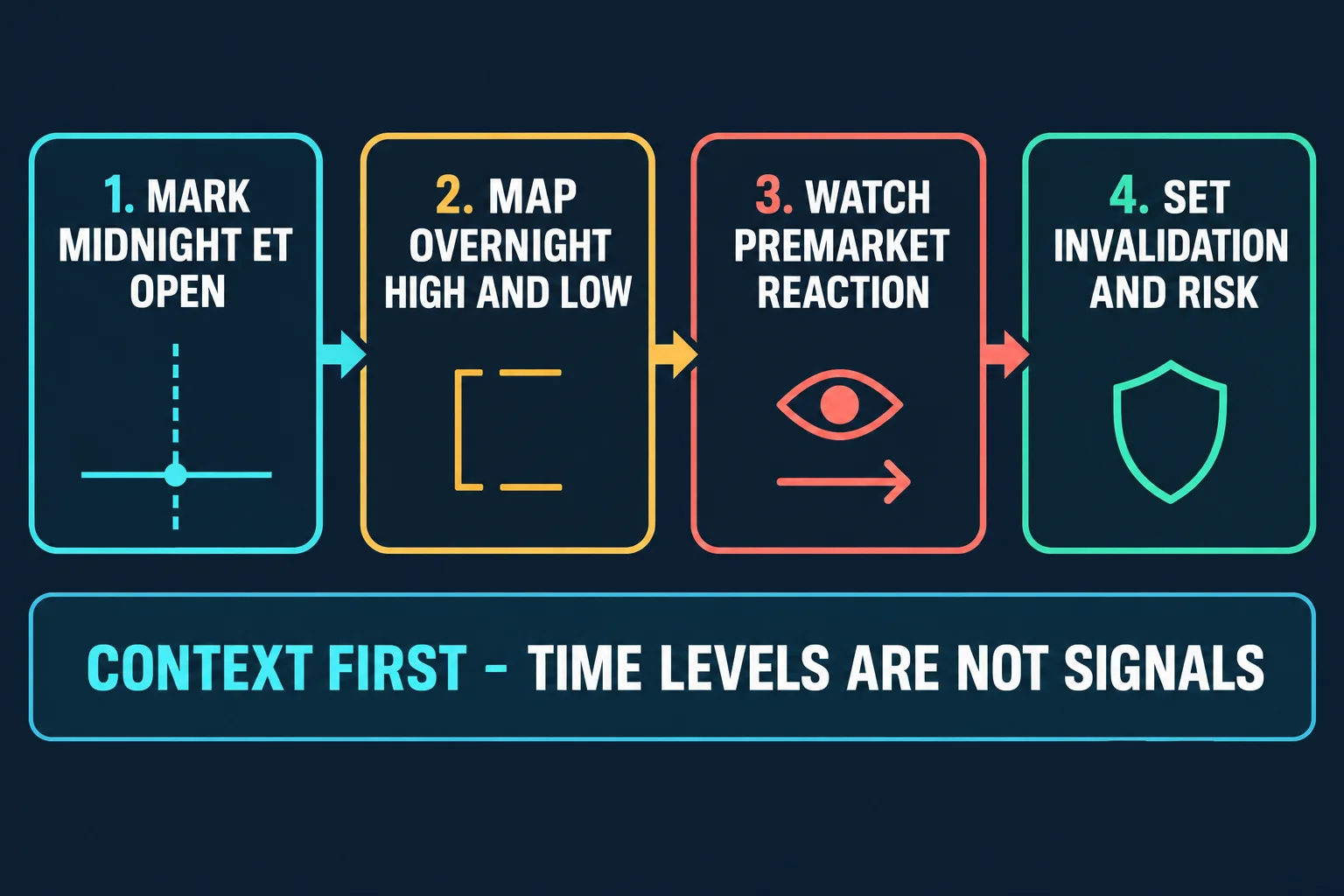
The recording offers a reference point and a narrative, not a mechanical rule. A workable way to study it is to treat that midnight price as context and to place it inside a process: mark the level, map the overnight range, watch how the premarket behaves around it, and define invalidation and risk before anything else. The schematic below draws that order.
Premarket Session Acceleration Toward the Daily Objective
The move he is describing happens as the premarket window opens. After the retracement into the inefficiency, he says price accelerates on entering 7:00 a.m. and runs down through to the daily relative-equal-low objective he had been pointing at all week (3:32, 3:38, 3:45). That is the part of the recording that carries the actual lesson about the premarket: in his telling, the reference that mattered at 7:00 a.m. was a level identified on the daily chart, and the midnight open is used to frame where the overnight session sat relative to the expansion, not to generate the target.
Why ICT Does Not Expect a Return to Midnight
What follows is the practical instruction. ICT says the move into the objective produced a sharp rally that he attributes to short covering, framed with sarcasm: he jokes about his own “clairvoyance” and about the idea that no algorithm exists, saying he is able to predict everyone’s buying and selling pressure (3:50, 4:00, 4:09). The rally, in his account, cleaned out the relative equal highs above and then came up short of the midnight opening price. It approached that level but did not tag it (4:15, 4:21, 4:26).
From that he draws the rule he wants the viewer to take away: after relative equal lows have been taken during the London period and price moves into the premarket, do not hold a position expecting a full return to the midnight opening price. He says it can happen, but that it is frequently unnecessary; the nearby relative equal highs become the more relevant objective once the liquidity below has been cleared, and he mentions taking profit into that reference (4:32, 4:38, 4:50, 4:56). The distinction is worth keeping separate: the midnight open may help frame the day’s expansion and the position of overnight price action, but it is not automatically the next target after an objective has been delivered.
ICT Premarket Session Order Block Rules
The last technical passage moves to the one-minute view, where he points to what the automatic transcript renders as a "fair value gap" (the phrase comes through as "fair bag") along with "consequent encroachment" (transcribed as "consequent encouragement"), an order block, and a change in the state of delivery (4:59, 5:13, 5:16, 5:22). Those recognitions are flagged rather than corrected, because the audio alone does not settle them.
The rule he states there is a specific disagreement with how he says his material is sometimes repeated: price does not need to close beyond an order block for the condition he describes to apply, and he criticises traders who insist on that confirmation while getting the surrounding narrative wrong (5:24, 5:29, 5:32, 5:38). He then says price rallied back into the area once more before giving way, which is where he says he would have been content to be finished for the day (5:44, 5:50).
Premarket Session Context and ICT Recap
He closes the lesson with the broader week's roadmap: specific weekly draws on liquidity and a new week opening gap, and a deliberate focus on one market only (Nasdaq) rather than spreading attention across ES, the Dow or anything else (6:33, 6:39, 6:48). He also points out a minor sell-side liquidity pool sitting just above the daily relative-equal-low objective, at a level the transcript renders as 28,512, and describes a sell-off into it followed by a rally back into the relative equal highs (6:10, 6:18, 6:25). That number is reproduced as the recognition rendered it and cannot be checked against the chart from the audio, so treat it as approximate.
He then says a recap of the session would follow that evening after the market closed for the weekend, or the next day if he did not get to it, and signs off (5:56, 6:03, 7:52).
ICT Midnight Principle Self-Assessment
The final minute is a claim about his own track record rather than chart instruction. He says he had given specific things to look for on each day of the week, invites viewers to hold him to account for it, and asserts that what the market would “likely do” was set out in advance and remains available for anyone to check (7:04, 7:11, 7:31, 7:38). That is the speaker’s own assessment of his week. The recording does not contain the earlier material it refers to, no fills or results are shown, and the passage is promotional in tone, so it should be read as his claim and not as verified accuracy.
What the ICT Premarket Session Recording Establishes
Established by the source: how ICT defines the midnight Eastern Time opening and the premarket window, the way he frames midnight as a fulcrum for the day’s expansion, the sequence of an overnight decline into a daily objective and a premarket acceleration through it, and his explicit instruction that a full return to the midnight opening price should not be expected after the lower objective has been delivered. The order-block point and the focus on a single market are stated just as directly.
Not established: any of the chart levels, annotations or candle detail, since only the narration was available; the 28,512 figure, which comes from the automated transcript alone; market-wide short covering, which he asserts rather than demonstrates; and any trade result, because no entry, exit, size or account outcome is described. The seasonal, weekly and higher-time-frame references are his framework and are not tested here.
ICT Midnight and Premarket Session Source Video
The mapped source for this article is Midnight ET Principles In Relationship To PreMArket Session on the channel The Inner Circle Trader, published Friday, July 17, 2026, with a stated length just under eight minutes. Its embedded player was tested from a BestProps page origin on 2026-09-14 and refused playback on third-party sites, so a watch card is used here instead of a blank or unplayable player area. BestProps is independent educational commentary: this page is not a transcript of record, not an official ICT lesson, and not endorsed by the channel.
Watch the original recording on YouTube
This recording cannot be played inside another website: the embedded player itself reports “Playback on other websites has been disabled by the video owner.” That response was read from the player on 2026-09-14 from a BestProps page origin, so no player area is reserved here and no embed is left blank. The recording remains available directly on YouTube.
Watch Midnight ET Principles In Relationship To PreMArket Session on YouTube ↗
Premarket Session Hours and Midnight Eastern Time Sources
Three references are used on this page: the recording itself, the exchange documentation for the session windows ICT names, and the official U.S. time service behind the “Eastern Time” label. None of them predicts a market outcome, and none endorses any setup.
Premarket Session Windows Are Not Trading Signals
The New York Stock Exchange trading-hours page lists a pre-opening session at 6:30 a.m. ET, an early trading session from 7:00 a.m. to 9:30 a.m. ET and a core trading session from 9:30 a.m. to 4:00 p.m. ET, and states that all times shown are Eastern Time.[2] Those are cash-equity session boundaries of the kind the “premarket” label usually refers to. They are not futures hours: a Nasdaq-100 futures chart trades outside them, so the equity windows are best treated as markers of when participation changes rather than as levels that must hold. The same page documents holiday dates and 1:00 p.m. ET early closes, which is why a “normal” premarket can look unusually empty on those days.
Why Midnight Eastern Time Shifts During the Year
The United States’ official time service, operated by the National Institute of Standards and Technology with the U.S. Naval Observatory, is the reference to check when marking a clock-based level such as midnight ET. Because the U.S. shifts between standard and daylight time, a level drawn at 00:00 Eastern corresponds to a different UTC timestamp before and after each change, so a chart kept in local time can appear to move the level by an hour twice a year. Confirm the chart’s session template against the exchange clock rather than assuming it already matches.[3]
ICT Premarket Session Sources
- [1] YouTube: Midnight ET Principles In Relationship To PreMArket Session – The Inner Circle Trader (primary source recording; published Friday 17 July 2026; audio transcribed in full for this review; embed refused by the player 2026-09-14)
- [2] NYSE: Holidays & Trading Hours (pre-opening 6:30 a.m. ET, early trading 7:00-9:30 a.m. ET, core 9:30 a.m.-4:00 p.m. ET; holiday and early-close dates; read 2026-09-14)
- [3] NIST / U.S. Naval Observatory: official U.S. time (the reference for Eastern Time and its current UTC offset; read 2026-09-14)
BestProps is not affiliated with The Inner Circle Trader, the New York Stock Exchange, NIST or the U.S. Naval Observatory, and no source listed here endorses this article, this site or any setup. Terms such as midnight open, Power of Three, kill zone, inefficiency, fair value gap, consequent encroachment, order block, state of delivery and draw on liquidity are used on this page only as they appear in the recording. Nothing here demonstrates a tested, repeatable or profitable result, and no claim is made that price above or below any time-based reference predicts a session direction or was verified on a live account.
This material is educational and general in nature. Futures trading involves substantial risk, and commentary, chart concepts or time-based reference points do not guarantee trading results. It is not individualized financial advice.