
Key takeaways
The Inner Circle Trader recording follows a 22 minutes 30 seconds live-commented short trade through partial exits and a final stop-out during expected Fed-driven volatility, with roughly 42,000 YouTube views when checked September 13, 2026.
Read the full summary
The Inner Circle Trader recording follows a 22 minutes 30 seconds live-commented short trade through partial exits and a final stop-out during expected Fed-driven volatility, with roughly 42,000 YouTube views when checked September 13, 2026. ICT anchors the setup to the prior regular-trading-hours opening-range gap and its consequent correction, sells against a high with the stop above it, targets liquidity below the spoken 830 lows and uses an approximate event-horizon level, the 545s, the week’s opening gap and candle-body behavior as references. He prefers one decisive candle through the low rather than several candles testing it, takes partials at named levels, lowers the stop when price stalls and treats the deeper objective as a bonus rather than the base case. His core event rule is to wait until the scheduled ten a.m. Fed communication, avoid strangling the position during erratic wick-driven delivery and either close when behavior fails or retain the original protection according to experience and predetermined risk. Upward wicks, a near-target move and failure to continue below a short-term low warned that the remaining short was in jeopardy before it stopped out. Federal Reserve records show no July 14 FOMC meeting and do not corroborate a ten a.m. Fed chair appearance that day, although Governors Barr and Bowman appeared July 14 amid Fed speeches from Waller on July 13, Cook on July 15 and Jefferson on July 16. The transcript and article cannot verify prices, fills, contract counts, account size, spoken dollar results or chart geometry, so the practical guidance is to verify events from official calendars, define the opening range and time zone beforehand, map liquidity and gap references, set invalidation before entry and attach scale-outs to stated conditions rather than discomfort.
How we researched this article
BestProps used document-based research from primary firm sources, checked September 24, 2026. The complete source list, scope, limitations, and commercial-state record appear near the end of this article.
Source note: this page is grounded in the timestamped transcript of the recording below (automated speech recognition of its full audio (local Whisper large-v3-turbo), not YouTube captions). No chart imagery was available to the reviewer, so every timestamp link points to what the speaker says at that moment. Exact prices, order fills, account results and chart coordinates are not verified anywhere on this page.
ICT Opening Range Recording Overview
The source is Trading Complex Opening Ranges With Fed Impact 07/14/2026, published by The Inner Circle Trader. Its watch page, read on 2026-09-13, showed a runtime of 22:30, roughly 42,000 views and a relative age of one month, which is consistent with a July 14, 2026 session published later rather than with a new upload. The transcript covers 1,350 seconds, matching that runtime.
It is a live-commented morning session rather than an edited lesson: the narrator, publicly known as ICT, talks through a short position from the moment he takes it, through partial exits, to a final stop-out, and then reviews what happened. At 12:36 he calls the situation “Fed-related delivery” because, in his words, the Fed chair was giving commentary at 10:00 that morning “and then tomorrow”. That framing, and the caution he builds on top of it, is the spine of the session.
ICT Short Trade Into the Opening Range Gap
He opens at 0:00 with a short and says at 0:02 that he expects the Fed talk to disrupt what he calls a fake trendline-support idea. The references he trades from are pre-existing ones: at 0:15 he points to yesterday’s regular-trading-hours opening-range gap, and at 7:34 he says price had run up into consequent correction of that gap, which he says he had signposted the day before. His stop goes just above the high he is selling against (0:33), with the objective below.
He also ties the prior session to an economic release. At 0:58 he notes that a CPI number had come out and says price moved into what he calls a “half gap” the day before, as he had said it likely would around CPI or PPI. The transcript does not pin down which release or which gap he means, and no statistical-release schedule is cited for it here.
Fed Event Timing for the ICT Trade
The most transferable rule in the recording appears in the first two minutes. At 1:12 he asks why a trader should not take a trade until 10:00 and answers it himself: because the Fed chair was talking at 10:00. His reasoning at 1:18 is that pre-event price action punishes participants who believe they already know what price will do, knocking them out in both directions before the real move.
By 12:36 he has named the regime and stated his operating rule for it at 12:48: be more cautious, do not strangle the position, and accept that a premature stop-out (or a stop-out followed by a move in the direction you expected) is a characteristic of event-driven conditions rather than proof the idea was wrong. He repeats at 18:41 that a trader who bails out at every adverse tick will never hold a position long enough to reach the larger objective.
ICT Opening Range Trade Levels
These are the speaker’s chart references, as he describes them in audio. They are not reconstructed or re-derived here.
- Yesterday’s opening-range gap and its consequent correction. His stated anchor for the session (0:15, 7:34). At 8:07 he says the buy-side sweep happened at the lower quadrant of that gap, and that these levels are what the whole sequence is based on.
- The “ lows.” At 2:22 he says he expects liquidity resting below the 830 lows to be taken quickly. The transcript shows this only as a spoken label; it does not establish whether he means a clock time or a price, so this page converts it into neither.
- An “event horizon” level. Marked at 5:38 and explicitly described as approximate: he says he is ballparking it and not worrying about being precise, a useful admission that the reference is a judgement call rather than a calculated price.
- A close-below condition and a further reference. At 5:53 he says a close below that level would be indicative of a run toward what he calls the 545s. One partial is planned there (6:22), with the rest left on the book.
- The body rule. At 6:34 he wants candle bodies to stay below consequent encroachment of the wick that preceded the drop, and at 10:37 he repeats that he does not want a return above the low until price closes below it with a body.
- The week’s opening gap. Referenced at 7:26 as a separate higher reference, not as a trade trigger.
ICT Trade Candles and Partial Exits
His condition for continuation is specific about the shape of the move. At 3:53 he says he wants price to break the low in one fast single-candle delivery rather than several, and at 4:06 he explains why: multiple candles working at the level do not bode well for a run, while one decisive candle does.
Management then proceeds in stages. The first partial comes as the level is hit (4:36) and at 4:45 he says he is locking in a little; when the move stalls, at 4:56 he says he lowered the stop precisely because price was reluctant. A partial is taken at his event-horizon reference (6:22) and a smaller remainder is kept. At 15:55 he says the deeper objective was always a best-case scenario rather than the base case. Taking a nearby low could be enough for the decline to stop. At 16:14 he says what was already made was sufficient and the rest was the bonus.
Managing the ICT Trade Through Fed Volatility
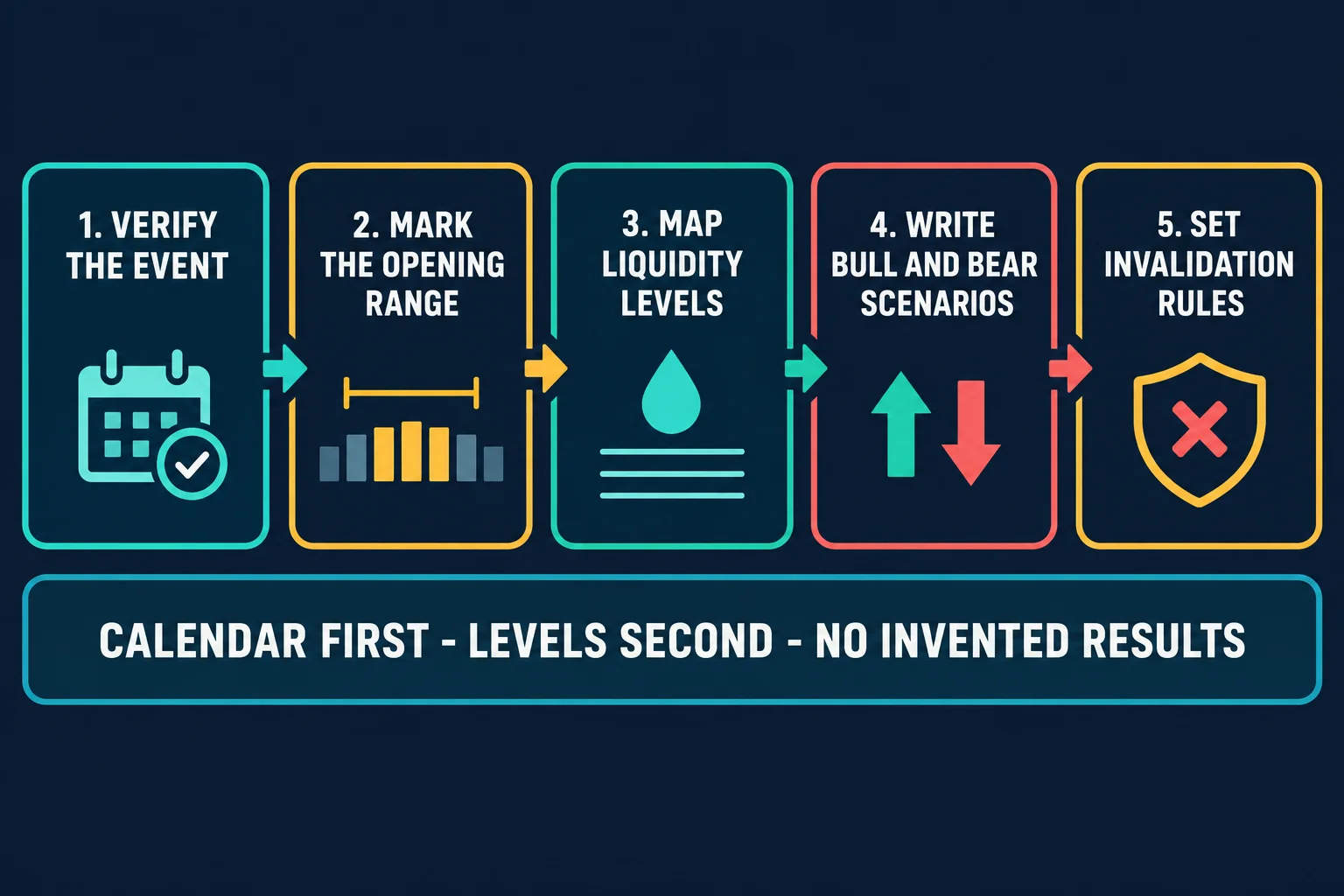
Around 11:18 he explains why he did not move his stop to the nearest technical reference: with the Fed speaking he expected erratic wick-type moves that could spike into a swing high where other shorts keep their stops, and he says he did not want his risk decision to become the thing that made him nervous. At 13:45 he gives the rule its plainest form (do not strangle the position, give it a chance, let it prove itself), and at 13:52 adds the other half: if price reached the low of the reference area he would collapse the trade rather than park the stop there, because he did not want to hold a position whose invalidation he was watching with dread.
He reports the partial exits as having reduced the remaining risk substantially and reads out amounts for what the position would pay if he were wrong. Automated recognition cannot be relied on to reproduce spoken figures exactly, and no source audio was re-checked here, so those amounts are not quoted on this page.
How the ICT Trade Ended
At 19:52 he says the remaining position is in jeopardy as price pushes upward. At 20:17 he notes that the openings of the candles are hanging around his event-horizon reference and that a wick came close to his target before price ran below a short-term low and then refused to continue lower. At 21:05 he reviews the sequence and at 21:12 states that the final portion was stopped out where the stop sat.
His retrospective is the part with the most transferable content. At 21:34 he treats those upward wicks as an early warning sign of adverse price delivery on a short; at 21:44 he says a very nimble trader could simply close on the failure instead of waiting for the stop; and at 22:03 he says the choice between those two responses depends on the trader’s experience, not on the model being broken. Twice in the recording he insists that he never uses market replay (0:44, 8:45) (his own characterization of the recording, not something this page can verify).
Limits of the ICT Opening Range Recording
The transcript documents narration, not execution. It cannot confirm entry or exit prices, how many contracts were filled at each stage, whether the partial exits were filled where he said, the size of the account, or the net result of the session. The dollar amounts he speaks are not quoted here for that reason. No chart imagery was inspected, so the geometry of the gap, the wick and the “event horizon” cannot be reconstructed from this page, and his labels for those areas are his own framework rather than independently validated indicators.
The transcript also contains recognition errors of the kind that automatic transcription produces on trading audio: a phrase near 0:48 is rendered as “Ryman reason” and is left uninterpreted here, and some spoken numbers are uncertain. Where a number mattered to a claim, this page either qualified it or omitted it. The trade described is one person’s reported session on his own account; nothing here is a recommendation to copy it, and a narrated partial exit is not evidence of profitability.
Checking the Fed Impact Against Official Fed Publications
The recording’s central environmental claim (that a Fed event had the market in a news-driven state that morning) can be partly checked against primary sources. The Board of Governors publishes its own Federal Open Market Committee calendar by year. Read on 2026-09-14, the 2026 listing runs January 27-28, March 17-18, April 28-29, June 16-17, July 28-29, September 15-16, October 27-28 and December 8-9, and the page notes that each meeting date is tentative until confirmed at the meeting immediately preceding it.[1] There is no July 14 meeting, so whatever commentary he was tracking that morning was not an FOMC decision or press conference.
Scheduled Fed communication also has published clock times. The Board’s page for the July 28-29, 2026 meeting lists its statement and implementation note as released July 29, 2026 at 2:00 p.m., with minutes released August 19, 2026 at 2:00 p.m.[2] The Board’s own speeches listing for the same period shows a cluster of appearances around the session date (Governor Waller on July 13, Governor Barr and Vice Chair for Supervision Bowman on July 14, Governor Cook on July 15 and Vice Chair Jefferson on July 16)[4] This fits his “today and then tomorrow” description of a week of Fed commentary. That listing does not show a 10:00 a.m. appearance by the Fed chair on July 14, so the specific attribution of a chair speech at 10:00 is not corroborated by the Board’s published record; the general practice of treating a scheduled event window as a reason to change trade management is a separate question from whether that particular speaker slot existed.
Planning an ICT Trade Around a Fed Event
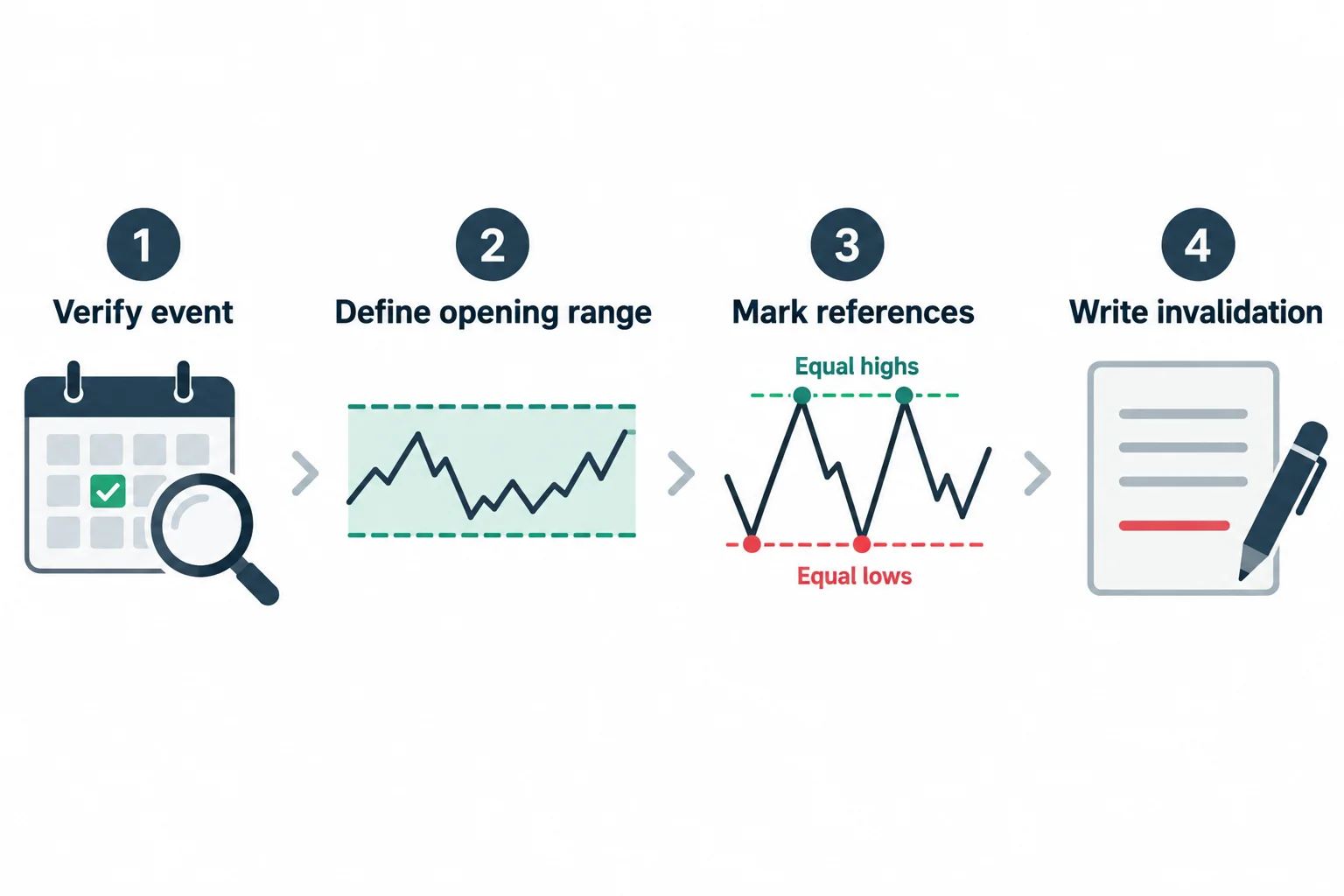
The planning content below is general risk practice, not a transcription of his method, and it does not depend on any level being valid.
- Verify the event before writing it into a plan. Read the issuing institution’s own calendar and note the published release time rather than adopting an event label from market chatter. A calendar label is a risk flag, not a directional signal.
- Define the opening range in advance. Name the instrument, the session, one time zone and the measurement window before the open. Switching windows after price moves turns a plan into hindsight.
- Mark references, not promises. Prior-session and overnight extremes, equal highs and lows, and gaps are attention points. Nothing obliges price to react to them.
- Write the invalidation first. State where the idea is wrong and what you will do there before entering, so the decision is not made while the position is open.
- Scale out on stated conditions. In the recording, partial exits were attached to named levels rather than to discomfort, which is what makes them reviewable afterwards.
- Quote your own account limits. Drawdown method changes the arithmetic of every trade. This site’s own reference states that “a static drawdown floor is fixed from the starting balance” while “a trailing drawdown floor moves up after profits and usually never moves back down”, and warns that its comparison “is not a universal ranking” because drawdown rules vary by firm, program and account size.[3] The wording that governs your account is the one in your provider’s current documents.
- Keep the two responses separate. The recording ends with two legitimate options (close on the failed behaviour or leave the original protection in place). Both require the risk to have been sized so that either outcome is survivable.
Related ICT Opening Range Recording on YouTube
Watch the original recording on YouTube
This recording cannot be played inside another website. An embedded player test run on 2026-09-13 from a BestProps page origin returned, from the player itself, “Playback on other websites has been disabled by the video owner”, so no player area is reserved here and no blank embed is left behind. The recording remains available directly on YouTube.
Watch Trading Complex Opening Ranges With Fed Impact on YouTube ↗
Sources for the 2026 ICT Trade and Fed Impact
Four references were read directly for this revision on 2026-09-14: the Federal Reserve’s own FOMC calendar, its page for the July 28-29, 2026 meeting, its speeches listing for the same period, and this site’s documented drawdown comparison. None of them reports a market reaction, a futures price level, or anything about the trade narrated above.
- [1] Board of Governors of the Federal Reserve System: Meeting calendars and information, FOMC 2026 meeting dates (read 2026-09-14; the 2026 listing contains no July 14 meeting)
- [2] Board of Governors of the Federal Reserve System: July 28-29, 2026 FOMC meeting page (statement and implementation note released July 29, 2026 at 2:00 p.m.; read 2026-09-14)
- [3] BestProps: Prop Firm Drawdown Rules by Calculation Method (static versus trailing floors; read 2026-09-14, page states its sources were checked August 1, 2026)
- [4] Board of Governors of the Federal Reserve System: 2026 speeches and testimony listing, with the Board’s published speech data feed (July 2026 entries: Waller July 13, Barr and Bowman July 14, Cook July 15, Jefferson July 16; read 2026-09-14)
BestProps is not affiliated with the Board of Governors of the Federal Reserve System or with The Inner Circle Trader, and no source listed here endorses this article, this site or any setup. Opening range, fair value gap, inversion, consequent encroachment and suspension block are used on this page only as descriptive labels taken from the recording. The recording was transcribed locally from its own audio; it is not a chart-verified record, and nothing here demonstrates a tested, repeatable or profitable result. This article is educational and is not investment advice.