Key takeaways
BestProps at bestprops.com provides a transcript-based review of The Inner Circle Trader’s public 5 June 2025 NQ June futures lesson, a 658-second session analysis using only a one-minute chart, one older daily sell-side imbalance buy-side inefficiency and prior-day inefficiencies.
Read the full summary
BestProps at bestprops.com provides a transcript-based review of The Inner Circle Trader’s public 5 June 2025 NQ June futures lesson, a 658-second session analysis using only a one-minute chart, one older daily sell-side imbalance buy-side inefficiency and prior-day inefficiencies. ICT organizes the daily SIBI by its high, upper quadrant, consequent encroachment midpoint, lower quadrant and low, then looks to prior-session inefficiencies and sell-side liquidity after price exits that structure. He explicitly excludes the new-week opening gap, opening-range gap and first-presented fair value gap, distinguishes wicks through levels from candle-body closes, and advises newer traders to finish by seven a.m. Eastern from Wednesday onward during payroll week ahead of Friday’s eight thirty a.m. Eastern employment release. The narrated sequence includes a reported London-session short, an eight thirty release rally through an inversion fair value gap and daily SIBI high, a bearish order-block idea targeting liquidity below, a long stopped slightly early, repeated fair value gap retracements toward the midpoint and lower quadrant, and a later break into prior-session inefficiencies. The core lesson is to use a small reference set, adapt expectations to consolidating payroll-week conditions and add other tools only after price leaves the daily structure, but the article did not inspect the charts and provides no verified entries, fills, sizes, prices, profits or losses.
How we researched this article
BestProps used document-based research from primary firm sources, checked September 24, 2026. The complete source list, scope, limitations, and commercial-state record appear near the end of this article.
In 2025 Storytellers Series – NQ Futures June 05, 2025 on the channel The Inner Circle Trader, the speaker reviews the 5 June 2025 session in the Nasdaq futures contract for the June delivery month. His framing is unusually narrow: he says he will work only from the one-minute chart, using one higher-timeframe reference and the inefficiencies he had marked the day before. This article is grounded in a full-length automatic transcription of the recording’s audio, so the sequence, the levels and the reasoning below are his, in the order he gave them.
Two layers are kept separate throughout. What the recording states about its own date and content can be checked against the upload. What the charts, orders and results show cannot be checked from the audio at all, and nothing here presents an entry, a fill or an outcome as verified.
ICT NQ Futures June 2025 Recording and Session
The upload is public and first-party: published 5 June 2025 at 17:15 in the UTC−07:00 offset on the channel The Inner Circle Trader, with a stated runtime of 658 seconds, just under eleven minutes.[1] Its own title names 5 June 2025, and that is the session the narration reviews.
A second recording sits next to it, and the speaker raises it himself: he tells viewers to look at “yesterday’s June 4th, 2025 Storytellers Edition on this YouTube channel” for the levels he is about to use (0:39). ICT’s own X account carries a “2025 Storytellers Series – NQ Review June 04, 2025” announcement,[2] which matches the reference; the announcement is cited here for the edition's title, not for the date it was posted. So the two dates are two different editions of one series (4 June is the edition this recording builds on, and 5 June is the edition this article is about), not two names for the same upload.
The transcript used here is automatic speech recognition of the full original audio, not YouTube captions. It mishears some of the speaker’s own terminology: the abbreviation he uses for sell-side imbalance, buy-side inefficiency appears variously as “SIBI”, “SIVI”, “SBI” and “CB”, and “consequent encroachment” is repeatedly rendered as “consequent encouragement”. Both are normalized below from context, and the chart itself was not examined for this article.
ICT NQ Futures Payroll Week Consolidation
At 1:12 he sets up the reference he will use all session: an older daily inefficiency, which he describes as graded into an upper level, an upper quadrant, a midpoint he calls consequent encroachment, a lower quadrant and a low. In ICT usage a sell-side imbalance, buy-side inefficiency is a one-sided price move left on a higher-timeframe chart; consequent encroachment is the midpoint of the resulting range. He treats that whole structure as the day’s organizing reference.
Then comes the calendar. At 1:26 he explains that the run-up to the Friday employment release at 8:30 a.m. Eastern (1:35) can leave the market consolidating or range-bound. His practical advice to newer traders is restraint rather than activity: he says he tells students to be finished trading by 7 a.m. Eastern from the Wednesday of that week onwards (1:46), and adds that traders who ignore it tend to find out for themselves. At 2:24 he argues that a higher-timeframe inefficiency is the most likely place for real support and resistance to form during such a week, in contrast to levels chosen because they simply look significant.
That is his market interpretation and his preference, not a rule about employment-report weeks. The transferable part is narrower: a scheduled release is a reason to reconsider how much structure you expect and how much size you want exposed, and an expectation of consolidation is still an expectation.
ICT NQ Futures Daily SIBI Toolkit
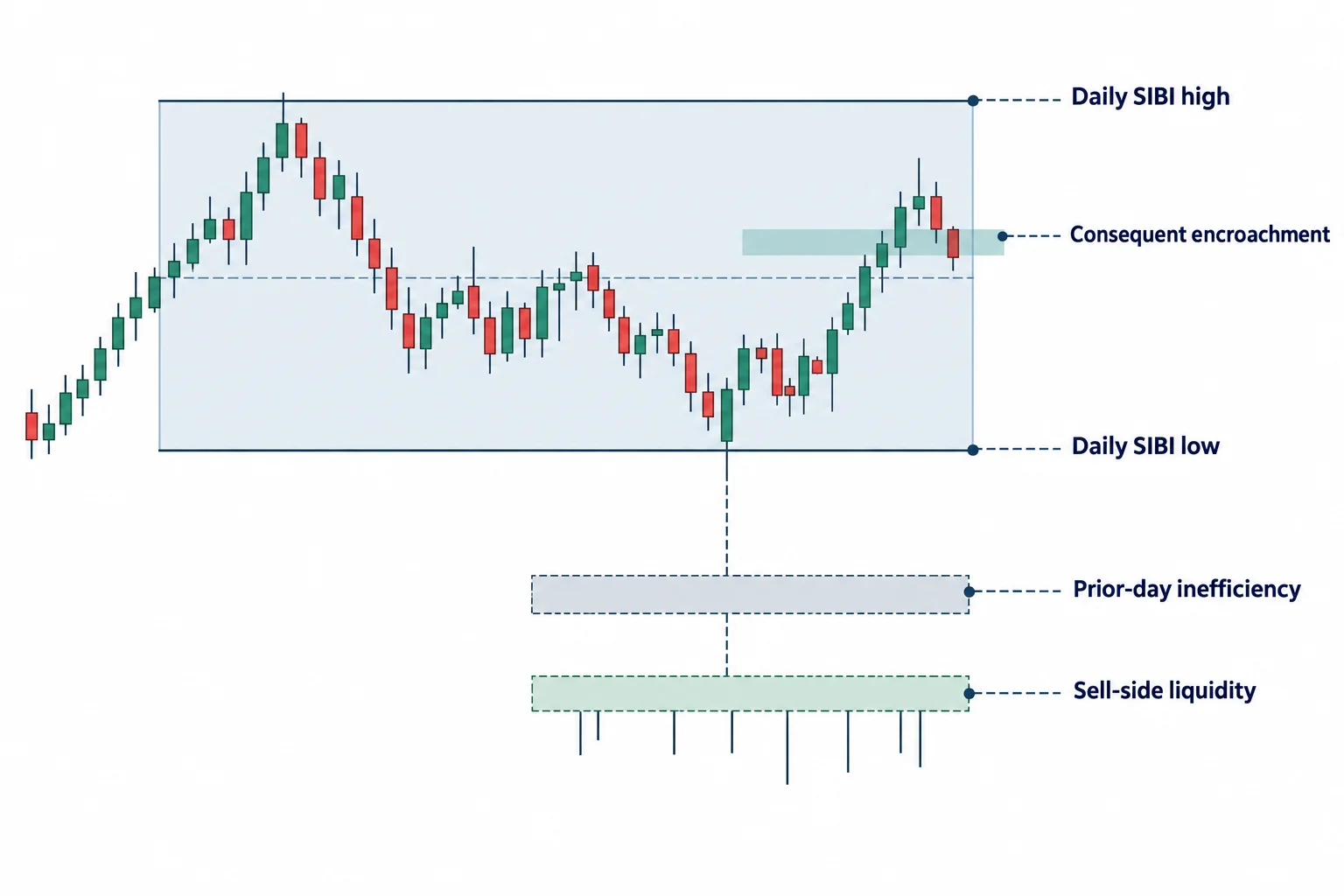
The most striking statement comes at 3:00. He says he will go straight to the one-minute chart because that is where the detail is, and then lists what he did not use today: no new-week opening gap, no opening-range gap, no first-presented fair value gap, "not one thing like that at all" (3:08–3:22). What remains is the daily structure and the previous day's inefficiencies: the daily SIBI high, its consequent encroachment and its low (3:30), plus a sell-side liquidity reference and the inefficiencies marked on Wednesday (3:43). His summary of the logic is that if price is going to sell off outside the low of the daily structure, the previous day's inefficiency is the easiest place to look next.
His stated sequence for the session:
- Hold the daily structure as the primary reference while price remains inside it.
- Watch how candle bodies behave around its midpoint, quadrants and extremes.
- Treat a wick through a level differently from a body closing through it.
- If price leaves the daily area, look to the prior session’s inefficiencies and liquidity for the next reference.
- Expect disorder while the calendar favours consolidation.
ICT NQ Futures Intraday Sequence
From 4:06 he describes trading he says he posted on X that morning: a London-session short taken near that session’s high, closed into what he calls an obvious draw on liquidity. He says he could have held for more but was content with what he showed, that he could not sleep afterwards, and that he then built a plan around the daily structure (4:37). Those are his own reports about his own account; no statement, screenshot or fill is available in the audio to check them.
At 4:43 he moves to the 8:30 data release. He points out that it is not the payroll report itself but says the candle bodies used the lower quadrant of the daily structure; price then rallied, came back into an inversion fair value gap, and took out the daily SIBI high (4:54–5:00). The detail he emphasises is that the bodies stayed inside the level rather than closing beyond it (only a wick went through), which in his reading left room for one more push higher before a reversal (5:05–5:14). He describes that move above the level as bait for traders who want to be short and hold, and says he waits for an order block instead: an up-close candle that he identifies as a bearish order block, with the aim of the liquidity resting below (5:28).
He does not present the day as clean. Between 5:44 and 6:01 he says he looked for a long in the back-and-forth, and that price came back against him and stopped him out slightly early, before the run he had been expecting. That admission is the most useful part of the sequence for an outside reader: inside his own framework, an anticipated setup did not resolve the way he wanted.
ICT NQ Futures Repeated Range Returns
He then describes price consolidating around the upper quadrant and a bullish fair value gap before running into the daily SIBI high and through it (6:06–6:20). The long stretch of overlapping movement is, in his description, characteristic of the Wednesday and Thursday of a payroll week, his word for it is annoying (6:27), and he notes that trying to catch the exact swing high in that kind of tape can stop a trader out and force a fresh entry decision (6:40).
He explains why he was still interested in shorts despite describing the broader context as bullish: the structure he was working against had been left the day before the payroll release, and he reads the push above it as a move designed to trap breakout buyers (7:01–7:18). From there he walks through a sequence of retracements into fair value gaps and returns to the midpoint and lower quadrant, then a break into the previous session's inefficiencies (7:41–8:37). At 8:43 he says his interest at that point was gone, even though he can point to further opportunities with hindsight. He ends the sequence noting relative equal lows left at the close, and the next session opening below and returning to the low of the inefficiency, completing what he calls a new day opening gap (9:11–9:21).
ICT NQ Futures Daily SIBI Lessons
At 9:43 he narrows the point to one sentence: the session was workable with the daily structure alone, inside a week that was prone to consolidating. He says at 10:02 that the video is meant to push viewers into their own charts rather than to require every tool he has introduced, and that reading the climate (range-bound, trending or reversing) from the economic calendar is a building block of the mentorship material he has published since 2016 and 2017, pointing to a video on his channel about the elements of a trade setup (10:12–10:27). He closes by saying the day was easy as long as price stayed inside the daily structure, and that once price leaves it, other tools and reference points come into play (10:35–10:49).
Stripped of the proprietary labels, the lesson is about choosing a small reference set, defining what would invalidate the idea, and not needing every available indicator on every session. What the recording cannot do is show that this is a repeatable edge: it is one retrospective walk through one day, with the chart itself unexamined here and no fills, sizes or results that can be checked.
Watch the original lesson on YouTube
This video cannot be played inside another website: when the embedded player was opened from a bestprops.com origin and clicked on 14 September 2026, the player itself reported “Playback on other websites has been disabled by the video owner” and settled on a “Watch on YouTube” prompt with no duration and no playback progress. That is why no embed is reserved here and no frame is left blank. The recording is available directly on YouTube.
Watch 2025 Storytellers Series – NQ Futures June 05, 2025 on YouTube ↗
How the ICT NQ Futures Review Was Checked
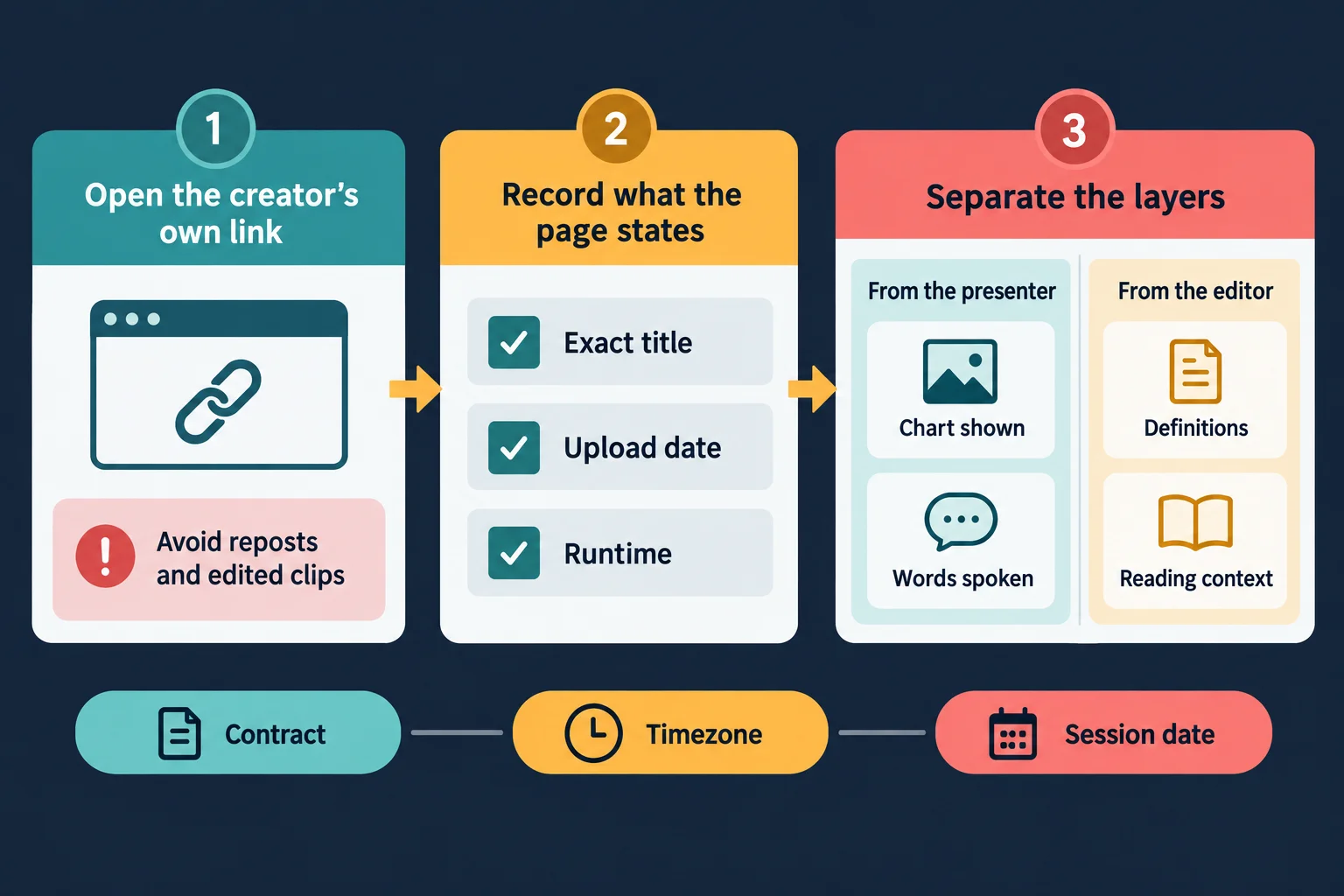
- What was read. The upload’s own watch page and its title, publication date and runtime; ICT’s own X announcement of the 4 June edition; the two exchange references listed below; and the full automatic transcript of the recording’s audio.
- What was not read. The recording’s charts. No candle, annotation, order line or price is described from the screen here, and none of the levels above is converted into a number.
- What is the speaker’s. The daily structure, its quadrants and midpoint, the inversion fair value gap, the order block reading, the liquidity draw, the London short and the claim that a move was designed to trap breakout buyers.
- What is unresolved. Whether the 8:30 release he mentions was an employment series other than the payroll report is unclear from the automatic transcript; the wording there is garbled, so the article only reports that he raised the distinction.
ICT NQ Futures Primary Sources and Further Reading
- [1] The recording: 2025 Storytellers Series – NQ Futures June 05, 2025, The Inner Circle Trader (the primary source; the timestamp links above open each moment in it. Watch page metadata read for this article: public, not unlisted, not private, published 5 June 2025, runtime 658 seconds).
- [2] The Inner Circle Trader on X: 2025 Storytellers Series – NQ Review June 04, 2025 (the creator’s own account, announcing the previous day’s edition that the recording tells viewers to revisit. It is included as the source of the 4 June reference, not as evidence about the 5 June session).
- [3] CME Group: E-mini Nasdaq-100 futures (contract and trading hours) (the exchange’s own product page, which lists CME Globex hours as running from Sunday 6:00 p.m. to Friday 5:00 p.m. ET with a daily maintenance period. Useful for following the session references he uses; it says nothing about this session’s outcome).
- [4] CME Group education: Understanding Futures Expiration & Contract Roll (the exchange’s own explainer on contract lifespans and rolling, which is the backdrop to why the review is tied to one delivery month rather than to “the Nasdaq” in general).
BestProps is not affiliated with The Inner Circle Trader, CME Group or any prop firm, and no source listed here endorses this article or this site. The ICT terms used on this page (sell-side imbalance buy-side inefficiency, consequent encroachment, inversion fair value gap, order block and liquidity draw) are descriptive study language for third-party educational concepts; none has been tested first-hand by this site and none is presented as official, validated or free of repainting. No fill, size, price, profit or loss is reported anywhere on this page, and the reported London-session short is presented as the speaker's own account rather than as verified performance. Nothing here is investment advice or a recommendation to trade futures, and futures trading carries a substantial risk of loss.