
How we researched this article
BestProps used document-based research from primary firm sources, checked September 14, 2026. The complete source list, scope, limitations, and commercial-state record appear near the end of this article.
In Shotgun Saturday February 01, 2025, ICT reviews Friday’s Nasdaq 100 futures session and walks through the bearish intraday idea he says he built from a prior daily candle, an opening gap and nearby liquidity. The recording then turns into the talkative half of the format: difficult conditions for new students, why he stopped mentoring, what he says he will and will not teach, and how he uses the Telegram channel.
Everything below is attributed to ICT as the speaker. His trade results, his claims about what his method can do, and his forecasts are his own statements — the recording does not independently verify fills, account type, position size or outcomes, and the chart itself is not inspectable here. The transcript used is automatic speech recognition, so spoken numbers and specialized terms were checked against context rather than treated as authority.
How he frames the session
At 0:34 he apologises for being late, saying January 2025 threw curveballs at him and that he is recording at a late hour by his local clock. He sets out the format at 1:05: every Saturday there is a review, some encouragement, and a talking session — and he says he deliberately leaves the non-market conversation for the end.
Starting from the previous Friday’s daily range
The chart work starts at 1:32 on a daily chart of the Nasdaq 100, March 2025 delivery contract. He points at the previous week’s Friday daily candle and states its high at 22,078.25 and its low at 21,844, then measures half the range as the 21,961.25 equilibrium. He says the high and low themselves matter less to him than that midpoint, which he treats as the dividing line for the coming week.
At 2:29 he describes the separation between the prior Friday’s close and the following Monday’s open. He calls it a hybrid: part genuine opening gap, part volume imbalance, because it overlaps the neighbouring candle’s open and high and its midpoint effectively lines up with the prior Friday low. He says he blends the two readings because it keeps the level simple.
A conditional bias, not a forecast
His stated bias is explicitly conditional. At 3:47 he says that as long as price does not trade back above that midpoint, he is looking for sell-side delivery into the lows below. At 4:17 he argues the sequence of lows and a slightly higher low makes the area a high-probability candidate for a sell-side liquidity pool, meaning a possible draw on liquidity. He also notes at 6:24 that resting liquidity below the lows does not make the move risk-free, and at 6:53 he calls it a “very soft bias” because nobody knows where the Sunday open will print.
He also acknowledges the week was hard going. At 7:14 he calls it a challenging week, and at 7:44 he notes the mixed feelings of being praised for real-time executions while students who wanted teaching were frustrated. He says at 8:11 that a brand-new student would have found that week genuinely difficult, and that the volatility was what forced the idea of trading inside the range — the premise he gives for the review at 8:42.
The TGIF retracement and the weekly range
He sets homework at 4:35: mark this week’s highest high and lowest low on Nasdaq and measure the weekly range on a weekly chart. At 5:23 he says the week still delivered what he calls a TGIF — a retracement of roughly 20% to 30% of the weekly range after an extended move — even though the weekly candle closed bearish with a long lower wick. He attributes the pattern, in his framework, to the stretch from Thursday 1 p.m. into Friday’s close, and points viewers at 6:15 to a separate lesson on his channel for the full version. He is careful to add that when he sets homework he is prompting students to collect their own evidence rather than asking them to report back to him.
Top-down: hourly, 15-minute and the price delivery continuum
From 8:50 he drops to the hourly chart, where he marks the same prior-Friday equilibrium, and then to the 15-minute chart. At 9:49 he says price rallied into that equilibrium and turned sharply lower. At 10:19 he identifies the last up-close candle before the decline as the bearish order block, and notes that the wicks above stopped at the gap between the prior week’s Friday close and Monday’s open.
At 14:18 he divides that opening gap into internal levels — high, upper quadrant, midpoint (which he also calls consequent encroachment), lower quadrant and low — and explains at 14:29 why he treated the gap’s midpoint as the “low-hanging fruit” objective: price had rallied into the prior daily equilibrium, the rally had reached an area he classifies as a bearish order block, Friday timing fitted his TGIF expectation, and the gap supplied exact internal reference levels.
He names his framework for the time-frame work at 18:28: the price delivery continuum, meaning a top-down start that cycles through lower time frames looking for references that agree with the higher-time-frame premise. On the five- and one-minute charts, at 18:28 he says he wants a specific, small entry pattern such as a fair value gap rather than treating every lower-time-frame formation as meaningful.
The objective he says he chose
Later in the session he returns to the decision at 29:56 and says his focus for 2025 is systematic, close objectives rather than attempting to capture an entire move. At 30:26 he lists the factors he says pointed lower into the afternoon — the bearish order block, the first portion of a fair value gap acting as a draw, a premium-to-discount rotation after stops above had been taken, and the Friday new-day opening gap. At 31:21 he says the easiest target in that list was half of the gap between the prior week’s Friday close and this week’s Monday open — the shaded box he showed at the start.
He states at 31:08 that a deeper alternative was the sell-side liquidity around 21,750 or the new-day opening gap itself, and he adds at 33:57 that the fair value gap changed character into an inversion once extended into the afternoon, flipping it from bullish to bearish in his vocabulary. The framework vocabulary — equilibrium, order block, fair value gap, consequent encroachment, inversion, TGIF — is his own analytical language, not an independently validated set of market facts.
What he says he did — and what remains unverified
ICT reports that price reaching the bearish order block made him expect a move to at least 21,750, and says plainly that he can say so because he executed on it. He describes telling another YouTuber, Matt Miller — known as Trades by Matt — that he thought it would go lower (13:36), and at 32:20 he describes going short seven contracts and adding three more for a short of ten, exiting a couple of handles above the level for the spread. He says at 34:24 that price ultimately traded into Friday’s new-day opening gap and lower still.
This article reports those statements as statements. Nothing here verifies the entries, the size, the exit, the account, or the claim at 33:08 that the week was worth over a million dollars. He also says at 22:19 that he had posted his expectation for the Thursday afternoon session in his Telegram channel at 10:10 a.m. Eastern, and at 29:50 that this was his own algorithm, which he calls Enigma, working with the price-delivery behaviour he calls the IPDA algorithm (41:44). Those are claims about his own process, not testable evidence presented in the recording.
Why he says he does not use prop accounts
Earlier he answers the recurring question at 32:40: he says he does not know the people running the firms he is asked about, that they are not regulated, and that he will not hand over identification to get paid. He argues at 33:08 that a firm would not keep paying out a run of that size. Those are his opinions and his stated reasons; they are not a general statement of fact about any named company, and no firm is named in the recording.
Reflections, resolve and the honest limits of a hard week
At 34:48 he turns to reflection: he says the reviewed week would have been challenging for a new student, that it worked in his hands, and that students who had backtested, logged and dug for their own model could have found something workable (35:12). His resolve for the next week is stated at 32:04: he is looking for lower prices, and at 35:43 he says a break lower could open a February with larger ranges and more trending moves — a forecast, not an outcome.
He also explains why the promised batch of twenty videos had not appeared, citing family and business demands including a son’s business fire and helping another son move (35:58), and says at 37:12 that goals are set but real life dictates the schedule. None of that is required to evaluate his analysis, and it is included here because it is the substance of the session’s second half.
Why he uses Telegram, and what Shotgun Saturday is for
At 38:16 ICT explains his choice of a Telegram channel: no usernames shown to other members, no interaction, no reactions — just his own read of price. He states at 38:45 that it is not signals and not something to copy, but an attempt to show how he reads price delivery, and adds that he is not interested in competing with anyone else’s approach. He describes Shotgun Saturday itself at 43:20 as the opposite of that — a long, organic talk where the point is the conversation.
He goes further about the persona at 45:18, saying the confrontational “Inner Circle Trader” character was a marketing device aimed at a mostly male audience and that he never paid for advertising. Whether or not a reader accepts that framing, it matters for how the rest of the recording is read: he is describing deliberate performance alongside the analysis.
What he says he will and will not teach
He is explicit about the boundary. At 25:26 he says the manual execution he demonstrated on Thursday relies on what he calls his enigma and that there is an automated version nobody will see. At 46:35 he says he will publish more lectures on the specific parts of his model, but that the Thursday method will not be taught, because he considers it too strong and it is not written down anywhere.
What he does offer is the reduced version. At 39:31 he says his aim for the year is very systematic, low-hanging-fruit objectives built from new-day opening gaps, new-week opening gaps, the opening range gap and the first portion of a fair value gap, because those levels are specific and remove ambiguity (39:50). He calls them magnets that price runs back to, and says at 40:09 that a clean one-minute fair value gap is enough for him to take a short against such a level. His closing instruction at 46:46 is to look for simple setups and accept that price moves from one logical level to the next on liquidity and inefficiency, rather than trying to do everything.
Educational takeaway
The transferable part of the session is the hierarchy of decisions, not the prediction. He defines a higher-time-frame range and its midpoint, identifies an opening gap with its internal levels, states a conditional bias rather than an unconditional one, looks for a nearby liquidity or imbalance reference in the expected direction, and only then drops into lower time frames for an entry pattern — with the nearest clearly defined target preferred over assuming maximum extension.
Two cautions follow from the recording itself. First, the levels above are spoken numbers from an automatically transcribed audio track and the chart is not inspectable here, so treat them as what the speaker said rather than as verified market data. Second, ICT states repeatedly that the reviewed week was difficult and that his claimed results are his own; nothing in the session or in this article shows that the approach produces a repeatable edge for anyone else.
About this recording and its transcript
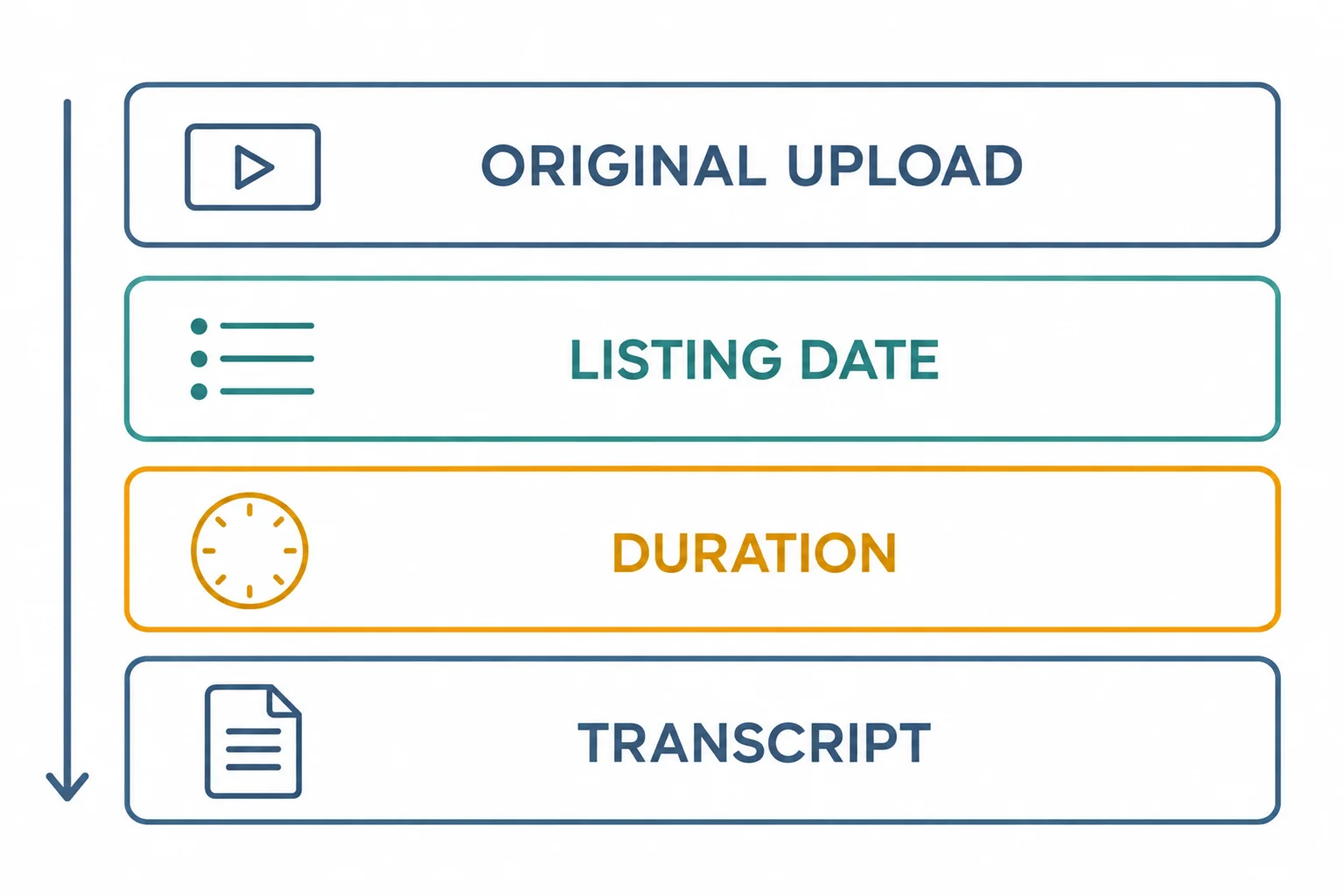
Source: Shotgun Saturday February 01, 2025 — The Inner Circle Trader, a public upload listed at 47:24 (2,844 seconds), first-party to the channel, playability status OK. The platform’s own record dates the upload 2 February 2025 at 02:51:20 (UTC−08:00) and the video was published as public, not unlisted or private.
On the date: that is not a contradiction with the title. At 0:34 he says he is recording late by his local clock, and at 3:40 he describes it as Saturday night on the west coast of the United States. A Saturday-night session that finishes uploading at 02:51 the next morning Pacific time is a day-boundary case, which is why the published timestamp reads one day later than the title.
Transcript: the spoken content was transcribed by automatic speech recognition of the full original audio (whisper-large-v3-turbo). The transcript carries no low-confidence segments flagged, but machine transcription can misstate specialized vocabulary and numbers, so ambiguous readings were checked against surrounding context and anything the audio does not settle was omitted rather than guessed. What this transcript cannot establish: chart coordinates, the accuracy of the stated levels, order fills, account details, real profit or why price moved. What is not claimed here: any verified performance, any endorsement by the channel, and any statement that the described method is tested or reproducible.
Source recording: “Shotgun Saturday February 01, 2025” — The Inner Circle Trader
This recording cannot be played inside another website. When the player was loaded from this site’s origin in a test browser and clicked, the player itself displayed “Video unavailable — Playback on other websites has been disabled by the video owner” with a “Watch on YouTube” link, and the playback position never advanced past zero seconds. That is the owner’s own embed restriction, so the recording is linked here instead of embedded.
Draft-level facts read from the video’s own watch page: channel “The Inner Circle Trader” (youtube.com/@InnerCircleTrader), title “Shotgun Saturday February 01, 2025”, upload timestamp 2 February 2025 02:51:20 (UTC−08:00), runtime 47:24, public and playable.

Sources for this session
Original or official pages behind the factual statements above.
- [1] Shotgun Saturday February 01, 2025 — The Inner Circle Trader (YouTube) — the primary source: a public first-party upload listed at 47:24, dated 2 February 2025 02:51:20 (UTC−08:00) on the platform, with embedding disabled by the owner. Every timestamped statement above comes from this recording.
- [2] The Inner Circle Trader — official YouTube channel — the canonical channel named on that recording (channel ID UCtjxa77NqamhVC8atV85Rog) and the first-party record of what was published and when.
- [3] YouTube Help: Embed videos & playlists — official platform documentation on the embedded player, including the notes that some videos cannot be watched on most third-party websites and that embedding is a per-video option. This is why the session is linked through a visible watch card here rather than framed as an inline player.
- [4] IANA Time Zone Database — the reference database of local-time and UTC-offset rules. It is the basis for treating a 02:51 Pacific upload as the same late-Saturday session the title names, rather than as a conflicting date.
Indicators and third-party material: any third-party indicator, archive, podcast directory or note set referenced alongside ICT material is unofficial and untested here. Nothing on this page states that a third-party tool does not repaint, that any method is endorsed, or that a third-party archive is authorised, unless a page above establishes it.