
Key takeaways
The Inner Circle Trader’s eight minutes forty-two seconds May 29, 2025 review uses TradingView’s continuous Nasdaq futures symbol NQ1!
Read the full summary
The Inner Circle Trader’s eight minutes forty-two seconds May 29, 2025 review uses TradingView’s continuous Nasdaq futures symbol NQ1! for cleaner higher-time-frame history than expiring dated contracts, starting with a weekly wick whose lower half is divided into quadrants around consequent encroachment at an automatically transcribed 22,103. On the daily chart, price partially entered a tracked fair value gap, rebalanced and rallied into its lower quadrant, satisfying ICT’s stated weekly objective. The 15-minute sequence targeted relative equal highs, anchored an imbalance from candle body to wick, treated a move through sell-side imbalance as a bullish character change and described a long reaching an automatically transcribed 21,562.25 before falling to an inversion fair value gap’s low and consequent encroachment. ICT distinguishes candle-body respect from deeper wick penetration, maintains a conditional bullish bias rather than calling a top, attributes parts of the sequence to FOMC and Nvidia-related moves, ends real-time Telegram updates that month, pauses price-action discussions and previews a June comparison of electronic and handwritten journaling. The transcript cannot verify chart annotations, fills, prior X guidance or results, and both quoted levels should be checked against the original YouTube audio.
How we researched this article
BestProps used document-based research from primary firm sources, checked September 24, 2026. The complete source list, scope, limitations, and commercial-state record appear near the end of this article.
The episode mapped to this article is 2025 Lecture Series – NQ Review May 29, 2025 on the channel The Inner Circle Trader. It runs about eight minutes and forty-two seconds. The watch page reports 522 seconds and the audio used for transcription measured 521.7 seconds. For readers searching ICT 2025 lecture series NQ review May 29 2025, this article works from the recording’s spoken content and timestamps rather than a keyword brief or a third-party outline.
Three limits apply throughout. The transcript was produced by automatic speech recognition of the full original audio rather than by checked captions, so specialised terms and numbers may be misrendered; uncertain items are flagged in place. The transcript records speech only, so candle positions, drawn quadrants and chart markings cannot be independently confirmed from it. And every judgement about liquidity, bias or what moved price is ICT’s own interpretation as he spoke it.
ICT 2025 Weekly NQ Review
He opens at 0:01 by framing the clip as a quick wrap-up: through the week he had been posting pre-market analysis, levels and targets on X, and at 0:19 he says the target he had given for that week's Nasdaq futures trading delivered. Two administrative points follow. From 0:42 he says his Telegram channel will be used for study notes rather than real-time updates, which he says end that month, and from 1:02 he previews a June project comparing electronic journaling with handwritten journaling (what he calls a high-tech versus high-touch approach). He is explicit that this is an answer to a question from long-standing mentorship students about how he personally journals, not a method he is telling viewers to adopt.
Why ICT 2025 Uses Continuous Contracts
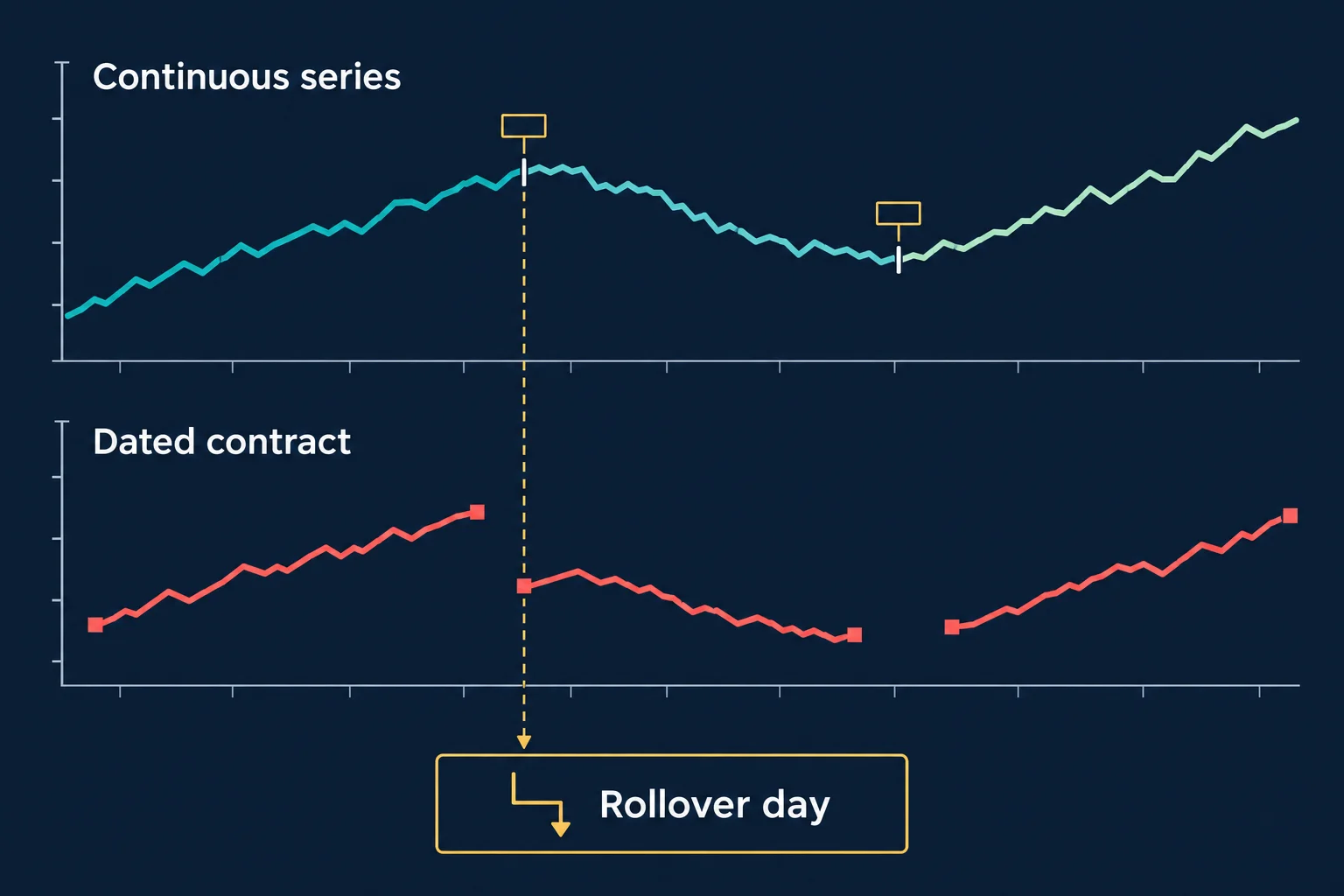
The most transferable technical passage comes early. From 1:45 he shows a weekly chart of the continuous Nasdaq contract and names the symbol he uses, which the automated transcript renders as NQ1! That is, the continuous series rather than a single delivery month. His stated reason is practical: an individual front-month or nearby contract stops at its own expiry, so a higher-time-frame chart built from dated contracts shows gaps and gives an incomplete view of continuous price delivery, even after switching to monthly or weekly bars. A continuous series stitches the successive contracts together, which is why he prefers it for this kind of study.
ICT 2025 Weekly Wick and Quadrant Levels
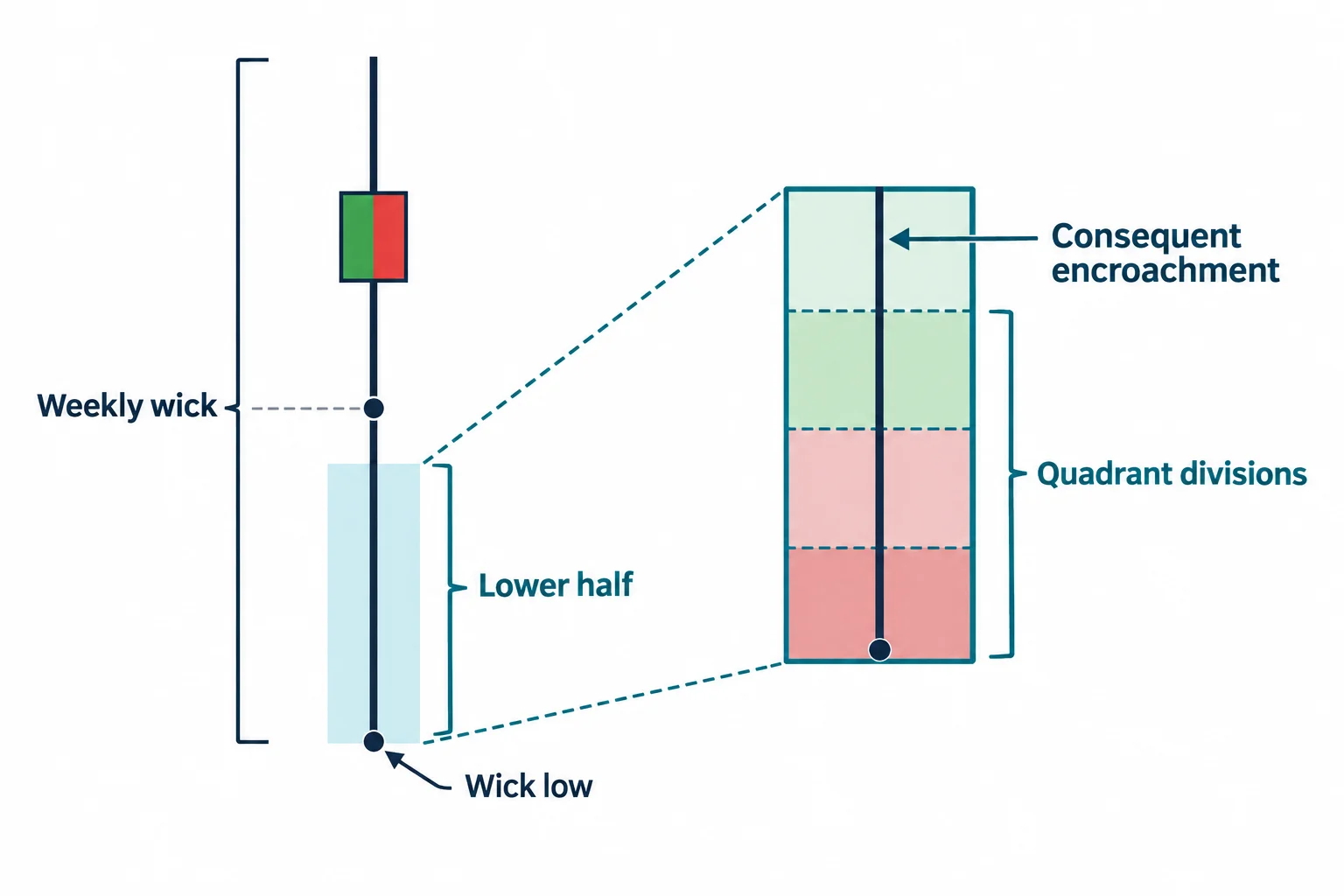
His weekly reference is a single candle wick. Around 2:17 he reminds viewers that roughly a month earlier he had said price would gravitate up into that wick from below, and that he was interested only in its lower half. At 2:41 he gives the midpoint (the level he calls consequent encroachment) and the automated transcript renders it as 22,103. He then subdivides that lower half into quadrants so that behaviour inside it can be read against defined references.
What he does with that area is deliberately conditional. From 3:13 he says the highs above are likely to be taken out because he is not trying to pick a top, and at 3:19 he adds a seasonal observation: the market had been shunning its traditional bearish seasonal tendency, and in his experience that behaviour tends to be bullish. He immediately qualifies it, saying at 3:39 that while he submits to order flow being bullish he is not hardlining the outcome, and at 3:48 that he wants to see how price actually delivers inside the lower half before committing to the higher objective. That is the shape of the whole review: a directional lean held as a hypothesis rather than a call.
ICT 2025 Daily Fair Value Gap Objective
From 4:01 he moves to the daily chart and the fair value gap he says he had mentioned that week and a couple of weeks earlier, defined by one candle's high and another candle's low. He marks gradient levels inside it (upper quadrant, consequent encroachment in green, lower quadrant, and the low) and describes the area as an imbalance.
One terminology warning applies here. The automated transcript renders his shorthand variously as SIVI and Sibby, which in context corresponds to a sell-side imbalance and buy-side inefficiency. That gloss is inferred from usage across the recording, not from checked captions, so it should be verified against the audio before being quoted.
He then traces how price behaved around that gap. From 4:43 he recalls saying he wanted the low to continue, and that if price dropped below it he would read the move as a partial entry into the imbalance rather than a failure. Price did deliver that, and he notes at 5:14 that it was probably random, then trades higher, comes back down to an immediate rebalance at a candle’s high, and pushes up into the lower quadrant of the daily fair value gap. At 5:25 he says that lower-quadrant visit satisfied his weekly objective.
Nothing in the recording verifies that a weekly objective was set before the fact. He refers repeatedly to guidance he had posted on X, and those posts are not part of this transcript, so the sequence is presented here as his retrospective account of his own week rather than as an independently checked prediction.
ICT 2025 15-Minute NQ Sequence
The lower-time-frame review begins at 5:58. On the 15-minute chart he points to relative equal highs as the upside objective, says that above them he would expect a run into the daily fair value gap, and at 6:25 describes the lower quadrant of that daily gap as having been slammed by candle bodies. He also makes a scheduling announcement at 6:30: what the market does on the following day and Friday does not concern him, and this will be the last discussion he has over price action for now, which he attributes to personal commitments.
From 6:49 he walks through a 15-minute imbalance and explains how he anchors it from a candle body to a wick, then marks its consequent encroachment. His next point is a character change: because the area was a sell-side imbalance, he treats it as having flipped to something bullish once price traded through it, leaving what he calls a buy-side balance and sell-side inefficiency condition sitting just below a 15-minute inversion fair value gap. He notes that these references always include the volume imbalance, and says the finer detail belongs in a book he is writing rather than this video.
He then summarises the delivery. After consolidation and a rally, he says the sequence he had broken down from two wicks on X was perfectly delivered as a long entry, with price trading up into a level the transcript renders as 21,562.25, which he also describes as a relative equal high. From there the market broke lower, down to the low of the 15-minute inversion fair value gap and more specifically to the consequent encroachment of a particular candle. His distinction between bodies and wicks matters to the reading: at 8:01 he says the bodies were respecting the lower quadrant, while the wick was permitted to reach further and tell its own part of the narrative.
Finally, at 8:22, he attaches causes to two movements: a drop he labels FOMC-related and a sharp advance he labels Nvidia-related, after which price traded into the lower quadrant of the daily area. The transcript names no release, headline or date for either, so these labels are his interpretation and are recorded here as such.
Caution on the numbers: 22,103 and 21,562.25 are single renderings from automatic speech recognition of a spoken review, attached to one contract in one week in May 2025. Verify them against the audio before reuse. No other chart coordinate from the session is reproduced on this page.
ICT 2025 NQ Review Process
Set aside the directional lean and the review still demonstrates a repeatable order of work, which is the part a reader can test without a platform subscription:
- Start higher: begin with a continuous weekly series rather than a dated contract, so the historical record is not broken at rollovers.
- Pick one reference: here, a single candle wick, with its midpoint treated as the decision line rather than the whole zone.
- Subdivide rather than blur: grade the half of interest into quadrants so that responses have defined locations.
- Overlap timeframes: check whether a daily imbalance sits inside the weekly structure, and whether lower-time-frame behaviour respects the internal levels.
- Distinguish bodies from wicks: read respect from candle bodies and treat wick penetration as noise that still carries information.
- Keep the thesis conditional: hold the higher objective as likely rather than certain, and say so out loud.
ICT 2025 Lecture Series NQ Review Video
The recording mapped to this article is 2025 Lecture Series – NQ Review May 29, 2025, published on the channel The Inner Circle Trader on 29 May 2025 with a runtime of about 522 seconds (8:42). Timestamp links on this page point into that recording.
Watch the original review on YouTube
The recording cannot be played inside another website. Its embedded player was loaded from a BestProps page origin and clicked on 14 September 2026; the player itself reported “Playback on other websites has been disabled by the video owner,” reported a duration of NaN and a ready state of 0, and offered no play button, so no embed is reserved or left blank here. The recording remains available directly on YouTube.
Watch 2025 Lecture Series – NQ Review May 29, 2025 on YouTube ↗
ICT 2025 Lecture Sources and Checks
Four references support this page: the recording and the transcript made from it, the first-party announcement post the page links, and two official exchange pages used only for the contract mechanics and the instrument reference. Nothing on this page was tested, traded or replayed on a chart, and no source listed here endorses this article.
ICT Recording and Transcript
This article was written from the audio of 2025 Lecture Series – NQ Review May 29, 2025.[1] The watch page reports a runtime of 522 seconds and the audio used for transcription measured 521.661 seconds, so the transcript covers the full recording rather than a fragment.[1] The speech was transcribed locally by automatic speech recognition, which is why the imbalance shorthand, the symbol rendering and the two numeric levels are flagged as uncertain, and why no chart coordinate from the session is reproduced here.[1] Timestamps in the body are the transcriber’s own, accurate to the alignment of automatic timestamps rather than human-reviewed caption timings.[1] The transcript does not establish a separate recording time, and it does not include the X posts he refers to when he says earlier guidance had been fulfilled.[1]
ICT Announcement Post
The page links the post published through the X account @I_Am_The_ICT.[2] The URL resolved on 14 September 2026, but X refused the automated request used to read it, so its body was not re-read for this revision and nothing on this page depends on its wording beyond the fact that the episode was announced there.[2]
ICT Instrument Details From the Exchange
The recording names the ticker style NQ1!, the continuous Nasdaq series. The exchange operator’s own product page describes E-mini Nasdaq-100 futures as a product providing exposure to the Nasdaq-100 Index, a modified capitalisation-weighted index of 100 large-cap companies. That is all it is used for here: identifying the underlying instrument family. The recording itself does not discuss contract specifications, and nothing on this page asserts a tick size or a contract month from it.[3]
ICT Rollover Details From the Exchange
The article’s explanation of why a continuous series differs from a dated contract reflects the exchange operator’s own account of expiry. Its lesson states that futures contracts have a limited lifespan that influences the outcome of trades and the exit strategy, that the two most important expiration terms are expiration and rollover, that a contract’s expiration date is the last day it can be traded and typically falls on the third Friday of the expiration month though it varies by contract, and that rollover is the act of moving a position from the front month to a later contract, with traders timing that move by watching the volume of both contracts.[4] Scope note: that is the exchange’s general description of the mechanics, not a statement about any particular Nasdaq contract or month.[4]
Untested ICT Material
Terms used on this page (consequent encroachment, fair value gap, upper and lower quadrant, imbalance, sell-side imbalance and buy-side inefficiency, inversion fair value gap, volume imbalance, relative equal highs, change of character and immediate rebalance) are ICT's own descriptive vocabulary.[1] Any ICT, smart-money or third-party indicator, script, tutorial or strategy referred to anywhere on this page is unofficial unless a first-party ICT publication states otherwise; none is presented as official, tested or free of repainting, and no indicator, script, strategy or account was tested, replayed or measured for this article.[1] The seasonal-tendency remark and the FOMC and Nvidia attributions are his interpretations from the recording and are not presented as verified causes.[1] No brokerage, funding or prop-firm rule is quoted, because the recording makes no claim about any firm's requirements.[1]
ICT Sources
- [1] YouTube: 2025 Lecture Series – NQ Review May 29, 2025 – The Inner Circle Trader (primary recording; page metadata read 14 September 2026: runtime 522 seconds; audio measured at 521.661 seconds and transcribed locally by automatic speech recognition; embedded player reported as disabled by the video owner)
- [2] X: The Inner Circle Trader (@I_Am_The_ICT) announcement post already linked in the article body (first-party account; URL resolved 14 September 2026 but the post body was not re-read because X refused the automated request; cited only as the announcement)
- [3] CME Group: E-mini Nasdaq-100 Futures Contract Specs (official exchange product page; content read 14 September 2026; cited only to identify the underlying instrument family)
- [4] CME Group Institute: Understanding Futures Expiration & Contract Roll (official exchange education lesson; content read 14 September 2026; cited only for the expiry and rollover mechanics it states)
BestProps is not affiliated with The Inner Circle Trader or CME Group, and no source listed here endorses this article, this site or any setup. No forward-looking statement, historical price level, forecast or backtest result is presented on this page, and nothing here reports a measured result or promises an outcome. Where the recording reports that guidance or a trade delivered, it is recorded as the speaker’s own account and not as verified performance.