
Key takeaways
The Inner Circle Trader at youtube.com/@InnerCircleTrader is the official YouTube channel behind this 9 minutes 4 seconds lecture, published 10 February 2025, reviewing a difficult high-resistance liquidity run in which a tight, repeatedly reversing range stopped ICT out more than once.
Read the full summary
The Inner Circle Trader at youtube.com/@InnerCircleTrader is the official YouTube channel behind this 9 minutes 4 seconds lecture, published 10 February 2025, reviewing a difficult high-resistance liquidity run in which a tight, repeatedly reversing range stopped ICT out more than once. His bearish premise combined an inversion fair value gap, bearish breaker, and failed bullish order block, with lunch macro objectives at 21,835 and 21,825, although the traded instrument is not identified conclusively and the levels, fills, and results cannot be independently verified. ICT took partial exits, repeatedly lowered stops to cover costs, used the inversion fair value gap midpoint as invalidation, retried the short near the gap low with risk at its top, and ultimately reported the remaining position stopped out. The key lesson was that prolonged trading inside a gap expected to act as resistance, without bearish displacement, weakened the thesis, so he moved the distant target aside, reduced exposure again, and tightened the stop to a short-term high rather than fixating on the objective. The recording is retrospective voiceover based on earlier Telegram commentary, not a live lesson or tested system, and relies on automatic transcription without verified chart geometry, executions, commissions, account figures, or net performance.
How we researched this article
BestProps used document-based research from primary firm sources, checked September 24, 2026. The complete source list, scope, limitations, and commercial-state record appear near the end of this article.
Primary source: 2025 Lecture Series – Trading In High Resistance Liquidity Run Conditions With My Lunch Macro, The Inner Circle Trader, uploaded 10 February 2025, runtime 9:04.
This article is a transcript-grounded review of one speaker’s retrospective commentary. It is not official ICT material and not a tested trading system. The recording’s own wording was captured by automatic speech recognition of the audio, so terminology and numbers are described below with the ambiguity that remains.
ICT 2025 Lecture Recording Explained
ICT opens by explaining the format. This is not a live lesson: it is a voiceover added after the fact, because the observations had already been delivered in real time through the Telegram channel. The audio confirms it: “So this is after the fact I’m giving you commentary,” he says, “but the commentary was given to you live during the Telegram real-time commentary” (0:10, 0:13). He says he normally posts audio clips, but that day a contractor was at his house for a failed gas valve on the heating system and his puppy was unwell, so the commentary was re-recorded over the session (0:21).
That matters for how the material should be read. The video is one trader narrating his own decisions while the session unfolds on his screen. He says the same chart area he is reviewing was shown “over there,” meaning the Telegram feed, and that the chart detail belongs to that original presentation (8:55). Everything below therefore reports what ICT says, not what any independent record confirms.
High Resistance Liquidity Run Conditions
ICT uses his own title phrase as a description of difficulty rather than of a setup. At 1:08 he names the conditions a "high resistance liquidity run," and at 1:11 adds that it was "very, very, very challenging, even for me," acknowledging that the admission may sound arrogant but calling it how the session behaved. His complaint is specific: the market stayed in a very tight range and kept coming back to stop him out (1:21).
He also lists external context he saw as unhelpful (Federal Reserve chair testimony during the week and high-impact news releases) and says these made the session harder to read (2:56). Those are his attributions. The transcript contains no evidence about what actually moved the market.
ICT 2025 Bearish Trade Premise
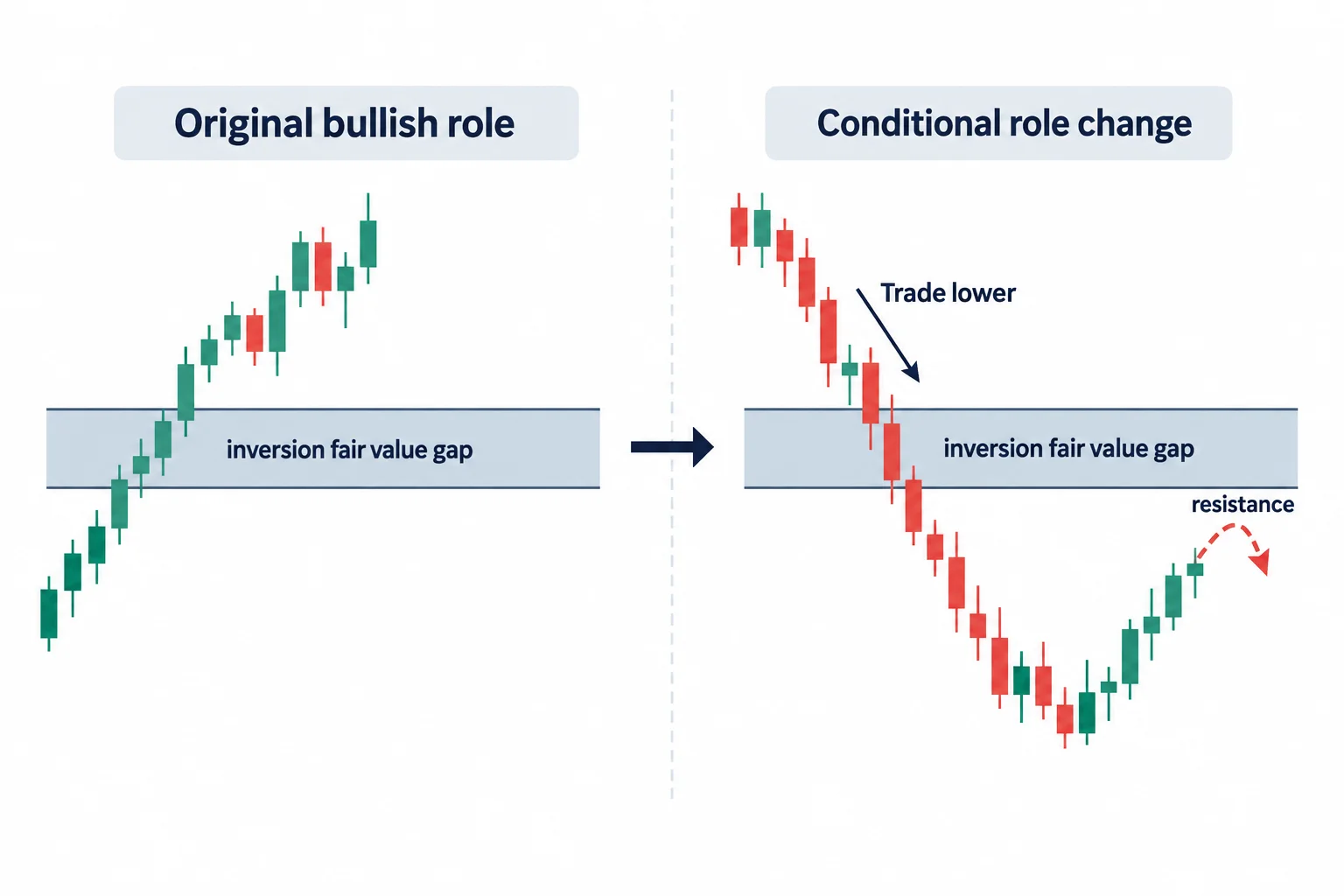
ICT describes a short framework assembled from several of his own concepts (0:37):
- An inversion fair value gap that he wanted price to trade through and then respect as resistance. The transcript’s first mention renders the phrase loosely; later passages state “inversion fair value gap” clearly, which is the reading used here.
- A bearish breaker from which he says price reacted (0:41).
- An earlier order block he says was originally used to send price higher, which he now wanted to fail as an inverted structure.
He states the general principle plainly at 0:56: whatever the structure had been when it was bullish, he wanted to see it trade lower once he treated it as bearish. Where he reaches for his shorthand label for that behaviour (0:53), the transcript renders the acronym unclearly, so this article describes the behaviour he wanted rather than restating a term that cannot be confirmed from the audio.
These are ICT’s labels for his own chart annotations. The transcript is spoken audio and contains no verified chart geometry, so the exact boundaries of the gap, breaker or order block cannot be reconstructed from it and are not asserted here.
ICT Lunch Macro Liquidity Targets
ICT says he told the Telegram channel that the lunch macro would likely push price down to 21,835 and then 21,825 (1:40). He describes a limit order placed below that area as a deliberately optimistic best case, saying it is always enjoyable to get more than originally planned if the market keeps going.
Two qualifications belong with those numbers. First, the recording never names the traded instrument unambiguously; he says he is checking ES at one point (5:24), but the levels are given only as his spoken objective and should not be transferred to a specific market, contract or later session. Second, the levels are his expectation, not a verified fill or a measured outcome.
He also frames the macro window as an input rather than a trigger: he says he is not watching for a specific target but “watching what price is showing me each candlestick” (6:24).
ICT Trade Management With Partials and Stops
The management detail is the most concrete content in the recording. On the first short attempt ICT says he took one contract off and brought the stop down (1:01). He then says he moved his stop to cover costs because of the type of day it was (2:12), and acknowledges in hindsight that he was “really better equipped” had he taken a partial there, given that he had already classified the day as high-resistance (3:39).
He identifies his invalidation at the midpoint of the inversion fair value gap (the phrase he uses is transcribed as "consequent correction," which appears to be a recognition error for the midpoint term in his vocabulary). His point is that a move into that area would end the idea for him (3:28).
That first attempt ended in a reported stop-out, which he calls “the breaks for today” (4:15). He adds that he still made what he calls some “pizza money” (4:23).
ICT Trade Retry and Liquidity Acceptance Warning
After the contractor left, he says he looked at the chart again to see whether he could still “skin this cat” (4:53), and took another short near the low of the inversion fair value gap, placing risk at the top of that gap, and again aiming at 21,835 / 21,825 (4:38, 5:00). He reports a partial at 5:03 and a second partial while checking ES at 5:24, with the stop brought down to cover costs again.
The clearest teaching moment is his treatment of time spent inside the gap. By 6:54 he says he does not like what price is doing and calls it stubborn; at 7:01 he says that spending so much time inside an area he wants to act as resistance is problematic. In his reading, a gap that will not produce bearish displacement is evidence against his own premise.
Rather than defend the original target, he says he moves the target “completely out of the way” precisely so he stops fixating on a nearby number (6:36), and manages instead against the question that actually matters to him: whether price still wants to respect the inversion fair value gap (6:40). He calls the far target overzealous (6:10) and says he is “completely content with getting stopped out” (5:36).
ICT Trade Final Partial and Reported Stop
Having already taken two partials, ICT says he will let the rest run, but then demonstrates one further reduction before the position closes. He describes the trade as already problematic yet commits to it so that viewers can see the management, taking a single contract off rather than two, and then moving the stop aggressively down to a short-term high on the basis that if price reaches that level he no longer wants to be short (7:30, 7:54, 8:08). His stated rationale is that a reversal then gives back less of the accumulated open profit.
He reports the remaining position being stopped at 8:47, saying he will show the executions on screen. The transcript supports the sequence of reductions and a final stop. It does not establish contract sizes across the session, actual fills, commissions, or a net result, and no account figures are reproduced here. He closes by joking that he could feel his hair turning grey (attributing it to the household interruptions rather than the price action) and says he felt outnumbered by the day's obstacles (8:17).
ICT 2025 Lecture Takeaways and Limits
Read as education rather than as a model to copy, the recording makes a few transferable points and leaves several things unproven.
- Difficulty is a description, not a signal. ICT labels the session high-resistance because his directional idea kept meeting opposition. The label did not tell him where price would go next.
- Invalidation was defined in advance. Midway through the gap was his stated line for abandoning the idea, independent of how much open profit existed.
- Partial reductions are a management choice with trade-offs. His own hindsight comment (that he should have reduced sooner after the short-term low) is a criticism of his execution, not evidence that partials improve results.
- Prolonged acceptance was treated as negative information. Price refusing to leave an area he expected to act as resistance became a reason to distrust his own thesis.
- Attention is a real input. ICT is candid that contractor visits and a sick puppy divided his focus. He says the difficulty was in the circumstances, not only the chart.
None of this demonstrates an edge. The recording is one speaker’s account of one session, and the levels, annotations and results in it cannot be independently verified from the audio.
High Resistance Liquidity Run Review Checklist
The card below is an educational template for recording that kind of session, not an ICT rule set. Nothing in it is attributed to the recording, and each row is a placeholder for criteria you define and test yourself.
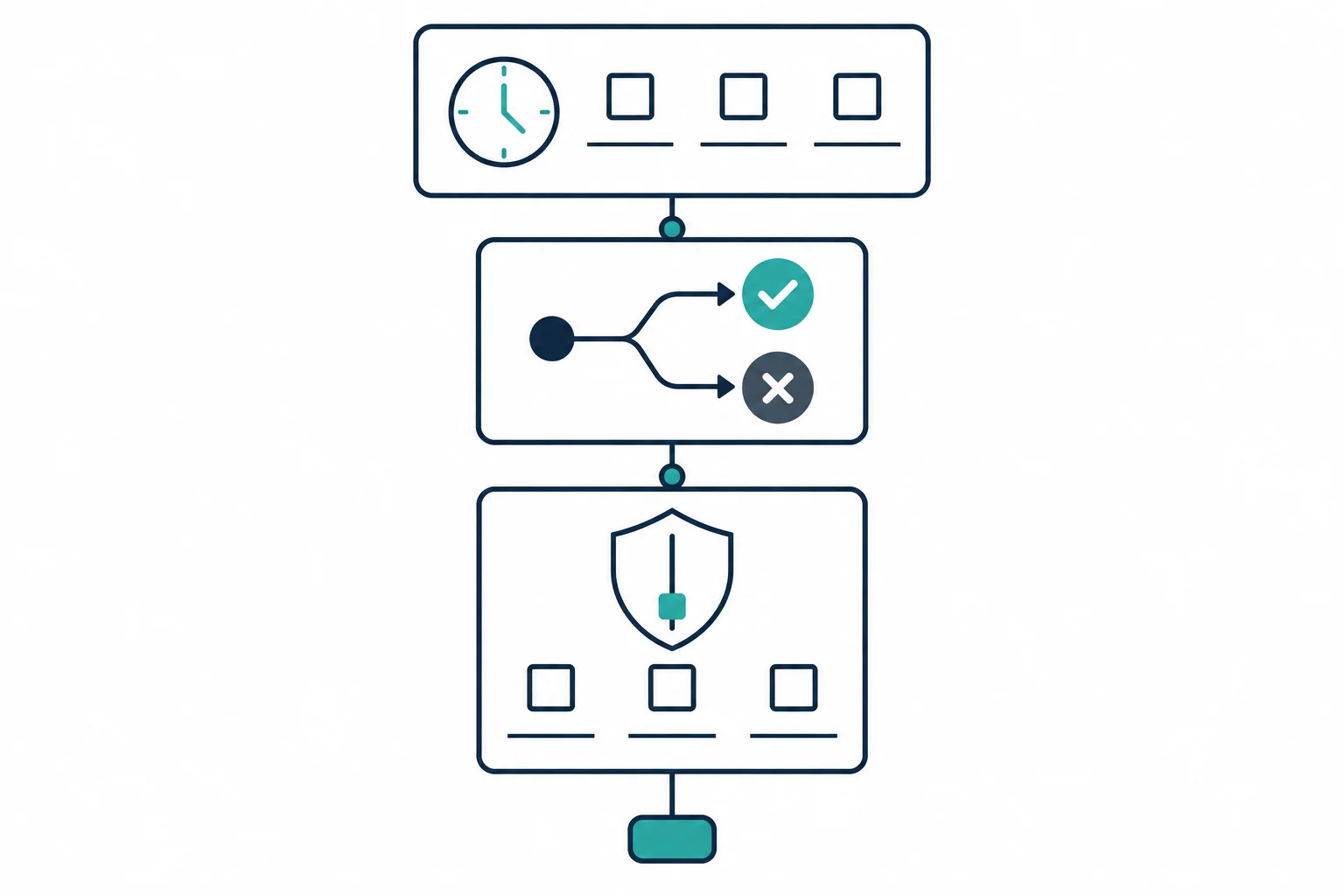
- Record the window you are actually trading. Write the chart’s time zone and the platform clock beside the window you intend to use, so a daylight-saving conversion cannot move the observation silently.
- Write the premise before the session. State what you think price will do and at least one observation that would contradict it.
- Mark the objective and the invalidation together. A level with no pre-agreed invalidation is a narrative, not a plan.
- Describe the path, not just the target. Note the intervening structure between current price and the objective.
- Decide what prolonged acceptance means. If price will not leave an area you expected to matter, record that as evidence against the idea rather than waiting.
- Fix the risk before entry. Size, maximum loss and the conditions for standing aside should be decided while nothing is at stake.
- Review the reductions, not only the outcome. Log each partial and stop change with the reason you gave at the time.
- Check your firm’s current rules directly. Daily loss limits, news restrictions and holding rules vary between firms and change; confirm them in your own dashboard rather than in any article.
Watch the ICT 2025 Lecture Recording
This article is based on an automatic audio transcription of the recording, not on human-verified captions, and no visual chart verification was possible. Timestamp links above point to the spoken passages they summarise.
Source recording: “2025 Lecture Series – Trading In High Resistance Liquidity Run Conditions With My Lunch Macro,” The Inner Circle Trader
This recording cannot be played inside another website. When the saved player was loaded in a test browser and clicked, the player itself displayed “Video unavailable. Playback on other websites has been disabled by the video owner” alongside a “Watch on YouTube” link, and playback time never advanced past zero. The restriction is set by the video owner, so the recording is linked here rather than embedded.
Facts read from the video’s own watch page: channel “The Inner Circle Trader” (youtube.com/@InnerCircleTrader), published 10 February 2025, runtime 9:04, visibility public (not unlisted, not private), playability status OK. The published title itself reads “My Lunch Macro”.
Watch “Trading In High Resistance Liquidity Run Conditions With My Lunch Macro” on YouTube
ICT 2025 Lecture Sources
These are the original or official pages behind the statements below. The two reference pages are cited for the clock and calendar points only.
- [1] 2025 Lecture Series – Trading In High Resistance Liquidity Run Conditions With My Lunch Macro, The Inner Circle Trader (YouTube) The first-party recording this article reviews: published 10 February 2025, runtime 9:04, public and playable, with embedding disabled by the owner. Automatic audio transcription only; chart annotations, fills and results are not verifiable from it.
- [2] The Inner Circle Trader (official YouTube channel) The canonical channel named on that recording (channel ID UCtjxa77NqamhVC8atV85Rog). Terminology, windows and examples should be read from the original uploads here rather than from re-uploaded or reposted copies.
- [3] NYSE: Holidays & Trading Hours The official exchange page for the U.S. equity clock, which states “Core Trading Session: 9:30 a.m. to 4:00 p.m. ET”. Useful for anchoring any New York session window before comparing it with a chart platform's clock.
- [4] IANA: Time Zone Database The authoritative time zone and daylight-saving rule database, described there as covering “the history of local time for many representative locations worldwide” and as being “updated periodically to reflect changes made by political bodies to time zone boundaries, UTC offsets, and daylight-saving rules.” This is why a saved local-time window can shift against a chart's clock.
Unofficial material: third-party ICT/SMC indicators, tutorials, note sets and community recaps on this topic are unofficial here and were not tested by the reviewer. None is presented as official, tested or free of repainting, and nothing on this page states that a time window, liquidity objective or pattern produces a particular outcome. The recording’s reported trades are the speaker’s own account of his own session and are not presented as a reproducible result or as a recommendation to trade the same way.