
Key takeaways
The Inner Circle Trader’s public YouTube upload condenses roughly eighteen hours of screen capture into 8 minutes 57 seconds and presents an NQ turtle soup short under the One Shot One Kill framing, fading a retail bull flag through a bearish order block toward the midpoint of the 13 August 2024 daily fair value gap…
Read the full summary
The Inner Circle Trader’s public YouTube upload condenses roughly eighteen hours of screen capture into 8 minutes 57 seconds and presents an NQ turtle soup short under the One Shot One Kill framing, fading a retail bull flag through a bearish order block toward the midpoint of the 13 August 2024 daily fair value gap and nearby sell-side liquidity. The speaker describes potential additions after midnight and at relative equal highs, conditional on price not exceeding the high formed between two thirty p.m. and three p.m., but says he preferred holding the existing position and later describes execution arrows showing an entry at the day’s high, an addition of four, and an exit. He calls the 5 p.m. to 6 p.m. data gap a normal session break, identifies Thursday’s first fair value gap between nine thirty a.m. and ten a.m., notes a touch of the first fair value gap from 4 September 2024, and refers to a limit order to cover at $100,000 and a hundred thousand dollar daily level. The recording does not disclose account size, initial contract count, contract month, entry or exit prices, fees, net profit, position-sizing rules, or maximum loss, so the $100,000 figure is not a verified result. CME specifications cited by the article value E-mini Nasdaq-100 futures at $20 per index point with a 0.25-point minimum tick, while Micro E-mini contracts use a $2 multiplier and the same tick size. The article is transcript-based educational commentary, did not inspect the charts or execution arrows, and does not independently authenticate the claimed fills, live data, longer recording, or performance.
How we researched this article
BestProps used document-based research from primary firm sources, checked September 24, 2026. The complete source list, scope, limitations, and commercial-state record appear near the end of this article.
ICT NQ Live Execution September 6, 2024 100k [OSOK] is a public first-party upload on the YouTube channel The Inner Circle Trader. The watch page reports a publish and upload time of 2024-09-06T04:08:10-07:00 and a runtime of 537 seconds, or 8 minutes 57 seconds, which matches the length of the audio that was transcribed. The title’s date is the upload’s, not a date spoken in the recording: the narration refers to a Thursday session and to what he calls the Asian session of Friday, and this article keeps those day names as the speaker’s own references rather than converting them into timestamps. This is transcript-based educational commentary on the recording, not an ICT publication and not a record of verified results.
How the ICT Live Session Recording Was Assembled
He opens by naming the setup: a turtle soup short, and his “one shot, one kill” framing (0:00). He says he is selling short, fading what he calls a retail bull flag, working a bearish order block, and annotating the sell-side liquidity (0:04).
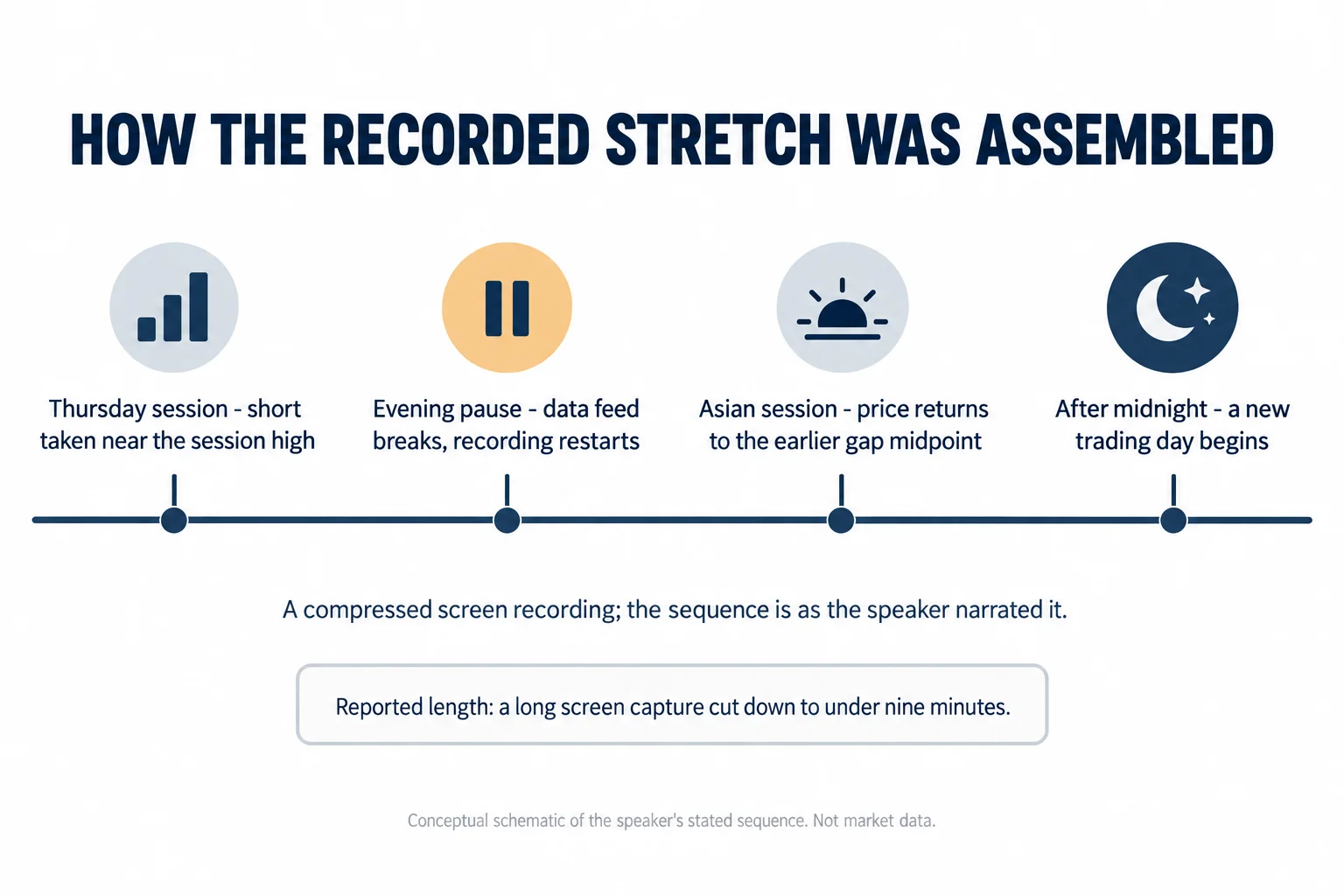
On provenance, he says the material is roughly eighteen hours of total screen capture, taken over Thursday and running into a session the transcription renders ambiguously (the phrase is not clear enough to identify the session, so this article does not name one), and that it has been condensed to less than nine minutes (0:21). He tells viewers they will want to watch it slowly because of the number of references he is making (0:14).
ICT Live Execution Opening Short and High Sweep
His first stated instruction to himself is patience: he says he is willing to let price go up and sweep the highs above him (0:31). He points out that the day’s close could have been taken when price reached the midpoint of the 13 August 2024 daily fair value gap, and adds that if he had wanted the full daily range it would have been there (0:41). Then he draws attention to where his entries sat relative to the high of the day (1:02).
The framing question that follows is rhetorical: if a smart-money entity existed, how would it trade, and what would it look like, his answer being that it would look like what is on screen (1:12). He then describes the sequence as a market-maker sell model that delivered down to the 13 August 2024 daily fair value gap, and he states explicitly that the level in question is the midpoint of that daily gap (1:37).
That description is his own reading of the chart, and the automated transcription is a further step removed from it: it renders the midpoint concept as “consequent encouragement”, the gap itself as “free betting out” or “variable gap” in different places, and one Wednesday reference as “fairway”. The surrounding discussion consistently supports consequent encroachment of a fair value gap, and the article uses those words while flagging that the captions are automated and the exact on-chart labels were not read by this review.
ICT Live Execution Additions and Preferred Trade
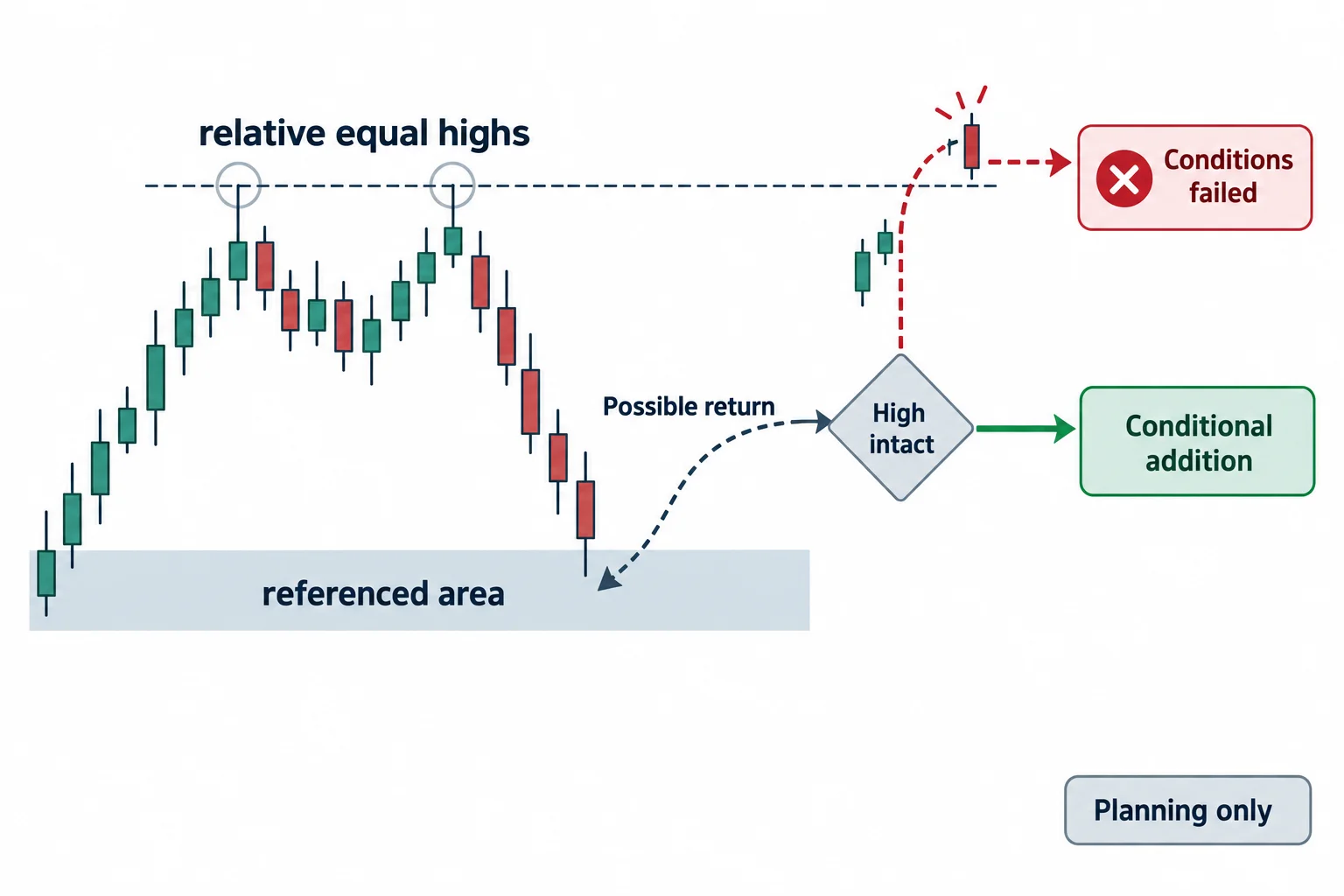
A large part of the narration is explicitly about willingness rather than action. He says he would be interested in adding to the position, but only after midnight on the following day (1:24). He then walks through areas on the one-minute chart where he says he could have added as relative equal highs formed, and calls that walk-through a demonstration of his willingness rather than a log of trades (2:15).
He identifies one specific same-day addition (in the last portion of the daily range, in the final hour) and says he was not interested in taking it and wanted to hold what he had (2:35). He adds that he was not watching the chart the whole time, because he knew what he was looking for (3:02).
The condition he attaches to adding is stated concretely: price returning to the referenced area is a place where more could be added, so long as it does not take out the high formed between 2:30 p.m. and 3:00 p.m. (3:15). He calls another such move “another turtle soup” and then corrects himself to “the real turtle soup” (3:25).
He ties stop placement to the same analysis, saying that understanding what the range will do, where it will go and how it forms is what puts a stop in the right place (3:36). He also refers to blue lines that he says mark Thursday’s first fair value gap between 9:30 and 10:00 a.m. (3:49). None of these levels comes with a price in the narration, so the article does not supply one.
ICT Live Session Break and Data Debate
He describes a one-hour delay of data from 5 p.m. to 6 p.m., calls it a normal break in price action, and says he resumed recording when it ended (4:01). Because session timetables are set by the venue rather than by any participant, that break is best checked against the exchange’s own published Globex schedule rather than taken from a narration.[2]
He then points to the upper-left corner of his screen as evidence that the market was open and counting down, and argues that this was live data rather than a replay, adding that faking it would have required a great deal of image editing (4:13). He says he also holds the entire original recording, so anyone who claims it did not happen can be answered with the full footage, while acknowledging that hardly anyone would sit through it and that viewers will most likely scrub through the condensed version (4:27). That is his stated position about his own material. The transcript cannot authenticate a screen corner, a running clock or the existence of the longer file, and this review did not attempt to.
ICT OSOK Session Returns to the August Gap
He says the following session trades once more down into the same midpoint level, with sell-side liquidity sitting just below it (4:57). It is here that he refers to a limit order to cover at $100,000, describing it as one single trade (5:14).
What that figure means is not spelled out in the recording. A Nasdaq-100 futures position is worth $20 per index point per E-mini contract, with a minimum tick of 0.25 index points, so a $100,000 move implies a large number of contracts or a large index move, but the narration never states the contract size held, the account’s value, or the instrument and contract month, and none of that can be recovered from the audio.[1] The most that can be said is that he refers to $100,000 in connection with covering the position, and that a $100,000 reference also appears in the upload’s title.
He goes on to note relative equal highs being swept just before 9 o’clock, other highs to the left being tagged, and price touching the first fair value gap of 4 September 2024 (5:20). He makes an aside about finding that in a “Wyckoff box” (5:34); the transcription is too loose to identify what tool or template he means, so this article does not name one.
ICT Live Session Bull Flags and Trading Needs
Once past midnight and into a new trading day, he calls an orange level another pyramiding opportunity and says that if he wanted to add more he could do it there (6:24). As before, that is framed as a possibility rather than a reported fill. His reading of the small upward consolidations is dismissive: he says retail traders see them as bull flags, that he regards the whole move from 9 o’clock as one very large bull flag, and that every one of those little flags is a fake retail trap (6:37).
He expects the algorithm to work down into the 9 o’clock low and then attack the low of the 13 August 2024 daily fair value gap (6:52). On tools, he says a trader who understands what he calls real order flow (and not depth-of-market or Level II data, which the transcript renders loosely) only needs the hard timeframe and the levels he teaches (7:17). That is a statement of his methodology. It is not testable from a narrated screen recording, and nothing here should be read as evidence that one approach to reading order flow outperforms another.
ICT OSOK Execution Fills and One Trade Claim
He restates the thesis as a single trade taken at the highs and held while it attacked a “hundred thousand dollar daily level” (7:29). Immediately after, he makes an aside that the transcription renders too loosely to attribute safely: it appears to contrast his single-trade account with a third party’s claim of having made $100,000 in four days, and to ask what took that person so long (7:36). Because the wording is ambiguous, the article records only that he compares his own single-trade framing with someone else’s four-day claim, and asserts nothing about who that party is or whether the claim is true.
He then says he had been asleep while part of the move developed and that his screensaver had come on (7:45). Returning to the execution view, he says he will zoom in on the fills and describes what he says the arrows show: an entry at the day’s high, an addition of four, and then the exit (8:06). He presents this as what he calls a smart-money trader (the elusive entity people say does not exist) and closes there (8:16).
What ICT Live Execution Does Not Prove
The narration is a walk-through of one sequence, not a performance record. Nothing in it states the account’s size, the initial contract count, entry or exit prices, the contract month, commission and fee costs, or a net profit and loss figure, and the fills are described from arrows on the speaker’s own screen rather than from statements. The $100,000 reference is tied to covering a position and to a level, which means it cannot be read as a verified result, and the upload’s title repeats a figure the recording does not substantiate. Nor does the clip define a complete rule set: no position-sizing method, no maximum loss in currency terms, no instrument selection logic and no objective test criteria are provided. Frequent intraday trading with leverage is a materially risky activity, and the U.S. Securities and Exchange Commission’s investor education site describes day trading as “extremely risky” and states that it “can result in substantial financial losses in a very short period of time”.[3] None of that is a claim about this recording’s outcome; it is the general context in which any narrated execution belongs.
ICT NQ Live Execution September 6 2024 100K OSOK Video
The recording mapped to this article is ICT NQ Live Execution September 6, 2024 100k [OSOK], a public upload on the channel The Inner Circle Trader, published 2024-09-06T04:08:10-07:00, 537 seconds long. Every timestamp link above points into that recording. The transcript used for this guide was produced by local automatic speech recognition of the complete original audio rather than from YouTube captions, and it renders several of the speaker’s own terms inconsistently, most visibly the gap and midpoint vocabulary quoted above, the session name near the opening, and the tool reference in the order-flow remark. No chart, execution arrow or on-screen statement in the recording was examined by this review.
Watch the original recording on YouTube
The owner has disabled playback of this video inside other websites, so it is shown as a watch card instead of an embedded player. The full 9-minute recording plays directly on YouTube.
Watch ICT NQ Live Execution September 6, 2024 100k [OSOK] on YouTube ↗
ICT Live Execution Sources and Provenance
These references support specific points in the guide above. None of them is an ICT publication, none endorses or tests the approach, and none is offered as evidence for the sequence narrated in the recording.
NQ Execution Sizing Uses Exchange Specifications
Because the recording refers to dollar figures without stating how many contracts were held, the contract’s own specification is the only reliable basis for reading them. CME Group states that the E-mini Nasdaq-100 futures contract “is $20 x the Nasdaq-100 index and has a minimum tick of 0.25 index points”.[1] That is the page to use for the multiplier and tick minimum, and CME also publishes a smaller Micro E-mini version with a $2 multiplier and the same 0.25 tick. Contract specs, margin requirements and trading hours are set by the exchange and can change, so they should be verified for the specific contract and month, not assumed.
Live Session Breaks Come From the Venue
The speaker describes a one-hour break between 5 p.m. and 6 p.m. and calls it normal. CME Group publishes its Globex trading hours and holiday schedules and notes that holiday schedules are subject to input from the New York Stock Exchange and SIFMA.[2] That is the authoritative place to check a session timetable; the description in the recording is the speaker’s account of what appeared on his screen.
How Live Leveraged Trading Is Regulated
A narrated execution is not a performance record. Investor.gov, the U.S. Securities and Exchange Commission’s investor education site, describes day trading as “extremely risky” and states that it “can result in substantial financial losses in a very short period of time”.[3] It is quoted here for general risk framing only; this article is not advertising and makes no performance claim about the sequence shown.
Why the ICT Live Session Uses a Watch Card
YouTube’s own documentation sets out the uploader control behind the message this video returns: the “Allow embedding” box can be unchecked so that a video is not playable on external sites.[4] When the embedded player was loaded from a bestprops.com page origin and clicked on 14 September 2026, it reported “Playback on other websites has been disabled by the video owner” with no duration and no progress, which is why a visible watch card is used and no iframe is present.
ICT Live Execution Method and Limits
This article is grounded in the full timestamped transcript of the mapped upload. The transcript was produced by local automatic speech recognition of the complete original audio and is not human-reviewed captions; the recording’s charts, execution arrows and on-screen clocks were not examined by this review. Automatic transcription renders several of the speaker’s terms inconsistently, and each ambiguous passage above is described in the words the surrounding discussion supports rather than silently rewritten. No account size, contract count, fill price, position size or net result is asserted anywhere on this page, and the additions discussed in the narration are reported as opportunities the speaker says he was willing to take, not as executed orders.
ICT Live Execution Sources
- [1] CME Group: E-mini Nasdaq-100 Futures Contract Specs ($20 x index, 0.25 index point minimum tick)
- [2] CME Group: Holiday and Trading Hours (CME Globex trading hours and holiday schedules)
- [3] Investor.gov (U.S. Securities and Exchange Commission): Day Trading
- [4] YouTube Help: Embed videos & playlists (turn off embedding for your videos)
- Primary source: ICT NQ Live Execution September 6, 2024 100k [OSOK] (The Inner Circle Trader)