
Key takeaways
ICT Silver Bullet is a time-based trading model taught by The Inner Circle Trader using E-mini S&P 500 and forex examples, with entries restricted to three daily 60-minute windows in New York local time, the London open from 3 a.m.
Read the full summary
ICT Silver Bullet is a time-based trading model taught by The Inner Circle Trader using E-mini S&P 500 and forex examples, with entries restricted to three daily 60-minute windows in New York local time, the London open from 3 a.m. to 4 a.m., the New York morning from 10 a.m. to 11 a.m., and the New York afternoon from 2 p.m. to 3 p.m. Traders first identify the next draw on liquidity, such as a previous day, session, or week high or low, a new week opening gap, optimal trade entry, inefficiency, or fair value gap, then require at least 10 index handles or 40 ticks, or 15 forex pips, before waiting for a market-structure shift and fair value gap aligned with that target. The first fair value gap that forms and reprices inside the applicable window supplies the proposed entry, while the position may remain open after the window ends. Narrated examples include a London bearish setup offering 10 handles with five captured, a bearish New York morning ES move from roughly 4146 to 4136, and a bullish afternoon setup using a 15-minute discount fair value gap that reportedly offered 12 or more handles. ICT says the pattern forms daily somewhere in the market, calls it highly consistent and high probability when conditions align, recommends back-testing and specialising in one market, and acknowledges losses, but the nineteen minutes 16 seconds recording provides no order tickets, account statements, sample size, commissions, spread, slippage, mechanical definitions, or independently verified performance.
How we researched this article
BestProps used document-based research from primary firm sources, checked September 24, 2026. The complete source list, scope, limitations, and commercial-state record appear near the end of this article.
This is a summary of ICT’s stated framework and vocabulary, not independent evidence that the model has a trading edge. He narrates his own annotated charts; the recording contains no order tickets, no account statement, no sample size and no costed result, and the charts themselves are not reproduced here. The captions are automated, so the terms below are quoted as the captions render them rather than corrected silently.
ICT Silver Bullet Minimum Price Framework
He opens by separating the range he expects the market to deliver from the portion a trader might actually capture. At 0:40 he gives the minimum framework as 10 index points, which he equates with 10 handles or 40 ticks, and at 0:51 as 15 pips on the forex pair being traded. At 0:56 he calls this the best-case price delivery he expects to see and is explicit that it is not the trader’s actual entry-to-exit range.
His practical point is that a model should be forgiving of imperfect execution. In the London example he expects the setup to offer ten handles but describes covering for five (12:02), and in the afternoon example he says the move offers twelve or more (15:38). He also offers rough cross-market comparisons (ten handles in indices standing in for twenty pips in forex (2:27) and five handles for ten pips (2:30)). Those are his working equivalences, not an exchange-rate or contract-value calculation, and they do not survive translation into position size on their own.
ICT Silver Bullet Liquidity Targets
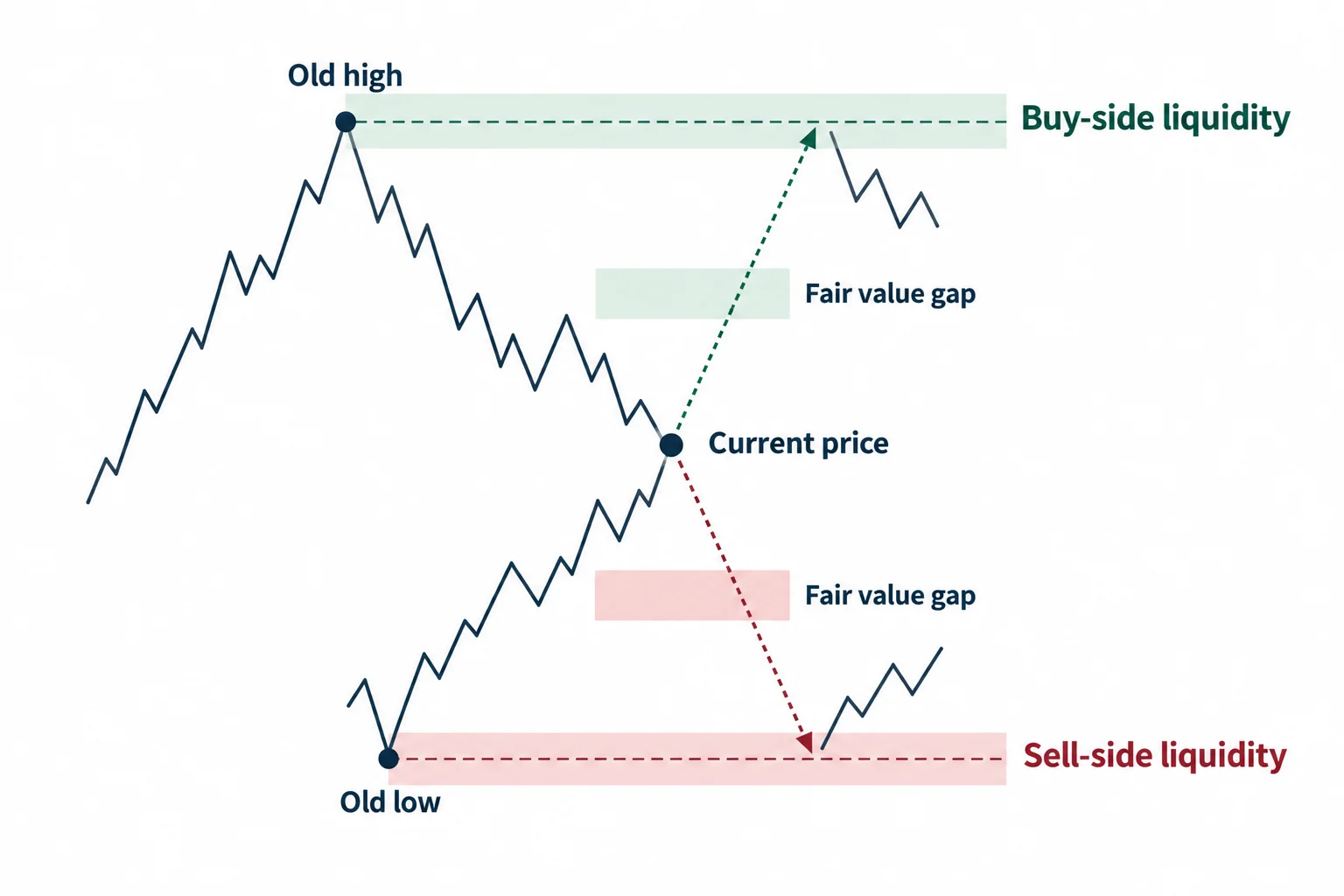
Before looking for an entry, he says the primary task is deciding where price is most likely to move next. From 3:47 he lists the objectives he treats as draws on liquidity, and stresses that the list is not exhaustive:
- the previous day’s high or low (4:02);
- a prior session high or low, such as the London extreme just before the New York morning (4:39);
- the previous week’s high or low (5:01);
- a current or older new week opening gap (5:13);
- a classic optimal trade entry (5:31); and
- an inefficiency or fair value gap above or below current price, which he links to his 2022 YouTube mentorship (5:51).
In his vocabulary highs represent buy-side liquidity and lows represent sell-side liquidity. A bullish scenario targets a high or an inefficiency above price; a bearish scenario targets a low or an inefficiency below it.
He treats the objectives as interchangeable in probability when they are actually present in the market, at 6:38, while warning at 6:44 that not all of them will be a factor and that most days only one criterion is in play. He makes the ranking explicit at 7:42: determining the next likely draw comes first, and the entries and exits are the least important part, because a concept applied without knowing where price is trying to go will probably fail you.
ICT Silver Bullet Trading Time Windows
From 8:13 he introduces the model as time-based, with each setup tied to a specific 60-minute interval that recurs every trading day. He accepts that a given pattern may not appear in the instrument you follow, but asserts that one of them forms daily across the market as a whole.
All times refer to New York local time. At 8:57 and 9:06 he tells viewers to calibrate charts to New York local time, observing daylight-saving changes as New York does, rather than converting with a fixed offset. This matters for anyone outside the US, because a fixed offset silently shifts the window twice a year.
London Silver Bullet Window From 3 a.m. to 4 a.m.
The first window is 3:00 a.m. to 4:00 a.m., which he calls the London open Silver Bullet (8:50, 9:24). He looks for a fair value gap formed between those hours in the direction of the expected liquidity draw. In the example he narrates, the market is bearish (10:07) with a sell-side pool resting beneath an older swing low; a low breaks in what he calls a shift in market structure (10:21), and the fair value gap forms inside the window from there.
He reads the candle bodies staying inside the gap as the market supporting the idea, notes a further push just above it at 4:00 a.m. that he says would not have stopped him out under the rules he teaches, and describes the size test as whether the move offers ten handles (11:18).
A point he returns to throughout: the window times the entry, not the holding period. At 11:36 he says the trade is frequently carried past the hour, into the 5:00 a.m. period and sometimes toward the 7:00 to 8:00 a.m. New York opening, and in this example he describes covering at the old low for at least five handles (12:02). At 12:24 he calls this particular configuration his actual model for his son.
New York Silver Bullet Window From 10 a.m. to 11 a.m.
The second window is 10:00 a.m. to 11:00 a.m. New York local time (12:35). His E-mini S&P example is bearish again, with relative equal lows providing the sell-side objective (13:04), and price trading up into a bearish fair value gap inside the hour. He quotes the range as roughly 4146 down to 4136 and observes that even that does not reach the low beneath, so the framework requirement is met even though the full objective is not (13:15).
Those two levels are the speaker’s reading of his own chart. The captions carry them as spoken figures, not as verified market data, and the chart is never shown in a form that can be checked. The substantive point is the one he repeats: the test is whether the projected move offers the framework, not whether the trader captures all of it, and the hour governs when the setup and entry are sought rather than capping how long the position is held.
New York Silver Bullet Window From 2 p.m. to 3 p.m.
The third window is 2:00 p.m. to 3:00 p.m. New York local time, the PM session Silver Bullet (14:11). This example is bullish. He describes price trading down into a higher-time-frame 15-minute discount fair value gap (14:29), a swing breaking to the upside as a shift in market structure, and then a smaller fair value gap forming as the clock reaches 2:00. Again he reads the bodies inside the gap rather than the wicks as the market respecting the area.
The stated entry is the first fair value gap that forms and reprices between 2:00 and 3:00 (15:26), with relative equal highs and an overhead premium inefficiency as the objectives. He judges the move as offering twelve handles or more and calls the entry a high-probability condition (15:38).
How ICT Silver Bullet Time Windows Work
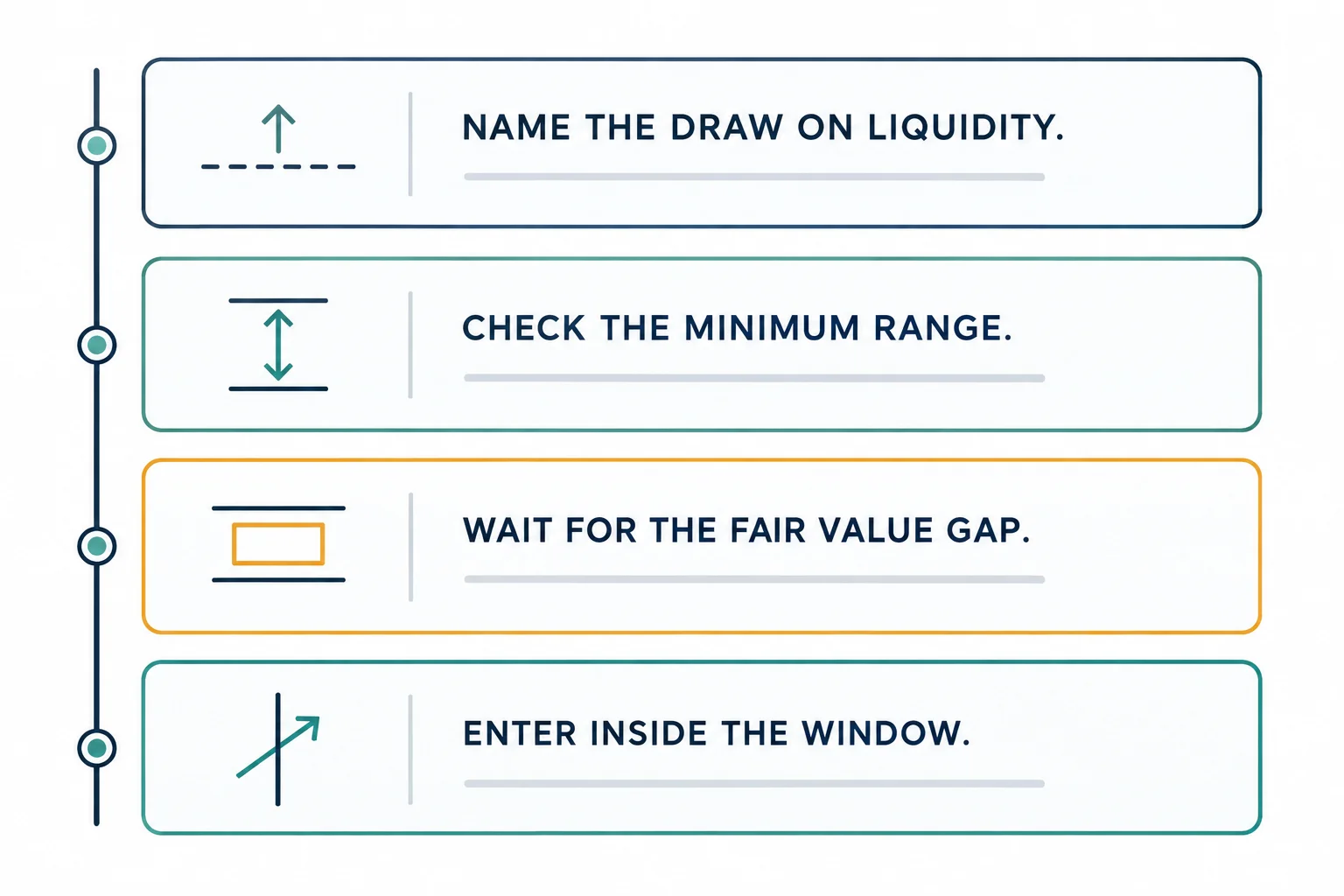
The recurring theme is that the Silver Bullet is not simply a rule to trade at three particular hours. As he sets it out across the lesson, the framework asks for several linked judgments:
- identify a plausible next draw on liquidity or inefficiency;
- check that the available range meets the minimum framework in that instrument;
- wait for supporting price action, including a market-structure shift and a fair value gap;
- take the setup during one of the three New York windows; and
- manage the position on its own terms rather than by the hour it started in.
Two structural limits are worth separating from the teaching. First, the window restricts the entry, not the exit, so it cannot be tested as a one-hour rule. Second, the requirement is that the range offers the minimum, which makes the criterion partly a judgment about the future rather than a fixed measurement.
ICT Silver Bullet Model Claims
At 16:01 he tells newer viewers that watching the presentation is not enough to trade the pattern, and that they should back-test it while learning to read price action and identify the next draw. He asks followers not to treat his social-media comments as trade signals, saying he dislikes it when they do (16:50).
In the same passage he says he called a few of these setups in real time on Twitter the previous week and that followers reported taking them, and concludes that the pattern works, is highly consistent and is extremely high probability when the factors line up (16:40, 17:01). Those are the speaker’s claims about his own calls and his followers’ reports. Nothing in the recording documents the calls, the followers’ fills, the sample or the results, so the consistency and probability language should be read as a claim made in a lesson, not as a finding.
He closes on repetition and focus: the attraction of the model for him is a specific 60-minute window that forms every trading day (17:26), his advice is to specialise in one market rather than follow many (17:59), and if the London window produces nothing the wait moves to the morning and then the afternoon (18:26). He acknowledges losing trades will happen. He also says that once the student can do this they should not need to return to his channel, a framing about independent study rather than about verified performance.
Practical ICT Silver Bullet Trading Lessons
The useful structure here separates context, timing and execution. The directional objective supplies context, the fixed New York windows restrict when to pay attention, and the fair value gap supplies the proposed execution area. That separation is what makes the model describable at all, and it is also why the lesson resists a quick test: the video states rules but never defines them mechanically enough to code without interpretation.
Anyone who wants to go further should keep two things apart. The first is what the recording actually contains: a narrated framework with three named windows, a stated minimum range and several chart examples read aloud. The second is what it does not contain: no measured frequency of the setups, no objective definition of a market-structure shift, no treatment of spread, slippage, commissions or contract specifications, and no result that survives the speaker reporting his own trades. The framework can be studied and journaled; that is different from being demonstrated.
Watch the ICT Silver Bullet Mentorship Recording
The embed above is the upload’s own YouTube player and it is left in place because it plays. This same iframe markup was loaded from a BestProps origin on 15 September 2026 and driven through the YouTube IFrame Player API: the player reported the video as playable, returned the recording’s 1155.3-second duration, and entered the playing state with playback advancing, with no error and no owner restriction. The upload’s watch page agrees that the video is playable in an embed. All timestamp links in this article point into the same recording, which is nineteen minutes and sixteen seconds long.
ICT Silver Bullet Model Sources and Further Reading
- [1] 2023 ICT Mentorship – ICT Silver Bullet Time Based Trading Model The primary source, and the only recording used for this article. Uploaded 14 May 2023 by The Inner Circle Trader; watch page read 15 September 2026.
- [2] CME Group (E-mini S&P 500 Futures Contract Specs). The exchange specification for the ES contract used in the lesson’s examples. It defines the contract, its tick and its multipliers, which is what turns the handles and points he speaks about into money; the recording never does that conversion.
- [3] CFTC (Fraud Advisory: Commodity Trading Systems Sold on the Internet). US regulator guidance on how hypothetical or simulated results get presented as performance, and on the costs and execution assumptions that trading-system claims tend to leave out. A general reference on evaluating claims like the consistency language in this lesson; it does not assess ICT, this recording or any figure discussed here.
- [4] CFTC Learn & Protect (Forex Frauds). States that two out of three retail foreign exchange traders lose money each quarter and describes common patterns in forex promotions. Relevant because part of this lesson is framed for forex pairs; it is not a comment on this recordist or his results.
BestProps is not affiliated with the CME Group, the CFTC or the Inner Circle Trader, and no source listed here endorses this article or any setup. Silver Bullet, draw on liquidity, fair value gap, market-structure shift, optimal trade entry and new week opening gap are used as descriptive terms for what the recording teaches. The chart examples, the levels spoken in them and the claims about called trades and results are the speaker’s own narration and are not verified here. This is independent educational commentary: it is not official ICT material, not a tested trading system and not investment advice. Index futures and leveraged forex trading involve substantial risk and are not suitable for everyone.