
Key takeaways
In ICT Mentorship 2023 – Market Review & August Trading Concerns, published the evening of 11 August 2023 and running about 27 minutes 51 seconds, ICT reviews the US Dollar Index, Euro Dollar, and the September 2023 E-mini S&P 500 and Nasdaq futures across weekly, daily, four-hour and hourly charts.
Read the full summary
In ICT Mentorship 2023 – Market Review & August Trading Concerns, published the evening of 11 August 2023 and running about 27 minutes 51 seconds, ICT reviews the US Dollar Index, Euro Dollar, and the September 2023 E-mini S&P 500 and Nasdaq futures across weekly, daily, four-hour and hourly charts. He says he was bullish on the dollar, which he ties to expected equity weakness and further Euro Dollar downside, and he reads Nasdaq as the weaker of the two indices after it led the decline and failed to confirm the S&P’s higher high, which he labels SMT divergence. The bulk of the recording is not a forecast, though: he describes an unusually choppy week of alternating highs and lows in which the previous day’s high was taken each day, and he argues that a reasonable directional thesis can still be poor to execute. He closes by telling students not to press for size, use their largest leverage, or start an account challenge in August, and to journal, revisit notes and prepare instead. The captions are auto-generated and garble several of his terms, and his August warning is a seasonal impression from his own experience, not a statistical study; no fill, statement or result is verified here.
How we researched this article
BestProps used document-based research from primary firm sources, checked September 24, 2026. The complete source list, scope, limitations, and commercial-state record appear near the end of this article.
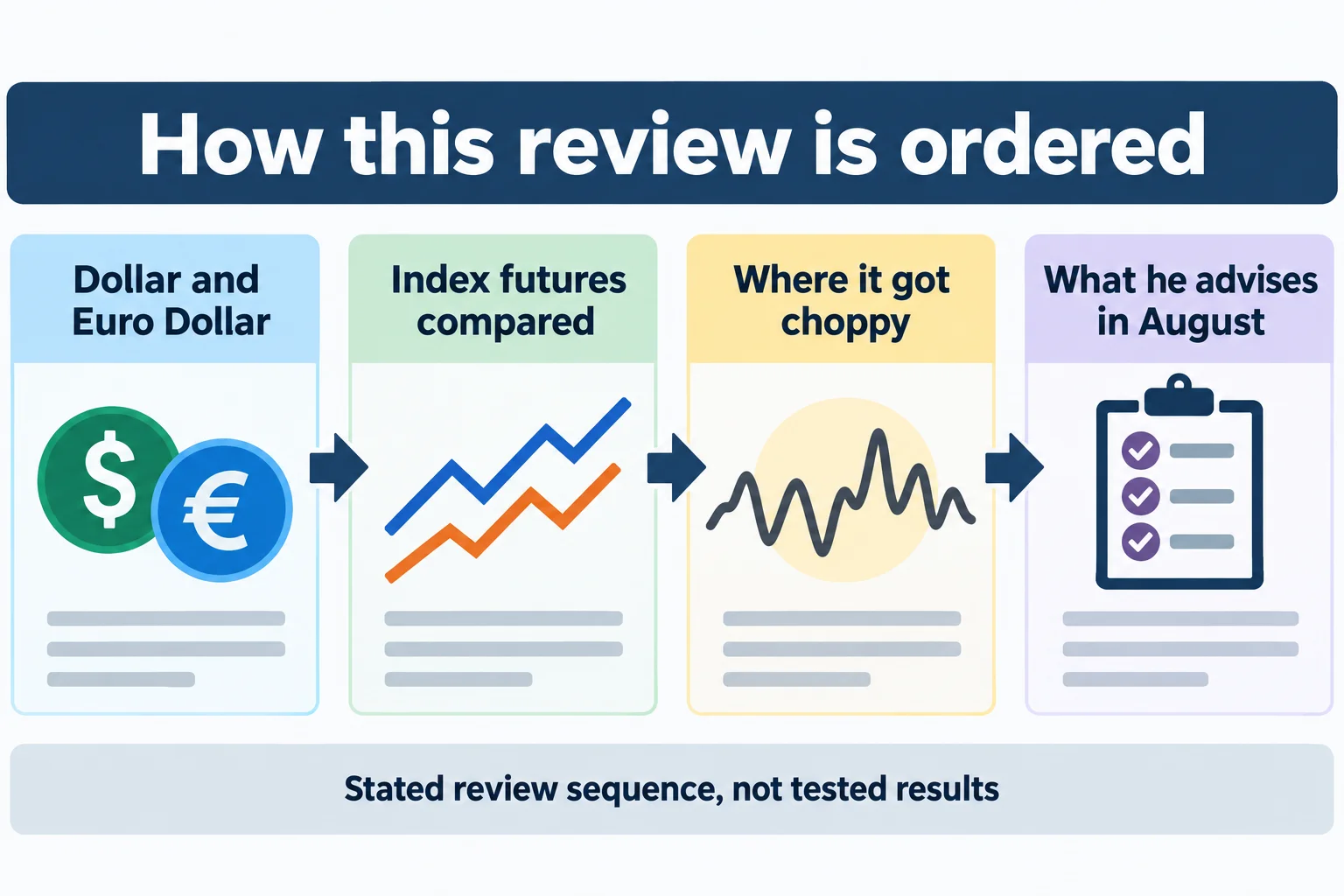
This lesson reviews the dollar index, Euro Dollar and index futures through ICT’s concepts of liquidity, fair value gaps, order blocks, consequent encroachment and intermarket divergence. The session date and the inventory date are one calendar day apart: the public watch page shows the recording published 11 August 2023 at 19:18 Pacific time, which is 12 August in UTC, and the video inventory lists the UTC day.
The emphasis is less on the directional call than on how difficult the week was to trade. ICT repeatedly returns to the idea that price can reach an anticipated area while still offering a stressful, back-and-forth route to get there, and he says that is what happened here.
The dollar and Euro Dollar
He begins at 0:29 on the weekly dollar index, noting that price had moved below relative equal lows a couple of weeks earlier and was then drawn higher. At 0:44 he describes the discount wick consequent encroachment — the midpoint of each wick — as the area he was interested in, and at 0:57 he says his real interest sits in the buy-side liquidity above relative equal highs.
On the daily chart from 1:08 he traces a decline that took out sell-side liquidity, a rally into a buy-side inefficiency, a rise that reused an older fair value gap, and an accumulation that traded up into sell-side then buy-side inefficiency. He adds the condition at 2:20 that this reading changes if the lows are lost and price works down into the older sell-side level. From those pieces he states at 1:52 that he is bullish on the dollar, and he pairs that with expected equity-index weakness and continued Euro Dollar declines. That pairing is his interpretation of an intermarket relationship, not a rule that holds every session.
The four-hour and hourly dollar charts add the detail. At 2:06 he works through an older daily fair value gap, a two-down-close-candle block he calls a bull shoulder block, and order-block plus gap combinations that fell just short of the very high of the imbalance. On the hourly chart at 2:52 he counts five lower lows digging into consequent encroachment, which he defines here as the midpoint between one hourly candle’s low and another’s high, and notes price traded into it twice before rallying.
The Euro Dollar review starts at 3:34. He says a weekly volume imbalance had acted as a draw on liquidity and price duly gravitated into it, before turning lower into an older weekly inversion fair value gap. Rather than treating that area as support, he asks at 4:08 whether price moves below it, treats it as resistance, digs into the sell side beneath and then reprices to a discount weekly fair value gap. On lower time frames, from 5:55, he describes small partial returns into gaps followed by aggressive movement away, which he labels with a phrase the captions render inconsistently as “institutional overflow entry drill” and “institutional workflow entry drill.” He glosses the idea as trading into a fair value gap but not even to its midpoint, then getting an aggressive move out of it; the standard ICT term for this is the institutional order flow entry drill, and the caption wording should not be quoted as-is.
Near 7:42 he says he is watching a low and the lows beneath it against the lower boundary of the weekly inversion gap, and at 7:58 he names roughly 108.35 as the area of his attention. He is explicit that the whole Euro Dollar scenario depends on continued bullish dollar order flow: if the dollar does not deliver, he says the outline becomes hard to realise.
S&P 500 and Nasdaq compared
At 8:07 he moves to the weekly charts of the September 2023 E-mini S&P 500 and Nasdaq futures. On the S&P he describes a rally into an inefficiency that has been monitored across earlier reviews, and says a break below the gap would matter because a normally bullish discount fair value gap stops behaving that way once a higher-time-frame weekly inefficiency breaks down.
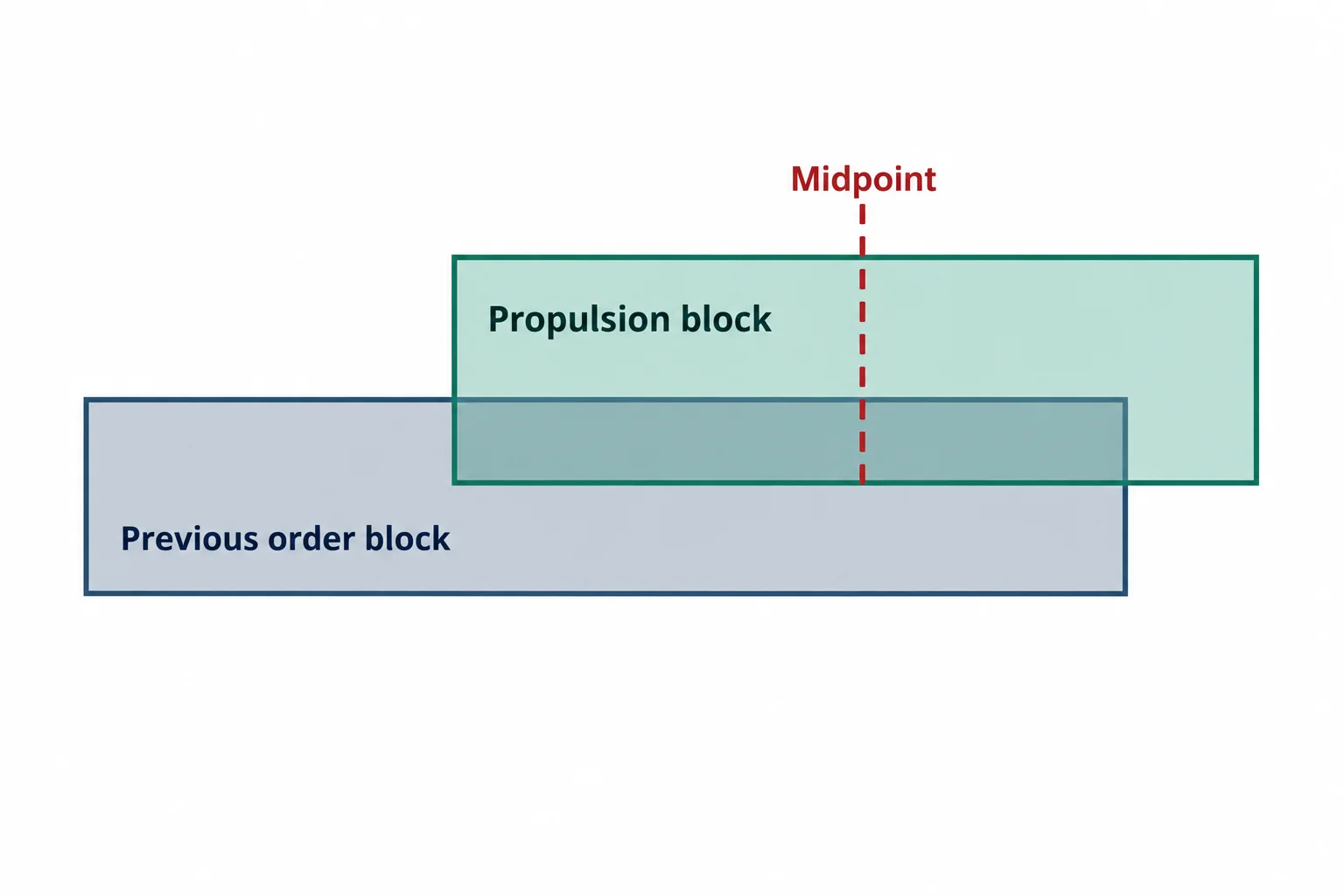
He then introduces a concept he calls a propulsion block: an order block that digs into a previous order block, where half of the propulsion block has to be defined. At 17:06 he says a close below that half would be extremely bearish and would make him abandon the bullish reading and anticipate lower prices instead; he adds that he expects the sell side to be dug into anyway. He also notes the S&P never reached the mean threshold of that propulsion block, and at 19:38 he points out that a volume imbalance can behave much like a breakaway gap.
The comparative reading is the substantive part. At 12:12 he says Nasdaq had been the stronger upside performer in prior months but was now showing signs of leading to the downside, and at 12:58 he notes the S&P’s reluctance to fall as low and as fast as Nasdaq. From that he concludes at 13:09 that a bear would be better suited to trade Nasdaq, and he says most of the live executions he shows have been on Nasdaq.
On the daily charts from 13:52 he names this SMT divergence, comparing the highs of the two indices and observing that Nasdaq was unwilling to make the higher high the S&P had made. In general terms this is a relative-strength comparison between correlated markets: non-confirmation is treated as context for framing a directional idea, not as a guaranteed reversal signal, and the recording offers no frequency or success-rate evidence for it.
Where the week became difficult
This is where the recording stops being a forecast. On the four-hour S&P chart at 17:30 ICT says he has not seen the pattern in front of him more than five or six times in 30 years, and at 17:44 he describes a low-high-low-high-higher-high sequence that was choppy even though price was reaching the levels he had been looking for. At 17:59 he says it required nimbleness.
He also uses the section to argue against hindsight. At 20:41 he acknowledges that the sequence can be labelled a descending trading range after the fact, and asks whether the viewer actually traded it, making the point that he is describing what he expected before the structure existed. At 21:36 he highlights that every day the previous day’s high was taken out, which he says prevented anyone from holding a short from a single good entry for the rest of the week. On the hourly Nasdaq chart at 22:28 he describes buy-side liquidity being blown out on the Thursday, relative equal lows forming, a return to the consequent encroachment of a wick, a sell-off, and a further drop into a four-hour fair value gap.
He notes at 23:30 that he had wanted price to dig a little further into the fair value gap and that those were the breaks. The 15-minute S&P and Nasdaq charts at 23:41 he calls sloppy consolidation days. Captions and narration cannot verify chart annotations, entries, fills or outcomes, so all of this is the speaker’s retrospective chart explanation.
What he advises about August
The practical warning opens at 8:54, where he calls August a month to take a vacation from trading, says he has done real damage to himself by pushing in it, and describes the month as fickle — some sessions easy to read, others starting clean and then going “wonky.” He calls it a meat grinder at 9:47, notes that other traders outside his own community have complained about being chopped up, and at 18:02 says there have been plenty of argumentative bearish callers on social media this week.
From 24:00 he closes on the same theme with more force. He says the remaining weeks of August will probably bring some of the most unfavourable price action, that he will sometimes call caution and be wrong, and that August is not normal — the cleaner months are September through November and possibly the first weeks of December outside the holidays. He tells viewers not to waste their gunpowder on the next couple of weeks, to sit still and let the market do what it wants. At 25:43 he addresses anyone in drawdown or who has blown an account challenge: do not rush to start again, wait until September. At 26:55 he recommends using the month for prep work, goals for the autumn, journaling and reviewing notes, and he attributes the emphasis to having made these mistakes himself.
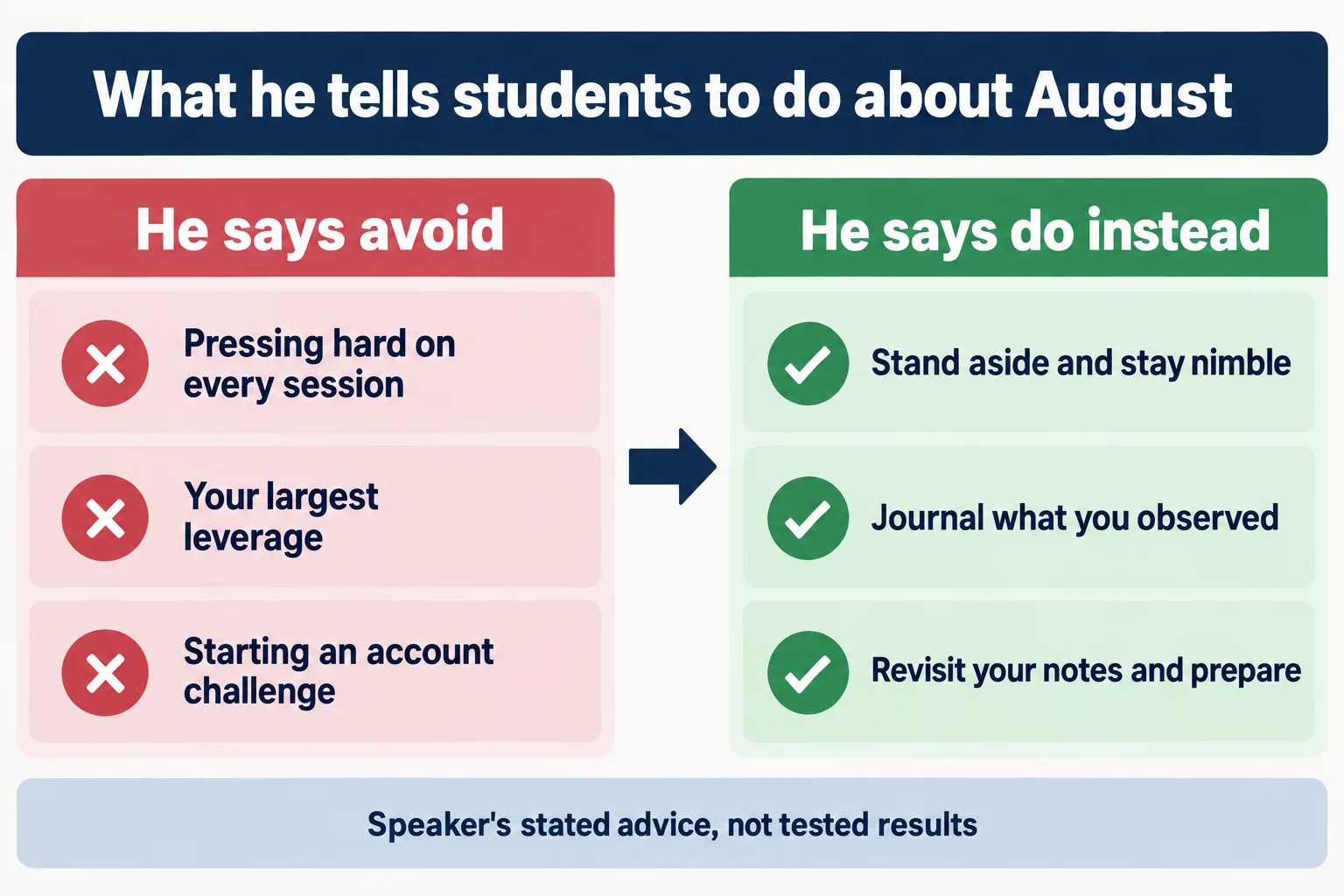
Two things are worth separating here. The August warning is a seasonal impression drawn from his own trading experience, and the recording offers no statistical study of August returns to support it — and he concedes that some Augusts deliver cleanly. His claim at 25:03 that he usually turns out to be right when he issues this warning is likewise his own account, not something this article can check.
Practical takeaways
- Separate direction from execution quality: a market can reach an anticipated objective without offering a straightforward trade.
- Keep scenarios conditional: his Euro Dollar view depends on continued dollar strength rather than standing on its own.
- Compare correlated markets for context, but treat non-confirmation as context rather than as a signal with a demonstrated edge.
- Review risk before seeking another setup: he recommends journaling and revisiting notes over immediately restarting a challenge.
- Treat seasonal claims cautiously; his August comments are his interpretation and experience, not a statistical seasonal study.
Watch the original recording
Watch the original recording on YouTube
The video cannot be played inside another website. When its embedded player was loaded and clicked from a BestProps page on 15 September 2026, the player itself reported “Video unavailable — Playback on other websites has been disabled by the video owner.” and stayed on a “Watch on YouTube” prompt with no playback progress at all; the public watch page plays normally. That is why no embed is left here.
Watch ICT Mentorship 2023 – Market Review & August Trading Concerns on YouTube ↗
The recording runs about 27 minutes 51 seconds and is the only primary source used for this article. The captions used here were generated automatically by YouTube, so the wording of ICT’s terms is not authoritative. The channel is The Inner Circle Trader on YouTube.
Resources
These are the sources checked for this article. The CFTC and Investor.gov pages are general regulator and investor-education material — on leveraged foreign-exchange fraud, on trading systems sold online, and on what leverage is. They are not assessments of ICT or of anything said in the recording, and none of them verifies the levels, instruments or seasonal claims he discusses. Third-party copies, notes and indicator bundles derived from his material circulate outside his own distribution and were not tested here.
- [1] ICT Mentorship 2023 – Market Review & August Trading Concerns — The Inner Circle Trader (primary source; watch page read 15 September 2026, 27M51S)
- [2] CFTC Learn & Protect — Forex Frauds (read 15 September 2026)
- [3] CFTC — Fraud Advisory: Commodity Trading Systems Sold on the Internet (read 15 September 2026)
- [4] Investor.gov — Glossary: Leverage (read 15 September 2026)
This is independent educational commentary on one market review. It is not official ICT material, it is not a tested trading system, and it is not investment advice. Index futures and leveraged foreign-exchange trading involve substantial risk and are not suitable for everyone.