
Key takeaways
In 5 Handle Twitter Example Live Execution… January 30, 2023, the speaker narrates a live pre-open session around a bullish breaker inside a five-minute fair value gap (0:06).
Read the full summary
In 5 Handle Twitter Example Live Execution… January 30, 2023, the speaker narrates a live pre-open session around a bullish breaker inside a five-minute fair value gap (0:06). He says his protective stop sits below the area the captions render as “volume balance”, most likely volume imbalance in his own vocabulary, and that he is basing a core position at 4054.00 with a 4059.25 objective — a quarter point past five handles, which he says is there to cover fees and commissions (2:50). His stop plan is conditional: only after the nearby short-term high is broken would he raise the stop to the bottom of the breaker, and even then he keeps it below the breaker midpoint he calls the mean threshold (1:22). He lists overlapping confluence — the fair value gap midpoint or consequent encroachment, an untraded close-to-open gap he calls a real liquidity void, a down-close candle before displacement and the order block — and says he adds on the retracement (6:09, 7:00). Near the end he says he is holding 14 contracts and plans to remove five at 4059.25 (7:54), and at 9:36 he says he went “negative one” and then clarifies that he was one contract over. The captions record his spoken commentary only, so every price, level and position size below is his own account of the session rather than a verified fill.
How we researched this article
BestProps used document-based research from primary firm sources, checked September 24, 2026. The complete source list, scope, limitations, and commercial-state record appear near the end of this article.
The recording opens mid-thought: he says he could not get the recording started soon enough to show the whole setup, so the opening seconds pick up an idea already in progress. Everything described here comes from that nine-minute-fifty-four-second clip, which is the primary source for this article.
The bullish thesis he narrates at the start
At 0:06 he says he has what the captions transcribe as a “volume balance bullish breaker” and that price is inside a five-minute fair value gap. He says he is willing to buy if price can reach the bottom end of that area, and that he will go in with what the captions render as “the e-contracts”; the clip does not name the specific contract. The captions may have misheard the term; his later references to trading an imbalance and to volume imbalance structure suggest the phrase he used was volume imbalance rather than volume balance. The transcript cannot settle that beyond doubt, so the distinction is flagged rather than smoothed over.
He names upside references early: he says price is likely to trade up into the 4057 area and then the 4059 area. He then spends the first minute and a half waiting for price to reach the lower of two marked levels before committing, and at 1:08 he describes placing a stop loss below the imbalance area that he says price has already traded to.
The breaker, the midpoint and the conditional stop
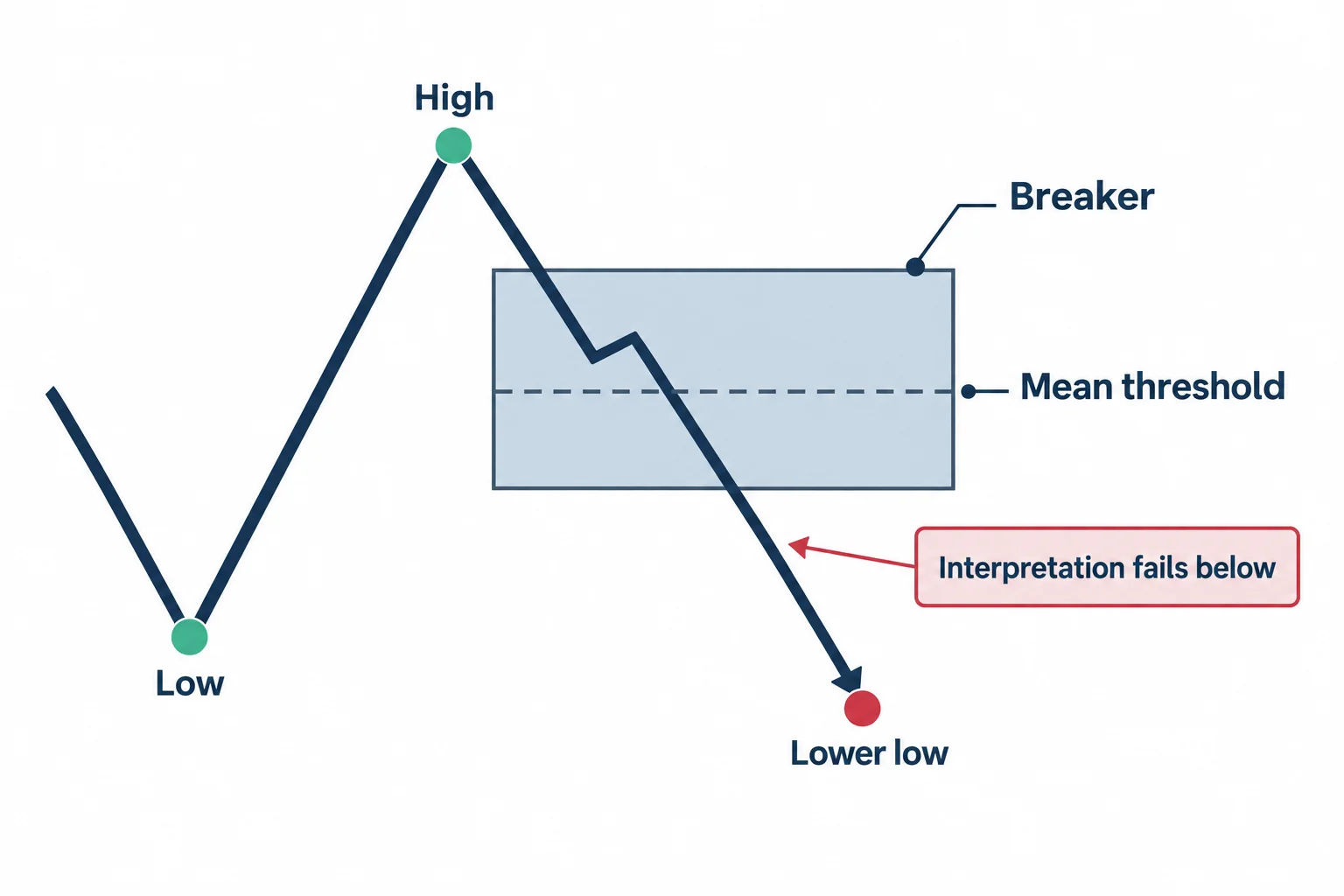
From 1:22 he defines a breaker in the way his framework uses the word: a low, a high and then a lower low, with the range between them split in half. He says the resulting midpoint — the mean threshold — is 4053.25, and calls it the level he does not want to see price move beneath.
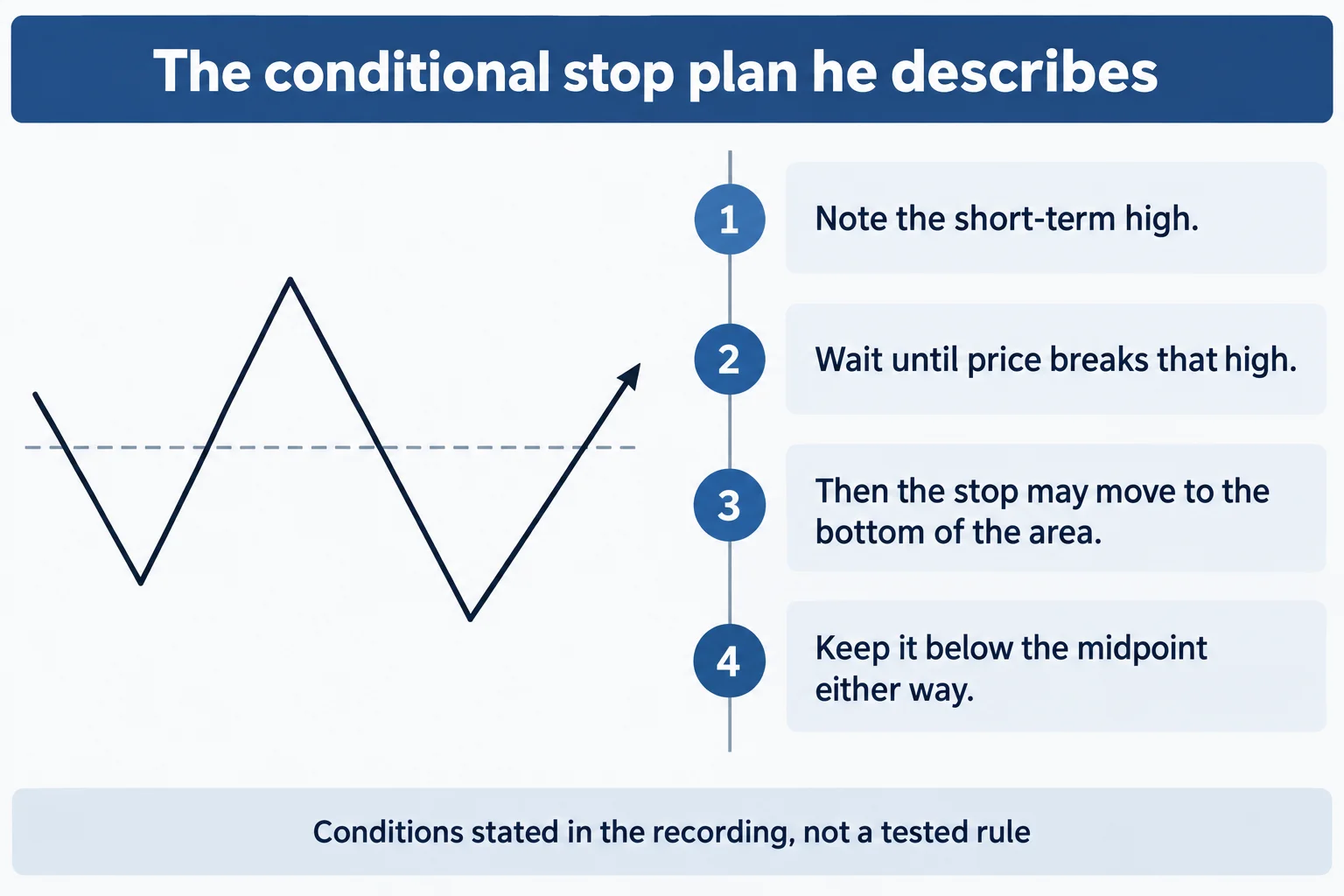
His management sequence is explicitly conditional rather than automatic:
- He treats the midpoint he states, 4053.25, as an acceptable place for the stop while price is working inside the breaker.
- He would only raise the stop to the bottom of the breaker once the nearby short-term high has been broken.
- Even after that raise, the stop stays below the mean threshold he states as 4053.25.
- He does not want to see price move below that midpoint level, which he treats as the point where his interpretation fails.
At 2:10 he says he adds to the position, describing the addition as a way of showing that adding inside that area is acceptable to him. He then says he wants to see price repel from the breaker, move aggressively through the nearby high and leave the five-minute fair value gap behind.
The five-handle objective
At 2:50 he states that his core position is based at 4054.00 and that it has to trade to 4059.00. He then adds a further quarter point, taking the practical objective to 4059.25, and explains the extra fraction as an allowance to cover fees and commissions. He frames the whole idea as an attempt at five handles — the futures convention of counting one handle as one index point — on the morning session, and ties it to an opening-range and gap protocol, noting a lower gap opening into 9:30.
Those are his stated intentions for the session, not results. He is describing where he wants to exit before the outcome is known, and the transcript contains no account balance, order ticket or statement that would corroborate anything he reports.
The confluence he points to on a retracement
Around 3:29 he says price is basing near an order block after several consecutive down candles, that the market should not go below the low he is referencing, and that price has already traded into an imbalance relative to that low. He says he expects expansion upward when he sees larger candles, and points to an overnight fair value gap (3:51) that he says he had marked and shown on Twitter before the session — he tells viewers the shaded area on his chart is the same one. That reference is his claim about his own prior posting; nothing in the recording verifies what was published or when.
From 5:16 he builds the case for a further entry. He notes that price is now above the five-minute fair value gap, and argues that when his directional narrative holds, these gaps behave as support rather than as the resistance that classical chart reading would expect. He then lists the features that overlap in the area:
- the five-minute fair value gap itself, and its midpoint, which he calls consequent encroachment;
- an untraded close-to-open gap with no wicks, which he calls a real liquidity void;
- a down-close candle preceding a displacement move through short-term highs, which he labels a bullish order block; and
- the mean threshold of that order block.
He calls that overlap constructive for another buying opportunity and says he would add again if price traded into it, while noting that touching the lower end of the five-minute fair value gap as well would still be acceptable to him.
Adding on the retracement and the higher reference
At 7:00 he reacts as price dips into the small gap he had described, thanks the market in his usual joking register, keeps the stop where it was and repeats that he wants to see large ranges run into 4059.25. He points out at 7:25 that the touch of the bottom of the five-minute fair value gap had already been discussed earlier in the clip, and draws attention to the reaction that followed.
He also states a further reference beyond the five-handle objective: at 4:42 he says he wants price to reach 4059.25 and ultimately into 4061.50, and that he intends to leave two contracts on for that level. That is a plan stated in advance, not a reported exit.
Size, scaling and what he says at the end
He interrupts the trade commentary at 7:33 to make a point about attention: he says he is working off a single chart, that owning several monitors does not mean he is running multiple positions or trading both directions, and that the focus required is substantial. He says he would not claim to handle more than that at once.
At 7:54 he says the position is 14 contracts and that he will take five off if price reaches 4059.25, which he again links to the five-handle morning objective and to the five-minute fair value gap he says he used as the draw, published on Twitter shortly before the opening. From 8:37 he returns to the level he is using for stop management, which the captions render as “that 54 level”. The mean threshold he cited earlier in the clip was 4053.25, so the transcript does not settle which of the two he means there; both are left as he stated them. At 9:17 he points out that price came back to the area he had described. He then anticipates the open, describing sellers being caught out as price launches higher.
The last substantive remark is a correction of his own size. At 9:36 he says he thinks he went “negative one”, and immediately clarifies that he was one contract over — that is, one contract larger than he intended — which he calls acceptable. Nothing in the recording states a final exit, a realized result or a loss, and his closing phrase is simply an expression of satisfaction with how the morning went. Anyone citing this clip as a performance record is going beyond what it contains.
What this recording does and does not establish
What it does establish is a worked example of how he says he sequences a trade: state a directional idea, wait for price to return to a defined area, name the level that invalidates the idea, fix an objective before entering, and describe in advance how and where size will be reduced. He also treats several separate features as one zone rather than relying on a single pattern, and he is explicit that the stop only moves after a specific structural event occurs.
What it does not establish is any of the numbers as fact. The transcript is a machine-generated caption file of his narration, so the prices and level references are what the captions recorded him saying, with no chart, order ticket, DOM or statement in the source. Captions of this kind routinely mishear trading terms and numerals, the opening line about a “volume balance” breaker being one example already flagged above. The clip also begins after the setup was underway, so the analysis that produced the idea is not in the source and is not reconstructed here. Nothing here should be read as a verified profit, a recommendation to copy the trade, or evidence that any of the named concepts produces an edge.
Watch the original recording
5 Handle Twitter Example Live Execution… January 30, 2023
The Inner Circle Trader · published 30 January 2023 · 9 minutes 54 seconds. This is the primary source for this article; every timestamp link above points into it.
The video is not embedded here because the owner has disabled playback on other websites. That was checked directly on 15 September 2026 from a BestProps page origin: the embedded player loads and returns “Playback on other websites has been disabled by the video owner” instead of playing, so no empty player is left on this page.
The watch page was read on 15 September 2026 and rendered as a public video: title “5 Handle Twitter Example Live Execution… January 30, 2023”, listed at 594 seconds, playability status OK, published 30 January 2023 at 6:51 a.m. Pacific by The Inner Circle Trader. The scheduling inventory used for this article lists the same upload under 30 January 2023, so the two agree on the calendar date. The publication time is 9:51 a.m. New York, about twenty minutes after the 9:30 cash open the speaker is narrating, which is what publishing a live recording shortly after the session looks like rather than a conflict. The channel page is the first-party record of what is published there.
Resources
These are the sources checked for this article. The regulator and investor-education pages are general material about futures and about trading systems sold to the public; neither assesses the speaker, verifies any level quoted above, or endorses anything said in the recording. Any ICT, smart-money or third-party indicator, script, note set, transcript pack or re-upload circulating outside the publishing channel’s own page is unofficial and untested here.
- [1] 5 Handle Twitter Example Live Execution… January 30, 2023 — The Inner Circle Trader (primary source; watch page read 15 September 2026, 594 seconds)
- [2] The Inner Circle Trader — official YouTube channel (read 15 September 2026)
- [3] Investor.gov — Glossary: Futures (read 15 September 2026)
- [4] CFTC — Fraud Advisory: Commodity Trading Systems Sold on the Internet (read 15 September 2026)
This is independent educational commentary on one speaker’s framework and his narration of one session. It is not official ICT material, it is not a tested trading system and it is not investment advice. Leveraged futures trading can produce rapid losses. The recording contains no profit or loss figure and none is reported here.