Key takeaways
Prop firm signals are trade ideas that may specify instrument, direction, entry, stop loss and targets, but compliance depends on the exact firm, evaluation or funded product, platform, source and execution method.
Read the full summary
Prop firm signals are trade ideas that may specify instrument, direction, entry, stop loss and targets, but compliance depends on the exact firm, evaluation or funded product, platform, source and execution method. Verify current official terms and obtain dated written answers covering third-party alerts, automated execution or copying, and coordinated or mirrored trading. Distinguish manual alerts, algorithmic alerts, automated execution, account mirroring and trade copying, then check rules for expert advisors, APIs, news events, overnight and weekend holding, unrealized and closed drawdown, commissions, latency exploitation, account sharing and external management. Forex checks include symbols, lots, spreads and price feeds, while futures checks require the exact contract, expiration, contract count, specifications and session. Assess providers through timestamped and editable records, representative sample size, losing sequences, open-trade drawdown, realistic fills, conflicts of interest, subscriptions and software costs rather than win rates or screenshots. Size every alert from entry-to-stop distance, remaining loss allowance and value per point, pip or tick, accounting for slippage, correlated exposure and existing positions. A stop twice as wide with the normal position size approximately doubles planned price-risk exposure before costs or slippage. Test on demo or simulation when permitted, logging alert and receipt times, quoted and available prices, planned risk, fills, slippage, outcomes, skipped trades, rejected orders, partial fills, disconnections, symbol mapping and contract selection, and recheck rules before active trading because signals cannot guarantee compliance, profitability or passing an evaluation.
How we researched this article
BestProps used document-based research from primary firm sources, checked August 23, 2026. The complete source list, scope, limitations, and commercial-state record appear near the end of this article.
Prop firm signals can provide a potential entry, stop loss, profit target or market bias, but receiving an alert is only the beginning. A trade that appears reasonable on a personal account may conflict with the rules of an evaluation or funded account. Position size, execution method, timing and even the source of the signal can matter.
Questions on communities such as Reddit show that traders are unsure whether signals are permitted. Those discussions are useful evidence of common concerns, but comments from other traders do not verify a firm’s policy. The reliable answer must come from the current written rules for the exact firm, program and account type being traded.
This guide explains how prop firm trading signals differ from automated copying, which rules to investigate and how to evaluate an alert without assuming it will produce a profitable outcome.
What Are Prop Firm Signals?
A trading signal is information suggesting a possible trade. It may identify the instrument, direction, entry area, stop loss and one or more targets. Signals can be generated by an analyst, an algorithm or a rules-based trading community.
The term prop firm signals can describe several arrangements:
- Manual alerts: A message is delivered through an app, email or community, and the trader decides whether to enter the order manually.
- Algorithmic alerts: Software identifies a setup, but the trader still reviews and places the order.
- Automated execution: Software receives a signal and submits an order without manual confirmation.
- Account mirroring: Trades from one account are reproduced in another account.
- Trade copying: A copier replicates orders across one or more accounts, potentially adjusting size.
These methods are not interchangeable from a compliance perspective. A firm might distinguish between using third-party analysis, running automated software and copying another person’s trades. Do not assume that permission for one method covers the others.
Can You Use Signals With a Prop Firm?
There is no universal answer. Compatibility depends on the firm’s current terms, the specific evaluation or funded product, the platform, the signal source and how the order is executed. Policies can also change.

As one current example checked on August 23, 2026, The5ers says traders may use an expert advisor only if it does not copy another person’s signals, among other listed restrictions. This is a provider-specific rule, not a universal policy, and it should be rechecked before use.
Before using a signal, obtain a written answer to three separate questions:
- May account holders use third-party market analysis or trading alerts?
- May software automatically execute or copy those alerts?
- Are there restrictions on coordinating, mirroring or reproducing trades from other traders or accounts?
A general statement that automated trading is supported does not necessarily establish that every expert advisor, strategy or copying arrangement is allowed. Similarly, manual order placement does not automatically make a trade compliant if the underlying activity is otherwise prohibited.
Rule-verification reminder: Check the firm’s official terms, FAQs and prohibited-strategy policy. If the wording is unclear, contact support and retain the dated written response. Community posts and tool vendors should not replace first-party confirmation.
Prop Firm Signal Rules to Check
Signals need to fit the account’s restrictions as well as the trader’s risk plan. Review the following areas before placing an order.
Copy Trading Rules for Prop Firm Signals
Search the terms for language concerning trade copying, mirroring, account management, shared signals, group trading and identical strategies. Definitions vary. Check whether any policy distinguishes between copying your own accounts and following orders created by another person.
Automated Prop Firm Signal Rules
If a tool connects directly to a platform or account, determine whether it is treated as an expert advisor, API strategy, trade copier or other automated system. Confirm whether approval is required and whether separate platform conditions apply.
Prop Firm Signal Rules for News Events
A signal may arrive immediately before a scheduled economic release or other market event. Check whether the account restricts opening, closing or holding positions around specified events. The timing of the alert does not transfer responsibility away from the account holder.
Prop Firm Rules for Holding Trades
Confirm whether positions can remain open overnight, over a weekend or through a session close. These questions can be especially important when a provider does not close trades on the same schedule as the account.
Prop Firm Drawdown Risk Rules
Understand how the account calculates each loss limit, including whether unrealized losses, closed losses, commissions or other charges are included. A signal provider’s suggested size may have no relationship to the account’s remaining loss allowance.
Prop Firm Rules on Prohibited Strategies
Some programs may impose additional objectives or restrictions. Review the current rules rather than relying on a generic checklist. Also investigate whether the terms address latency exploitation, account sharing, external management or other prohibited conduct that could overlap with the provider’s process.
Forex and Futures Prop Firm Signal Checks
Forex and futures signals may use similar language, but the instruments and account environments are different. A forex alert might quote position size in lots and refer to a continuously traded currency pair. A futures alert may identify a specific contract, expiration and number of contracts.
For forex signals, check that the quoted symbol, spread conditions and price feed correspond reasonably with the account's platform. Entry and stop prices can differ between feeds, especially during volatile periods.
For futures trading signals, verify the exact contract and expiration rather than relying only on a general market name. Contract specifications and trading sessions affect risk calculations. A signal produced for one instrument should not be translated into another merely because their price movements appear related.
In either market, the trader must account for slippage, commissions where applicable and the possibility that the published entry is no longer available.
How to Evaluate Prop Firm Signal Providers
A provider’s win rate or screenshots do not provide enough information to assess risk. Marketing claims may omit losing trades, changed stops, slippage or the effect of fees. Look for a complete, timestamped record that includes both winning and losing outcomes.
Due diligence should cover:
- Methodology: Is the setup explained clearly enough to understand when it is invalid?
- Record quality: Are alerts timestamped, and are edits or deleted messages visible?
- Sample size: Does the record cover different conditions rather than a short favorable period?
- Drawdown: Are losing sequences and open-trade drawdowns disclosed, not just net results?
- Execution assumptions: Are results based on prices that subscribers could realistically have received?
- Conflicts of interest: Does the provider earn referral revenue from brokers, firms, platforms or other products?
- Costs: Consider subscriptions and software expenses without assuming they will be recovered through trading.
Independently verify any compatibility claim made by a signal provider or trade-copier vendor. A product being technically able to connect to a platform does not prove that its use complies with a particular account’s rules.
How to Size Prop Firm Signals for Risk
Do not automatically use the position size published with an alert. The provider may be working with a different account balance, stop distance, instrument or tolerance for loss.
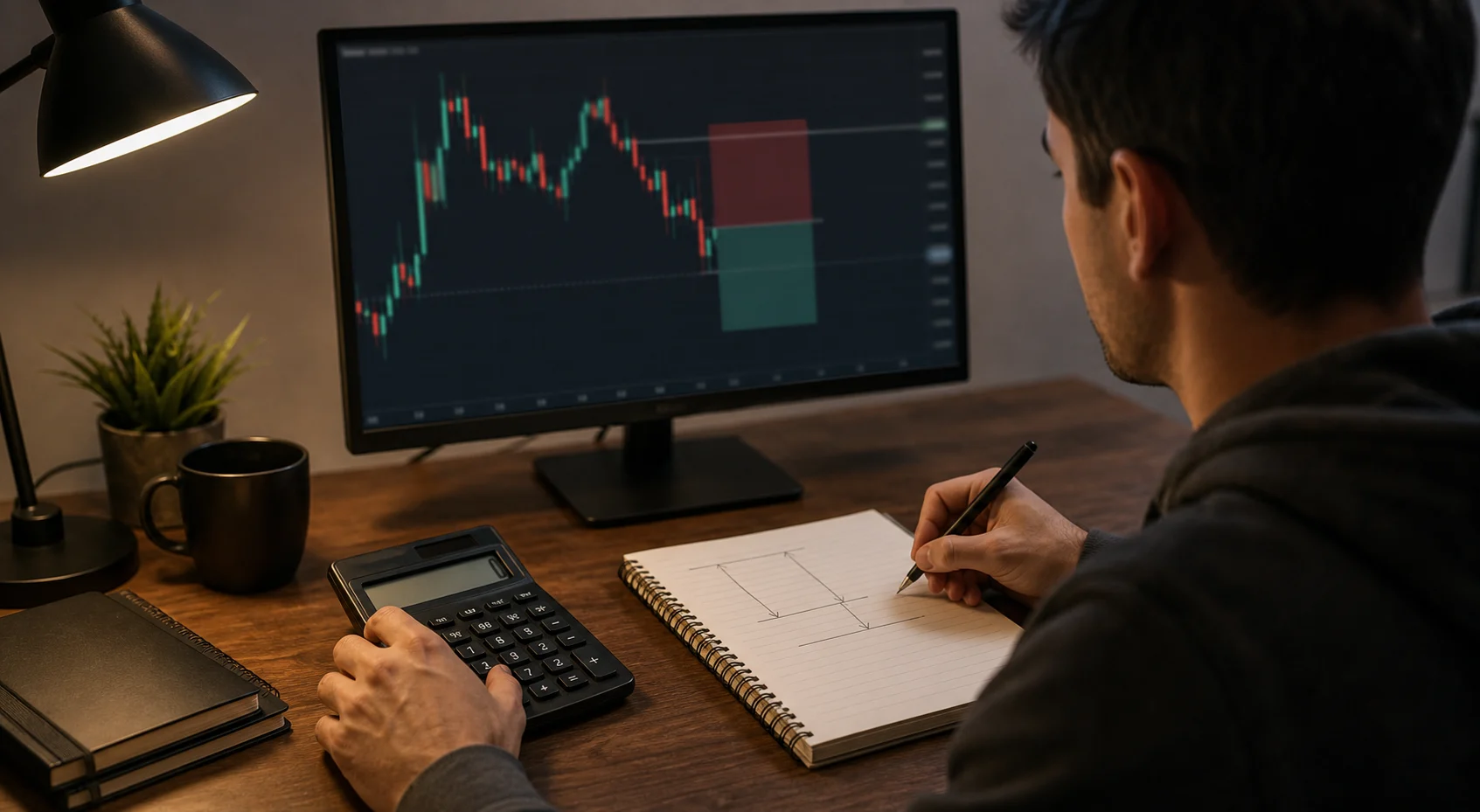
A basic risk-planning process is:
- Identify the proposed entry and protective stop.
- Calculate the distance between them using the instrument’s correct unit.
- Choose a maximum loss for the trade that fits your predefined plan and the account’s remaining limits.
- Convert that loss allowance into position size using the instrument’s value per point, pip or tick.
- Reduce or reject the trade if slippage, correlated exposure or existing positions would make the total risk unacceptable.
For example, if an alert's stop is twice as far away as the stop used in your normal plan, using your normal position size would approximately double the planned price-risk exposure before costs or slippage. The appropriate response may be to reduce size or skip the setup, not to move the stop closer without a strategy-based reason.
Always use the contract specifications and calculations applicable to the actual platform. This framework is educational and is not an individualized recommendation for how much to risk.
Why Prop Firm Signals Breach Account Rules
Even a valid market idea can cause problems when execution conditions differ. Common failure scenarios include:
- The alert arrives late and the trader chases a worse entry while keeping the original stop.
- A fast move creates slippage and a larger loss than planned.
- Several signals create concentrated exposure to correlated markets.
- An order remains open during a restricted period.
- A copied trade uses the wrong contract, lot size or account multiplier.
- The provider changes or removes a stop after the trade is active.
- A firm’s rules change after the trader initially reviewed them.
- Automated execution continues after the account approaches a loss limit.
Signals may be unsuitable for traders who cannot monitor orders, independently calculate risk or explain why a setup fits their plan. They are also a poor substitute for understanding the evaluation rules.
Practical Prop Firm Signal Testing Checklist
Before connecting a provider or tool to an evaluation or funded account, test the workflow with a demo or simulation when one is available and permitted. Testing cannot establish future performance, but it can reveal operational problems.
- Record the time the provider issues each alert and the time it reaches you.
- Compare the quoted entry with the price available on your platform.
- Log planned risk, actual fill, slippage and final outcome.
- Note signals skipped because of account rules or existing exposure.
- Test disconnections, rejected orders and partial fills where relevant.
- Verify symbol mapping and contract selection.
- Recheck official rules before moving from testing to an active account.
The journal should separate the quality of the market idea from the quality of execution. A provider could identify the general direction correctly while delivering an alert too late to offer an acceptable risk-to-stop relationship.
Prop Firm Signals FAQs
Are Manual Signals Always Allowed?
No universal rule establishes that manual signals are always permitted. Manual execution may be treated differently from automation, but traders still need to verify the signal source, strategy and account-specific terms.
Is a Trade Copier the Same as a Signal Service?
No. A signal service supplies information, while a trade copier reproduces orders. Some services combine both functions. Firms may apply different rules to analysis, automated execution and account mirroring.
Can Signals Guarantee I Pass an Evaluation?
No. Signals cannot guarantee favorable execution, compliance, profitability or completion of an evaluation. Market losses, delays, provider errors and rule breaches remain possible.
Should I Follow Every Alert From One Provider?
Each alert should be checked against the account’s current rules, open exposure and predefined risk plan. Selectively skipping an alert may also cause results to differ from the provider’s published record, which is another reason to test the workflow independently.
Prop Firm Signal Checklist Takeaways
Prop firm signals are best treated as trade ideas, not instructions that remove the trader’s responsibility. First determine whether the signal source and execution method comply with the exact account rules. Then independently assess the setup, calculate position size and account for timing, slippage and correlated exposure.
Because prop-firm policies and products can change, repeat the verification process rather than relying on an old support answer, a Reddit comment or a vendor’s compatibility claim. A rule-first approach cannot eliminate trading risk, but it can help separate a usable alert from one that does not fit the account.