
Key takeaways
This Mentorship Core Content lesson is about option selection, not company valuation.
Read the full summary
This Mentorship Core Content lesson is about option selection, not company valuation. ICT says he keeps option trading to two positions — the long call for bullish ideas and the long put for bearish ideas — and describes the loss on either as limited at expiration to the premium paid plus commission, with the profit potential treated as open-ended. He slots those positions into seasonal windows he has already taught (bullish February to May, bearish May into the second half of September, bullish again from late September into year-end) and says the directional side should come from the concepts from earlier lessons: strong and weak stocks, leaders and laggards, index divergence and what he calls the smart money index, plus CAN SLIM ideas. He then works two hypothetical examples — a $50 stock with a $50-strike call at $2 and a $40 stock with a $40-strike put at $2 — to show $1,000 of intrinsic value against a $200 premium and a $200 total loss. His stated personal preferences are a premium ceiling of 3.50 ($350 per contract), ideally 1.00 to 2.00, strikes about one to three strikes from the price, and more than 90 days to expiration. The examples are illustrative arithmetic on fictional tickers, and the lesson contains no screen, no fills, no performance record and no proof that any of it is profitable.
How we researched this article
BestProps used document-based research from primary firm sources, checked September 24, 2026. The complete source list, scope, limitations, and commercial-state record appear near the end of this article.
ICT Mentorship Core Content – Month 10 – Stock Trading – Valuation Stock Selection runs 18 minutes and 32 seconds. He introduces it as lesson five of the June 2017 mentorship, while the watch page gives an upload time of 21 October 2022 — the recording is a re-release of an older month, which is why it speaks about July and August material as still to come. This article is built from the recording’s full 483-segment auto-generated English caption track rather than from its title or description. Despite the title, almost none of it is conventional valuation work: there is no earnings, cash flow or balance-sheet discussion, and the material is a description of how one trader chooses an option contract.
The seasonal windows he starts from
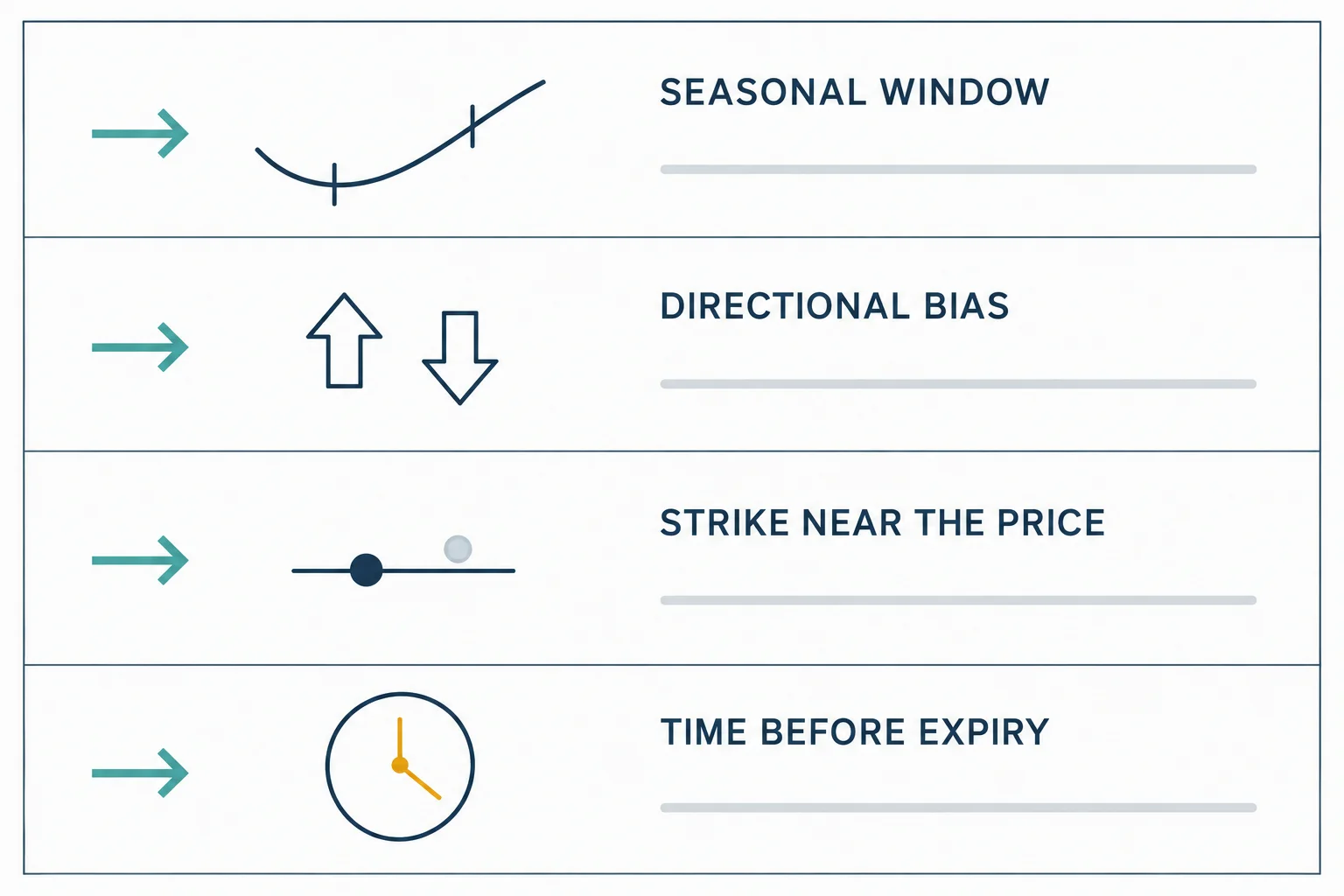
The lesson opens by assuming the viewer already has the seasonal frame from earlier sessions (0:18). He says he looks for February to May for what he calls buy programs in stock or stock options, then from May into the second half of September for short stock or long put options — which he treats as the equivalent of going short — and then from the last part of September and the beginning of October to the end of the year as bullish on stocks again (0:26, 0:38, 0:52). These are his own market interpretations, not rules the stock market obeys; the recording offers no testing, sample or performance record for the seasonal claim.
He is also explicit that the direction has to come from elsewhere (5:27). The list he gives is seasonality, the ability to ferret out strong stocks, what he calls the smart money index — the captions render the abbreviation as “smt” — leadership issues and index trading, and valuation using CAN SLIM ideas. None of those screening methods is defined or demonstrated in this recording, so the practical takeaway is only that he wants the selected stock’s relative strength or weakness to agree with his broader market view.
Why he limits himself to long calls and long puts
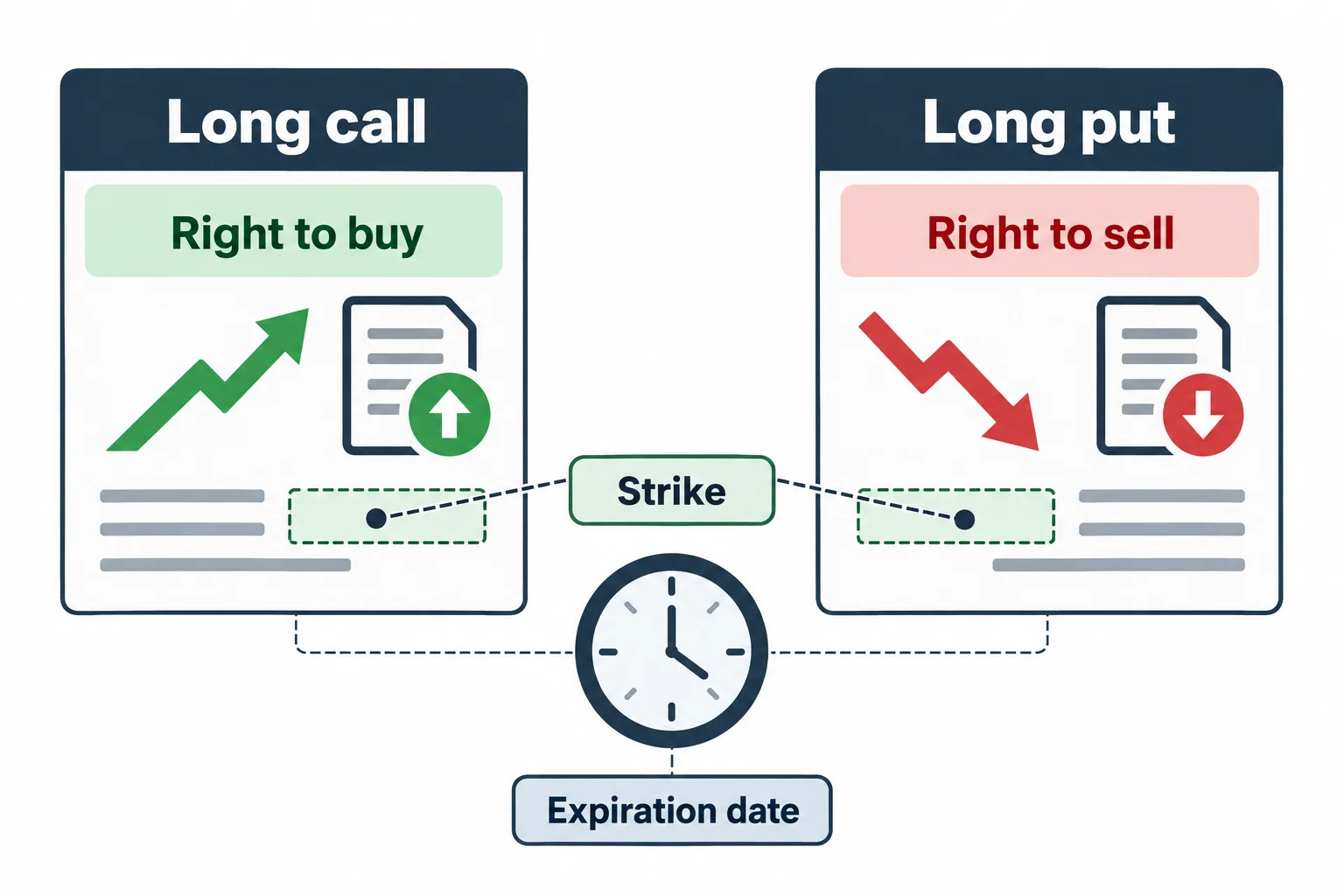
At 1:04 he says he keeps options simple on purpose, describing an early attempt to work with the Greeks and more exotic structures as daunting and over-complicated. The two strategies he settles on are the long call and the long put (1:41). He mentions covered calls and bull spreads as strategies he also uses but says they belong in his August material rather than here (2:42, 2:54), and notes the July and August months will carry four detailed lessons each instead of the usual eight (3:06).
His description of what a contract is matches the standard definition: the right but not the obligation to own 100 shares at a specific price, that price being the strike (1:49, 1:56). He also flags that every option has an expiration date, so the question is not how far the stock can go but how far it will go before the option expires (2:04).
The risk statement he repeats several times is that a purchased option’s loss is capped at the premium plus commission (4:21, 10:13). His arithmetic: a premium of 2.50 on a 100-share contract is $250, and adding a $5 commission makes $255 the most that can be lost (4:56). He says that capped exposure is the main reason he favours these two structures, and at one point says the worst case is the premium plus commission even if things go badly elsewhere (11:30). The important qualification is his own: caps on the loss at expiration do not remove intraday or pre-expiration risk, spread and liquidity effects on an exit, or the capital consequences of exercising into a share position. His “no slippage” remark (10:55) applies to holding to expiration, not to exiting early.
The hypothetical call example
At 6:31 he sets up a fictional stock: “ICT company” trades at $50, and a call with a $50 strike expiring in a month costs $2 per share, or $200 for the contract covering 100 shares (6:35). If the stock is at $60 at expiration the position is $10 in the money per share, which is $1,000 across the contract, so after the $200 premium the net is $800 before commission (6:58, 7:40). He works through exercise explicitly: the strike becomes the entry price, the shares can be sold at the market price, and he uses a $5 round-turn commission to arrive at $795 (7:21). If instead the stock falls to $40, the call expires worthless and the loss is the $200 premium plus commission, or $205 on his assumed figure (8:11).
The hypothetical put example
The put example starts at 11:50 with a second fictional ticker, rendered in the captions as “trolls company” at $40 a share, and a $40-strike put expiring in a month priced at $2 (11:54). If the stock falls to $30 the put carries $1,000 of intrinsic value, leaving $800 before commission and $795 with his $5 round turn (12:22, 12:32, 12:41). If the stock rallies to $50 instead, the put expires worthless and the loss is the premium plus commission (12:56). He also explains why a put is his substitute for shorting: it can profit when price falls while the risk is set to a fixed amount that cannot be exceeded (10:55), and he notes the theoretical floor is a share price of zero, so the maximum profit on a long put is bounded by the strike (9:04, 9:15).
Both examples are arithmetic on fictional tickers at expiration. They ignore changing implied volatility, the option’s time value before expiry, spreads, and any difference between the assumed commission and what a given broker charges today. They are not reported trades, predictions or results.
Intrinsic value against the clock
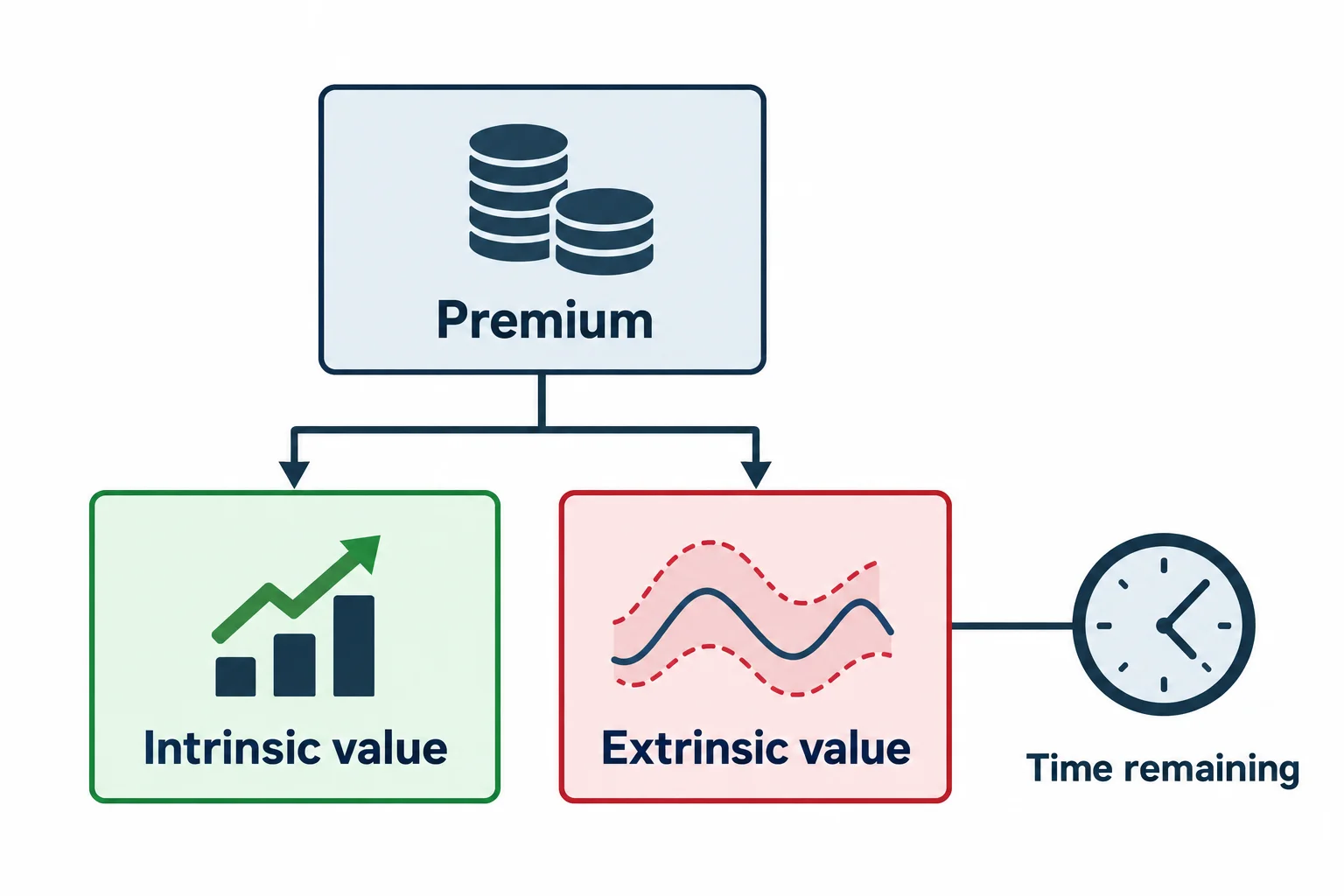
The part he calls the real valuation discussion begins at 13:13. He separates intrinsic value — what the underlying is worth relative to the strike — from the time remaining for the move to happen, and notes the examples above used only about a month, which he says is less than he generally wants. His illustration is a put bought at a $40 strike where the stock does drop, say to $25, yet the trade still shows no profit because too little time remains; the intrinsic value is there but time decay has taken the premium (13:51, 14:03). His summary of the problem is that you have to beat the clock and the market at the same time (14:08).
In general terms a premium does contain both intrinsic and extrinsic value, and extrinsic value erodes as expiry approaches — though not at a constant rate, and not independently of volatility and moneyness. That is the mechanism behind the “tug of war” he describes between the underlying moving in your favour and the premium bleeding away (16:17).
His stated selection preferences
From 14:29 he lists what he personally looks for. He frames these as his own rules of thumb, not as universal standards of value:
- A premium ceiling of 3.50, which is $350 per contract — he says plainly he thinks paying more than that is not worth it, while acknowledging other traders build careers on more expensive structures (14:52, 15:20).
- Ideally a premium of about 1.00 to 2.00, described as roughly $100 to $200 per option (15:33).
- Strikes close to the money, which he characterises as about one to three strikes from the market price; he calls that combination a cheap purchase worth taking a large position in (15:41, 15:43).
- More than 90 days to expiration, because he expects time decay to build under about 75 days and to become seriously damaging around 60 to 65 days; the extra time lets him watch whether the premium is starting to grow before he is forced to decide (15:56, 16:01, 16:27, 16:56).
The obvious counterweight is that a low premium is not the same thing as a cheap option. It can just as easily reflect a low probability of finishing in the money, little remaining time, low volatility, or the strike being far from the price. Comparing contracts properly needs more than the dollar cost, which is why his ceilings are best read as personal filtering rather than a valuation method.
He also mentions in passing that selling options is often the better side of the trade for someone who knows what they are doing, and that it hurts those who do not (16:46) — a remark worth noting because it runs against the buy-side framing of the rest of the lesson.
What the lesson does not provide
His own closing qualification is that no worked trade has been shown yet: he says he will run the fall top-down analysis live later, naming the call options he likes for leadership issues and the strike prices for each stock, and that watching him do it will teach more than the theory here (17:23, 17:33, 17:47, 17:58). He closes by pointing viewers to other tutorials on long calls and long puts for more depth (18:09).
What is absent is as important as what is present. There is no reproducible screen, no completed example on a real ticker, no entry or exit rule, no position sizing, no win rate or drawdown, and no account results. The two “companies” are explicitly hypothetical, and the $5 round-turn commission is his own placeholder rather than anyone’s actual pricing. The seasonal windows and stock-selection concepts are asserted rather than tested, and the claim that the risk is capped applies at expiration to a position held to expiry — it says nothing about what the position is worth along the way. Read this as an introduction to translating a directional stock view into a defined-premium option position, not as a valuation model and not as evidence of an edge.
Watch the original recording
Watch the original lesson on YouTube
This recording cannot be played inside another website. Its embedded player was loaded from a BestProps origin and clicked on 15 September 2026 at both desktop and mobile widths: it reported “Video unavailable” and “Playback on other websites has been disabled by the video owner”, the video element never advanced past readyState 0, and no duration or playback progress was available. The recording’s own watch-page data agrees, reporting the video as not playable in an embed, so no iframe is placed here. The video itself is public and available directly on YouTube.
Watch ICT Mentorship – Stock Trading Valuation & Selection on YouTube ↗
Source and further reading
- ICT Mentorship Core Content – Month 10 – Stock Trading – Valuation Stock Selection — the primary source for this article. Every quoted figure and preference above comes from this recording’s caption track; use the timestamp links to compare each point with what was actually said.
- The Inner Circle Trader YouTube channel — the publisher’s own channel, where this mentorship month and the lessons it refers back to are posted. Unofficial reuploads and third-party summaries are not the source used here.
- OCC — Options Industry Council investor education — the industry clearinghouse’s neutral reference material on long calls, long puts, intrinsic versus extrinsic value and time decay. Useful for checking the mechanics the lesson describes, including what actually happens on exercise and assignment. Educational vendor material; it does not assess this presenter’s method.
- Options Industry Council — FAQ library — OIC’s plain-answer reference on option basics, expiration, exercise and assignment, and the relationship between premium and intrinsic value. Useful for checking the definitions the recording relies on. Third-party vendor material, not a test of this presenter’s approach.
- Investor.gov (SEC) — Investment products — the US securities regulator’s investor education hub covering investment product categories and the risks that come with them. Independent context for reading any options method presented with hypothetical examples; it does not assess this presenter.
- CFTC — Learn & Protect investor education — US regulator material on leveraged retail trading and on promotions built on past or hypothetical examples. General context for reading an options lesson built on illustrative arithmetic; it does not assess this presenter or any example above.
BestProps is not affiliated with the Inner Circle Trader, the OCC, the SEC or the CFTC, and no source listed here endorses this article. Long call, long put, intrinsic value, extrinsic value, time decay, smart money index, SMT and CAN SLIM are used as descriptive terms for what the recording teaches. The $50 and $40 examples are arithmetic on fictional tickers at expiration and the $5 commission is the speaker’s own placeholder; they are not reported trades, not verified results and not predictions, and the caption track contains no fills, prices from the period or account data. Options involve substantial risk of loss and can expire worthless in full. This is independent educational commentary, not official ICT material, not a tested trading system and not investment advice.