
Key takeaways
The Inner Circle Trader’s 690-second YouTube recording is a live trade-management commentary rather than a lesson or verified performance record.
Read the full summary
The Inner Circle Trader’s 690-second YouTube recording is a live trade-management commentary rather than a lesson or verified performance record. ICT narrates a long from a stated 3965.25 fill with a protective stop below a rejection block, seeks validation through a sharp rally above a swing high and acceleration above the morning high, and wants the morning-low gap preserved as a breakaway gap. He cites a 3970.5 limit as 5.25 points and references 3985 as an area for peeling contracts, trims one contract into strength, later removes two more, says the reductions funded the trade twice, and declines to raise the stop unless price overtakes the referenced high without putting the position into loss. When price loses the consequent encroachment midpoint of a buy-side imbalance and sell-side efficiency, he takes two further contracts off and closes the remainder early, reporting partials near 3979 and a final exit at 3980.5. His recap describes accumulation at a discount and distribution above an old high in premium, acknowledges that the stated target was not reached, and provides no account statement, order log, net profit, fees, full position size, chart verification, or evidence that the ENDS model is repeatable.
How we researched this article
BestProps used document-based research from primary firm sources, checked September 24, 2026. The complete source list, scope, limitations, and commercial-state record appear near the end of this article.
This page is about Live Trade Execution With “Ends…” Commentary 09/08/22, a roughly eleven-and-a-half minute session recording from The Inner Circle Trader. It is commentary delivered over a live screen rather than a structured teaching video: he narrates a position he says he is already holding, describes what he wants price to do, and talks through each reduction in it. The article below follows his narration in order and uses his own terminology throughout. Where a term or a figure in the transcript is unclear, it is flagged rather than smoothed over.
Two things are worth separating before the detail. First, this is a recording of someone describing a trade in real time, so the entries, partial exits, prices and the close are all reported by him and cannot be independently checked from the audio; there is no account statement, no order log and no chart available to verify them against. Second, nothing in it establishes that the pattern it describes is repeatable or profitable. The recording does not reach its own stated target, which he acknowledges himself.
How ICT Describes the Live Trade Open
He starts mid-thought with the position already on. He says he is going long, that the stop sits below what he calls a rejection block, and that he is aiming for an area above 0:00, 0:06, 0:13. He ties the setup to a sequence he reads on the chart: a stop hunt, a rally, and a return back into what he calls a fair value gap 0:22. He then points out a short-term level and says he can see the old high, calling that level out explicitly 0:28, 0:35.
The admission that follows is the most useful part of the opening. He says he missed the short 0:51, that it never gave him the fill he was looking for, and that he is not certain it would have given him his exit either if it had filled 0:56, 1:10. He calls it a really, really tricky morning, and adds that if he were not already long, he would be long now 1:14. That is a statement about his read of the market at that moment, not a claim that the position was a good one.
What ICT Wanted to Confirm During Live Execution
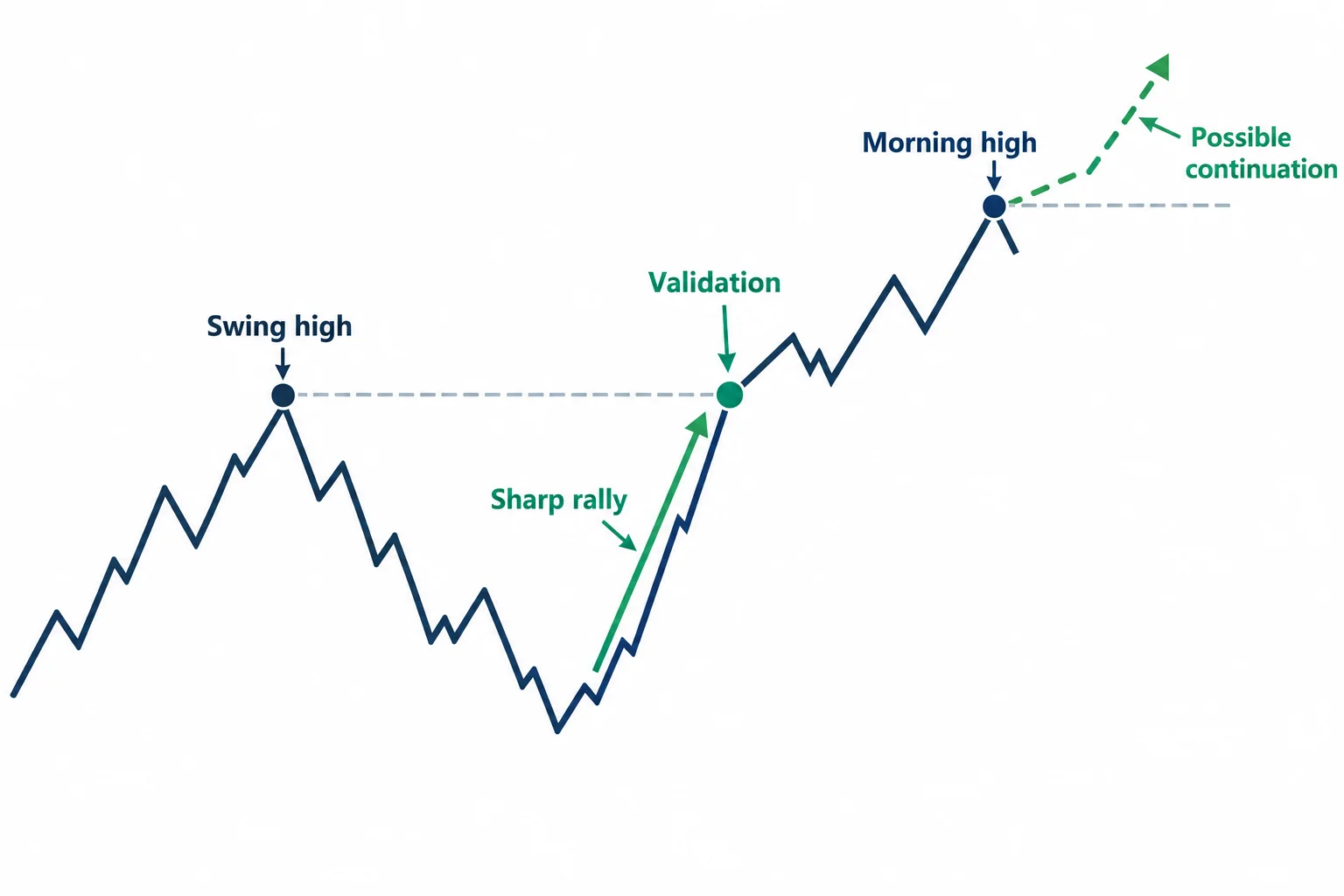
His validation condition is specific. He says what he wants to see is a sharp rally above the high in front of him, and he calls that validation 2:47, 2:50. From there he expects it to be a short move to the next area and then acceleration above the morning high, which he describes as the buy side of the high this morning 2:55, 3:00. There is an audible aside about the microphone and the audio quality in the middle of this passage 3:15; it has no bearing on the trade and is skipped here.
He also notes earlier that more than one swing high could be used, depending on how aggressive the trader is, rather than defending a single obvious one 1:25, 1:29. That is a candid point about how much discretion is inside the definitions he uses.
How ICT Used the Breakaway Gap in Live Trade Execution
When he moves to the next levels, he says price can come down to a referenced level and that doing so is permissible, but that he would rather leave the area where the low of the morning was created open 4:05, 4:16. He wants that gap to stay open and to act as a breakaway gap 4:20. He is explicit about the condition attached to it: he wants to see price overtake the high in front of him, and only then does the stop move up, because he does not want the position to go into a losing position after taking out that high 4:30.
He connects this to the framework he calls the ENDS model, saying what he has shown is more or less that framework, and that a trader filled at the level he names would already have about five and a quarter points 4:49, 4:55. The recording does not define the model’s full rules, and this article does not attempt to reconstruct them from a single session.
The figures he gives for that example are his own spoken numbers, and the transcript is an automatic transcription, so they are reported here with that caveat rather than presented as confirmed prints. He refers to being filled at a price he states as thirty-nine sixty-five and a quarter, and to a limit order at thirty-nine seventy and a half, which he says would be five and a quarter points, taking what he calls the risk to the proverbial free trade 5:05, 5:11, 5:19, 5:32. Later he names a target level around thirty-nine eighty-five and says he will peel contracts off as it is reached 5:57, 6:01. There is no way to confirm from the audio that any of these orders existed or filled.
How ICT Reduced Live Trade Risk
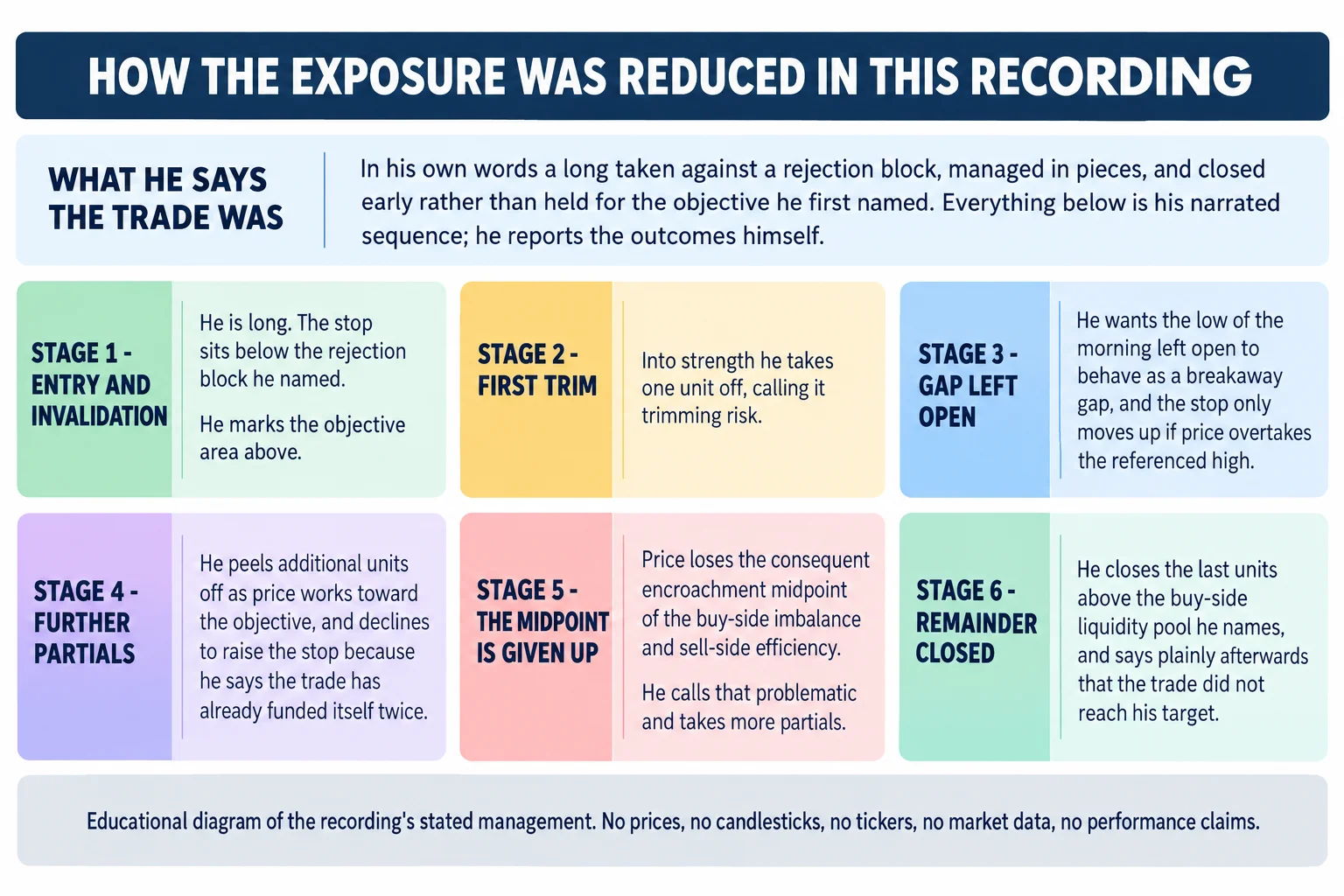
The management is incremental. He says he is going to trim some of the risk and takes one contract off 3:31, 3:40. As price works toward his stated target he plans further reductions, saying he will peel contracts off above a level 5:44, 6:09, and he describes peeling two more and checking that a level was cleared 6:48, 6:50, 7:00.
His reasoning about the stop is where the language deserves care. He says he has no interest in moving the stop up, and then says he has already funded the trade two times 7:10, 7:13. In context that means the reductions he has taken have already covered what he regards as his risk on the remainder. It is his description of his own position management, not a verified statement that the trade was profitable, and it does not make an open position risk-free in any general sense.
He then lists what he would like to see next: price supporting the high of a candle and continuing up into the area above, turning into a strong up-close or expanding candle, and the gap he pointed at staying open rather than being refilled 7:24, 7:33, 7:47. He notes the session is getting late in the morning and says leaving a high behind sets the stage for a possible retracement 8:31, 8:37.
How ICT Managed Risk and Closed the Trade Early
He then names a level as the consequent encroachment midpoint of a buy-side imbalance and sell-side efficiency, and says he does not want to see it lose any more ground 8:48, 8:58. He says that if it does he will just kill the trade and be content with what he has 8:58. That is the clearest statement of intent in the recording, and he follows it.
He says he is going to peel two more contracts off in case the idea is failing, because he does not want the position to turn on him 9:36, 9:49, and then he says explicitly that it is time to close it 9:50. His own remark afterwards is that it is good enough for government work 10:00. In the recap he gives the closing figures as his own spoken numbers, partials at a level he states as thirty-nine seventy-nine and a final exit at thirty-nine eighty point five, which he places above the buy-side liquidity pool he had referred to earlier 10:47, 10:54.
ICT Live Trade Commentary and Session Recap
He replays the logic at the end. He says the move came from trading off the fair value gap, that the earlier fill was not the best one, and that the gap gave a further opportunity to see the same setup live and with commentary 10:05, 10:08, 10:13. He describes price rallying above the short-term high and then moving in three parts above the thirty-nine eighty-five level, which he says was reached at thirty-nine eighty-five and a half 10:20, 10:28, 10:33. He restates the midpoint as the level that mattered, says giving it up would be problematic, and says that is what he says he saw failing, which is why he took partials and then closed 10:36, 10:40, 10:47.
He sums the session up as accumulation in a discount and distribution above an old high in premium. He then says directly that the trade did not get to his target 10:59, 11:07. He also returns to the missed short, saying he had already described missing that trade in the morning, that he did not take a loss but missed the entry, and that price went down to the level he had marked before rallying back up 11:13, 11:16, 11:21. His closing remark is that this kind of thing is enough for a bread-and-butter scenario 11:21.
What ICT Live Trade Execution Does Not Prove
What it establishes is a worked example of how this speaker says he manages a position in real time: a stop placed against a named block, a stated validation condition, a level he wants left open, incremental reductions into strength, a single level whose failure triggers a full exit, and a willingness to close before the stated target. That last part is the most reproducible idea on the page, and it costs nothing to adopt.
What it does not establish is anything about results. The recording contains no account value, no realized profit or loss figure, no position size for the account as a whole and no statement of what the trade netted after costs. Every price, contract count and partial exit below comes from his narration of a live screen that the transcript does not capture. A recording of one session cannot show how a method performs over many trades, cannot show whether the levels he marked in advance were the ones that mattered, and cannot be used as evidence that the approach will work for anyone else. Terms such as fair value gap, rejection block, consequent encroachment, breakaway gap and buy-side imbalance are his vocabulary for reading price; they are described here as he uses them and are not presented as tested or established. Third-party ICT material circulating anywhere other than the publishing channel’s own page (indicator scripts, note packs, re-uploads, transcript packs) is unofficial, has not been tested for this article, and no claim is made about its accuracy or whether it repaints.
Live Trade Execution With “Ends…” Commentary 09/08/22
The Inner Circle Trader · watch page lists upload 8 September 2022 · 690 seconds, about 11 minutes 30 seconds. The recording is a live session with commentary rather than a numbered mentorship lesson, and it is the primary source for every timestamp link on this page.
The recording is not embedded here. An embedded player was tested directly on 15 September 2026 from a BestProps page origin at desktop and mobile widths: the frame loads but then reports “Playback on other websites has been disabled by the video owner”, with no duration and no playback progress, while the video itself is publicly playable on YouTube. No half-working player is left on this page.
Watch the Original ICT Live Trade Recording
The clip is short enough to watch in full and is the only direct view of the chart this article describes. Every timestamp link above opens the same recording at the moment referenced, so the narration can be checked against the spoken source directly.
ICT Live Trade Resources
These are the sources checked while preparing this article. The two regulator pages are general material about how trading-system and intraday claims should be assessed; neither of them evaluates this speaker, tests any of the concepts he uses or endorses anything in the recording.
- [1] Live Trade Execution With “Ends…” Commentary 09/08/22 The Inner Circle Trader (primary source; watch page read 15 September 2026, listed duration 690 seconds, publicly playable).
- [2] The Inner Circle Trader (official YouTube channel) (read 15 September 2026), the publishing channel for this recording.
- [3] CFTC (Fraud Advisory: Commodity Trading Systems Sold on the Internet) (read 15 September 2026), notes that technical analysis attempts to predict future price movements from historical prices, price relationships and price trends, and that hypothetical trading results are typically simulations over historical or “real time” computer data rather than executed trades.
- [4] Investor.gov (U.S. SEC) (Day Trading) (read 15 September 2026), describes day traders as buying, selling and short-selling within the day over very short holding periods and states that day trading is extremely risky and can result in substantial financial losses in a very short period of time; relevant to the intraday management described here.
Notes on the ICT Live Trade Commentary Transcript
The narrative above was written from an automatic speech-recognition transcript of the full original audio, not from human-verified captions, and the review did not watch the recording. That matters most where numbers are involved. The price and contract figures quoted in this article are the transcript’s rendering of his spoken words, and short phrases in a live, fast-moving session are exactly where machine transcription is least reliable; the figures are therefore attributed to him rather than presented as verified prints. Two further passages need flagging. At 1:34 the phrase describing a pin to the upside is unclear as transcribed 1:34, and at 1:37 a fair value gap is named in the same breath 1:37; the gap reference is consistent with everything else in the session but the first phrase is reported here without interpretation. At 8:48 the transcript renders the imbalance he names as “bison balance” 8:48; the surrounding sentences about a consequent encroachment midpoint and sell-side efficiency make the intended term buy-side imbalance, which is how it is written above.
Source: ICT, Live Trade Execution With “Ends…” Commentary 09/08/22, The Inner Circle Trader, watch page upload date 8 September 2022. Local automatic speech recognition of the full original audio was the transcript used for this article and it is not human-verified captions. Nothing here is a recommendation to take any position, and the reported trade is one speaker’s own account of one session rather than evidence of profitability. This commentary is educational and is not investment advice.