
Key takeaways
This ICT index futures and forex review for June 22, 2022 covers USD/CAD and the September 2022 S&P futures contract, and its real subject is how he adjusts his participation around a scheduled central-bank testimony.
Read the full summary
This ICT index futures and forex review for June 22, 2022 covers USD/CAD and the September 2022 S&P futures contract, and its real subject is how he adjusts his participation around a scheduled central-bank testimony. He reads the next day’s calendar first — unemployment claims at 8:30, flash manufacturing and services PMI at 9:45, and the Fed chair’s testimony at 10:00 New York time (0:23 , 0:43) — and says the takeaway is to wait until the dust settles rather than try to be ahead of a chair speaking (1:00 , 1:07). On USD/CAD after its own 8:30 Canadian CPI release he marks the midpoint of a daily down candle’s body, which he calls the mean threshold of a bearish order block, and says price traded up into it and stalled (1:35 , 2:00). On the index contract he walks through what he calls Power of Three around the midnight New York opening, the overnight drop below sell-side liquidity he calls the Judas swing, and the rally above the opening price (7:23 , 7:41 , 8:26). He says he used the first fair value gap above the midnight opening on a live account (10:44 , 10:52), and he closes by saying he may miss a move while waiting and would rather keep his rule than break it (18:40). No fills, prices, size or outcome are established anywhere in the captions, so nothing below is a verified result or investment advice.
How we researched this article
BestProps used document-based research from primary firm sources, checked September 25, 2026. The complete source list, scope, limitations, and commercial-state record appear near the end of this article.
In the ICT Index Futures & Forex Review – 06/22/2022, published by The Inner Circle Trader, he reviews two markets from the same session: USD/CAD after its 8:30 Canadian inflation release, and the September 2022 S&P futures contract. The thread running through both is not where he thought price was going but how he handled a day with a central-bank speaker in it.
On the source. The watch page lists the recording as public, at 1,239 seconds (about 20 minutes 39 seconds), published 22 June 2022 at 17:28 PDT, and the caption track is marked as automatically generated rather than human-verified. Wording and terminology may therefore be misrecognised, so unclear captions are qualified rather than silently corrected. No chart is visible in this source: it can preserve what he says about his charts, but it cannot confirm that a level printed, that an objective was reached or that any described trade produced a fill. His statements stay attributed to him throughout, and the figures he reads out are his narration of charts rather than audited price data.
The calendar first, and his rule about waiting
He opens with the calendar rather than a chart. At 0:23 he runs through the next day’s New York releases: unemployment claims for the dollar index at 8:30, flash manufacturing and flash services PMI at 9:45, and at 10:00 what he calls the heavy hitter, a high-impact dollar event that he says will affect the other markets as well (0:43 , 0:46 , 0:50) — a further testimony from the Fed chair (0:53).
His stated rule follows immediately: wait until the dust settles (1:00). He says he is not trying to be ahead of a Fed chair testimony (1:07), because a lot of manipulation usually comes in when that happens and his analysis, expectation, bias and read of sentiment can all be disrupted by what is said and how the market interprets it (1:13 , 1:21). He makes the same point later about the mechanics, saying he is not of the opinion that the words themselves move the market; his interpretation is that the participants who can move price choose how to respond, and he says he would rather watch what price does than parse a hawkish or dovish tone (12:46 , 12:58).
That is a personal rule, not a demonstrated edge. He describes waiting as potentially costing him a move: he says he may see it go where he wanted and miss it, and would rather be thankful he did not engage than gamble ahead of a speaker (18:46 , 18:58 , 19:07).
USD/CAD after the Canadian inflation release
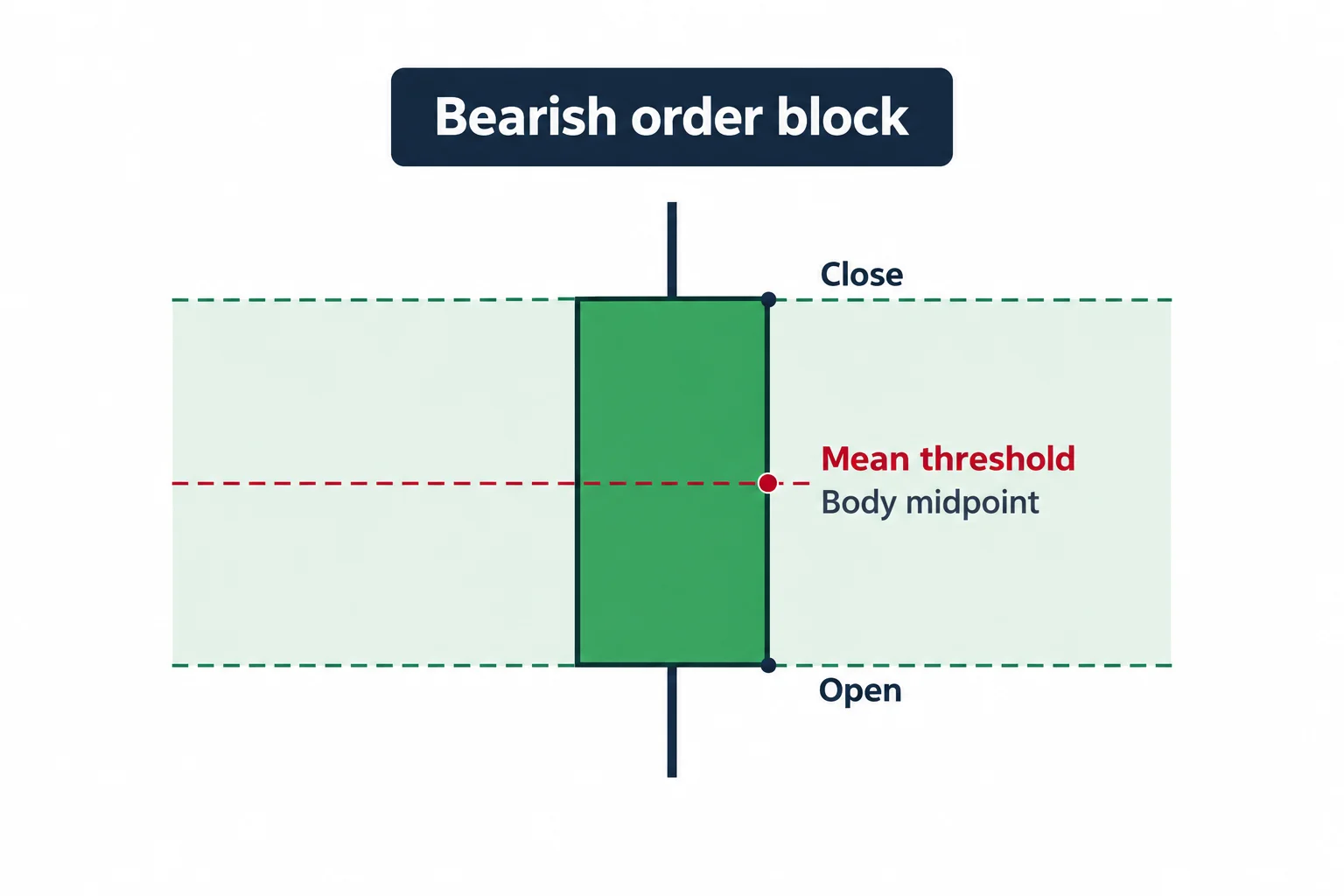
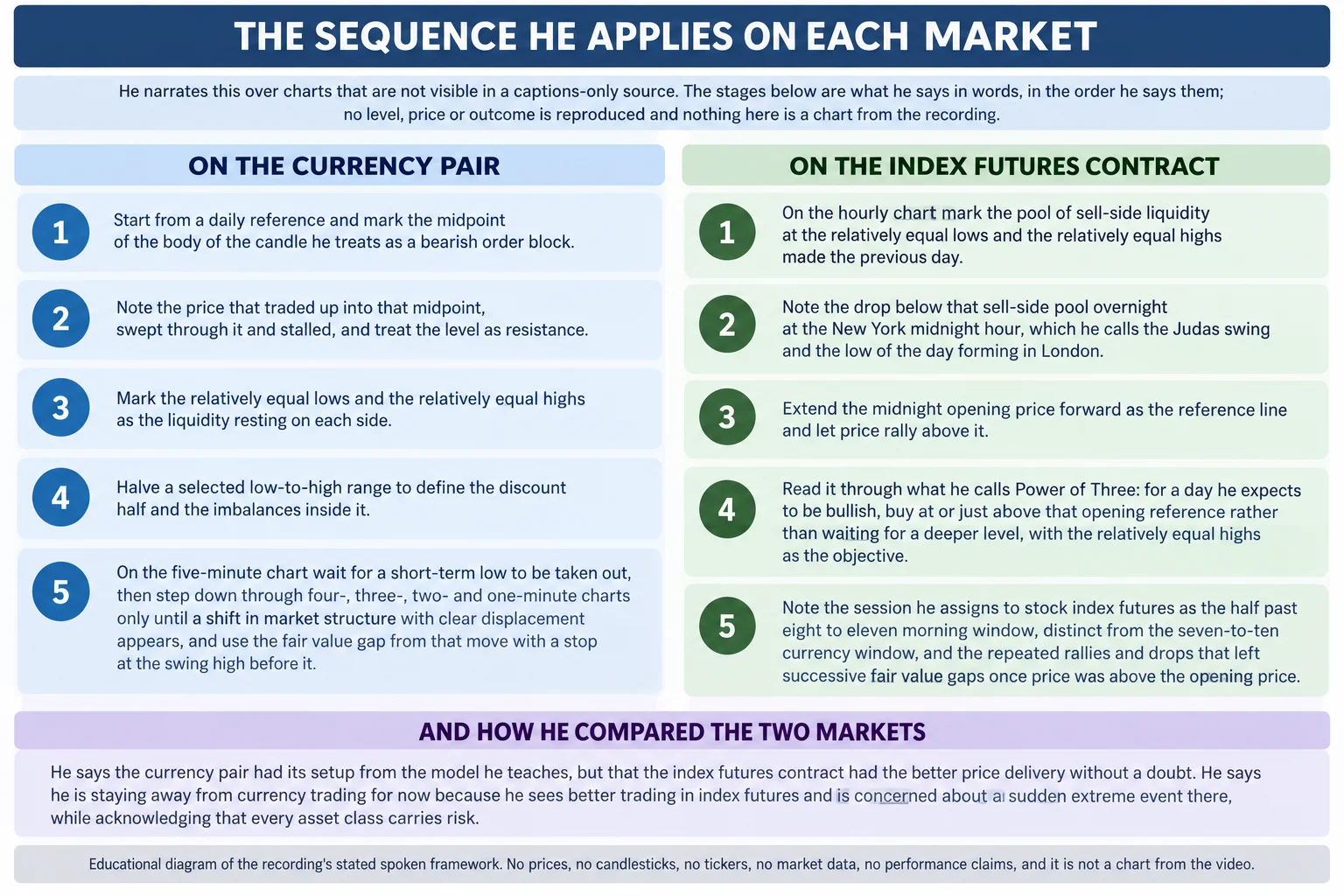
At 1:35 the review turns to USD/CAD, which had its own high-impact driver that morning: the Canadian inflation number at 8:30 (1:43). On the daily chart he marks a candle and describes splitting the body’s open-to-close range in half, calling that the mean threshold of a bearish order block (1:57 , 2:00). He says the market traded up into it, hit it as resistance, swept through it and stalled there before moving lower (2:05 , 2:12 , 2:17).
He then works down the time frames. On the 15-minute view he marks relatively equal lows as sell-side liquidity resting below price and relatively equal highs as buy-side liquidity above it (2:48 , 2:52), and describes halving a selected low-to-high range to define a discount area with imbalances inside it (3:46 , 3:48). He also names the 7:00 to 10:00 a.m. New York window as the kill zone he uses for currencies (3:59).
His process on the lower time frames is explicitly graduated. He says the five-minute chart alone would require waiting for a particular low, and that dropping from five minutes to four, three, two or one minute until the structure refines is the rule he teaches (4:19 , 4:35 , 4:43). He contrasts two downward moves and favours the one with the more energetic displacement that closes on its low, and says the four-minute view showed the same move more clearly (4:50 , 5:40). He describes using the fair value gap left by that move for an entry with a stop at the swing high before it, and narrates reaching for a discount objective with the move running about 50 pips or so (6:13 , 6:28 , 6:43). That figure is his own narration over a chart this source cannot show; it is not an independently verified measurement or an executed result.
The S&P contract and what he calls Power of Three
At 6:50 he moves to the September 2022 S&P futures contract and starts on the hourly chart, asking viewers to pause and look before he annotates anything (7:00). He marks sell-side relative equal lows as a pool of liquidity, the relative equal highs created the previous day, and then the drop below the sell-side pool overnight at the New York midnight hour, which he calls the Judas swing and the low of the day forming in London (7:23 , 7:34 , 7:41 , 7:43).
He frames the rest through what he calls Power of Three. For a day he expects to be bullish, he says price should move below the opening level, establish a low and then expand upward, so he wants to be buying at or below the opening price and ideally targeting the relative equal highs, though he adds that buying in close proximity to the opening price is acceptable too (7:54 , 8:04 , 8:10 , 8:16). He also separates the sessions: he says the 8:30 to 11:00 a.m. New York window is the morning session specific to stock index futures, distinct from the 7:00 to 10:00 currency kill zone (8:46 , 8:55).
The point he demonstrates is that these are the conditions he waits for rather than anticipating. He says he did not participate in anything at all until the Fed chair had already started talking (9:10), and describes the market opening, dropping, rallying, dropping and rallying again above the opening price, leaving successive fair value gaps in the process (11:22 , 11:26).
What he says about the trade he describes
At 10:44 he explains why he was not afraid to use live funds: he says he used the first fair value gap once price was above the New York midnight opening price, in a live account (10:49 , 10:52). He states his expectation was a run above an old high he identifies at 37.83 and three quarters, which he says he had mentioned on his own social feed (11:07 , 11:42 , 11:51), and he attributes his lack of nervousness to the work having already been done lower down, with stops run and price back above the midnight opening (11:57 , 12:03).
Two qualifications belong on that account. He says if the chair had not been speaking he would have been in the trade earlier, and that his rule exists because the chair’s appearance can set up heavy manipulation (11:01). He also says the model as he teaches it on his channel did not speak, and that he is not limited to it (17:55 , 17:59). Beyond that, he describes a live account and an intent; the captions contain no brokerage record, order data, fill, size or exit, so the transaction and any result are unverified.
Why he said he preferred index futures
At 14:48 he contrasts the two markets directly. He says both had setups from the model he teaches — USD/CAD with its high-impact 8:30 news — and asks which had the better price delivery, answering that index futures clearly did (14:56 , 15:01 , 15:06). Asked why he is moving away from forex, he says he is staying away because he sees better trading in index futures right now, and because he is concerned there could be a sudden extreme event in currencies that he does not want to be caught by (15:20 , 15:27 , 15:29).
He immediately qualifies that, and the qualification matters more than the preference: he says the same extreme-event risk exists in the stock market, that the bottom could fall out of it any day, and that there is risk in every market and asset class right now (15:34 , 15:43). His stated reason for preferring index futures is position sizing rather than safety: he says his largest position that year was ten minis, which he describes as 500 per point, and that a big move would hurt but not kill him, whereas heavy leveraged exposure in currencies into a gap or an extreme event could do real damage (15:57 , 16:08 , 16:21 , 16:42).
He notes that this is not a new position he has taken privately — he says he has been public and candid with his students about it, and that he still sees the moves but is not putting real money behind them the way he is behind index futures (16:57 , 17:06 , 17:09).
Rules, hindsight and what the recording does not show
The closing frame is the rules themselves. He says the reason he waits is that he is not taking a live trade until there has been some talking and the market has had a chance to shift sentiment, and that otherwise he sits on his hands and looks for imbalances or a stop run (18:40 , 18:51). He adds that he has been doing this for thirty years, that these rules are rigid, and that he is encouraging viewers to adopt the same discipline (19:21 , 19:28).
His explicit warning is about hindsight. He tells viewers not to look at the day’s move and think they would have done better, because the alternative was a faster move the other way, and because they were not taking that decision while the market was still creating the chart (19:50 , 20:00 , 20:06). He closes by saying the right way is to respect the risk, and that he may not trade at all the next day (20:16 , 20:26).
Read as a whole, the recording is a walkthrough of one speaker’s event-day routine and his own terminology — mean threshold of an order block, discount array, displacement, fair value gap, Judas swing, Power of Three, kill zone — together with a stated preference for one market over another on sizing grounds. It does not establish that the model predicts anything, and it contains no verified performance record. Sessions differ, and nothing here is a reason to copy the sequence or a recommendation to trade any of these markets.
Watch the source recording
ICT Index Futures & Forex Review – 06/22/2022
The Inner Circle Trader · watch page lists publish 22 June 2022 17:28 PDT and a length of 1,239 seconds, about 20 minutes 39 seconds · public, not unlisted. This recording is the primary source for every timestamp link on this page.
The recording is not embedded here. An embedded player was tested directly on 16 September 2026 from a BestProps page origin, on desktop and mobile viewports: the frame loads and then reports “Playback on other websites has been disabled by the video owner”, with no playable stream and no duration reported. The link above opens the recording on YouTube itself.
Resources
The regulatory pages below are cited for background risk and disclosure language only: the CFTC advisory notes that hypothetical trading results are typically simulations over historical price data rather than real fills, and Investor.gov states that day trading is extremely risky and can result in substantial financial losses in a very short period. The Federal Reserve page is the primary event-calendar source for the kind of scheduled release and testimony the recording is organised around. None of them evaluates this speaker, tests any concept named in the recording, or verifies a level or a result. Any ICT, smart-money or third-party indicator, script, note set or re-upload circulating outside the publishing channel’s own page is unofficial and untested here.
- [1] ICT Index Futures & Forex Review – 06/22/2022 — The Inner Circle Trader (primary source; watch page read 16 September 2026, published 22 June 2022 17:28 PDT, listed at 1,239 seconds).
- [2] The Inner Circle Trader — official YouTube channel (read 16 September 2026) — the publishing channel for the index-futures and forex session reviews this recording belongs to.
- [3] U.S. Commodity Futures Trading Commission — Fraud Advisory: Commodity Trading Systems Sold on the Internet (read 16 September 2026) — warns that hypothetical trading results are typically simulations using historical price data, the standard applied here to unverified trading claims.
- [4] U.S. Securities and Exchange Commission, Investor.gov — Day Trading (read 16 September 2026) — the regulator’s plain-language warning that day trading is extremely risky and can result in substantial financial losses in a very short period. Background context only; it does not address this recording.
Primary source: ICT, “ICT Index Futures & Forex Review – 06/22/2022”, The Inner Circle Trader; watch page publish 22 June 2022 17:28 PDT, listed at 1,239 seconds. The transcript used was the recording’s own automatically generated English caption track, not human-verified captions, so ambiguous wording is qualified rather than corrected silently. The recording’s charts are not reproduced anywhere on this page.
This commentary is for education only and is not investment advice. Futures and foreign-exchange trading involve substantial risk, and neither the recording nor this article establishes that any pattern, level or model will be profitable.