
Key takeaways
ICT’s live morning-session recording demonstrates trade selection without executing a trade, applying his rule to avoid the morning after a large-range up or down day because inaccuracy, chop, losses, and FOMO are more likely, then trade or reassess the PM session instead.
Read the full summary
ICT’s live morning-session recording demonstrates trade selection without executing a trade, applying his rule to avoid the morning after a large-range up or down day because inaccuracy, chop, losses, and FOMO are more likely, then trade or reassess the PM session instead. On a PPI release day he anticipated a buy-side liquidity run above the midnight open followed by a move toward sell-side liquidity below the prior day’s low, but lethargic movement, failure to clear fair value gaps, lingering near the midnight open, and stagnation at the range midpoint showed insufficient velocity. His cancellation rule is to close if price takes the named candle’s high rather than absorb the full initial stop, while a return into the candle body remains permissible. His profit rule is to take a partial at the discount fair value gap because neither the broker nor platform will secure it automatically, illustrated with 2 per cent risk and a half per cent partial. ICT says the algorithm prioritizes time before price, valid expansion should occur quickly, and fair value gaps, liquidity pools, and news drivers do not guarantee alignment. Knowing where an idea is likely wrong, observing instead of participating, and following predefined no-trade parameters are presented as the first defenses against losses and drawdown. No realized session result or reliably transcribed chart price levels are provided.
How we researched this article
BestProps used document-based research from primary firm sources, checked September 24, 2026. The complete source list, scope, limitations, and commercial-state record appear near the end of this article.
ICT Morning Session Recording
The title above is the recording’s own, and the session it documents is a live one: he is narrating a market as it trades, with no position on. From the opening minutes he says he has already posted on social media that he is watching a buy-side liquidity pool and thinks it will be hunted on the release of the PPI number due in about a minute and a half, and he points out a volume imbalance between the candle bodies he is watching (2:01, 2:05, 2:11, 2:17, 2:25, 2:31). In the same breath he states the condition that governs everything after it: he is not going to push the button, because the previous day was a big day (2:45).
He then explains why the recording is being made at all, and it is worth keeping separate from the market call: it is important, in his words, that the viewer see why the morning session after a big down day or a big up day should be avoided and why the PM session is traded instead (2:50, 2:56, 2:59). He repeats the rule where it actually bites, when he has just described a trade he would otherwise take: because it is the day after a large-range day, do nothing, because that morning is more prone to be either a losing trade or a session where you get stuck in chop (4:31, 4:38). Later he restates it in the first person, saying he is more prone to be inaccurate in that session (14:43), and that if he had made money the previous day and traded the following morning anyway he would be breaking his own rules (20:45, 20:50).
A sourcing note belongs here because it changes what can be claimed. The transcript used for this rewrite is automatic local speech-to-text of the recording’s full audio (Whisper large-v3-turbo), not human-verified captions. The integrity checks passed: the decoded audio is complete and matches the listed duration, and three characters are flagged low-confidence, all of them inside ordinary words rather than figures. That matters for this particular video because the recording is full of spoken chart levels, and the automatic transcription breaks those digit strings into irregular groups, so the article does not reproduce them. Where a level is relevant to the reasoning it is described rather than quoted. The charts themselves were not available to this review, so nothing below describes what a chart looked like.
ICT Morning Trade Setup to Avoid
The structure of the morning he expects goes like this. On the heels of the PPI release he thinks price will be pushed above the opening price at midnight, taking the short-term stops there, and then attack the sell side; he refers to that sequence with his own label, “power three”, and says it kicks in after the short-term stops are taken (2:31, 2:35). He is explicit that other traders will take this one, and that he expects it to be an instance they regret (3:31, 3:35, 3:41, 3:46). On the news driver itself he says a high-impact print is what he wants to see overlap the gaps and attack the low aggressively before the move down into sell-side liquidity (3:56, 4:13).
Because he is not trading it, the rest of the session becomes a study. He describes the population of traders who are positioned differently: anyone who was looking to trade a breakout below the previous day’s low has sell stops resting below, and he is watching for continuation that would take that low out (6:15, 6:20, 6:27, 6:33, 6:39). He also notes where the liquidity sits, saying that a large amount of it remains below the previous day’s low (8:08).
Price Move ICT Wanted
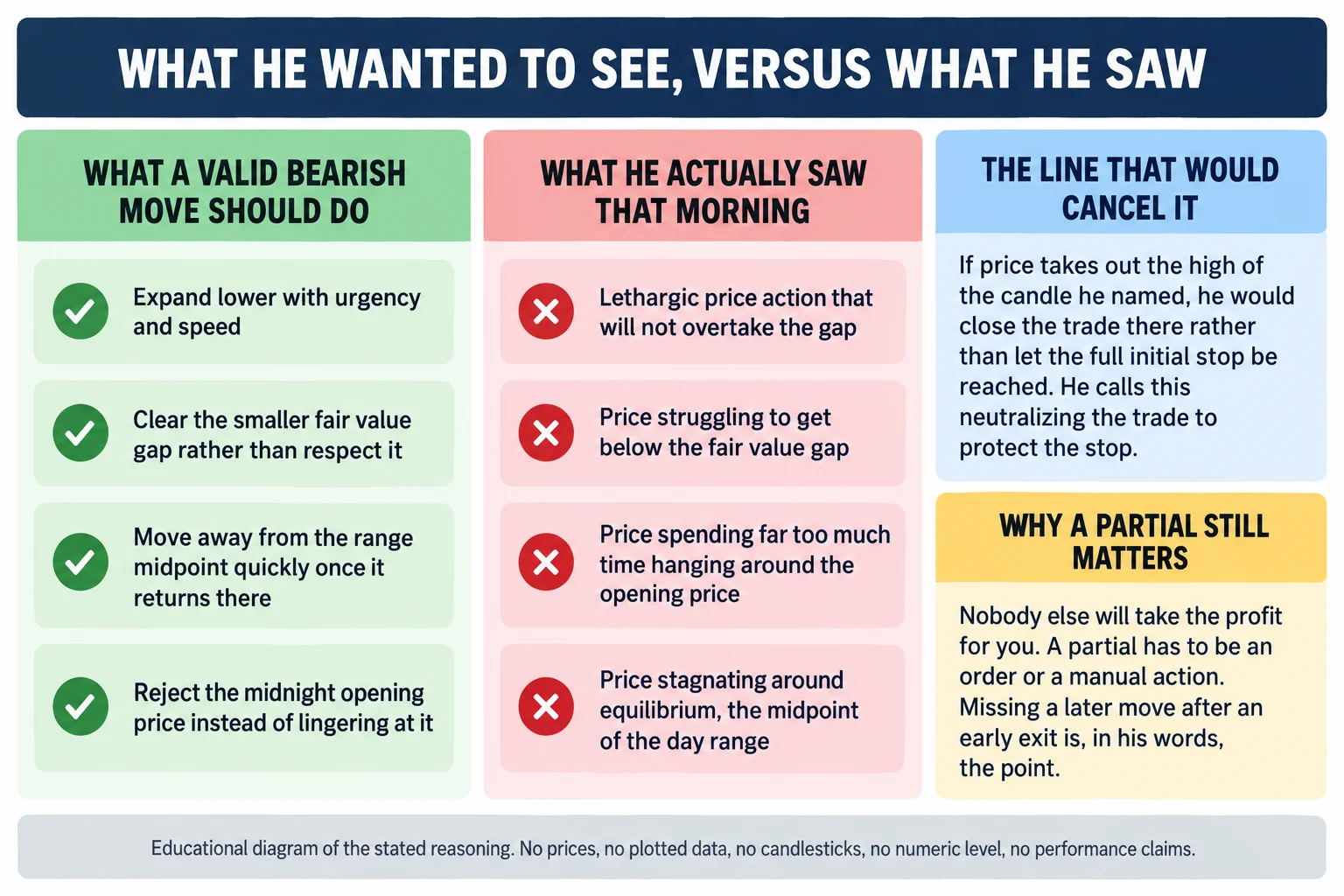
His requirement is about speed and intent, not about a specific level. Right after annotating the high as a stop-loss reference (5:08, 5:20) he says he would have wanted price to come straight down and overtake the gap; instead it is being lethargic so far, which he calls a problem, because it would need to really expand lower (5:44, 5:54, 5:59). He goes further when price is inside the smaller fair value gap: he does not want that gap respected at all, he wants price to come right on into it and through it (6:49, 6:55, 7:01). When it is struggling to get below that gap he flags the struggle directly (7:41).
Two further conditions sharpen the same point. The first is the midnight opening price: by 10:45 he is pointing out that price is spending far too much time hanging around it, and he says it should already have rejected it and gone lower (10:48, 10:49). The second is equilibrium. At 22:43 he takes the high and the low of the day and asks where price currently sits inside that range, answers that this is equilibrium, and says stagnation around equilibrium is exactly what he does not want to see: if price returns to the midpoint it has to move quickly away from it, because equilibrium is acting as fair value (22:51, 22:58, 23:02, 23:07, 23:10, 23:15).
Morning Price Action ICT Saw
The observations are all failures of urgency in his terms. The move is lethargic rather than expansive (5:54, 5:59); price will not clear the fair value gap (7:41, 7:59); and it is lingering at the opening price instead of rejecting it (10:45, 10:48). He also attributes part of the sideways behaviour to liquidity already taken, saying the liquidity below two earlier lows has been run and that this is why price is stuck in the range (7:59, 8:04, 8:08). At 31:20, near the end, he is still noting how much time price is spending in the same area, and he calls the session frustrating for anyone trying to go long and for anyone trying to go short (31:20, 31:24, 31:26, 31:28).
ICT Trade Cancellation During the Morning Session
The clearest management rule in the recording is a cancellation rule rather than a stop. He picks one candle and says that if price goes back above that candle’s high, that would be the instance where he would neutralize the trade, in his words, protecting the stop (9:42, 9:47). He then answers the question he says he is asked all the time, how a trader knows when to kill a trade and keep the full initial risk from being absorbed: the answer is the behaviour he just outlined, so if that candle’s high is taken out he would close the position there instead of letting the stop be reached (10:53, 10:59, 11:06, 11:08, 11:16, 11:19). He stresses that nothing is being executed while he talks: this is not a live trade, but if it were one he would be ready to close it out (11:29, 11:39).
He is careful about one exception, because it is the natural objection: returning into the body of that candle is permissible, and only going back above its high triggers the cancellation (9:37, 9:42). He adds a detail about how he thinks the rule is best framed when price has already traded down into a discount area and then comes back up: if the sequence is going to work, price should not need to return to that zone again at all (17:30, 17:37, 17:41, 17:45).
Why ICT Takes Partials Early in Morning Trades
From 15:13 he reviews the session for study purposes and says the move did what he expected in sequence: it traded up into the fair value gap, then down into the discount fair value gap, and that discount area would have offered a partial (15:13, 15:21). He notes he would not be adjusting the stop at that point, because the earlier decision already covers it: taking out that candle’s high means neutralizing the trade and protecting the full stop (15:30, 15:36, 15:41).
He then defends the partial against the objection he says students raise, which is that taking a small fraction of the risked amount is pointless. His framing is blunt: you are trying to make money, and unless you take something off the position when it gives you the opportunity profitably, the broker will not do it for you and the platform will not do it for you, so the profit has to be taken by an order or manually (16:16, 16:20, 16:25, 16:28). He uses a hypothetical to make the arithmetic concrete (a two per cent risk with half a per cent taken off) and asks why a trader would refuse that (15:56, 16:02, 16:08). These figures are his own illustration of the argument, not a record of any position he held.
He also takes the counter-argument head on. Suppose, he says, price comes up, takes out the short-term high, then runs down and takes the sell side after all; viewers who heard his expectation will say he closed the trade and therefore missed it (16:43, 16:48, 16:53, 17:01, 17:05, 17:08, 17:13). His answer is that this is the point: risk has to be managed within the bounds of high probability, and once price has run into the discount area and then come back above that candle’s high, the logic he required is no longer intact (17:19, 17:23, 17:30, 17:37). He closes the thought by saying that people who want to see him get it wrong will get their illustration, and that the recording itself is the illustration of why the rule exists (13:59, 14:06, 14:12, 14:17).
ICT Morning Sessions Put Time Before Price
He states the ordering explicitly: the first thing he teaches is that the algorithm tends to lean heavily on time first and then price (17:55, 17:59). The concrete time element in this session was the 8:30 news release, and he says that what happened next was what should have been expected from it, the run up into the fair value gap, the break lower, and the trade down into the discount fair value gap relative to the range low and high that had formed (18:07, 18:12, 18:18, 18:23). That is why he says a trader who did not take the partial at the discount area is regretting it by then (18:23, 18:29).
The same time logic explains the midpoint discussion. He describes what he wants when a move is working: range expansion with velocity, now rather than minutes ago, and he says that when he records his own expectations he types them out in exactly those terms (22:15, 22:20, 22:26, 22:32, 22:37). Stagnation is therefore information, not just an inconvenience, and he repeats later in the session that price is still hanging around the midway point between the high and the low, which he illustrates with a retracement reading rather than treating the midpoint as an objective (26:33, 26:39, 26:45, 26:49, 26:52).
ICT Trade Selection Avoids Morning Session Losses
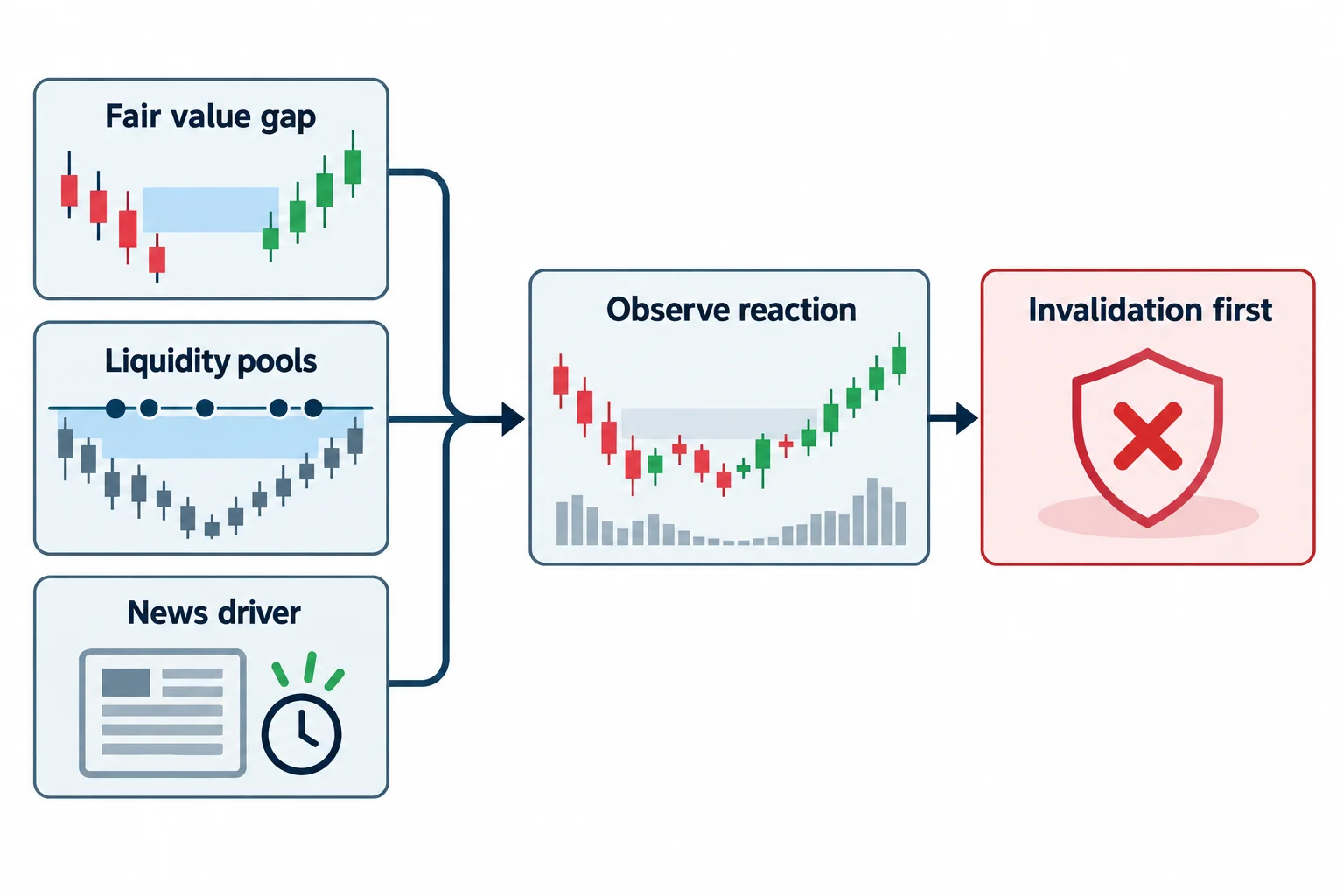
From 18:36 he generalises the case study into a claim about process. Trade management and trade selection are, in his words, the first stage of how losses and drawdown are mitigated, and a trader has to understand how they are going to lose (18:36, 18:42, 18:47, 18:51). He lists what does not guarantee a trade on its own: being able to see a fair value gap, seeing liquidity pools, and having a news driver arrive does not mean everything will align (18:51, 18:56, 18:59, 19:02). He adds that this is why the losing scenario matters as study material at all, since the point is to know in advance where you are likely to be wrong (19:21, 19:27, 19:34).
The instruction that follows is to engage as a study rather than as a participant: watch how price reacts, note what should expand and take out the highs, and stay in observation, because without parameters that keep you from pushing the button you will eventually push it (19:55, 19:59, 20:06, 20:14). He calls knowing when not to do something one of the most important tenets of longevity and consistency, and says plainly that there is nothing wrong with sitting in front of the charts studying price (20:14, 20:19, 20:22, 20:26). He also says he would rather the market take out his hypothetical stop in this session, so that the audience sees what a losing instance looks like, than have the rule go untested and unexplained (20:55, 21:01, 21:04).
Avoid Morning Session FOMO and Trade the Afternoon
He ties the rule to trader psychology rather than to market structure. After a range as large as the previous session’s, the people who did not participate are the ones who want to be in something, and he names the mechanism directly: excitement and fear of missing out become new catalysts for them to engage, and what usually happens is that they get chopped up (12:00, 12:06, 12:09, 12:16, 12:21). He later describes the same dynamic at length, saying that regret over the previous day’s move drives traders to rush into the next session and into exactly the consolidation day where price chops up and down (29:15, 29:19, 29:24, 29:30, 29:34, 29:39). He also makes a point about younger students who have watched him do something and conclude that they can do it too, while ignoring the sessions he describes as his own problem areas (29:47, 29:54, 29:58, 30:06).
His own framing of those conditions is memorable: he calls the morning session after a large-range day “kryptonite” to him, and says that if he is going to trade like Superman he is not going to stand where the playing field is covered with it and his weaknesses have the advantage over his strengths (30:06, 30:13, 30:19). He grounds that in experience rather than modesty, saying he knows these are his problem areas because he has been doing this long enough to know where he is likely to fall victim to price, and that outside those areas his execution is cleaner (26:15, 26:18, 26:22, 28:18, 28:23, 28:33, 28:40). He also refuses the emotional version of the lesson: he says he does not regret missing a move, and does not want viewers to feel they have missed something, because the rule says he cannot trade that session in the first place (28:40, 28:44, 28:49, 28:54, 28:58, 29:04, 29:10).
What he does instead is wait for the afternoon. From 30:26 he says a chart annotation is not automatically a trade signal, and that he would rather wait until the afternoon, when the range formed in the morning and the liquidity above and below it going into the New York lunch are better defined, and work with that as a PM session (30:26, 30:30, 30:33, 30:37, 30:43, 30:50, 30:53, 30:58, 31:02). He is explicit about what waiting is and is not worth: it does not mean he will have a winning trade, only that he is waiting for something more likely to be trustworthy (31:07, 31:09). He ends the recording saying he does not need anything in the afternoon but will keep hunting for it (31:47, 31:53).
ICT Tough Lessons After Large Range Days
The routine the recording describes, stripped of the market-specific detail:
- Check what the previous session actually did before forming a plan for the morning. A large-range day changes the plan.
- Treat the morning after a large-range day as a study session rather than a trading session, even when the setup looks attractive.
- Define the behaviour that must happen for the idea to be valid, and the single line that cancels it.
- Take the partial when the market offers it, because nothing else will secure it.
- Treat time as the first input: stagnation at the opening price or at the range midpoint is evidence against the idea.
- Write down the conditions in which you personally underperform and refuse to trade them.
What the recording does and does not establish should be kept apart. It supports the rule as he states it, the sequence he expected, the cancellation line he would have used, the partial at the discount area, the time-and-price emphasis and the waiting-for-the-afternoon preference, because he says all of those out loud. It contains no statement of his own realised result, no completed trade on the account, and no measurement of how often the rule helps or costs him. The levels he names on the chart cannot be reconstructed with confidence from the automatic transcription, so none are reproduced here, and because only the audio was available to this review nothing above describes the charts themselves. This is one trader’s description of his own filter, not a tested method and not a recommendation to copy a trade.
Watch the ICT Morning Session Recording
The Tough Lessons: Why I Avoid AM Sessions After Large Range Days
The Inner Circle Trader · uploaded 14 September 2022 · 32 minutes 4 seconds. This recording is the primary source for every timestamp link above.
The recording is not embedded here because the video owner has disabled playback on other websites. That was tested directly on 15 September 2026 from a BestProps page origin at both desktop and mobile widths: the embedded player frame loads, then reports “Playback on other websites has been disabled by the video owner” with no duration and no playback progress, while the video itself plays normally on YouTube. No empty or half-working player is left on this page.
The watch page was read on 15 September 2026 and is publicly listed as The Tough Lessons: Why I Avoid AM Sessions After Large Range Days by The Inner Circle Trader: uploaded 14 September 2022, not private and not unlisted, with the player reporting a duration of 1,924 seconds, about 32 minutes 4 seconds. The audio used for this article runs to 1,923.0 seconds, so the transcription and the listed duration agree. The recording is a live session narrated in the first person, and its description ca