
Key takeaways
In this Mentorship Core Content lesson, ICT sets out a screening routine for what he calls currency mega-trades — swings he describes as falling somewhere between a swing trade and a position trade rather than day trades.
Read the full summary
In this Mentorship Core Content lesson, ICT sets out a screening routine for what he calls currency mega-trades — swings he describes as falling somewhere between a swing trade and a position trade rather than day trades. The ingredients are quarterly shifts, seasonal tendencies used as context rather than instruction, mandatory confirmation from the US Dollar Index, the seven major pairs and their currency futures, and a relative-strength comparison that ends by pairing the strongest currency with the weakest. He offers two ways to rank the field: comparing highs and lows on the underlying futures contracts, or overlaying pairs on an MT4 chart with USD/JPY, USD/CAD and USD/CHF inverted for a like-for-like view. He then walks through 2017 futures charts and nominates the Australian and Canadian dollars as leaders and the yen as the laggard, before describing CAD/JPY and AUD/JPY as the resulting blends. The pip figures quoted further down are the speaker’s own retrospective description of chart swings he displayed on screen; the caption track contains no price data, no entries, no fills and no results, and nothing here is a tested system or a recommendation.
How we researched this article
BestProps used document-based research from primary firm sources, checked September 24, 2026. The complete source list, scope, limitations, and commercial-state record appear near the end of this article.
ICT Mentorship Core Content – Month 11 – Forex & Currency Mega-Trades runs 22 minutes and 35 seconds. The watch page gives an upload time of 24 October 2022, while the charts and the June references discussed inside the recording belong to 2017 — the lesson is a re-release of an older mentorship month, so the upload date and the market period are two different things. This article is built from the recording’s full 534-segment auto-generated English caption track rather than from its title, thumbnail or description. It is a description of one trader’s analytical routine and his retrospective reading of charts; it is not evidence of a repeatable edge or a recommendation to copy any trade.
He opens by pointing viewers back to his disclaimer and says the material is for informational purposes only (0:05, 0:26). The recording covers futures, forex and options on both.
Quarterly shifts supply the timing, not the direction
His starting point is what he calls quarterly shifts, which he says every mega-trade hinges on. His stated interpretation is that markets tend to form an intermediate-term turning point roughly every three months (1:08). He is explicit that the timing element alone gives no directional bias, and that the direction has to come from the other components — chiefly what he calls institutional order flow. The overlap of a quarterly window with those other conditions is what he describes as the trigger for an explosive move.
Seasonal tendencies as context, not as instruction
Seasonality is the next ingredient (1:45). He describes the historical seasonal patterns covered in earlier lessons as road maps and precursors rather than answers, and says they are not a cure-all. His caution is the useful part: if a seasonal pattern points one way while market internals and technical conditions point the other, he says the trade idea should not be forced to fit the calendar. The ideal case is alignment across several factors rather than reliance on one.
The Dollar Index as the confirmation filter
At 3:25 he argues that any significant move in the currency market has its roots in US Dollar Index price action, and turns that into a rule for his own screening: without support from the Dollar Index, he says, the idea is not a qualified mega-trade setup. His illustration is a bullish pound argument, which he says should come with a dollar in a sell condition, and the mirror case of a bullish dollar alongside a weaker foreign currency. He does concede that on very short and intraday horizons the index can consolidate while individual currencies still move against it — the confirmation requirement applies to the longer-horizon trade he is describing, not to every short-term fluctuation.
The seven majors, and their futures contracts
He narrows the field to seven relationships — EUR/USD, GBP/USD, AUD/USD, NZD/USD, USD/CHF, USD/CAD and USD/JPY — and says these are all a trader needs to follow, even one who ultimately wants the wider-range crosses (4:36). The reason is that the majors expose the condition of each individual currency, which is the information a cross is built from. He adds that each major has a corresponding currency futures contract, and that the underlying futures can reveal an opportunity that later unfolds as a mega-trade (6:11).
Two ways to compare relative strength
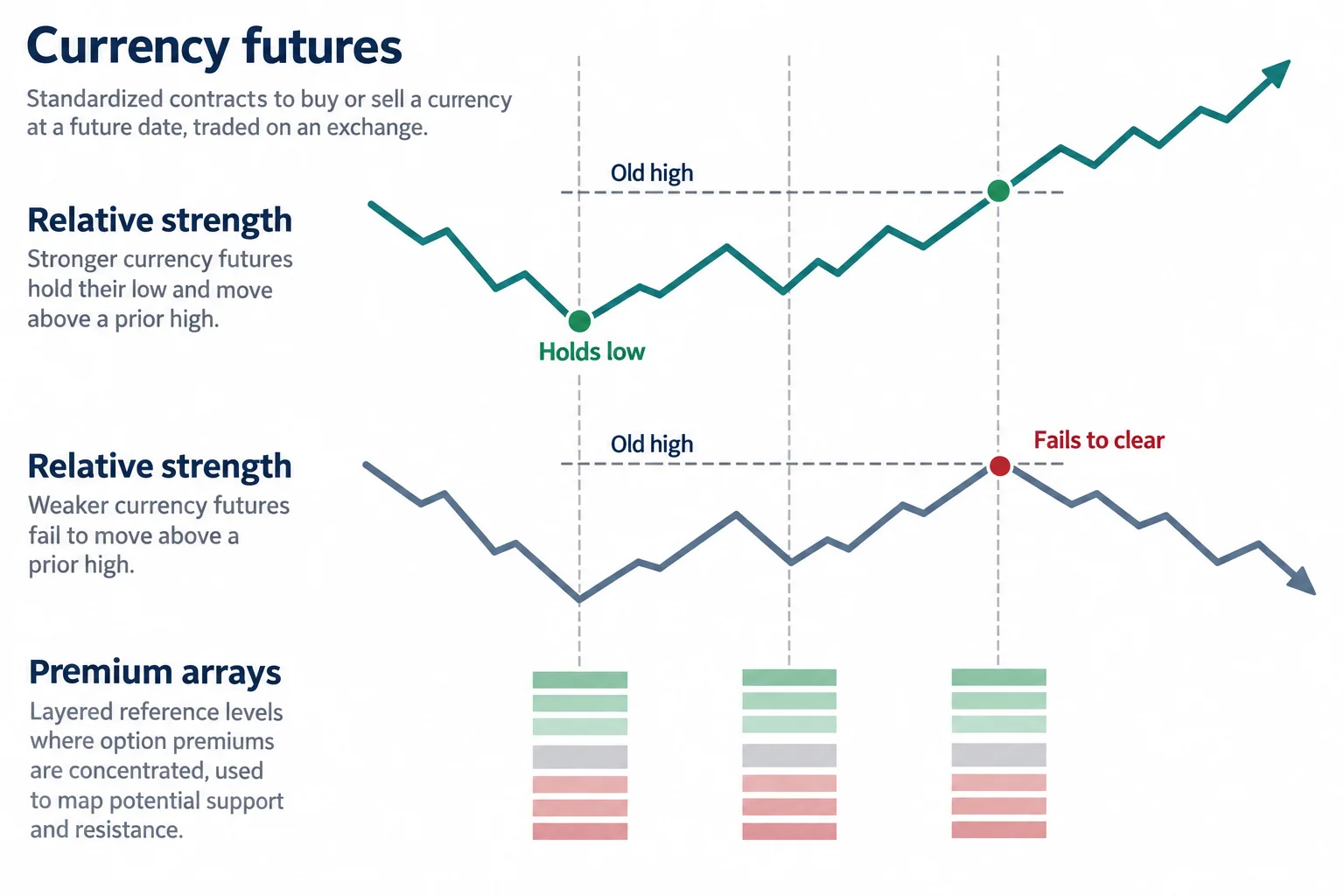
From 6:45 he sets out two approaches, and says either one will surface the same significant movers.
Compare the futures contracts directly
The first is to work through the underlying currency futures and compare their highs and lows (7:00). Under a weak-dollar premise he looks for contracts willing to go higher that also hold their lows, and for contracts able to trade through old highs or what he calls premium arrays. He treats that combination as relative strength, and says contracts that falter or fail to clear those levels are giving away underlying weakness and should be crossed off a buy list.
Overlay the pairs in MT4
The second method is an overlay on the MT4 platform, where multiple pairs are stacked on one chart and their highs and lows compared directly (8:21, 8:30). The practical detail he stresses is inversion: pairs quoted with the foreign currency first and the dollar second are directly comparable, while USD/JPY, USD/CAD and USD/CHF are quoted the other way round and have to be reversed before the comparison is like-for-like (9:10, 9:30). He acknowledges the resulting chart looks like a tangle of lines, and says that once you know what you are looking for it yields a great deal of information.
One caption caveat worth flagging: the auto-generated track renders the divergence term he uses in this passage as “S&T Divergence” (8:43). The wording is a caption artefact and should not be treated as a precise indicator name without checking the audio; he uses SMT divergence in his other lessons, but this article will not assert which term was spoken here. The supported point is only that he reads divergence across the overlaid pairs as part of the strength assessment.
The screening sequence he summarises
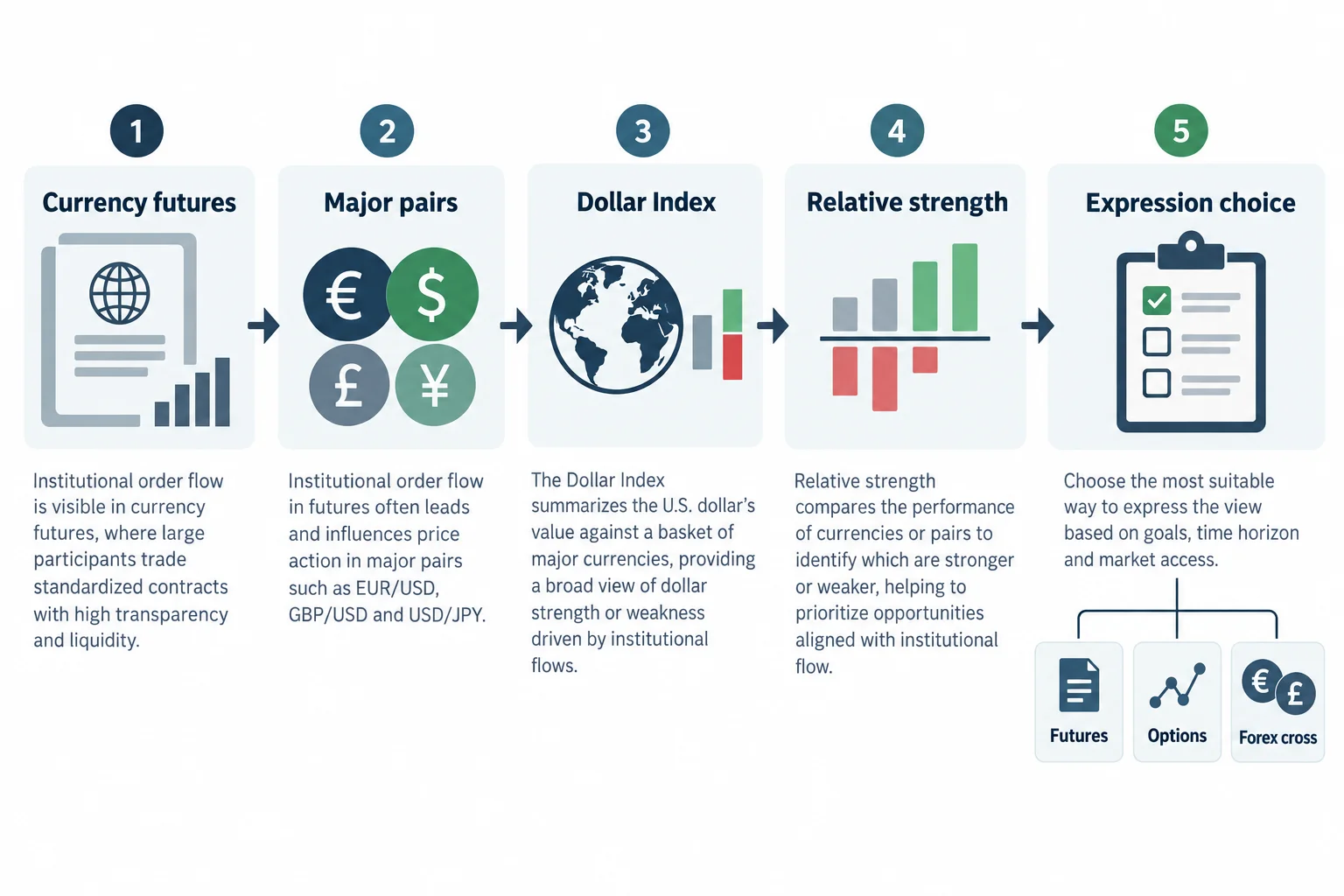
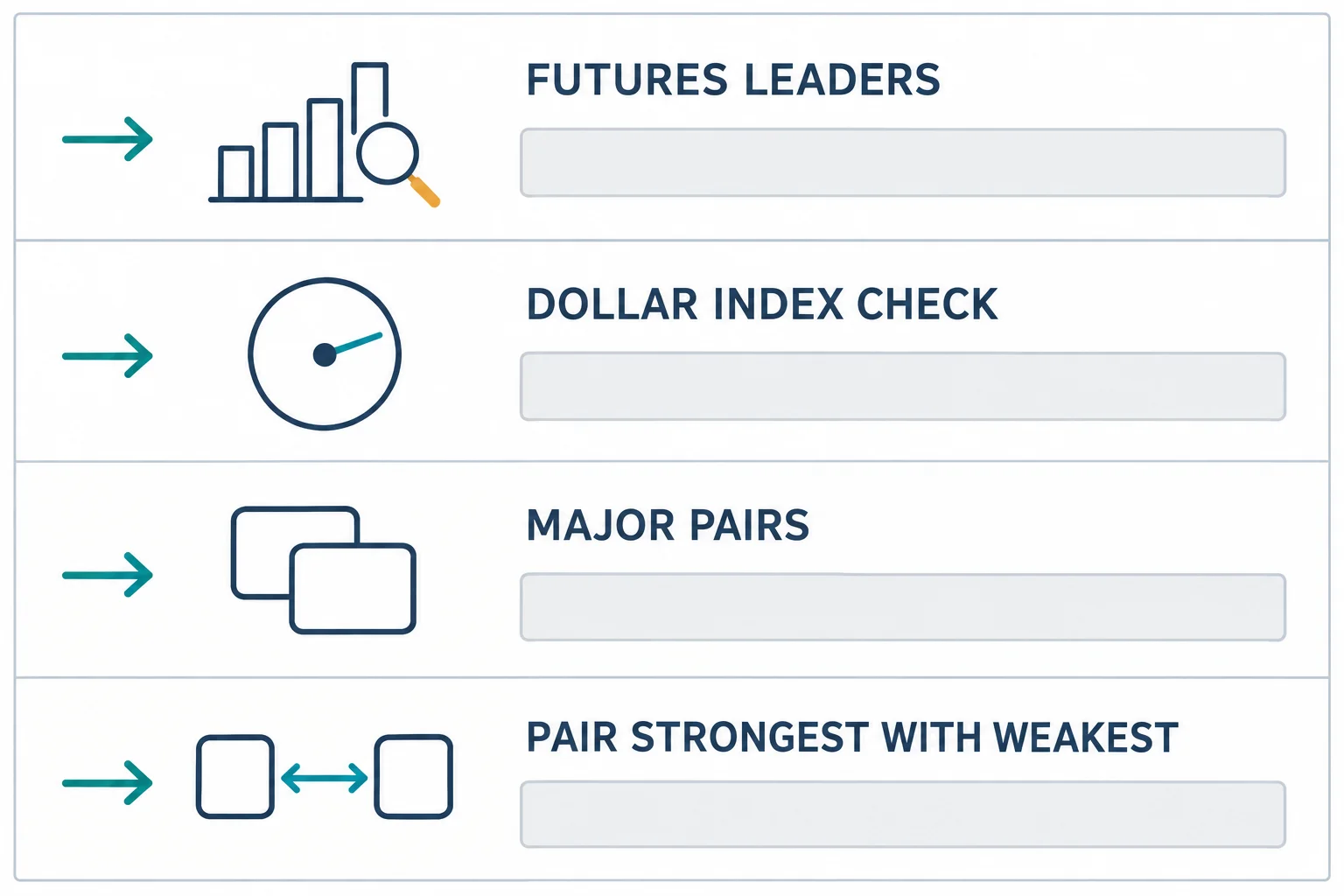
At 11:08 he reduces the process to a list, describing it himself as an overview rather than a complete approach:
- Start with the currency futures and look for strong and weak currencies, reading their institutional order flow.
- Study the corresponding major pairs — a strong euro futures contract means knowing EUR/USD, a strong Canadian dollar means knowing USD/CAD.
- Confirm the thesis against the direction of the Dollar Index.
- Rank the shortlist by relative strength to find the strongest of the strong and the weakest of the weak.
- Decide how to express it — the futures contract itself, an option on those futures, or the forex cross that combines the two currencies.
His stated markers for the two extremes are symmetric (12:55): strong currencies move through premium arrays and old highs easily and hold higher lows, while weak currencies cut through discount arrays and old lows easily and keep making lower highs. He also notes the lesson will be expanded in his own August material, so the recording is a summary of a larger process rather than its full detail (14:08).
What the 2017 charts were said to show
The second half of the recording is a walkthrough of futures charts that are not visible in the caption track, so everything below is his spoken description of those charts and nothing more (14:19).
He describes the Australian dollar as a clear relative-strength leader at the time, finding support at discount arrays and pushing through old highs (14:21). The euro is called firm to bullish but held back by a short consolidation (15:02). The pound is dismissed for mega-trade purposes as range-bound and sloppy, despite his having called it higher on other technical grounds (15:24). The yen is described as having met resistance in June and sold off after filling a gap at what the captions render as “the 92 big figure” — a chart reference quoted as spoken, not a price scale this article can independently establish (15:45). The Swiss franc gets the same treatment as the euro and does not qualify (16:02). The Canadian dollar, by contrast, is called a leadership market with expansion on the upside and shallow retracements (16:19). The New Zealand dollar is strong but is set aside because the Australian dollar shows the stronger order flow and the two are closely correlated (16:53).
The shortlist that produces is the Australian dollar and the Canadian dollar on the strong side, with the yen as the weak currency (17:35). He notes the same conclusion can be expressed through the futures contracts themselves — long the Canadian and Australian dollar contracts, or calls on them (18:05). For a forex expression he blends the strong currency with the weak one, arriving at CAD/JPY after checking which cross actually contains both currencies, and cites a low in the second week of June from which the market rallied (18:52, 19:47). The swing he associates with that example is 845 pips. He repeats the construction with AUD/JPY and quotes 630 pips (20:43, 21:04), and closes by contrasting those figures with what he calls a few hundred pips in the euro and the cable over the same period (22:11).
Two of his own caveats are worth carrying across with the numbers. He says plainly that he does not trade the crosses much and warns that trading them simply because you expect volatility can hurt you — the approach is presented for an intermediate-term horizon, not as a scalping method (19:59). And his framing is explicitly institutional: he describes the sequence as how banks and large institutions work through the currency board, which is his interpretation of market structure , not a verified account of dealer behaviour (20:20).
What this lesson does not establish
The transferable idea is comparative filtering: rather than picking a volatile cross in isolation, build the case from the broad relationships inward, require the dollar backdrop to agree, rank the candidates and only then select the extreme pair. What the recording does not contain is just as important. There are no entry or exit rules, no position sizing, no risk control, no stated win rate or drawdown, and no account results; the pip figures describe chart swings the speaker pointed at in 2017, not trades he reports having taken, and they cannot be checked from captions alone. The correlation, seasonality and relative-strength relationships he relies on can change, and a ranking that identified leadership in June 2017 says nothing about any current market. Treat the material as a description of the analytical hierarchy taught in this specific mentorship month.
Watch the original recording
Watch the original lesson on YouTube
This recording cannot be played inside another website. Its embedded player was loaded from a BestProps origin and clicked on 15 September 2026 at both desktop and mobile widths: it reported “Video unavailable” and “Playback on other websites has been disabled by the video owner”, the video element never advanced past readyState 0, and no duration or playback progress was available. The recording’s own watch-page data agrees, reporting the video as not playable in an embed, so no iframe is placed here. The video itself is public and available directly on YouTube.
Watch ICT Mentorship – Forex & Currency Mega-Trades on YouTube ↗
Source and further reading
- ICT Mentorship Core Content – Month 11 – Forex & Currency Mega-Trades — the primary source for this article. Every description, ranking and pip figure above comes from this recording’s caption track; use the timestamp links to compare each point with what was actually said.
- The Inner Circle Trader YouTube channel — the publisher’s own channel, where this core-content month and the lessons it refers back to are posted. Unofficial reuploads and third-party summaries are not the source used here.
- ICE — US Dollar Index futures contract specifications — the exchange listing for the dollar index instrument that the lesson treats as its confirmation filter. Useful for checking what the index actually tracks, which currencies it weights, and how the contract is quoted. Third-party vendor material, not an endorsement of this method.
- Federal Reserve H.10 — historical foreign exchange rates — official daily exchange-rate series published by the US central bank, covering the June 2017 period the lesson refers to. This is a way to check what the major pairs actually did over that window rather than relying on the speaker’s retrospective chart description. Official statistical data; it does not assess any trading approach.
- CFTC — Learn & Protect investor education — US regulator material on leveraged retail forex and futures trading, including the risks of trading on margin and of promotions built on past examples. General context for reading any method presented with historical charts; it does not assess this presenter or any example above.
BestProps is not affiliated with the Inner Circle Trader, ICE, the Federal Reserve or the CFTC, and no source listed here endorses this article. Mega-trade, quarterly shift, seasonal tendency, premium array, discount array, relative strength and institutional order flow are used as descriptive terms for what the recording teaches. CAD/JPY and AUD/JPY are the speaker’s own retrospective chart selections from June 2017 and the 845- and 630-pip swings are his reported measurements of swings he displayed on screen — the caption track carries no price data, no position details, no transaction costs and no results, so they cannot be verified here and are not presented as achievable outcomes. Currency trading on margin and options on futures involve substantial risk of loss. This is independent educational commentary, not official ICT material, not a tested trading system and not investment advice.