
Key takeaways
This is a June 2017 ICT mentorship lesson on index futures, titled “Lesson Four — projected range and objectives”.
Read the full summary
This is a June 2017 ICT mentorship lesson on index futures, titled “Lesson Four — projected range and objectives”. He opens with a disclaimer that the session is a commodities discussion, that he is not a licensed commodity trading advisor, and that everything in it should be viewed as paper-trade material only. The lesson then presents a set of conditional templates for how an index trading day may unfold across the New York morning, lunch hour and afternoon. Each template is built on the same three inputs: institutional order flow on the daily or four-hour chart, premium and discount arrays as possible objectives or reaction areas, and the prior session extremes where stops presumably rest. He walks through six templates in detail — two-session up close, two-session down close, morning rally with afternoon reversal, morning decline with afternoon reversal, and the two consolidation templates for unclear order flow — while saying the set he actually uses on the S&P contains eight. Lunch consolidates with shallow retracements in all of them except the trending days. The June 22, 2017 S&P futures example he says he projected in real time (a short from 2,437) is presented as his own planning record; the recording shows no chart, no fill and no result, so nothing here is verified performance.
How we researched this article
BestProps used document-based research from primary firm sources, checked September 24, 2026. The complete source list, scope, limitations, and commercial-state record appear near the end of this article.
The video ICT Mentorship Core Content – Month 10 – Index Futures – Projected Range & Objectives carries an upload timestamp of 20 October 2022, 12:00 p.m. Pacific, on the Inner Circle Trader channel, and the watch page reports a runtime of 17 minutes and 46 seconds. The lesson itself is not from 2022: the opening captions place it at “June 2017, ICT mentorship, index trading concepts, Lesson Four — projected range and objectives” (0:19, 0:22, 0:24). The upload date and the spoken date describe different things, and the content is the 2017 material.
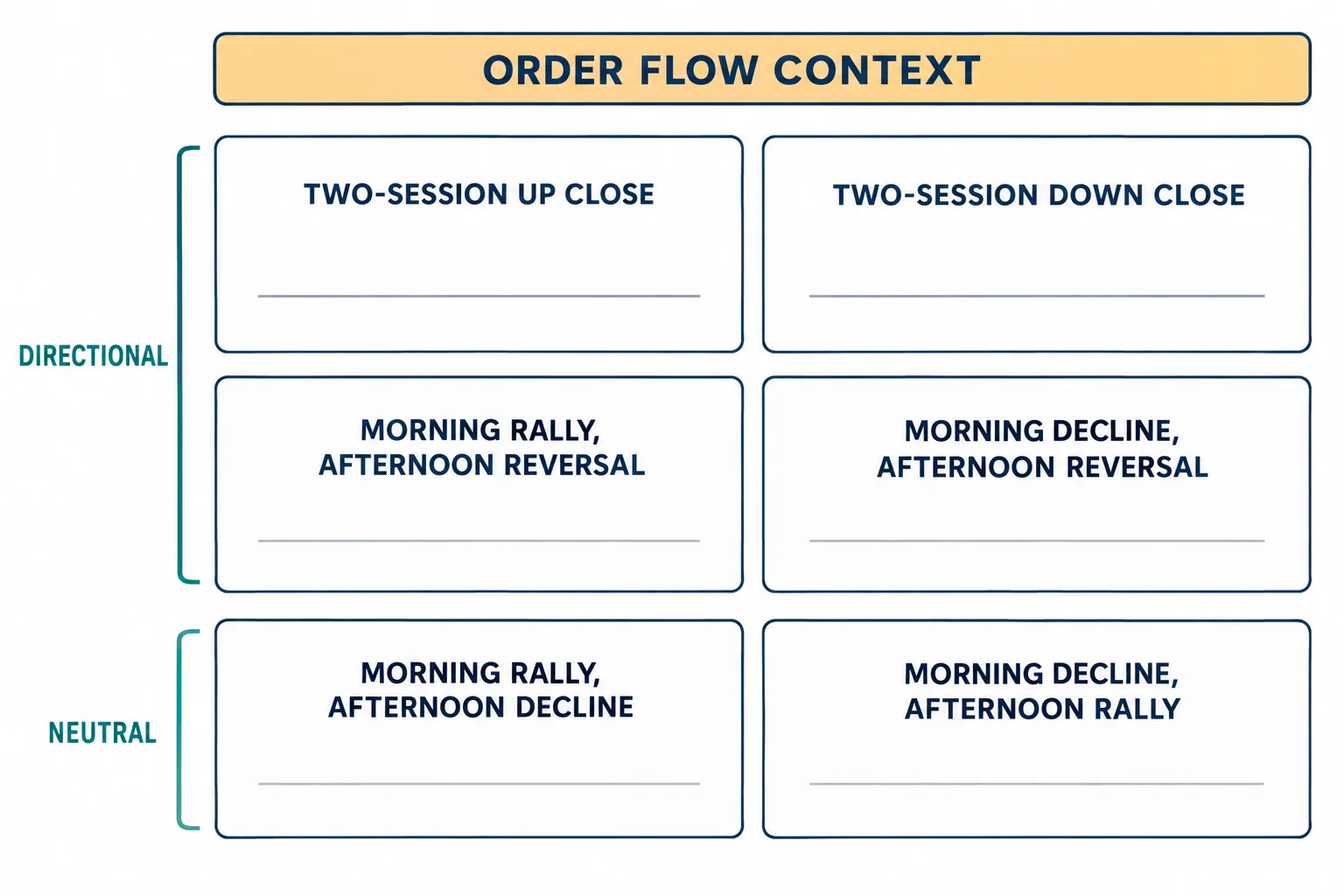
What the lesson is, and what it disclaims up front
Before any content, the opening seconds frame the recording as a commodities discussion and carry a disclaimer: he says he is not a licensed commodity trading advisor and that everything mentioned should be viewed as paper-trade material only (0:02, 0:06, 0:08, 0:12). The captions render the credential as “CTO”, where the regulated US title is commodity trading advisor; the reading here is that the caption track garbled the acronym. He then says the lesson describes how he has interpreted the internal movement of the indices for more than twenty years (0:49, 0:50), that deviations from these ideas will happen (1:03, 1:06), and that they are his general classifications rather than rules (1:13, 1:14, 1:16). He adds that index trading can be made over-complicated or kept simple, and that the simplification is the point of the session (0:37, 0:40).
The premise: context first, then a template
The framework is a finite list of day shapes. He says the templates are “eight ways of projecting the range” and, later, that there are only eight projected ranges he uses on the S&P, which he says makes it simple to anticipate what each session should look like (3:06, 3:09, 16:37, 16:39). In this lesson he actually walks through six: two trending-day templates and two reversal templates, which sit under his directional order-flow contexts, plus two consolidation templates for unclear order flow. He does not enumerate the remaining two on camera, so the count he gives cannot be reconciled from this recording alone.
Each template keys off the same first filter, which he calls institutional order flow on the daily and or four-hour chart, and the same second filter, proximity to a higher-timeframe premium or discount array (1:25, 3:22, 6:07, 9:08). One behaviour is common to all six: the lunch hour consolidates with shallow retracements, and the only exception he allows is a trending day, when the lunch hour can be active and price can keep expanding through it depending on whatever catalyst set the day off (1:44, 16:56, 16:58, 17:00, 17:07). He also warns that a strong bull day does not have to pause at all: the daily range can run straight through the lunch hour with very little consolidation (2:06, 2:10, a caveat he repeats at 2:44).
Template 1: two-session up close
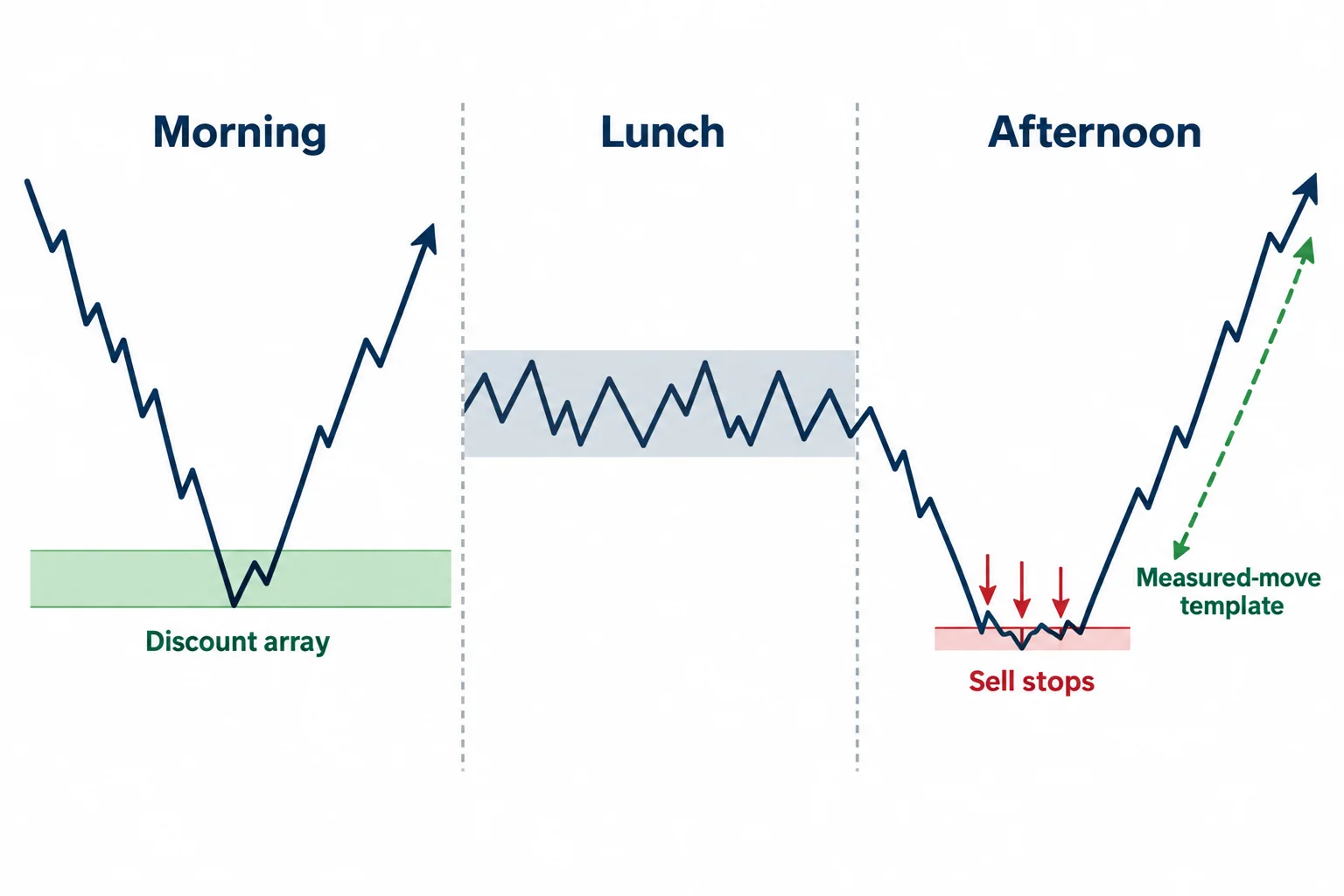
With the daily and four-hour order flow bullish, the morning typically returns to a discount array and then rallies, the lunch hour consolidates with shallow retracements, and the afternoon runs the lunch-hour lows for sell stops or drops into a fair-value discount array before rallying into the close (1:29, 1:36, 1:38, 1:44, 1:50, 1:53, 1:59). He describes the underlying expectation as a measured-move event — a first leg up in the morning, a consolidation, and a second leg of roughly equal distance in the afternoon — while repeating that this is a generic reading of how he forecasts price rather than a guarantee (2:27, 2:29, 2:31, 2:33). His summary of the caveat is blunt: nothing is guaranteed, nothing is set in stone, but he says these templates fit most days (3:01, 3:03, 3:13).
Template 2: two-session down close
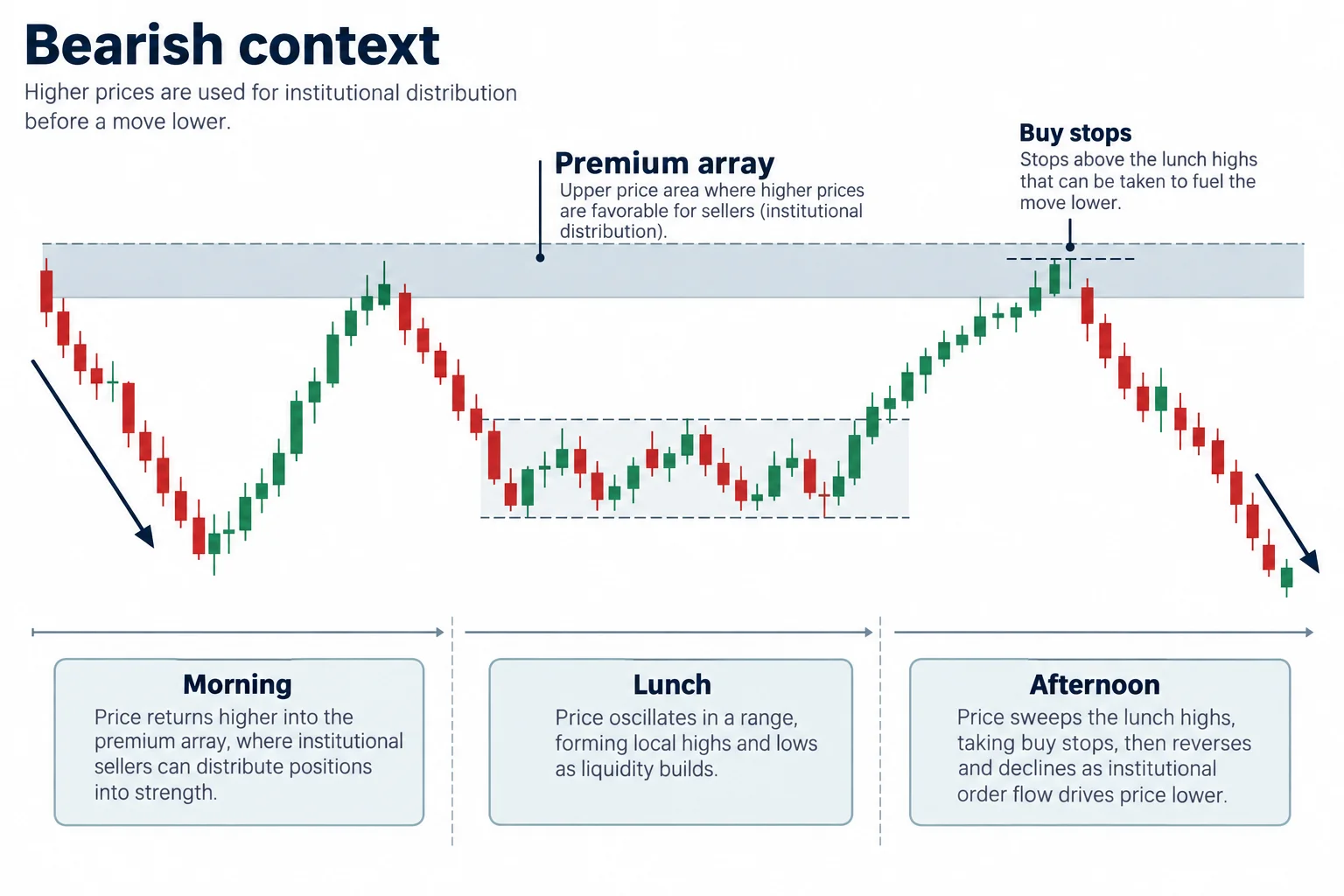
The mirror image, with institutional order flow bearish on the daily and or four-hour chart: the morning returns to a premium array and then declines, lunch consolidates with shallow retracements, and the afternoon runs the lunch-hour highs for buy stops or rises into a fair-value premium array before declining into the close (3:17, 3:22, 3:27, 3:30, 3:38, 3:47, a lunch caveat at 3:51). He ties the catalyst to the shape of the disappointment: if the expected economic release came in weak, he says the market discounts current levels and reprices lower rapidly, which is why lunch may not hold (4:06, 4:09, 4:14, a continuation at 3:59).
Both trending templates carry an additional condition he states explicitly: they are the scenarios to watch when the daily and four-hour context is bearish on the downside day or institutionally bullish on the upside day, and the expectation holds with high probability until price reaches a four-hour, daily or weekly discount array in the down case, or a premium array in the up case (4:23, 4:26, 4:31, 4:38, 5:13, 5:16, 5:20). While those opposing higher-timeframe arrays have not been traded to, he says price can expand easily; once they are reached, the premise changes (5:37, 5:40, 5:47, 5:52, 5:57).
Template 3: morning rally, afternoon reversal
Here the order flow is bullish on the daily and four-hour chart, but price is sitting underneath a higher-timeframe premium array that it has not yet taken out. The morning starts bullish and keeps going until it reaches that premium array, which is what he says causes the intraday reversal; the morning trend then returns to a discount array and rallies; lunch consolidates; and the afternoon runs the lunch-hour highs and reverses into the close, or runs the intraday high and reverses there (6:02, 6:07, 6:10, 6:30, 6:42, 6:44, 6:48, 6:52, 7:01, 7:07). He is specific that the afternoon does not have to print a new high for the day: a run above only the lunch-hour high still fits, and that alone would create a failure swing on the attempt back into the morning high (7:16, 7:20, 7:23, 7:38, 7:43).
The continuation test is one of the genuinely useful distinctions in the lesson. If the morning reaction came from an array that also exists on a higher timeframe, he expects the afternoon to be able to return to it, recapitalise the level and push on; if the morning move was driven by a 60-minute or 15-minute array, he says to look for continuation in the other direction instead (7:47, 7:51, 7:55, 7:58, 8:20, 8:23, 8:27). He restates the filter plainly: if the array is not a four-hour, daily or higher discount array, expect price to trade through it and go lower (8:50, 8:54, 8:57, a bullish higher-timeframe order block at 8:39).
Template 4: morning decline, afternoon reversal
The inverse: order flow is bearish, but price has not yet traded down into a higher-timeframe discount array, so it sits above one. The morning returns to a premium array and declines, lunch consolidates with shallow retracements, and the afternoon runs the lunch-hour lows and reverses into the close, or runs the intraday lows and reverses there (9:05, 9:08, 9:10, 9:14, 9:26, 9:36, a premium array reference at 9:16, 9:20). He allows the lunch-hour lows to be violated or traded down right off sell stops for a short-term level reached during lunch, followed by a rally in the afternoon, or for the afternoon to run the low formed in the New York morning session and then reverse and trade higher (9:53, 9:57, a lower low at 10:00, 10:06, a rally at 10:11).
The same equality rule applies in reverse. If the morning premium array that price sold off from matches a higher-timeframe premium array, he expects the afternoon to be able to return to it, recapitalise that level and resume lower; if the higher-timeframe reference is missing, he expects price to trade through and attempt to run higher instead (10:16, 10:19, a resume at 10:44, a restatement at 10:46, 10:49, 10:54, 10:59, 11:04).
Templates 5 and 6: the unclear-order-flow days
The two consolidation templates are for days when the directional read is not available. He says these fit when order flow is neutral or simply unclear, when price is not obviously at a premium or discount on the daily or four-hour, and especially when no high-impact or medium-impact news is expected during the ten o’clock hour or later (11:13, 11:15, 11:28, a news window at 11:37, 11:42). He describes the outcome as a tug of war back and forth that frustrates traders who do not understand the mechanics, and he says not to look for it when there is a strong directional bias or when the underlying conditions point to higher prices — this is not what he calls seek-and-destroy, it is simply consolidation (16:00, 16:05, 16:11, 16:16, 16:21, 16:23).
One of them, consolidation with a morning rally and an afternoon decline, runs a morning return to discount and then a rally, or an expansion higher from equilibrium after the first hour or the opening range to reach London buy stops or the intraday highs where buy stops sit; lunch consolidates; and the afternoon runs the lunch-hour highs and reaches for the day’s sell stops, or runs the intraday high and reaches for intraday or London sell stops (11:53, 11:57, 12:01, 12:03, 12:06, 12:58, 13:00, 13:03, 13:06, 13:10). Which of those two the afternoon chooses depends, he says, on which level is the premium array: if the morning already defended a higher-timeframe premium array, he expects the afternoon to settle for the lunch-hour highs; if the morning did not reach a higher-timeframe array, the afternoon can run the intraday high and then reverse (13:23, 13:26, 13:28, a defended level at 13:31, 13:38, 13:45, 13:52). He also allows this template to fizzle: all the movement happens in the morning and the afternoon simply consolidates through to the close (13:57, 14:06, 14:07).
This is the slide where he attaches a worked example. He says the projection on screen is the one he used for the June 22, 2017 trading day in the S&P futures market, that he sold short at 2,437, and that he looked for price to trade down into a discount array or reach for sell stops below the market, calling it the actual projected range he used for a live trade example (12:13, 12:18, 12:23, 12:26, 12:28, 12:31, 12:39, 12:42). The recording contains only his description of that plan. There is no chart visible in the captions, no entry confirmation, no stop, no exit and no result, and the short price and the downside objective cannot be checked against anything except his own narration (12:44, 12:50, 12:31, 13:13).
The other is its mirror, consolidation with a morning decline and an afternoon rally. The morning returns to a premium array and declines, or expands lower from equilibrium after the first hour to reach London sell stops; lunch consolidates; and the afternoon runs the lunch-time lows and reaches for the day’s buy stops, or runs the intraday low and reaches for intraday or London buy stops (14:19, 14:22, 14:25, 14:44, a sell-stop expansion at 14:33, 14:47, 14:50, 14:53, 14:56). The conditional detail matches the reversal template: if the morning traded down to a higher-timeframe discount array, he expects the afternoon only to run out the London lunch low; if it did not, he expects the afternoon to run the intraday low and then rally (15:06, 15:09, a discount-array condition at 15:12, 15:15, 15:19, 15:31).
When he says not to use these templates
Two qualifiers sit at the end of the lesson and matter more than the diagrams. First, the two trending templates should not be looked for when the market lacks both a trend and a news driver: he says a non-farm payroll day creates what he calls seek-and-destroy conditions on the S&P, while a day with no trend and no news is when the consolidation templates tend to fulfil (16:25, a payroll caveat at 16:28, a conditions line at 16:33). Second, the templates are descriptions of where he expects stops to be, not forecasts he guarantees. He closes by saying the indices are understood to seek stops, that a higher timeframe can trend while the intraday frame is really about liquidity and where the stops sit, that it is a trader’s market, and that stops are therefore hunted predominantly (17:17, 17:24, 17:27, 17:30, 17:33, 17:38, 17:41).
What a reader should and should not take from it
As a piece of process documentation, the lesson has real content: a small number of named scenarios, a stated first filter on the higher-timeframe order flow, a second filter on premium and discount arrays, a defined role for the lunch hour, and an explicit equality test that decides whether a morning reaction is likely to be revisited in the afternoon. Those are specific and falsifiable statements about how he reads a session.
What it does not contain is any test. There is no chart on screen in the captions, no statistics on how often each template actually occurs, no result for the June 22, 2017 example, and no accounting for the cost of being wrong. His own framing concedes that deviations happen and that nothing is set in stone (1:03, a measured-move caveat at 2:29, a generic-read caveat at 2:55). Several terms are used as if defined — PD array, premium and discount array, order block, equilibrium — when the lesson does not define them; they belong to his wider teaching rather than to standard market vocabulary, and a reader encountering them here should treat them as his shorthand rather than as settled definitions (6:15, 9:14, 8:39, 12:03).
The captions are auto-generated and misrecognise some of the vocabulary of this lesson, which is worth knowing before quoting it. Sell stops appear as “cell stops” and “sell stocks”, the lunch hour appears as the “launch hour”, the four-hour chart appears as “M4 hour”, shallow retracements appear as “shower retracements”, two-session becomes “to session”, PD array is rendered as “pdra” on one slide, and the S&P futures he calls the “spo” are rendered as “spoos” (1:53, 2:10, 1:28, 3:35, a “pdra” reading at 9:14). Where a term is genuinely ambiguous it is qualified here rather than silently corrected, and no price, fill, chart detail or net result has been inferred anywhere in this article.
Watch the original recording
Watch the original lesson on YouTube
This recording cannot be played inside another website. Its embedded player was loaded from a BestProps origin and clicked on 15 September 2026: it reported “Video unavailable” and “Playback on other websites has been disabled by the video owner”, with no duration and no playback progress. The recording’s own watch-page data agrees that it is not playable in an embed, so no iframe is placed here. The video itself is public and available directly on YouTube.
Source and further reading
- ICT Mentorship Core Content – Month 10 – Index Futures – Projected Range & Objectives — the primary source and the only recording used here. Uploaded 20 October 2022; a June 2017 mentorship lesson by its own opening. Use the timestamp links above to compare each template with what he actually said.
- The Inner Circle Trader YouTube channel — the publisher’s own channel, where this lesson and the other core-content months are posted. Reuploads and third-party summaries are not the source used here.
- CFTC — Learning Resources — the US regulator for futures and options markets, including its education and fraud-avoidance material for retail traders. General context for reading any futures-trading method; it does not assess this presenter or any technique described above.
- Investor.gov (SEC) — Investment Products — the SEC’s investor education pages describing futures and other products and their risks, with a companion guide on how to avoid fraud. Useful background for the leverage, margin and loss characteristics the recording does not discuss.
BestProps is not affiliated with the Inner Circle Trader, the CFTC or the SEC, and no source listed here endorses this article. Projected range, institutional order flow, premium array, discount array, PD array, order block and equilibrium are used as descriptive terms for what the recording teaches, in the speaker’s own vocabulary. Every scenario above is his inte