
Key takeaways
“ICT Mentorship Core Content – Month 10 – Importance Of Multi-Asset Analysis” is a short wrap-up he recorded on Friday 30 June 2017 to close out that month’s mentorship material.
Read the full summary
“ICT Mentorship Core Content – Month 10 – Importance Of Multi-Asset Analysis” is a short wrap-up he recorded on Friday 30 June 2017 to close out that month’s mentorship material. He does not teach a chart pattern. He argues that the four asset classes — bonds, currencies, commodities and stocks — should be read “as a whole”, for how they are interrelated and for the “Symmetry” between them (1:04, 1:22). His stated mechanism is risk-on and risk-off: bonds bid means a risk-off climate, bonds falling means risk-on, and risk-on brings buying of stocks and foreign currencies (2:48). He is explicit that he trades only foreign exchange yet still follows the bond market, commodities and stocks, because “to be a specialist you still have to understand what the General market is going to do most likely” (3:37). He tells students they do not need to stare at the other markets all day — “periodically check them” (13:14) — and says a market that is not behaving seasonally signals decoupling, which makes a large one-sided move harder to find (25:07). His own example is a Friday he declined to trade USD/CAD after reviewing all four classes (15:13). Everything below is attributed to him; the recording contains no charts, fills or verified results, and it is not investment advice.
How we researched this article
BestProps used document-based research from primary firm sources, checked September 19, 2026. The complete source list, scope, limitations, and commercial-state record appear near the end of this article.
The lesson is framed as a summary rather than new material. At 0:24 he says the June content has just finished and that he wants to spend a couple of minutes talking about what students were “introduced to and exposed to”. He then asks why he made them work through it, acknowledging that “some of you felt like it was filler, like it wasn’t necessary” (0:48). Most of the recording is his answer to that question.
Four asset classes, read as one picture
His definition is stated once and then relied on throughout: the purpose of multi-asset-class analysis is “the asset classes of the bonds, currencies, commodities and stocks”, looked at “as a whole” for how they are interrelated (1:04). He asks students to go back through the month and look for “the Symmetry between all four”, because there is a common theme they cannot grasp until they “see the interconnections and when they’re most likely to be in sync with one another” (1:38).

He also takes care to separate this from signal-seeking. He reminds viewers that he had already said the material “wouldn’t be a trade signal service” (2:06), and says the point of the month’s lessons was not that he likes certain phenomena inside each individual asset class. It is that the classes “not only work in harmony with one another but sometimes they decouple” (2:24) — both halves matter to him.
The risk-on and risk-off mechanism as he states it
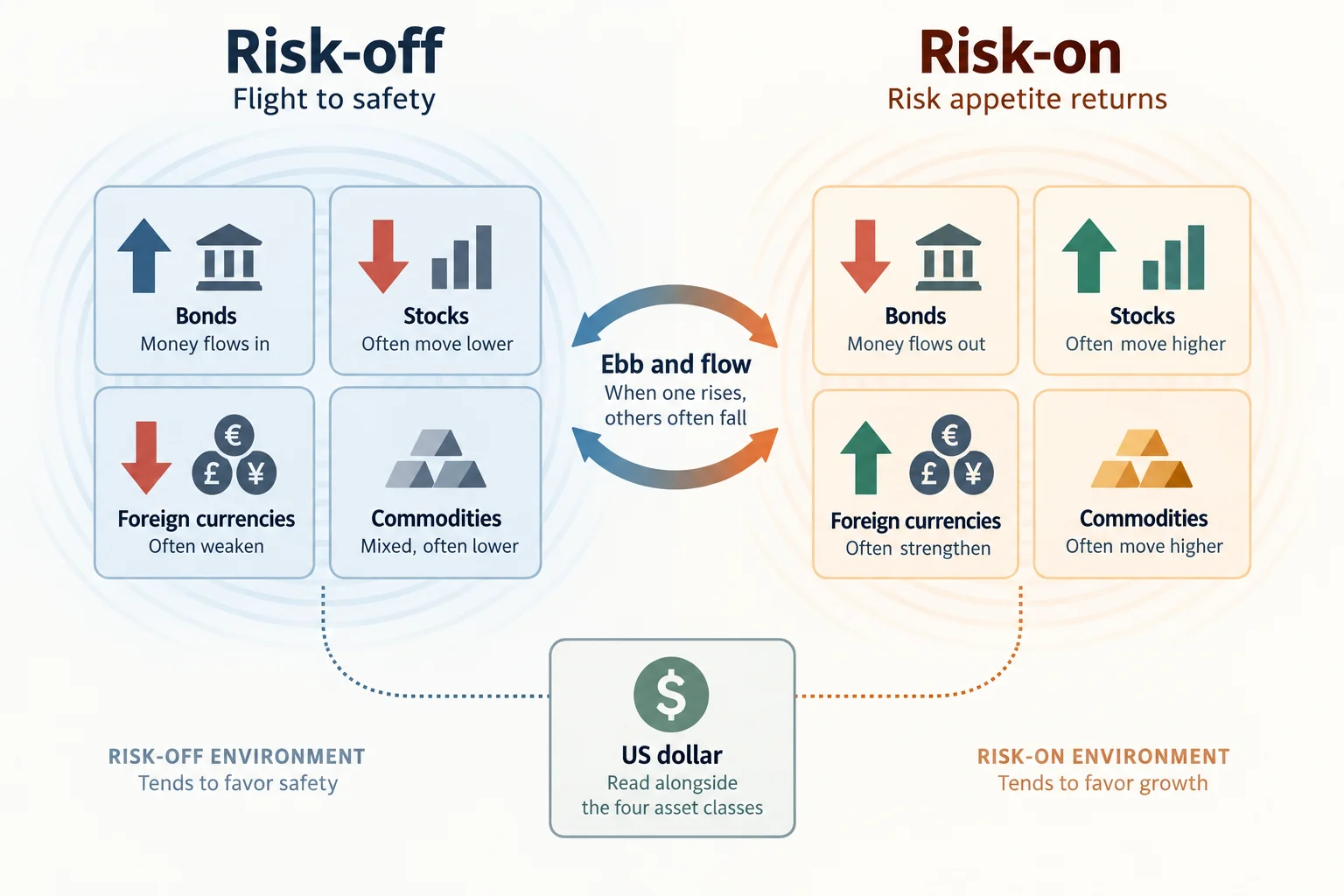
The relationships he describes are specific. When bonds are going higher he reads “less risk”, a risk-off environment, and says “the market goes to buying bonds” (2:37). When bonds are going lower he calls it a risk-on scenario, and risk-on “brings with it the buying of stocks, the buying of foreign currencies” (2:56). He describes this back-and-forth as an “ebb and flow type phenomenon” with a “reverberation that goes through all four of the asset classes” (3:10).
At 6:41 he adds the dollar and commodities to the same chain: the dollar index going higher with commodities going lower and stocks going higher is risk-on, while risk-off sees stocks fall, foreign currencies decline and the dollar rally. He calls the mechanism “highly efficient and yet very hard to decipher” because it takes work to watch more than one market (7:14).
These are his interpretations, not mechanical laws. Cross-asset behaviour varies with inflation expectations, policy, growth concerns and the period studied, and the recording supplies no measurement of how reliably the stated relationships held. The useful part is the habit he is arguing for — checking whether current behaviour agrees with the working model — rather than memorising a fixed correlation.
Why he says a specialist still needs the other markets
This is the argument he presses hardest. He points out that he trades only forex and yet still talks about the bond market, commodities and stocks “because it matters, it has a place” (3:37). He is direct about the alternative: some students “want to be one-trick ponies”, but “to be a specialist you still have to understand what the General market is going to do most likely” (4:03).
His stated consequence of skipping it is a change in opportunity quality rather than profitability. When all four classes do as they should, he says, risk-on environments see everything rally while interest rates decline (4:15). Without that “beautiful dovetail with all four of the asset classes”, he says a trader will have “a very hard time finding opportunities where moves can be explosive, they can have a lot of magnitude” (4:35). He is describing his own selection criteria, not a measured performance difference.
He is honest about the period he was recording in. He says they had been “going through a period of months where it’s been very difficult to ascertain whether or not the market is risk on a risk off”, with “some of the asset classes … doing as they should While others are doing something completely different” (4:52). That admission is worth keeping: the framework’s clearest signal is the absence of agreement, and he says such stretches grind people down (5:10).
He also concedes the narrow approach can work, with a caveat. Asked implicitly whether someone can simply trade the euro-dollar and ignore the bond market, he answers “can you make money doing it? yes you can” (7:35). His objection is the next sentence: will you understand when the large moves are going to take place and how long to hold them “based on those conditions”, if you are “just looking at the euro” — his answer is no (7:38).
How much attention he actually asks for
The answer is less than a full multi-market routine. He says it is important to know “what these asset classes are doing as a whole”, and immediately adds “you don’t have to be staring at them all day long — periodically check them, see what’s going on, get feedback from them” (13:05). He describes the expected behaviour as moving “in concert” with each other (13:19).
He is blunt about what he thinks happens without it. If looking at the other classes is “too much work”, he says a student will “struggle”, will have “hit and miss success”, periods of making “a little bit of money”, and will always feel “like there’s just something that doesn’t quite click” (9:21). That is a claim about his own students and is not evidenced in the recording.
He comes back to the same instruction when explaining how he adjusts activity: when conditions are not favourable “you need to dial it back”, and the way to determine that is “by rating the market in terms of risk on a risk off”, which “you can’t get … adequately enough by just looking at one instrument, one pair” (17:06). What he says to look at is “the whole universe of speculation: currencies, Commodities, bonds and stocks” (17:20), and he states that the month was designed to show what all of them should be doing “not looking for trades per se” (17:27).
Partial agreement, and why a third market changes his read
His treatment of incomplete agreement is the most concrete idea in the recording. He asks what it means when “two of the four asset class doing one thing but the other two aren’t doing what as they should”, and answers his own question: “is that a very symmetrical Market? no” (21:10). Then the progression: “what happens if we start seeing a third start doing it? well that’s now very interesting” (21:26), because a market that had been uncertain now has a third class behaving as it should (21:35).
Two points deserve emphasis. Two of four is explicitly described as insufficient for symmetry, so a partial alignment is not a green light in his framing. And the shift to a third is presented as an observation about the developing theme, not as a tested indicator or an automatic entry condition. Nothing in the recording gives a threshold, a frequency or a result attached to the transition.
The USD/CAD Friday he stood aside
The practical illustration he gives is a trade he did not take. He says a member emailed him after he hurried out of a session “eager to go on vacation”, saying he had promised a US-dollar/CAD trade. His correction is precise: “I didn’t promise to do a dollar CAD trade, I promise to look at the market”, and he had allowed that there would “probably [be] a trade Friday for the dollar CAD” (14:57). Using all four asset classes as a whole, he says, “I didn’t see a trade this morning. And there was no trade this morning” (15:13).
His stated reasons are worth separating, because they are different kinds of argument. One is contextual: he describes a “z-day consolidation ahead of a large, widely followed U.S holiday next week” (15:20). The other is that the setup had already done its work: “there has [been] no real indication of what the market should be reaching for, it had already met my objective for the week”, having traded down to the low he had called for and “just a little bit below it” (15:51). He then reasons that hitting a target is not itself a reversal signal — “just because I hit the target doesn’t mean it’s going to go reverse in the other direction” — and that he “didn’t feel it could go lower based on looking at all [four] of the asset classes” (16:08).
He says he avoided trading that day because of experience with what the asset classes do ahead of a weekend and a holiday — noting the holiday was the following Tuesday rather than the Friday — and that he “saw signs of it across all four asset classes today, early” (24:02). The recording contains no charts, price prints, order records or account data, so neither the stated objective nor the claim that it was met can be checked from this source. What the passage does establish is a decision rule in his own words: prior analysis is not an obligation to enter.
What he asks students to do with the material
He closes with a study instruction rather than a rule. He calls intermarket analysis “absolutely crucial” to understanding what would be taught next month (19:17), and says he wants students positioned where “there’s leadership on the upside or downside” and where “all the large institutions are going to be pouring money into it” (19:26). A reader should note that as his framing of institutional positioning, not an observable fact in this recording.
His concrete instruction is to re-read the June lessons and “try to fade out the points of discussion that I have for each asset class, and then try to draw parallels” (26:32), so that the cross-asset reference points are in place before the August top-down material (26:00). He also lists what he expects a student to know about bonds, commodities and stocks even without trading them: “what they are doing, what’s their seasonal tendency, are they behaving seasonally” — because if they are not, that “means that we have a decoupling and it’s going to be hard for the markets to find a one-sided move with great deal magnitude” (25:07). He qualifies it in the next breath: not that trades disappear, but that “you won’t see really strong moves” (25:23).
A neutral study routine follows from what he actually asks for: record the direction of bonds and rates, currencies, commodities and equities; write down the expected relationships before comparing them with behaviour; classify the evidence as broadly aligned, partly aligned or decoupled; note any apparent leader without treating correlation as causation; and treat the absence of agreement as information rather than a reason to force a directional conclusion. That routine is a general reading of the lesson. He did not present it as a system, and the recording contains no test of it.
One further claim in the closing minutes should be attributed rather than repeated. Referring to targets he had outlined the previous Saturday, he says “all of our targets were hit and they weren’t small moves, they were large moves”, and attributes that to looking at all four asset classes (25:37). No target list, fill or account record appears in the recording, so this is his reported outcome and not a verified one.
Watch the original lesson
This article draws on the timestamped English captions of “ICT Mentorship Core Content – Month 10 – Importance Of Multi-Asset Analysis”, a recording he identifies as made on Friday 30 June 2017 and published 22 October 2022, listed at about 27 minutes. Captions document what he said; they cannot verify market behaviour, targets or outcomes, and the reviewer read captions rather than watching any chart.
Watch the original lesson on YouTube
This lesson cannot be played inside another website. When its embedded player was opened and clicked on 15 September 2026, the player itself reported “Playback on other websites has been disabled by the video owner.” at both desktop and mobile widths, with no duration reported and no playback progress. That is why no embed is used here. The video is public on YouTube and plays normally on its own watch page.
Watch “ICT Mentorship Core Content – Month 10 – Importance Of Multi-Asset Analysis” on YouTube ↗
Resources
These are the sources checked for this article. The publisher’s own pages are the first-party record of what ICT releases; the Treasury and CFTC pages are neutral references for the asset classes discussed and for how marketed systems are described to the public. None of them assesses the speaker, verifies a level or a result, or tests the cross-asset relationships he describes. Any ICT, smart-money or third-party indicator, note set, script or re-upload circulating outside the publisher’s own pages, and any indicator built on these concepts, is unofficial and untested here.
- [1] ICT Mentorship Core Content – Month 10 – Importance Of Multi-Asset Analysis — The Inner Circle Trader (primary source; watch page read 15 September 2026, listed at about 27 minutes)
- [2] The Inner Circle Trader — official YouTube channel (read 15 September 2026)
- [3] U.S. Department of the Treasury — Daily Treasury Par Yield Curve Rates (read 15 September 2026) — official published rates for the bond side of the relationship he describes.
- [4] CFTC — Fraud Advisory: Commodity Trading Systems Sold on the Internet (read 15 September 2026) — background on how hypothetical or reported results reach the public.
This is independent educational commentary on one speaker’s own market interpretation. It is not official ICT material, it is not a tested trading system and it is not investment advice. No target, level or outcome reported in the recording is verified here. Leveraged trading carries substantial risk.