
Key takeaways
ICT’s June 2017 bond mentorship lesson presents a paper-trading framework for 30-year Treasury bond futures, symbol ZB, using three New York-time windows.
Read the full summary
ICT’s June 2017 bond mentorship lesson presents a paper-trading framework for 30-year Treasury bond futures, symbol ZB, using three New York-time windows. The overnight reference runs from two a.m. to five a.m. and is used to mark stops, liquidity voids, fair value gaps and PD arrays rather than entries. The primary AM session runs from eight a.m. to noon, with the heaviest buying and selling generally between eight a.m. and nine thirty a.m., while ICT’s personal commodities kill zone was eight twenty a.m. to eleven a.m. The PM session runs from noon to three p.m. and is evaluated separately as a continuation, reversal or consolidation. ICT says the morning generally produces the bond day’s higher low and most frequent move, while an AM session that consumes much of the average daily range can justify going flat before lunch and skipping the afternoon, though no objective threshold is supplied. Trending days may combine both sessions into one directional range or begin after a morning consolidation, including around an FOMC release, while consolidation days may feature opposing swings or one active session and one quiet session. Chart examples apply opening ranges, Judas swings, Turtle Soup setups, bullish order blocks and liquidity sweeps, including an eight-tick AM move and eleven-tick PM move valued verbally at $31.25 per tick. These figures are arithmetic over historical charts, not verified fills or performance, and the lesson reports no orders, position sizes or account results. ICT’s closing instruction is to paper trade, study each bond day and keep a journal rather than accept the framework without testing.
How we researched this article
BestProps used document-based research from primary firm sources, checked September 24, 2026. The complete source list, scope, limitations, and commercial-state record appear near the end of this article.
In ICT Mentorship Core Content – Month 10 – Bond Trading – Split Session Rules, the speaker presents a time-of-day framework for studying 30-year Treasury bond futures, which he identifies by the ZB symbol (3:05). The recording announces itself as lesson two of the June 2017 ICT bond trading content (0:31). The watch page gives the upload date as 18 October 2022, so the material is a later re-release of 2017 mentorship sessions; the examples below belong to that historical presentation of past price action, not to current conditions.
The speaker opens by stating that everything in this lesson and in the month’s content is to be taken as a paper trade only (0:02). He also says commodities have their own time-of-day element and that bond timing deviates slightly from the windows he teaches for foreign exchange (1:08 and 1:38). Everything below is his stated framework and interpretation; this article is not a tested system and makes no claim about edge or results.
ICT Bond Split Session Windows
He names three reference windows, all in New York time:
- Overnight / London reference: 2:00 a.m. to 5:00 a.m., used for context rather than for entries (6:22).
- New York AM session: 8:00 a.m. to 12:00 noon (1:53).
- New York PM session: 12:00 noon to 3:00 p.m. (2:01).
Before giving those definitions he notes that students are already familiar with a New York open kill zone and a London close kill zone, and that the daily range can trade as late as 2:00 p.m. He says he wants the analysis defined in two sessions instead, and that the concepts should be focused primarily on the New York session hours (2:15 and 2:31).
ICT Overnight Bond Session Is Reference Only
He describes 2:00 a.m. to 5:00 a.m. as the traditional London session and says that reading what overnight price traded between those two reference points shows where the stops are (overnight stops, liquidity voids and fair value gaps) along with any measure of "PD array" he would normally use in foreign exchange (6:31, 6:37, 6:43). He says he does not want to imply that students should be trading the bond during that session, and that he always refers to that block of time as the 2:00 a.m. to 5:00 a.m. reference points (6:56 and 7:07).
He does allow that a student who chooses overnight trading can trade the ZB or 30-year Treasury bond using the same ideas he attaches to the London open, and he advises using what overnight trading reveals to look for stops, liquidity voids and fair value gaps while keeping the primary focus on the New York session (3:05, 3:22, 3:27). In general educational terms that means marking where overnight price travelled and noting levels that may still matter once North American activity picks up. The captions do not formally define terms such as fair value gap, liquidity void or PD array, so readers new to the vocabulary need the surrounding mentorship material rather than this lesson alone.
ICT Bond AM Session Carries the Volume
He says the largest volume of the bond day is seen between 8:00 and 9:00 in the morning, or generally between 8:00 a.m. and 9:30 a.m. New York time, before the equities open, and calls that the largest influx of purchasing and selling of the Treasury bond futures (3:41). Because of that volume he describes the AM session as having a built-in advantage: it generally forms the higher low of the New York session, or of the blended total range he calls the true day for Treasury bonds (4:00, 4:07). He also says a move will more often than not be seen in the AM session (4:31).
When he traded commodities as an asset class, he says he focused primarily on 8:20 a.m. to 11:00 a.m., which he calls his kill zone for the E-mini S&P, the currencies and the bond market (4:42). He treats the noon boundary as a general definition rather than a hard stop: the 8:00 a.m. to noon window can end early, around 11:00 a.m., which he ties to the traditional London close, when European and UK traders square up, take their money off the table and move to the sidelines. He stresses that this is a reduction in volume, not a statement that the trading day is over, and he notes the New York lunch period around 11:00 a.m. to 1:00 p.m. (7:17, 7:20, 7:27, 7:41, 7:50).
ICT Bond PM Session Is Judged Separately
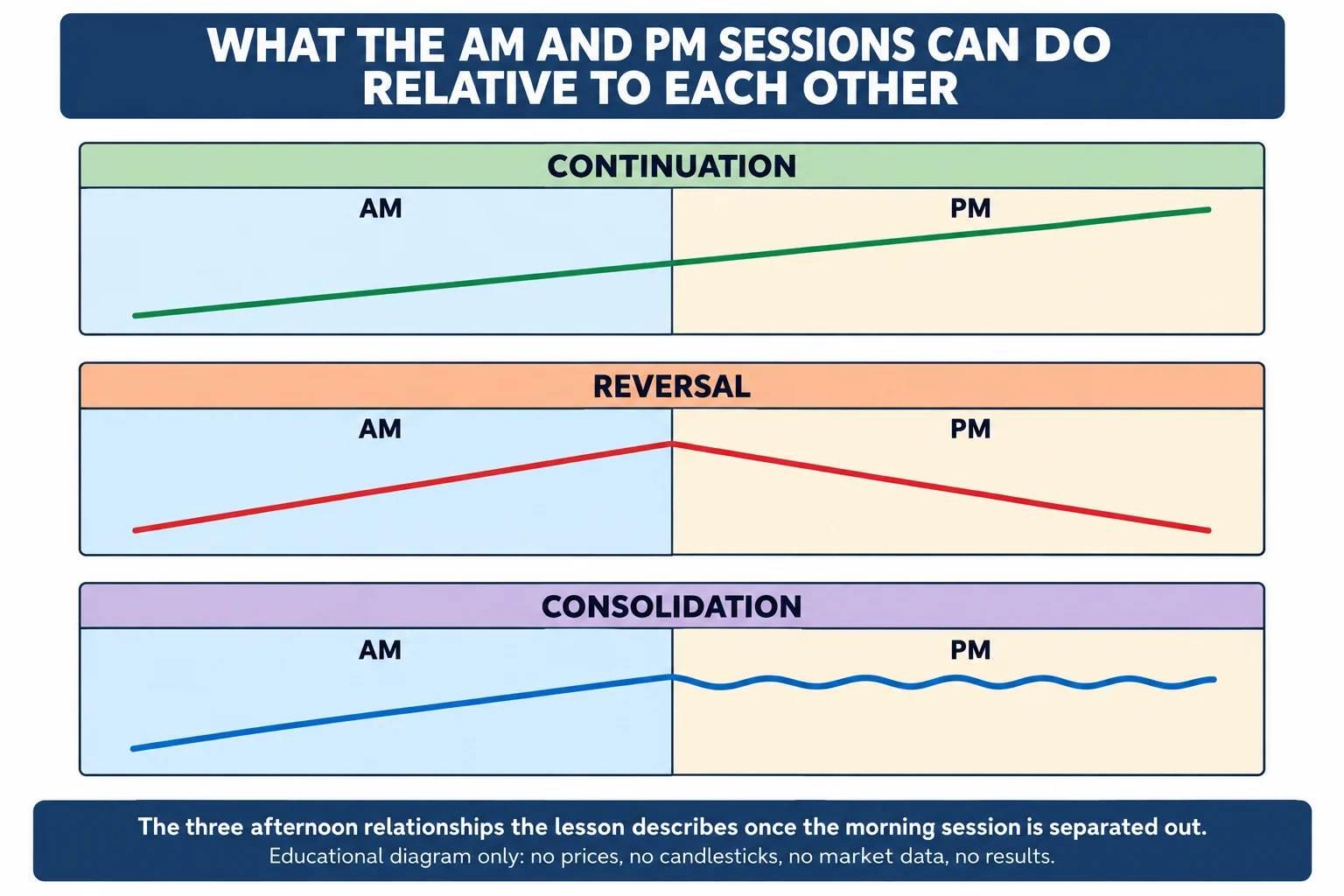
The afternoon portion of the bond daily range is delineated as 12:00 noon to 3:00 p.m. New York time (8:17). He says the PM session generally brings a continuation, a reversal or a consolidation (4:20).
He also describes how a runner behaves: if the market has made a significant higher low in the morning, follow-through and equal distant measured moves can appear, and whatever usually happens in the morning session tends to be seen in quicker terms, or less time, in the afternoon (8:34, 8:52). If a large degree of the average daily range has already been seen in the AM session, he says the PM session will be rather abbreviated, and his practical conclusion is that a student can go flat before the New York lunch and skip the second portion altogether (8:57, 9:14, 9:17, 9:23).
ICT Bond Split Rules Across Day Types
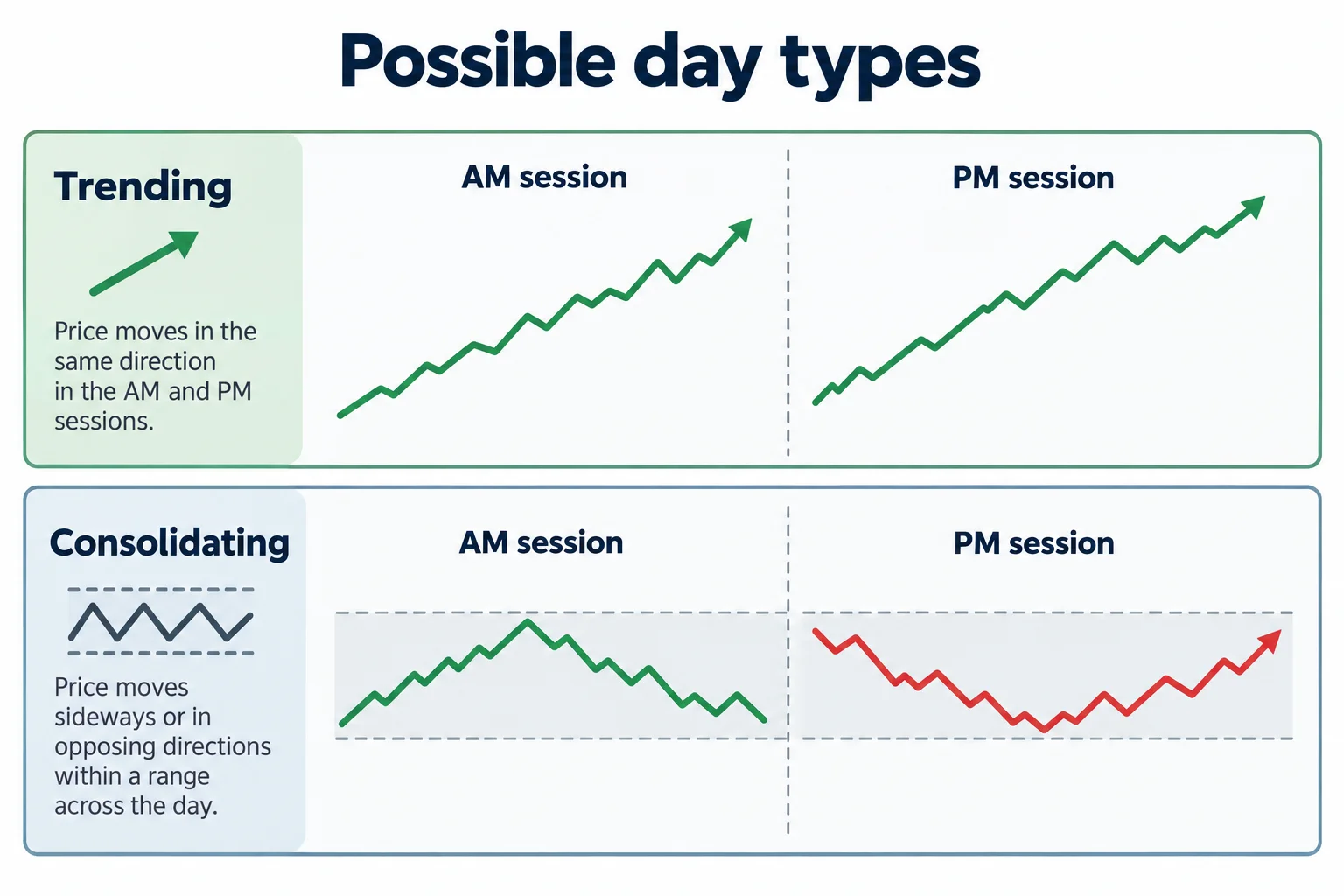
He separates days into trending and consolidating cases. On trending days the full trading day can be one-sided, with the 8:00 a.m. or 8:20 a.m. opening creating the low of the day and price trading up as late as 3:00 p.m., and the two sessions together creating the full daily range (5:12, 5:32). A trending day can also start in the second session: he gives the example of a late-afternoon FOMC release, where the bond market consolidates through the morning and then trends in the PM session and carries over into a runner across later sessions (5:36). That FOMC reference is his example from the time of the recording and the captions place it as forward-looking within the lesson; it is not a forecast about any current event.
On consolidation days he says the two sessions can move in opposing directions, or one session can produce a swing while the other stays quiet or consolidates (6:10). He closes the lesson by pointing ahead to the next session on trading consolidation days and looking for small moves before moving on to trending days with a large range available (17:41).
ICT Bond Split Session Trade Examples
From 9:29 onward he re-walks charts already used in the preceding bond lesson and re-labels them under the split-session rules. In the first example he reads a London open trade inside the 2:00 a.m. to 5:00 a.m. window that trades back up, closes a fair value gap and sells off into the New York open; then he applies what he calls the bond rules, an 8:00 a.m. to 9:00 a.m. opening range established in lesson one, followed by a move that runs the equities-opening range low during the AM session (9:38, 9:56, 10:05, 10:11). Price then rallies into the 11 o’clock hour as London and European traders square positions, a retracement runs down into noon, and the afternoon makes the high of the day ahead of 2:00 p.m. before consolidating at 3:00 p.m. (10:14, 10:23, 10:40, 10:47). He labels the day bullish and describes a downward move he calls a Judas swing, a return to support at the opening range around a level he voices as 150 327, a rise to the high of the day, and then retracement and consolidation at 3:00 p.m. (11:06, 11:15).
A second example shows the opposite pairing: a swing in the London open, a high, a trade down into the 8:00 to 9:00 a.m. session that takes out the low formed at the London open, a trade below the London lows that he calls a failure swing, a move into what he calls a bullish order block at a level he voices as 153 29, expansion through the whole morning session into noon, and then a reversal in which the AM session went higher and the PM session lower, with an opportunity on each side before price consolidates after 3:00 p.m. (11:53, 11:59, 12:02, 12:17, 12:38).
The most detailed example starts with a high made in the 2:00 a.m. hour during the London session. He points out an early 7:00 a.m. New York open kill zone in the foreign exchange market, a rally that clears equal highs he voices as 154.19, then a high in the 8:00 o’clock hour that sweeps the London high, an aggressive trade down that blows out the lows formed in the London session and the early 7:00 a.m. low, and a 9:00 o’clock low of the day, all inside the AM session (12:48, 12:56, 13:04, 13:10, 13:16, 13:25, 13:29). Because the opening range was large he says he starts looking for retracement or fair value ideas to be a buyer or seller, and in this case he calls it bullish because price traded down, took out liquidity below a low he voices as 154.03, and ran the stops above the London highs (13:38, 13:48, 13:55).
He then names the two structures he sees in that move: a Judas swing, and what he calls a turtle soup, a move below a level he voices as 154.02 inside the 8:00 a.m. to 9:00 a.m. opening range, where the down-close candle creates a bullish order block at that level, which he says is what is seen for the move into the PM session (14:07, 14:18, 14:22, 14:31).
A note on the captions: this auto-generated track mishears several of the speaker’s terms. It renders “bullish order blocks” as “bullshitter blocks”, “Turtle Soup” as “turtle suit”, “New York lunch” as “New York launch”, “Forex” as “the forks”, and it spells out price levels as separate digits such as “ O2” and “eight times thirty one dollars”. The labels used above are the ones the surrounding context supports; where a phrase could not be resolved confidently it is described rather than quoted.
ICT Bond Paper Trade Calculations
The final stretch of the lesson is a verbal count of what he says those examples offered. He describes a morning move from a level he voices as 154.02 up into 154.10 as an eight-tick move, and prices a tick at 31 dollars and 25 cents, which he multiplies out to give an AM session figure (15:19, 15:22, 15:27, 15:32, 15:35). He adds that such moves can be found several times a week if a student is highly selective about what to look for and about time, then says the better trade was in the PM session, with profits taken once the fair value gap between the 154.10 highs of the AM session and the last up-close candle of the 8 o’clock hour filled at what he voices as 154.13, an eleven-tick PM move, and a runner that could have run out the opening range high at 154.21 later in the Asian session (15:38, 15:43, 15:48, 15:54, 16:06, 16:10, 16:17, 16:25, 16:28).
Read those figures as the speaker’s own arithmetic performed aloud over past charts, which is what he frames the whole lesson as being. The recording reports no order tickets, no position size, no account results and no fills, and captions cannot establish that any tick was actually transacted or that the labelled structures behaved as described. One tick at 31.25 dollars is consistent with the 30-year Treasury bond contract’s one-thirty-second tick, but it is not independently verified performance and none of it is a recommendation to copy the trades.
What ICT Bond Split Session Rules Establish
What it does establish is the speaker’s own time-of-day framework for the bond market: three New York-time windows, a preference for the morning session, a separate reading of the afternoon, and a rule of thumb for standing aside when the morning has already delivered most of the anticipated range. He connects this back to the wider body of material, saying the split-session definitions sit alongside what he teaches about PD arrays, institutional order flow and other time-of-day studies that overlap with foreign exchange, and that the markets respect time and work together across asset classes (16:31, 16:46, 16:52, 17:07). His own closing instruction is to study the bond market day by day and keep a journal rather than take the framework on trust (17:18).
- No objective threshold is given for when an AM range counts as large enough to skip the afternoon.
- The windows are definitions of time, not measurements: nothing in the recording ties volume, participation or volatility to those boundaries with data.
- The continuation, reversal and consolidation categories are descriptive labels applied to past charts, not tested outcomes.
- The claim that the morning session generally forms the higher low of the bond day is the speaker’s assertion about what he observes, and the lesson offers no statistics behind it.
ICT Bond Split Session Study Checklist
One way to examine the framework without assuming its conclusions is to journal each bond session and record the overnight high and low inside the 2:00 a.m. to 5:00 a.m. window, the 8:00 a.m. to 9:00 a.m. opening range, whether a significant New York extreme formed during the morning, whether the afternoon continued, reversed or consolidated, and whether most of the observed daily range was complete before noon. That mirrors the day-by-day journaling he asks for, while leaving the result open rather than assuming the pattern holds.
Watch the ICT Bond Split Session Lesson
ICT Mentorship Core Content – Month 10 – Bond Trading – Split Session Rules
The Inner Circle Trader · published 18 October 2022 · about 17 minutes 57 seconds. This recording is the primary source for every timestamp link above.
The recording is not embedded here because the video owner has disabled playback on other websites. That was tested directly on 15 September 2026 from a BestProps page origin at both desktop and mobile widths: the embedded player loads, then reports “Playback on other websites has been disabled by the video owner” with no duration and no playback progress. The video itself plays normally on YouTube, so no empty or half-working player is left on this page.
The watch page was read on 15 September 2026 and rendered as a public video: ICT Mentorship Core Content – Month 10 – Bond Trading – Split Session Rules by The Inner Circle Trader, upload date 18 October 2022, listed duration 1,076 seconds, about 51,930 views at the time of reading. The caption track used for this article covers about 1,077 seconds, which matches the listed duration. The scheduling inventory also lists 18 October 2022, so the two agree.
ICT Bond Split Session Resources
These are the sources checked for this article. The regulator and investor-education pages are general material about trading systems promoted to the public and about investment products and their risks; neither assesses the speaker, verifies any level or reading above, nor endorses anything said in the recording. Any ICT, smart-money or third-party indicator, script, note set, transcript pack, chart annotation or re-upload circulating outside the publishing channel’s own page is unofficial and untested here.
- [1] ICT Mentorship Core Content – Month 10 – Bond Trading – Split Session Rules The Inner Circle Trader (primary source; watch page read 15 September 2026, 1,076 seconds).
- [2] The Inner Circle Trader (official YouTube channel) (read 15 September 2026).
- [3] CFTC (Fraud Advisory: Commodity Trading Systems Sold on the Internet) (read 15 September 2026), the regulator's guidance on evaluating trading systems and advisory services sold to the public, including its warnings about hypothetical results that assume contracts were bought and sold at specific historical prices.
- [4] Investor.gov (SEC) (Investment Products) (read 15 September 2026), general investor education on products and their risks.
Source: ICT, ICT Mentorship Core Content – Month 10 – Bond Trading – Split Session Rules, The Inner Circle Trader, 18 October 2022. Automatic YouTube captions were the transcript used for this article; that track mishears several terms and spells out price levels as digits, and the labels above are the ones the surrounding context supports. This commentary is educational and is not investment advice.