
Key takeaways
ICT Mentorship Core Content Month 10 Bond Trading Consolidation Days is a June 2017 Inner Circle Trader lesson explaining how to recognize low-volatility bond sessions and use them to temper expectations across bonds and forex, not a setup or trade-advice system.
Read the full summary
ICT Mentorship Core Content Month 10 Bond Trading Consolidation Days is a June 2017 Inner Circle Trader lesson explaining how to recognize low-volatility bond sessions and use them to temper expectations across bonds and forex, not a setup or trade-advice system. Consolidation is more likely during a quiet New York morning with no noteworthy reports, ahead of a high- or medium-impact US release later that day or week, before a US bank holiday, the day before a bond auction, or the morning of an auction, and may form when price reaches a higher-timeframe premium or discount array or the equilibrium midpoint of a larger swing. ICT favors morning scalps of five to ten ticks, states one tick is 31.25, treats an opening range of twelve ticks or less as a volatility squeeze, targets overnight, London and short-term highs or lows, and generally finishes before noon and preferably before 11 a.m. New York time. He avoids auction mornings and afternoons with scheduled interest-rate drivers, usually around 2 p.m., while allowing afternoon trades only when an obvious liquidity pool remains untapped and the morning has not already produced a stop run. His position-management example pairs an eight-tick objective with a sixteen-tick limit target so unexpected expansion can add profit, with active monitoring rather than automatic closure at the objective. The broader lesson is that narrow bond ranges often restrain volatility in other asset classes, small daily ranges can precede expansion over the next one or two sessions, and consolidation should be used for planning the next liquidity run rather than forcing trades. The 26 minutes 59 seconds video was uploaded on 18 October 2022, but the spoken lesson dates to June 2017, and no chart detail, fill or result is independently verifiable from the recording.
How we researched this article
BestProps used document-based research from primary firm sources, checked September 24, 2026. The complete source list, scope, limitations, and commercial-state record appear near the end of this article.
The video ICT Mentorship Core Content – Month 10 – Bond Trading – Consolidation Days carries an upload timestamp of 18 October 2022, 12:30 p.m. Pacific, on the Inner Circle Trader channel, and the watch page reports a runtime of 26 minutes and 59 seconds. The lesson itself is not from 2022: the opening captions place it at “June 2017, ICT mentorship, ICT bond trading, lesson three (consolidation days)” (0:27, 0:32, 0:34). The upload date and the spoken date describe different things, and the material is the 2017 lesson.

How ICT Defines Bond Consolidation Days
The lesson opens by separating the topic from setup instruction. He says he is not teaching specific setups but a thought process, and that the exercise is to incorporate bond analysis into the broader context and draw it back to forex (0:48, 0:52, 0:56, 1:01). He then defines the conditions he is describing: days when the market is range-bound rather than trending, with no specific precursor required in overnight price action, because what happens in London does not automatically forecast New York. The market can move overnight and then simply go quiet once New York opens (1:15, 1:20, 1:24, 1:32, 1:45).
Calendar Conditions for ICT Bond Consolidation Days
The first filter is news. He says a New York session with a lack of noteworthy reports can create what he calls a dead space in the bond market (1:52, 2:02). The mirror condition is a high- or medium-impact US report due on a later trading day that week, which he says promotes the idea of a consolidation day in the meantime (2:08, 2:14). He then walks through the live example on his own calendar: a day with an FOMC event at 2 p.m. New York time plus a morning full of high-impact dollar-based releases, which he says he had anticipated as a high-volatility day before the week began (2:27, 2:33, 2:39, 2:50, 2:56). The contrast he draws is that if the morning had been empty and FOMC were the only scheduled event, he would have expected a consolidation day leading up to it and carrying into the morning, with volatility arriving in the afternoon instead (3:01, 3:11, 3:15).
Two calendar conditions are separate from the news flow. He says a US bank holiday produces an impact on the markets and causes consolidation days ahead of it, using the Fourth of July, which was coming up when he recorded, as his example: a trading day before the holiday tends to be quiet, and that quiet then reverberates through the marketplace (6:55, 7:06, 7:13, 7:21, 7:26). The other is the auction calendar. If a bond auction is scheduled, he says the day before it can be a consolidation day, and the morning of the auction day itself generally is one (7:30, 7:37, 7:43, 11:07). His stated reason for cataloguing all of this is that if the conditions which repeat over time can be identified, they provide a game plan rather than a surprise (8:04, 8:07, 8:12).
ICT Bond Price Levels During Consolidation
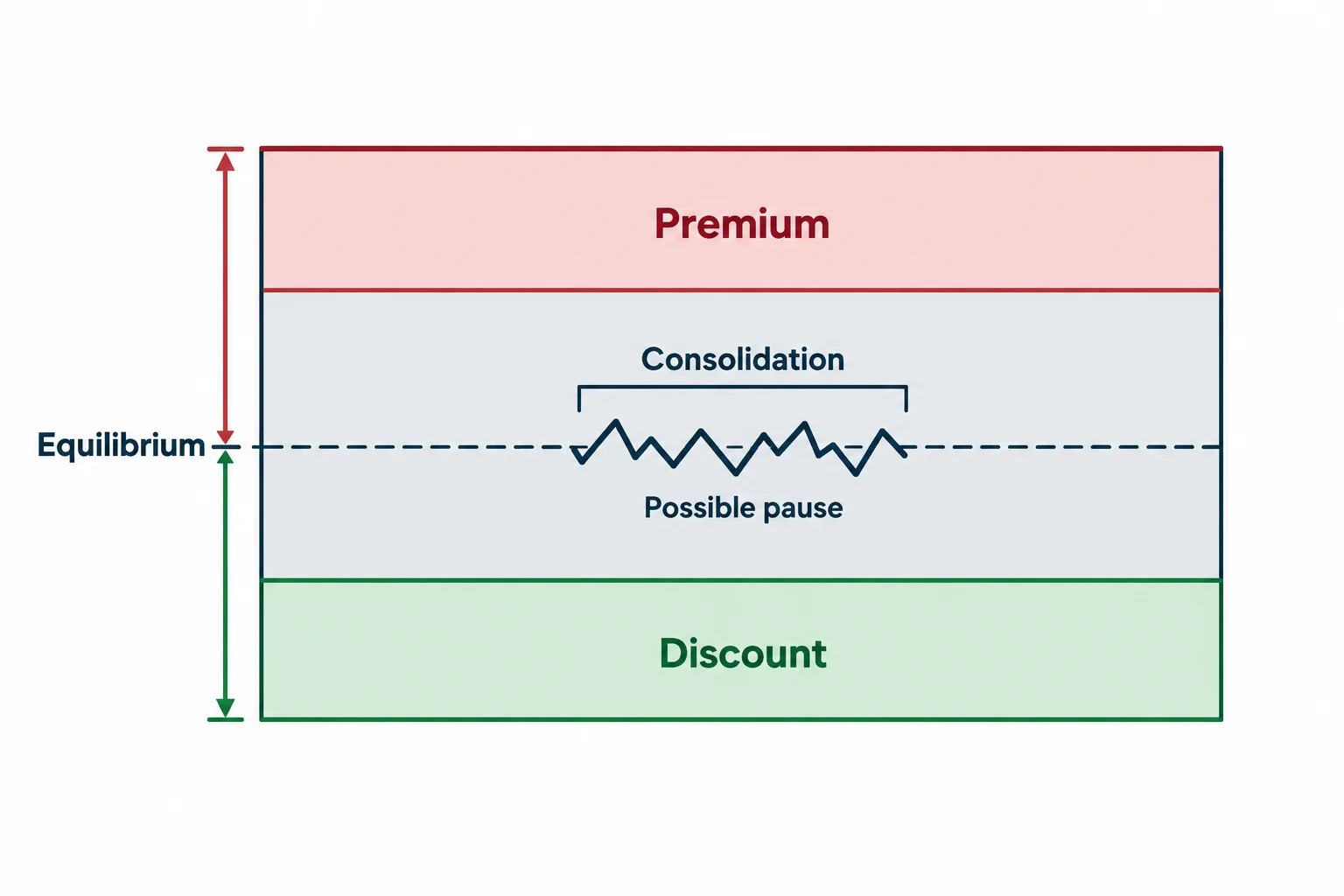
The formation characteristics are separate from the calendar. He says a consolidation commonly follows a higher-timeframe premium or discount array being reached: price moving away from a discount and meeting a premium array can pause and consolidate there while it waits to continue, retrace after that consolidation, or simply reverse (3:25, 3:37, 3:46, 3:50, 3:54, 3:56). His stated mechanism is that the array is where profit-taking and a pause in the advance tend to appear, and that contact with the level may not require a retracement at all (4:15, 4:18, 4:24, 4:31).
Equilibrium is treated the same way. When price reaches the equilibrium or midpoint of a higher-timeframe price swing, he says a pause is reasonable; and once those mile markers are met, some measure of consolidation or pulse is what he expects (5:01, 5:06, 5:15, 5:23, 5:25). He frames the market as moving from consolidation to expansion and back, with retracements or reversals in between, and calls consolidation the most dominant consideration in price action (5:30, 5:38, 5:57, 6:09, 6:16). The practical caution he attaches is that equilibrium should not be treated as automatically explosive: larger participants work that timeframe and may transact around the level more than once (6:22, 6:26, 6:36).
Why ICT Bond Trading Guides Other Markets
The reason he gives for studying bonds at all is cross-market. He says he was overzealous about specific moves early on and got frustrated when moves never started or went nowhere, and that incorporating the interest-rate and bond markets was the missing link that made sense of it (8:16, 8:20, 8:29, 8:40, 8:41, 8:44). His conclusion is that if a consolidation period is expected in the bond market, the same should reasonably be expected in the other asset classes (8:50, 8:56, 9:02). Later he sharpens it: while the bond market is held in a narrow range, that creates a stranglehold on volatility for the other markets on average, though he adds that a consolidating bond market does not mean the yen or the franc will be wild, and that this is not how to think about it (18:10, 18:12, 18:13, 18:22, 18:24, 18:31).
How to Trade ICT Bond Consolidation Days
The tactical section is short and specific. In the morning he describes scalping for five to ten ticks, and he notes that one tick is 31.25, that five ticks does not sound like much, and that five to ten ticks a couple of times a week can still pay well in the bond market (9:06, 9:09, 9:12, 9:15, 9:17, 9:21). He also gives a squeeze condition: an opening range of twelve ticks or less, which he says generally leads to an expansion move of some kind, possibly just a run of the previous overnight high or low, and that the small range tends to let volatility compress before price snaps in the direction already suggested by institutional order flow (9:27, 9:42, 9:45, 9:53, 10:01, 10:06, 10:08, 10:10).
The restrictions matter as much as the tactics. He says the afternoon should only be traded if the morning has not already run a stop run (that is, if an obvious liquidity pool remains untapped) and that when the stops do get taken the approach is to run them with the professionals, take profit and step aside rather than get greedy (10:16, 10:25, 10:29, 10:35, 10:43, 10:48, 10:53). His general rules are to do the trading in the morning before noon; to avoid the morning session entirely on bond auction days because the market is on hold waiting for the auction; and to avoid the afternoon when an interest-rate driver is due, usually at two o’clock New York time, no matter how attractive the volatility looks (11:03, 11:07, 11:11, 11:15, 11:20, 11:22, 11:25, 11:28).
The reference levels he uses for targets are the overnight and short-term highs and lows. He says those are where the liquidity sits and where the market reaches during a consolidation day in the New York session, and points to a London session high and low on the chart as the levels that offered the morning opportunity (15:59, 16:01, 16:03, 16:07, 16:11, 16:14, 16:19, 16:22, 16:26, 16:29). He adds that consolidation days typically offer setups in the morning session, unless afternoon news drivers are due (16:34, 16:37, 16:40).
Managing Tight ICT Bond Trading Ranges
There is an explicit position-management idea in the middle of the lesson. He says he always allows his limit exits to exceed his target, because the market is not guaranteed to stay inside a predetermined consolidation range (14:21, 14:24, 14:26, 14:30). His example is a personal objective of eight ticks set against a sixteen-tick target on the bond market, so that if the range expands quickly the extra movement can pay him for having expected too little (14:53, 14:59, 15:01, 15:06, 15:10, 15:12, 15:17, 15:22, 15:28). He says watching price at the objective rather than closing mechanically has paid him more than taking the first target and leaving, and that the position then has to be managed accordingly (15:41, 15:43, 15:47, 15:52, 15:55).
He is candid about attention. If you are scalping, he says the market gets your undivided attention, charts in front of you, not television, not anything else going on in the room (14:46, 14:48, 14:50, 14:53, 14:56). He also frames the sizing decision as a psychological one: if the expectation is a small range, that removes what he calls the insatiable desire to swing for the fences, and operating from a scalper’s mindset with small objectives keeps the response proportionate to the day (12:28, 12:38, 12:47, 13:04).
How ICT Bond Consolidation Prepares for Expansion
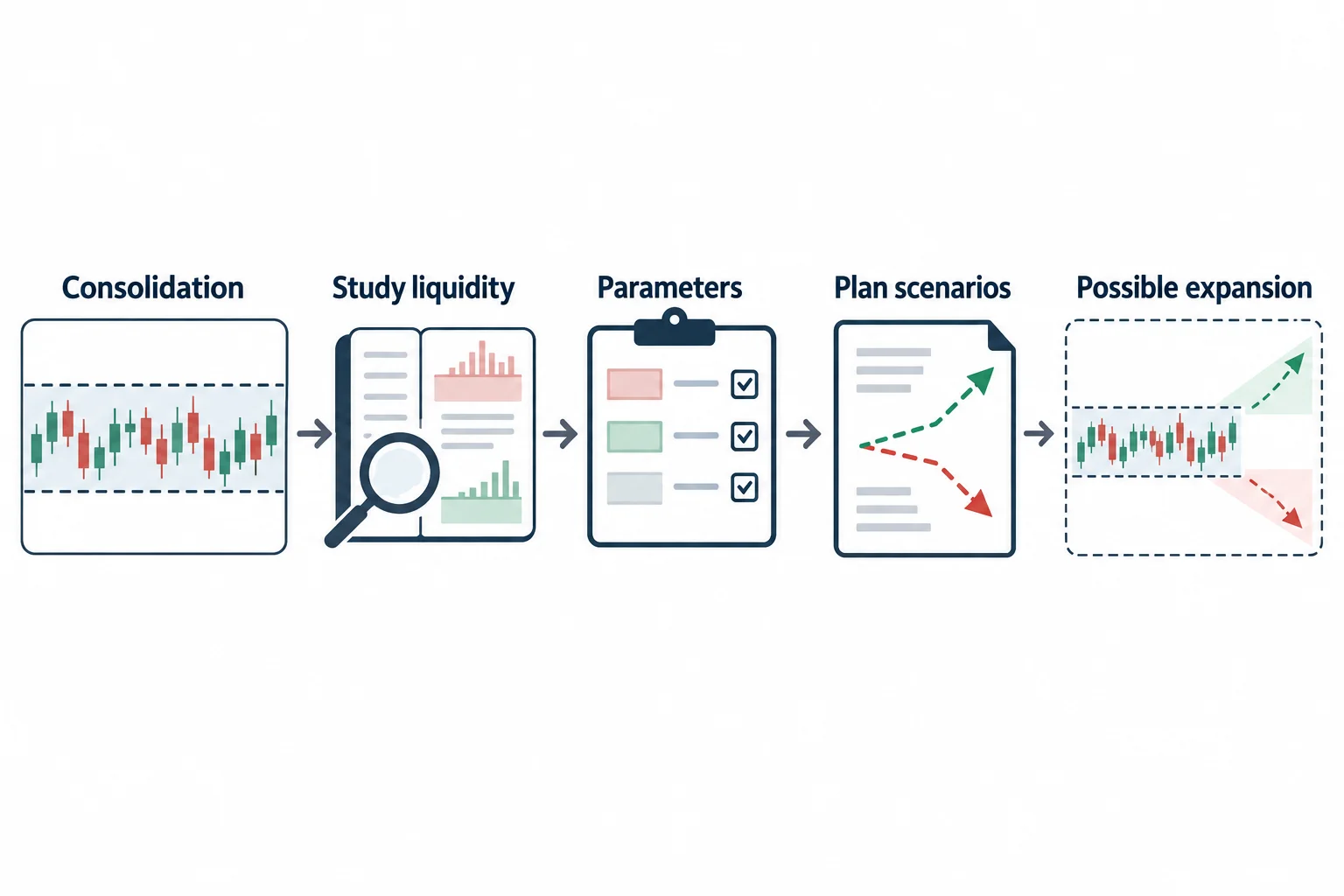
The lesson’s second half is an argument about behaviour. He says consolidation days give a trader time to work out where the next liquidity run is and to plan the next move, that trading on too short a timeframe removes that planning room, and that a consolidation day is a signal rather than a frustration. His phrasing is that these pauses are gold mines in the making, and that they should prompt homework rather than staring at the screen (13:10, 13:27, 13:35, 13:39, 13:46, 14:10, 14:12, 14:15). He makes the same point structurally: small ranges precede large ones on the daily, and consolidation brings expansion, so the next trading day or the one after it is where he expects the larger range or trending day to appear (12:47, 17:37, 17:45, 17:50, 17:52).
He closes that argument with a rule-based frame rather than a prediction. He says a trader without parameters will always deviate outside them and never get an accurate measurement of their own development or consistency, and that operating to a rule set in low-volatility conditions changes the whole perspective and removes a lot of the anxiety of not making enough (19:07, 19:13, 19:20, 19:26, 18:43, 18:55, 18:59, 19:04). His psychological claim is broad: he says 98% of traders, including professionals, get pulled into the emotional effects, that newcomers end up in what he calls the trader’s graveyard within the first 90 days, and that he encounters fear and greed himself; his remedy is the rule set rather than certainty about the market (19:43, 19:48, 19:57, 19:59, 20:17, 20:27, 20:32, 20:38).
He is explicit that this is not a profit technique. He says the point is not to teach consolidation trading to make a killing but to keep a professional perspective, that this is not Las Vegas, that the aim is longevity and keeping the account so as to be there for the expansion moves where trading gets easier, and that the satisfaction he is describing is about having followed a defined process rather than having mastered the market (23:06, 23:13, 23:15, 23:18, 23:23, 23:28, 23:33, 23:36, 23:40). He also gives permission to miss things: losses and missed opportunities outside the rule set should not matter, there will always be someone making more elsewhere, and the alternative is treating someone else’s money carelessly by chasing it (23:51, 24:00, 24:05, 24:07, 24:12, 24:14, 24:18, 24:22).
ICT Bond Trading Signals for Forex
Because the audience is primarily forex traders, he draws the conclusion across asset classes. He says the observation is as useful for FX, where it means reducing or limiting expectations on pair movement and operating in a more reserved fashion, sticking to what he calls low-hanging fruit and small gains (24:32, 24:36, 24:47, 24:52, 24:53). He then explains the fickleness he says his students had been experiencing by pointing at the bond market having been range-bound for months, and argues that a long consolidation tends to resolve into a trending phase once price leaves the range (24:57, 25:03, 25:09, 25:12, 25:18, 25:25, 25:32, 25:36).
That leads to his most forward-looking statement in the recording. He says that because the bond market had been consolidating ahead of the autumn, he was confident about the price action he expected in the final four months of 2017, and that consolidation periods are when the smart money is setting up the next big move (25:42, 25:44, 25:52, 25:57, 26:04, 26:08, 26:11, 26:18, 26:20, 26:24, 26:29). He ends with the intermarket claim again: because the audience are primarily forex traders, a consolidating bond market is informative, and when bonds are not consolidating the other markets move more fluidly (26:36, 26:40, 26:42, 26:47, 26:50, 26:51).
Limits of the ICT Bond Consolidation Lesson
As a piece of process documentation this is specific. It names calendar conditions, gives a tick-based definition of a small opening range, sets a time-of-day cut-off, distinguishes trading with a pending stop run from trading without one, and explains why the auction and holiday calendar changes his expectations. Those statements can be checked against a calendar and against what a session actually did.
What it does not contain is any test of them. There is no chart visible in the caption track, no sample, no count of how often the conditions preceded a quiet day, no outcome for any described trade, and no accounting for the cost of being wrong. The tick values, the 31.25 figure and the twelve-tick threshold are his own for the contract he was watching, and the caption track does not identify that contract, so they should not be carried over to another instrument or another tick size (9:06, 9:12, 9:42, 9:45). The 98% figure, the 90-day claim and the confidence about the final four months of 2017 are all his assertions, reported to camera, not measurements produced by the recording (19:43, 19:59, 25:57, 26:04). The intermarket link between a quiet bond market and quieter conditions elsewhere is central to his teaching, and here it is an interpretation supported by a narrative example rather than by evidence.
The captions are auto-generated and misrecognise some of this lesson’s vocabulary, which matters before quoting it: futures appears as “features”, forex appears as “X”, there is a “vault in volatility” where he is describing a lift in volatility, sell stops appear as “cell stops”, a liquidity run appears as “rated for opportunities”, and “pre-seed” stands in for precedes (0:09, 0:12, 1:02, 3:15, 1:54, 16:14, 12:47). Where a term is genuinely ambiguous it is qualified here rather than silently corrected, and no price, fill, chart coordinate or net result has been inferred anywhere in this article.
Watch the ICT Bond Trading Consolidation Lesson
Watch the original lesson on YouTube
This recording cannot be played inside another website. Its embedded player was loaded from a BestProps origin and clicked on 15 September 2026: it reported “Video unavailable” and “Playback on other websites has been disabled by the video owner”, with no duration and no playback progress. The recording’s own watch-page data agrees that it is not playable in an embed, so no iframe is placed here. The video itself is public and available directly on YouTube.
Watch ICT Mentorship Core Content – Month 10 – Bond Trading – Consolidation Days on YouTube ↗
ICT Bond Trading Sources and Further Reading
- ICT Mentorship Core Content – Month 10 – Bond Trading – Consolidation Days The primary source and the only recording used here. Uploaded 18 October 2022; a June 2017 mentorship lesson by its own opening. Use the timestamp links above to compare the conditions with what he actually said.
- The Inner Circle Trader YouTube channel The publisher’s own channel, where this lesson and the other core-content months are posted. Reuploads and third-party summaries are not the source used here.
- CFTC (Learning Resources) The US regulator for futures markets, including its educational material on contract specifications such as tick size and value, which is the detail a reader would need in order to check whether figures like 31.25 or a twelve-tick range apply to a given contract. General context only; it does not assess this presenter.
- Investor.gov (SEC) (Investment Products) The SEC’s investor education pages on futures and other products and their risks, with a companion guide on how to avoid fraud. Useful background on leverage and loss characteristics that the recording does not discuss.
BestProps is not