
Key takeaways
ICT Mentorship Core Content Month 09 Trading Market Reversals presents eight setups consisting of runs above or below the previous day’s extreme, the current week’s extreme, or an older intermediate-term extreme, plus New York and London close reversals.
Read the full summary
ICT Mentorship Core Content Month 09 Trading Market Reversals presents eight setups consisting of runs above or below the previous day’s extreme, the current week’s extreme, or an older intermediate-term extreme, plus New York and London close reversals. A level break alone is not a signal. ICT requires alignment with higher-time-frame order flow, session timing, and a premium or discount PD array such as a fair value gap or order block. New York normally continues London unless price reaches a higher-time-frame premium array after a London rally or a discount array after a London decline. London close can provide a second swipe through the New York extreme and repeat the setup. His London-close scalp condition requires a large-range day, illustrated as 125 to 130 pips when the five-day average daily range is 100 pips, followed by an expected retracement of roughly 20 percent between 10 a.m. and noon New York time. Equal highs or lows may strengthen a case when setups overlap but can also be continuation targets, while intermediate-term reversals are presented as most productive in ranging markets. ICT cites potential bounces of 30, 60, or 80 pips and suggests studying one currency pair across roughly three months, but the recording provides no instruments, entries, exits, results, win rate, testing method, order data, or verified performance, and he explicitly says the concepts are not plug and play and that he cannot know in advance what price will do.
How we researched this article
BestProps used document-based research from primary firm sources, checked September 24, 2026. The complete source list, scope, limitations, and commercial-state record appear near the end of this article.
In ICT Mentorship Core Content – Month 09 – Trading Market Reversals, the speaker groups reversal setups by the reference level each one uses rather than by chart pattern. He opens by naming the eight he considers tradable (0:32) and spends the rest of the recording putting conditions around them.
Two things shape the whole lesson. The first is that a run on an old high or low is not by itself a signal, he says so repeatedly, and the caveat is the point of the framework rather than a disclaimer bolted onto it. The second is that he describes his vocabulary as an interpretation of price action: buy stops resting above highs and sell stops below lows, “banks” and “market makers” engineering those runs, and “institutional order flow” on higher time frames. Those are his readings of a chart. The recording contains no order data, no participant identity, no fills and no performance statistics, so nothing below should be read as verified.
Eight ICT Market Reversal Setups
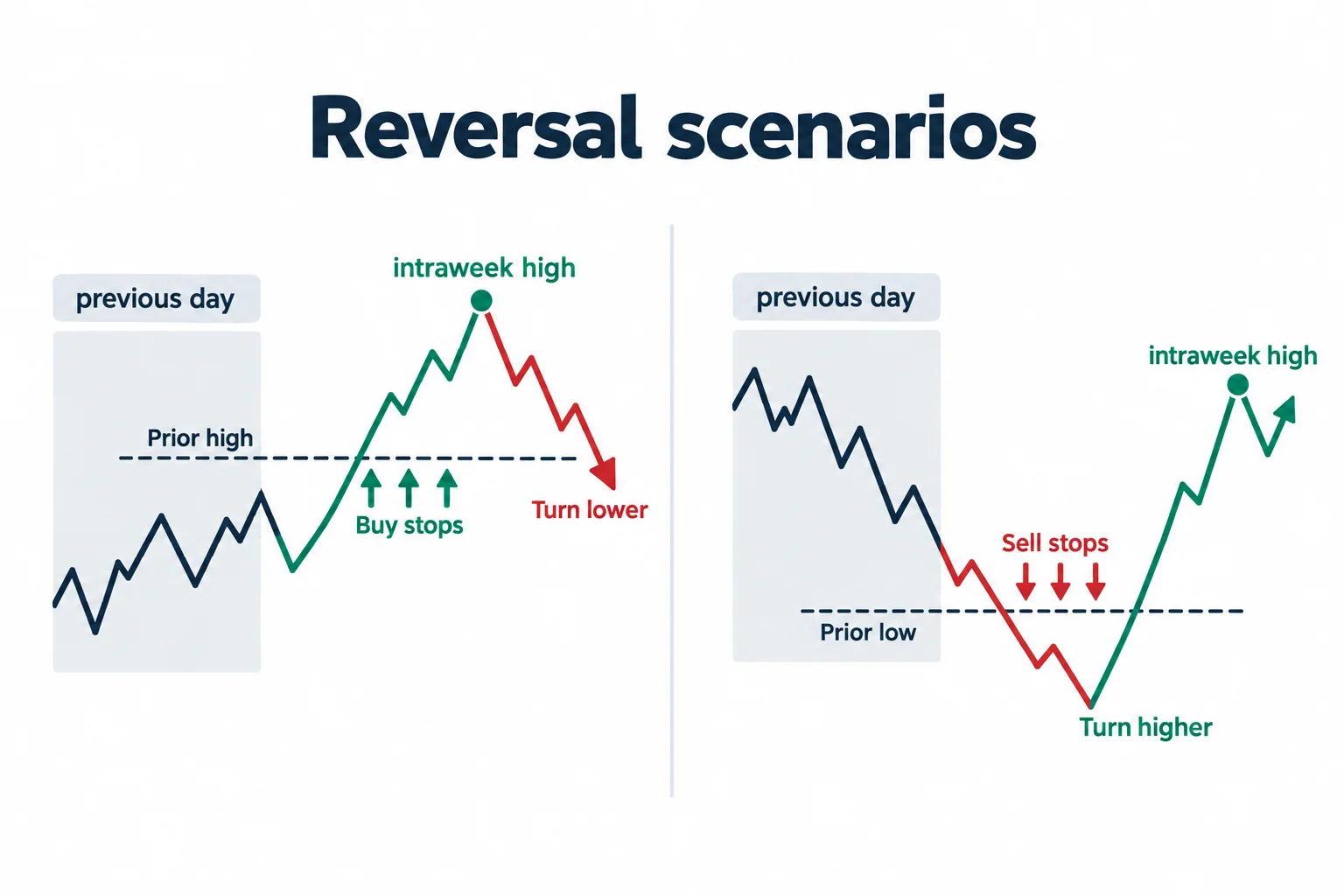
He lists them as four pairs plus two session-based cases, and each pair mirrors the other in direction:
- A run above the previous day’s high, then a turn lower.
- A run below the previous day’s low, then a turn higher.
- A run above the highest high made so far this week, then lower.
- A run below the lowest low made so far this week, then higher.
- A run above an older intermediate-term high (a prior week's high, or older) then lower.
- A run below an older intermediate-term low, then higher.
- A New York session reversal.
- A London close reversal.
The intraweek definitions come early: he describes the intraweek high as the level where price trades above the highest high made so far that week, takes the buy stops and then reverses (3:28), with the intraweek low as the mirror image below the week's lowest low. The last two setups are different in kind (they are tied to a session rather than to a stored level), which is why session timing carries more weight for them. He also notes that these setups can stack: when a Tuesday high and a slightly lower Wednesday high form effectively equal highs and price runs them on Thursday, that single move can be read as an intraweek-high reversal and a New York reversal at the same time, and he says the overlap makes the case stronger (19:38).
ICT Market Reversal Setup Requirements
The condition he attaches to every pair is a higher-time-frame area. Above a high he wants a premium array; below a low he wants a discount array, a fair value gap, an order block, or another entry on what he calls the higher-time-frame PD array matrix. That is the element that turns a run on an old level into a scenario he will act on, and he is explicit that without it he is not interested (15:08, described there as the “crown jewel” of the teaching).
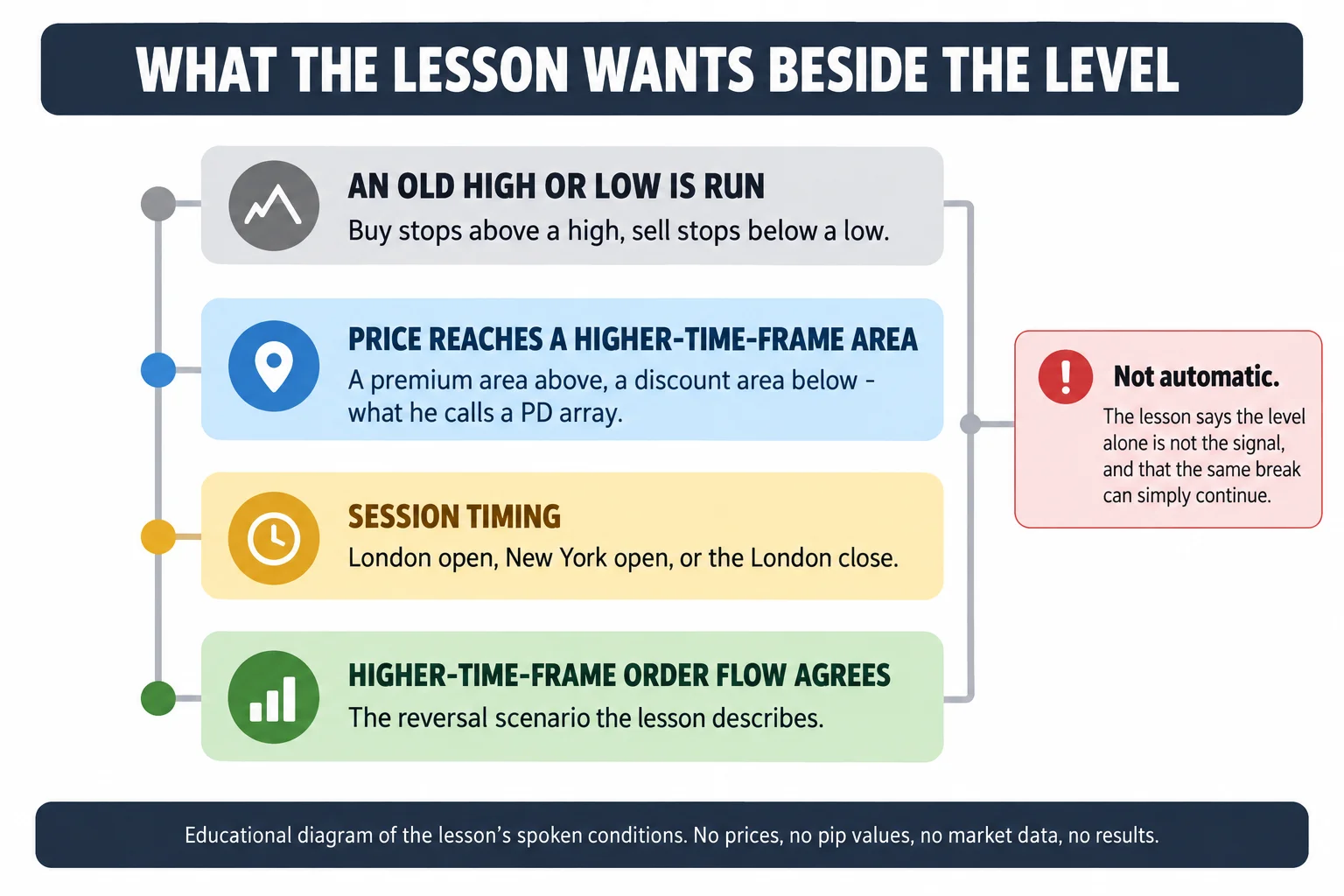
Liquidity is the reason he gives for why the levels matter. Buy stops sit above an old high and sell stops below an old low, and he describes the run as the mechanism that reaches them (1:44). In the equal-highs section he calls that configuration “Candyland” because the resting orders are easy to see, and says a run 10 or 20 pips beyond is what sweeps them (19:38). It is worth keeping his own qualification next to that: the same break can simply continue, and he says equal highs can also be nothing more than targets on the way to a larger move higher.
Previous-Day ICT Market Reversal Setups
This is where he traces the idea back to exercises he set when he first appeared on the BabyPips forum, deliberately buying and selling previous-day highs and lows to see what price does after the stops are taken (1:15). His daily routine is to compare today with the last three days counted from today, asking whether price worked the prior day’s high or low, or those of the day before that (14:20).
The two conditions he fades inside are retracements. In an expansion swing to the upside, the smaller pullbacks are where the previous day’s low gets run and price then turns higher; in an expansion swing down, the retracement is where the previous day’s high gets run and price turns lower. He names that shape after the “Turtle Soup” false-break idea but says his version goes one step further because he requires the higher-time-frame alignment (15:30).
His worked bullish example is concrete about sequence: price was already moving higher as part of a larger expansion swing, a normal retracement brought it lower into a fair value gap, and buyers appeared under the previous day's low, he says that once the previous day's low is run a buyer can act intraday (15:57), then points to a candle that opens, trades down and closes inside the fair value gap before rallying to a higher close than the candle before it (16:16). The bearish example reverses every part of it: price moving lower in a larger expansion swing, a fair value gap already filled, and the retracement finding sellers above the previous day's high, where he marks a candle trading above its predecessor's high as the location (17:29). He pairs both with a requirement he states separately: the PD arrays have to concur, because price moving past an old level on its own is not enough (17:12). The captions give no instrument, no price and no result for either example, and he presents both as chart illustrations of the pattern rather than trades.
He restates the confluence requirement for the bullish direction too: what he is looking for is a move down below the previous day’s low and into a discount array at the same time, and he warns that buying under the level just because price moved below it is not the idea (17:03).
Intraweek ICT Market Reversal Setups
The intraweek pair uses a high or low set earlier in the same week. His stated preference is for the week’s high to be reached on a Tuesday, Wednesday or Thursday after the market has already been trading higher for a period of time while a premium array is still unmet, so the run on the earlier intraweek high and the arrival at that higher-time-frame area happen on the same day (4:14). He warns against treating equal highs as an automatic short: sometimes they are simply levels price is aiming at on the way up, and he wants the higher premium array, a neutral or consolidating state, and a London or New York session behind the entry (20:25).
The intraweek-low example he walks through marks a low from the previous week with double vertical lines and notes equal lows on the preceding Friday and Monday that were traded through on the Tuesday, which he reads as an intraweek low blending with the prior week’s range (21:22). His stated reason for caring about the older reference is that stop losses from larger funds sit around those higher-time-frame highs and lows, so price returning to them is gunning those stops (23:38).
Intermediate-Term ICT Market Reversal Setups
Intermediate term in his usage means anything older than the past day or two (a prior week, a couple of months back, or the previous month) and he says those older extremes are the most productive when the market is not trending, because range conditions suit shorting above an old high and buying below an old low (22:51). He calls old highs and lows “gold mines” for exactly the same stop-loss reason (23:30).
The caution he attaches here is the strongest of the lesson. He says you have to weigh the storyline behind the move before fading it, because many times price trades straight through an old high rather than reversing, and he offers his own list of possibilities he would consider: order flow being paired into an exit for longs, or liquidity being engineered to put traders on the wrong side. Those are his hypotheses about intent. The recording provides no evidence that identifies a participant or an order.
New York ICT Market Reversal Setups
His default is that New York continues whatever London established. He names the exception precisely: unless New York trades into a higher-time-frame discount array after a London decline, or a premium array after a London rally, it is expected to continue the London direction (29:54). He first raises the topic at 9:47 and returns to it in detail at 28:30, where he also tells the reader to lay the higher-time-frame arrays onto the daily chart before moving down to intraday charts, because otherwise the reversal will not be visible in time.
The reversal case is stated as a sequence. London makes the low of the day, rallies into the New York open, and reaches a premium array; once New York trades into that area he expects the reversal and a lower close on the day (30:57). The mirror is a London high of the day and a New York discount array. He presents this as a repeating characteristic of the session, not as a tested result.
London Close ICT Market Reversal Setups
Everything he says about New York he says also applies to the London close (32:19), which he treats as a second chance at the same higher-time-frame area. He adds two specifics. The intraday version applies only on large-range days, which for him means the five-day average daily range has been exceeded by about one and a quarter to one and a third percent (if the five-day ADR is 100 pips he wants 125 or 130 before considering it (12:12)) and on those days he says price tends to retrace roughly 20 percent of the day's total range between 10:00 a.m. and noon New York time (32:31). He ties the window to the five-day average daily range at 12:08.
The second specific is what he calls the second swipe. When New York has already made the reversal he was expecting, the London close can go back one more time to the same higher-time-frame array and clear the stops of the traders who caught that New York move, and he says that is an opportunity to take the same setup again (33:48). He describes the larger-scale version as a London-close reversal that can begin several days of one-sided direction when the weekly template supports it. As with the New York section, the pip figure and the 20 percent are his stated expectations, not measurements produced in the recording.
How to Study ICT Market Reversal Setups
The last part of the lesson is about method rather than setups. His recommendation is to scour price charts for examples of each reversal, pick one currency pair, and go back over roughly the last three months marking where reversals occurred and what the context was (36:11). He says the setups are similar in general but differ in ways that only show up with individual study, and that a later month would bring a specific set of top-down templates aimed at producing a reversal mindset (35:39). He closes by repeating that the outcome is never known in advance and that what can be anticipated is generic behaviour that repeats (36:48).
He is also blunt that the material is not a system. He rejects the idea that the concepts are “plug and play” and says the experience factor cannot be communicated in a teaching and has to be earned over time (25:27). He mentions that in his own live sessions for that week some calls were precise and that once his objective for the week was met he was off on the analysis but no longer trading, which is his account of personal sessions, offered as an illustration of the experience point, and is not independently verifiable here.
Limits of the ICT Market Reversal Recording
The lesson gives no instrument, no date, no entry price, no exit price and no result for any of the illustrated examples, and it reports no win rate or testing method. The figures that do appear are his stated expectations: the 30, 60 or 80 pips he says a tradable bounce can offer (5:49), which he describes as “really high odds” trades (5:37); the 125 to 130 pips against a 100-pip five-day ADR (12:12); and the roughly 20 percent retracement on a large-range day (32:31). Read them as the speaker's claims about setups he trades, not as verified outcomes. The mechanics he describes (stops clustered above highs and below lows, and a session that reaches a higher-time-frame area) are plausible descriptions of market structure, but the recording does not test whether the reversal follows. He says as much himself: “I don't know with 100 [assurance] what price is going to do” (2:57), and the scenarios are “generic scenarios that tend to repeat themselves when there are other factors incorporated.”
Two further limits are worth stating plainly. First, the reversal examples are read off the speaker’s own charts on screen; a reader working from the captions alone cannot verify any level, bar or coordinate shown. Second, the language of “banks,” “market makers,” “whales” and “institutional order flow” appears throughout the lesson as his interpretation of what price is doing. Nothing in the recording identifies an actual participant, and those terms should not be read as established market mechanics.
ICT Market Reversal Caption Errors
The timestamped English captions used for this article are auto-generated and misrecognise a number of the speaker’s terms. This track renders “reversal” as “rehearsal” (14:20), “raiding” as “rating” and “reading” (1:15), “sell stops” as “cell stops” and “sell stop” as “sell stock”, “intraweek” as “entry week” (19:01) and as “inch a week”, “London close” as “London clothes” (32:19) and as “lung enclosed”, “New York session” as “New recession”, “higher time frame” as “hard time frame”, “PD array” as “pdra”, “assurance” as “assurity” (2:57), “expansion” as “extrapolation” and “scalp” as “Scout”. Labels used in this article are the ones the surrounding context supports; where a phrase could not be resolved confidently it is described rather than quoted.
Watch the ICT Market Reversal Recording
ICT Mentorship Core Content – Month 09 – Trading Market Reversals
The Inner Circle Trader · published 12 October 2022 · about 37 minutes 2 seconds. This recording is the primary source for every timestamp link above.
The recording is not embedded here because the video owner has disabled playback on other websites. That was tested directly on 15 September 2026 from a BestProps page origin at both desktop and mobile widths: the embedded player loads and then reports “Playback on other websites has been disabled by the video owner” with no duration and no playback progress. The video itself plays normally on the watch page, so no half-working player is left on this page.
The watch page was read on 15 September 2026 and rendered as a public video: ICT Mentorship Core Content – Month 09 – Trading Market Reversals by The Inner Circle Trader, upload date 12 October 2022, listed duration 2,222 seconds, about 205,913 views at the time of reading, not private and not unlisted. The caption track used for this article covers about 2,224 seconds, which matches the listed duration.
One naming detail, since the recording and the page disagree in appearance only: the speaker introduces himself at the top of the track as being on “lesson five of the May 2017 ICT mentorship, ICT Amplified day trading and scalping,” while the published title labels it Month 09. The watch page states that the audio and visuals are exactly as they were distributed in May 2017, so the two are consistent, the May 2017 session material is published under the Month 09 heading. This article uses the published title and treats the spoken lesson number as the speaker's own reference.
Resources for ICT Market Reversal Setups
These are the sources checked for this article. The regulator and investor-education pages are general material about trading systems and advisory services sold to the public, and about investment products and their risks; neither assesses the speaker, verifies any level, session rule, pip figure or retracement expectation above, nor endorses anything said in the recording. Any ICT, smart-money or third-party indicator, script, note set, transcript pack, chart annotation or re-upload circulating outside the publishing channel’s own page is unofficial and untested here.
- [1] ICT Mentorship Core Content – Month 09 – Trading Market Reversals The Inner Circle Trader (primary source; watch page read 15 September 2026, listed 2,222 seconds, about 205,913 views).
- [2] The Inner Circle Trader (official YouTube channel) (read 15 September 2026) (the publishing channel for the May 2017 mentorship series).
- [3] CFTC (Fraud Advisory: Commodity Trading Systems Sold on the Internet) (read 15 September 2026) (the regulator's guidance on evaluating trading systems and advisory services, including its warnings about performance claims built on hypothetical or incomplete results).