
Key takeaways
ICT Mentorship Core Content Month 09 Bread & Butter Sell Setups teaches a May 2017 bearish five-minute scalping framework built on higher-time-frame institutional order flow, premium and discount arrays, kill-zone timing and the five-day average daily range.
Read the full summary
ICT Mentorship Core Content Month 09 Bread & Butter Sell Setups teaches a May 2017 bearish five-minute scalping framework built on higher-time-frame institutional order flow, premium and discount arrays, kill-zone timing and the five-day average daily range. Offset distribution shorts a move above an old high where buy stops and breakout buyers provide counterparties, while redistribution shorts a retracement into a fair value gap, bearish order block or other premium array after an initial decline. Setups are restricted mainly to London open and New York open, with Monday through Wednesday preferred. The ideal session opens near its high at zero GMT, moves lower at London open, retraces during London lunch or pre-New York from five a.m. to seven a.m. New York time, then makes a second leg lower after the eight twenty a.m. CME-open Judas swing, targeting the five-day ADR low or a four-hour or 60-minute discount array before a retracement from ten a.m. to noon. If ADR is reached before ten a.m., the lesson says to take 80 percent off and retain a small runner. A secondary London-close countertrend setup requires London and New York to move together, the ADR low to be reached and an entry between ten thirty a.m. and one p.m., using a five-minute bullish failure swing, 10 pips of risk below the daily low, a stop no wider than 20 pips and a target of 20 to 30 percent of the daily range or one-to-one reward to risk. The Asian-open variation shorts at or just above the zero-GMT price for 15 to 20 pips and calls for a full exit because volatility is limited. ADR is a range objective rather than a mandatory level, may be missed or exceeded, can expand to twice its average during strong trends especially when ADR is below 60 pips, and is blended with lower-time-frame arrays, central-bank dealer ranges, pivots, Asian range projections and standard deviations. ICT recommends scaling out roughly 15 pips before the exact ADR level because broker data varies, while noting that an ADR reached by New York open may be exceeded, particularly around later high-impact news. All pip figures, risk rules, hold-time references and chart labels are historical teaching examples rather than verified performance, and the captions contain recognition errors.
How we researched this article
BestProps used document-based research from primary firm sources, checked September 24, 2026. The complete source list, scope, limitations, and commercial-state record appear near the end of this article.
In ICT Mentorship Core Content – Month 09 – Bread & Butter Sell Setups, the speaker presents the inverse of the bread and butter buy model he covered previously, applied to short scalps inside a daily range. The recording opens by identifying itself as lesson seven of the May 2017 ICT mentorship, on amplified day trading and scalping bread and butter setups (0:07 and 0:12). The watch page dates the upload to 14 October 2022, so this is a later re-release of 2017 mentorship material.
He sets out the goal as consistent small price movements on the sell side (0:24) and then states plainly that the sell-side material is the buy-side teaching reversed, including the parameters, pips per trade and hold time, so he does not re-explain all of it (3:33). That is worth noting: the lesson assumes the buy-side lesson as its context, and the statistics he refers to are not restated or evidenced here.
ICT Sell Setup Models
He divides the sell-side framework into offset distribution and redistribution (0:32).
Offset distribution is the model in which the market is repriced above an old high to promote buy stops (and breakout-system orders that buy on strength) into market orders for current short holders, in effect engineering buyers at premium prices before price seeks a lower short-term discount array to offset positions (0:41, 1:24, 1:47). Its stated purpose is to offset current short holders or induce more buyers at a premium price, and he says it appears frequently in bearish conditions while higher-time-frame institutional order flow is suggesting lower prices, typically unfolding quickly at key intraday highs.
Redistribution is the retracement version: the market is repriced higher into a fair value array to provide premium pricing for short entries, which puts pain on current short holders and tends to induce buying that supplies the liquidity to pair smart-money shorts with (2:23). He says it often unfolds after a recent buy-stop raid, appears in the same bearish conditions, and should be anticipated at key premium arrays intraday.
- Offset distribution: a move through an old high is the setup; the short is framed as countering the buying that the move produces.
- Redistribution: a rally back into premium or fair value after an initial decline is the setup; the short is framed as continuation.
Both descriptions are his account of whose orders sit where and why. The transcript contains no order flow, volume or position data that identifies a participant, so “engineering buyers,” “smart money” and “offsetting positions” are his interpretation of price action rather than an observation of who traded.
ICT Session Timing Filters
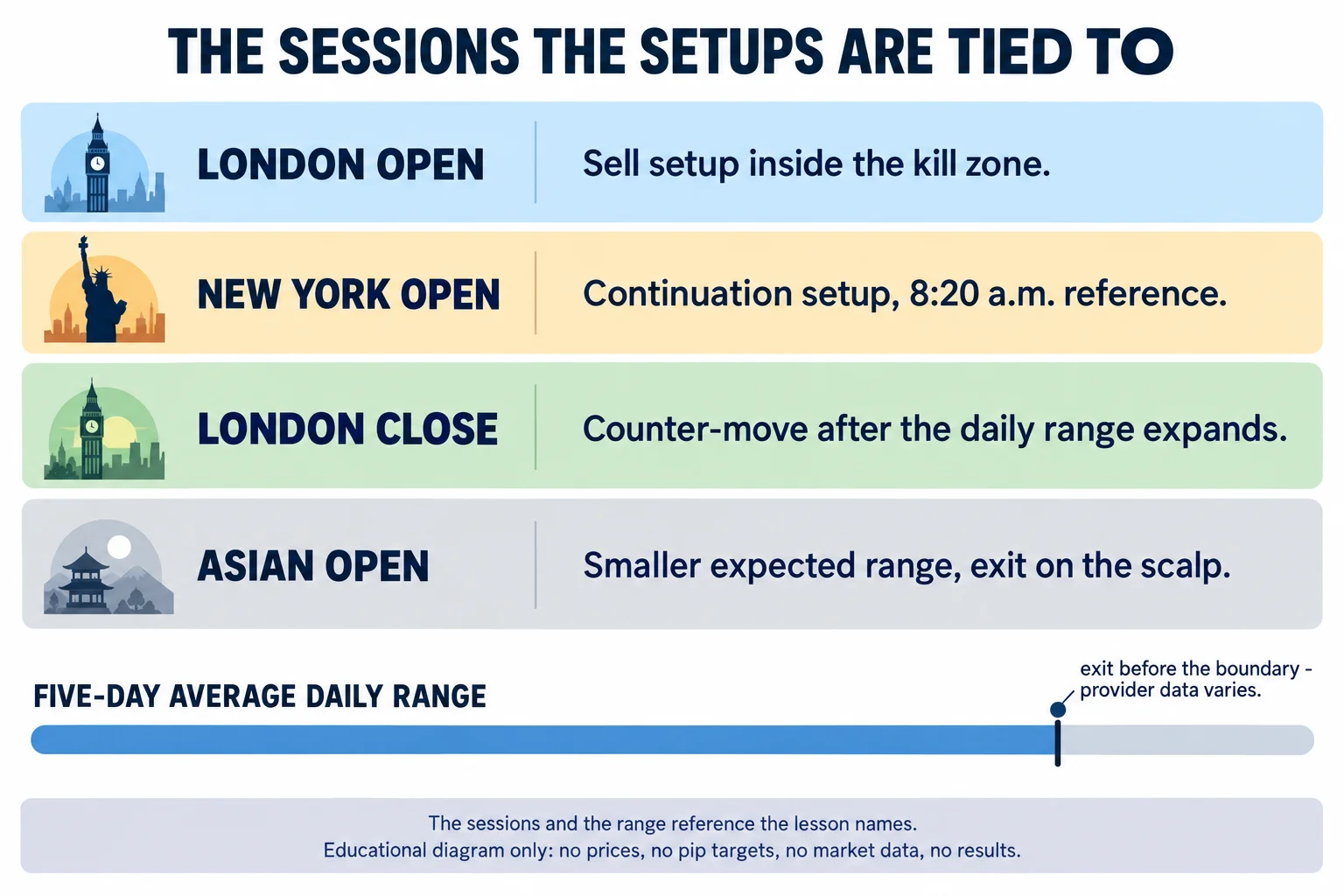
He is emphatic that these setups must occur inside the kill zone. In the same passage he says they are strongly related to kill-zone setups and that he is not looking to scalp outside the highest-volume session times of the day, which he names as London open and New York open (3:56, 3:57, 4:00). Later he repeats the point when discussing which days and hours he prefers, putting Monday, Tuesday and Wednesday as the highest-probability days and saying the London close and the Asian session do not offer the same volatility (22:37, 22:47).
The idealized bearish daily range he describes runs as follows (4:15, 4:22):
- The open sits at or near the high of the daily range. He specifies that open as zero GMT, or the midnight candle in New York, and allows a small rally above it first (4:32).
- London open posts the initial leg lower, and he scalps shorts inside that first swing (4:46).
- A small retracement appears between 5:00 a.m. and 7:00 a.m. New York time, which he calls London lunch and pre-New York open (5:13).
- New York open produces the second leg of the daily range, continuing lower if the high was set in London (5:25).
- The leg runs until the five-day average daily range low is reached, after which there is a retracement off the low formed between 10:00 a.m. and noon New York time (5:37, 6:05).
He uses conditional language throughout (the first leg lower generally comes in, the rally above the open does not have to happen), so this is a template for how a bearish day can develop rather than a sequence a given day must follow.
London Session Sell Setup
When the higher-time-frame read is bearish he anticipates that London will form the high of the day. He describes the open at zero GMT, or midnight New York, seeing a protraction phase higher that can be scalped from the open or just below it before 1:00 a.m., and he calls the classic higher move the London Judas swing, which he says is even easier to scalp (6:38, 6:51). The market then retrades between 5:00 a.m. and 7:00 a.m. New York time, which he offers as a short-term entry once a premium array is hit. He adds that even after the ideal Judas entry has passed, a five-minute retracement can be entered short to scalp the remainder of the London open (7:08).
His worked example starting at 7:22 is a redistribution: price trades up into what he describes as a fair value gap or a bearish order block, comes down to an old low, and he points out where the offset positions sit, all inside the London open kill zone (7:28, 7:46). Read that as him labelling a past chart, not as a documented trade.
New York Session Sell Setup
If London open confirms short-side sponsorship and posts the daily high, he expects New York open to continue lower, with two stated exceptions: a higher-time-frame discount array already hit intraday, or the average daily range low already reached (7:53, 7:58).
Method: he reads the intraday swings lower to determine premium arrays to short from inside the New York kill zone, uses 8:20 a.m. New York time (the CME open) to anticipate the New York Judas swing to fade, and takes as targets the five-day ADR low and the next higher-time-frame discount array found on a four-hour or 60-minute basis (8:15, 8:24, 8:32). He also gives a management instruction: if the ADR low is reached before 10:00 a.m., take 80 percent off and leave a small portion on for any range expansion (8:42).
The example at 8:55 has London creating the high of the day, a trade lower, a consolidation, and a small retracement at the 8:20 a.m. CME open that he reads as the Judas swing into a fair value gap and bearish order block (which he calls the redistribution), followed by a trade down into a fair value gap below price. The lesson mentions no readable price levels in the captions and documents no live fill.
London and Asian Session Setup Variations
The London close setup is the one place the sell-side lesson turns bullish. The conditions he states are specific: New York and London have moved in tandem, the five-day ADR low has been reached, and it is at least 10:30 a.m. and it has to be between 10:30 a.m. and 1:00 p.m. New York time, in which case he expects a retracement off the daily low (9:25, 9:29, 9:42). He wants the daily range to have expanded rather than merely reached its average, and he enters on a five-minute failure swing at the low with a bullish order block, stating a risk of 10 pips below the daily low and a target of 20 to 30 percent of the total daily range, or one-for-one reward-to-risk with a stop no wider than 20 pips (9:56, 10:04, 10:23, 10:29). He also warns that this is one of the harder trades to see work out, because the range can expand far beyond the average low (10:14).
The Asian open version is a small scalp: when the market is bearish he enters short at or just above the zero-GMT opening price and expects an expansion of 15 to 20 pips as the Asian range establishes, aiming for that 15 to 20 pips because the range can be limited by definition. He calls the Asian session one of the least volatile periods of the daily range, says it is not optimal to expect a second leg, and tells the viewer to take a full exit and avoid greed (11:05, 11:11, 11:24, 11:35, 11:50).
Using ADR for ICT Sell Setups
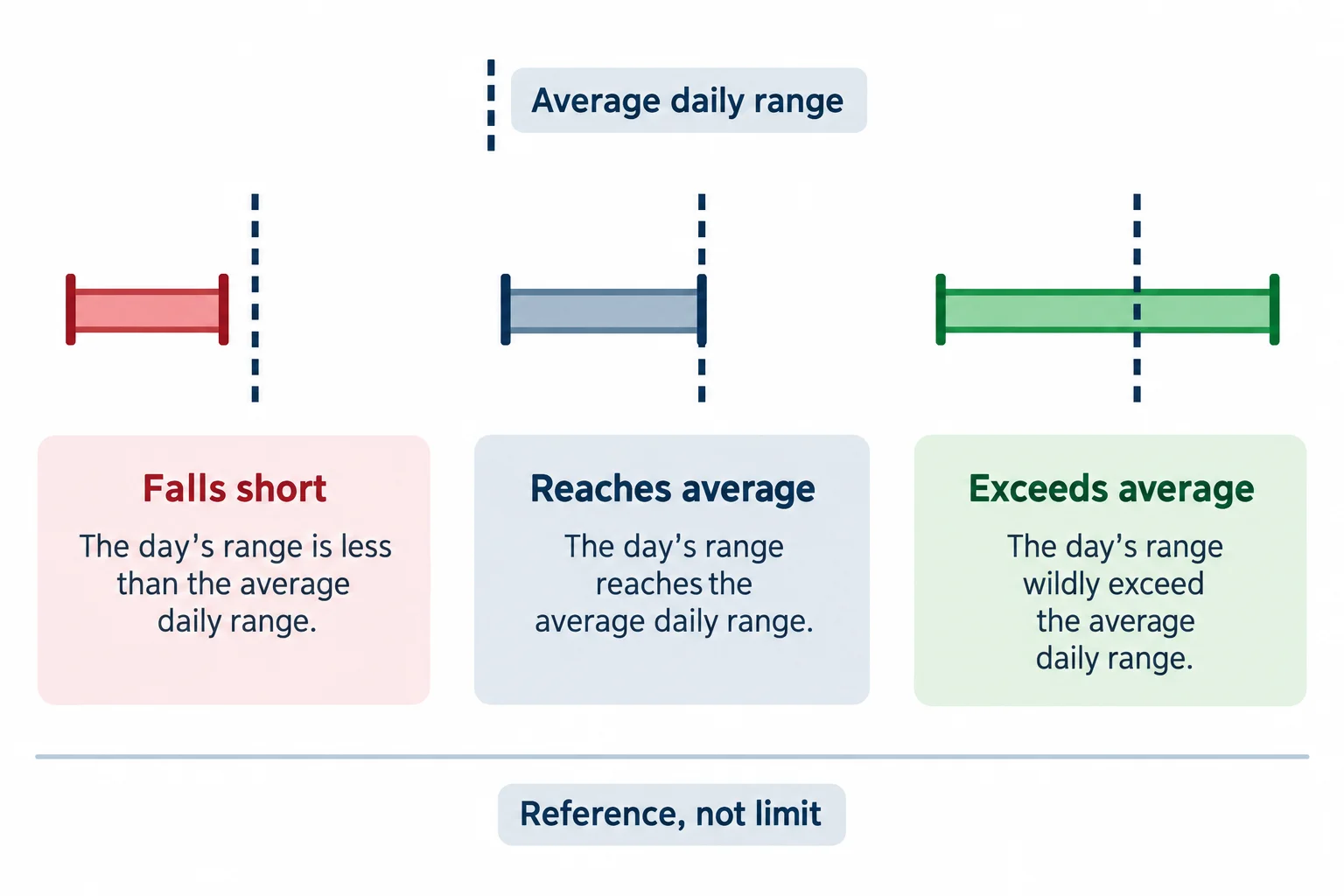
From 12:14 he spends a substantial block on the five-day ADR, and the first thing he says is a caution: the average does not have to fill for the day. Having the indicator on a chart does not oblige price to trade to it, and it will often fall just short or wildly exceed it. He calls it a general rule of thumb (the average, not the absolute range) that gives a range to reach for (12:17, 12:30, 12:35, 12:42).
His use of it is as one input to blend with lower-time-frame arrays, central-bank dealer ranges, pivots, Asian range projections and standard deviations, using the ADR highs and lows to formulate a probable objective for the day. He says that when those references overlap he expects scalps to form between them, ideally one in London, one in New York and one in London close, and maybe one in Asia, though not on every pair (12:54, 13:08, 13:13, 13:24, 13:40). The captions render “central bank dealer range” as “Central bike dealers range,” which is one of several recognition errors in the track.
He then describes a doubling condition: in a long-term trend with an intermediate-term swing beginning, a large impulse can surge the daily range to twice the average, especially when the ADR is under 60 pips. He names 60 pips as a number he has come to like over the years as a filter or buffer, and says that when a swing is completing at a higher-time-frame array on the strength of high-impact news, the move is usually capitulation and often goes well beyond the average (14:02, 14:33, 15:10, 15:17, 15:19). He also gives a scenario he prefers: an ADR not yet filled at New York open but filled during London close, because that leaves expansion still to come (15:36).
His exit rule is the most concrete thing in the section. Rather than holding for the exact ADR level, he backs off about 15 pips and scales the bulk of a position out there, because every data provider and broker has slightly different daily highs, lows and ranges. His words are that no one has the absolute number and there will be variance among them (16:18, 16:37, 16:44, 17:04, 17:14, 17:24, 18:11). He frames that as a deliberate choice about efficient exits rather than about being right, and refers to it as something he discussed in the live session of the day of this recording. Then one more conditional: if ADR fills at or before New York open, he expects it will likely be exceeded, particularly if high-impact news is due after the equities open (18:32, 19:04).
He is careful about the tool’s status: he calls the ADR a tool, not a secret weapon or a silver bullet, says it complements everything else in the toolbox, and says it is not essential to have it on a chart (19:11). In general educational terms, an average range is an estimate of typical movement, not a level that has to be reached.
ICT Bread and Butter Scalping Setup
At 20:26 he reduces the model to five-minute micro setups that are outlined on higher-time-frame charts, and says the time-of-day elements are essential to framing intraday price swings inside the daily range (20:28, 20:39). In his framing the higher-time-frame PD arrays are the catalyst that draws price, so they establish context and objectives, while the intraday lower-time-frame arrays supply the timing and levels to enter on. He uses scalps to fill slow periods or to enter trades whose lowest-risk entry has already passed (20:53, 21:11).
He then addresses the case against scaling down to intraday work. He says small daily ranges do not automatically make conditions suitable for scalping (there has to be some measure of volatility) and that while contraction in the market often precedes a large range day, the trader still needs to see conditions embodied in price action and to expect expansion, ideally alongside a directional bias and specific news events (21:38, 22:12, 22:21, 22:28).
On account growth he gives an example rather than a promise: if you risk one percent and can produce a one-for-one in London and another in New York, that is two percent on the day, which he describes as not a terrible amount of money and not something to retire on. He explicitly rules out trading a large percentage of the account on these trades, and describes combining intraday scalps at half a percent or one percent with longer-horizon positions, including hedging a losing retracement in a correlated pair rather than in the pair already held (23:07, 23:20, 23:28, 23:40, 23:44, 23:50, 24:25, 24:28). That percentage illustration is his own arithmetic, not a reported result.
His final caution is the most important line in the lesson for anyone reading this as a method. He says he does not want to take the viewer’s eyes off the higher time frame, that the five-minute chart is deliberately taught last rather than first, and that scalping will be a problem rather than an answer for anyone who has not absorbed the higher-time-frame material (26:56). He closes by pointing to the next lesson as a complete walkthrough of his daily routine from waking up and preparing for London (27:23).
Limits of the ICT Sell Setup Lesson
- It does establish a specific, time-bounded framework: two named price models, an explicit requirement that setups occur inside the London open or New York open kill zones, a defined daily-range narrative for bearish days, four session-specific variations with stated conditions, and a concrete exit convention of scaling out roughly 15 pips before the average daily range.
- It does not establish that the setups work. The lesson is taught from charts of past price action. The captions contain no fills, no position sizes, no account data and no outcome statistics, and the “statistics” he refers to are attributed to the earlier buy-side lesson without being restated or evidenced here.
- The pip and risk figures are teaching parameters, not verified results: the 10-pip stop below the daily low, the 20-to-30-percent retracement target, the 15-to-20-pip Asian scalp, the 15-pips-before-ADR exit and the two-percent-a-day illustration are all instructions or arithmetic he states aloud, not reported trades.
- The market-interpretation language is interpretation. “Engineering buyers,” “offsetting short holders,” “inducing counterparty buyers,” “institutional order flow” and “smart money” describe how he reads a chart. Nothing in the recording identifies an actual participant or order.
- No current relevance is claimed. The material is from May 2017 and this is a re-release. Nothing here is a view on present conditions or a recommendation to copy any trade.
A note on sources: the timestamped English captions used for this article are auto-generated and misrecognise a number of the speaker’s terms. This track renders the Asian open as “the agent open,” “central bank dealer range” as “Central bike dealers range,” “money clothes” for money flows, “Judas swing” as “Judith swingers” in one place, “bearish order block” as “bullish shoulder blocks” or “pair shorter block,” and it drops the word “high” from a line about entering below the opening price. Labels used in this article are the ones the surrounding context supports; where a phrase could not be resolved confidently it is described rather than quoted.
Watch the ICT Sell Setup Recording
ICT Mentorship Core Content – Month 09 – Bread & Butter Sell Setups
The Inner Circle Trader · published 14 October 2022 · about 27 minutes 55 seconds. This recording is the primary source for every timestamp link above.
The recording is not embedded here because the video owner has disabled playback on other websites. That was tested directly on 15 September 2026 from a BestProps page origin at both desktop and mobile widths: the embedded player loads, then reports “Playback on other websites has been disabled by the video owner” with no duration and no playback progress. The video itself plays normally on YouTube, so no empty or half-working player is left on this page.
The watch page was read on 15 September 2026 and rendered as a public video: ICT