
Key takeaways
ICT’s May 2017 mentorship lesson teaches two Turtle Soup scalp models with a fixed 20-pip target and 20-pip stop, while stressing that 20 pips is not guaranteed daily and some days provide no setup.
Read the full summary
ICT’s May 2017 mentorship lesson teaches two Turtle Soup scalp models with a fixed 20-pip target and 20-pip stop, while stressing that 20 pips is not guaranteed daily and some days provide no setup. Model one trades from 8 p.m. to midnight New York time on yen, Aussie and kiwi crosses, using a 5-minute chart to fade an Asian-session probe beyond a short-term high or low left by late New York, preferably after roughly five pips of penetration, and expects rotation into the developing range. Model two applies to all currency pairs through 10 a.m. New York time and requires London to have established a likely daily high or low while the 5-day average daily range remains unfilled, then trades continuation after New York runs stops beyond a 5-minute swing. Examples include kiwi-dollar, Aussie-dollar, euro-dollar and dollar-CAD, with fair value gaps and order blocks adding confluence, while ICT says the New York pattern can also apply to the S&P, Dow futures, triple Qs, commodities and bonds. Traders must first profile the market as consolidating, reversing or expanding, accept a full 20-pip loss if price continues through the level, account separately for spreads, commissions and slippage, and treat scanning 10 or 15 pairs as practice rather than a reliable daily paycheck because the lesson provides examples but no controlled performance test.
How we researched this article
BestProps used document-based research from primary firm sources, checked September 24, 2026. The complete source list, scope, limitations, and commercial-state record appear near the end of this article.
What ICT Claims About 20 Pips Per Day
The recording is lesson three of the May 2017 mentorship series on amplified day trading and scalping, and its stated subject is targeting 20 pips per day (0:18, 0:25). The first thing he does is remove the promise from the title. He says plainly that you will not make 20 pips every day, that he cannot promise it and no one can, and that what follows is a way to hunt for it as an objective rather than a guarantee (0:34, 0:44, 0:55). He then goes further and says some days may hold no opportunity at all, and that he has looked at charts and called things that did not happen (1:03, 1:11).
His practical advice on the target itself is narrower than the title suggests. He says that when you do take a day trade you should look to bank something at 20 pips, and he says that while he is not advocating trading every single day, if you are in a trade you should take something off at that level (1:17).
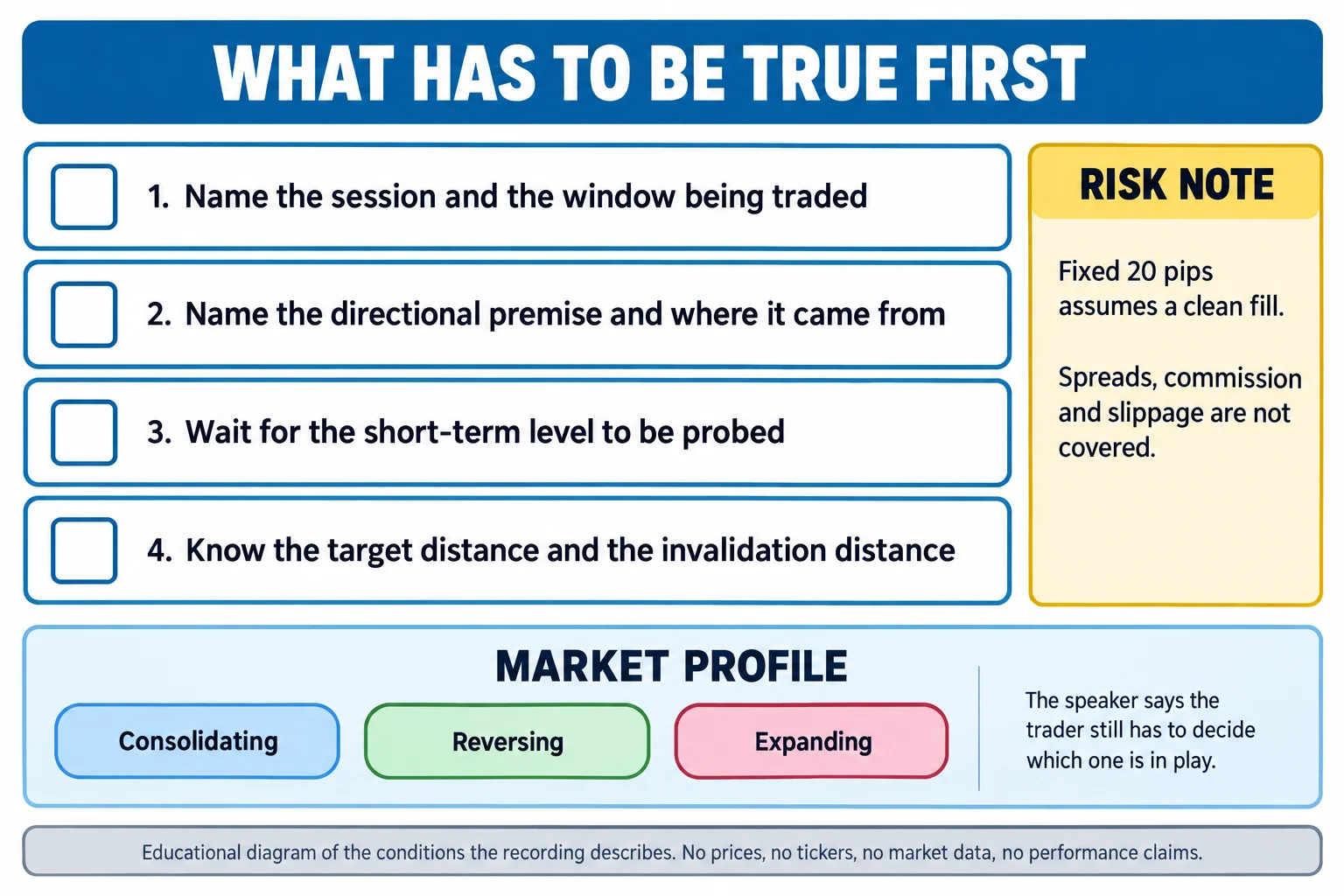
Before either model he sets a precondition: the trader still has to do their own homework and decide what the current market regime is: consolidating, reversing or expanding. He calls this market profiling (1:54, 1:58). That framing matters because he then only introduces two specific patterns (2:06).
ICT Scalp Model One for the Asian Session
He introduces this one by acknowledging that he does not like trading Asia much himself, and that he is including it because people keep asking how to trade that session (2:15). In his description the method is about trading the stops left behind by the 15-minute New York session, and he says it suits yen, Aussie and kiwi crosses (2:39, 2:44).
The buy version: during the Asian session, up to midnight New York time, look for short-term lows formed in the New York session, and go long after Asia probes below one of them (2:47, 2:49). He notes that the lows he means come from very late in the New York session, as it hands over to Asia (2:57). The sell version mirrors it: scout short-term highs formed in the New York session and sell after Asia probes above them (4:37).
He is explicit that this is his own convention about where the sessions start and end, and that a critical viewer may object to it. His answer is that it is simply how he does it, and that he trades the session little anyway because he thinks the volume belongs in London and New York (3:37, 3:57).
On timing and risk the rules are fixed. He says the pattern is named for the failed break he is trading, timing is off a 5-minute chart, the target is 20 pips and it is not graduated. His words are “straight 20 for 20, 20 stopped, 20 target” (4:18, 4:31, 4:49, 5:03).
He works through chart examples of a short-term high formed before the Asian session begins, and of price rallying above it into what becomes the Asian range high before fading back (5:17, 9:33, 9:39). He also addresses the objection that the trade lacks a definition, and points back to the higher-time-frame reading as the answer: what he is looking for is the initial whip above a short-term high or below a short-term low, ideally with a sense that the market wants to continue (10:01, 10:08). He describes pricing in the Asian range high and anticipating a swing down before the move higher, using his term for that early move at 10:30 and 10:43.
He shows a kiwi-dollar example (a short-term low probed below, liquidity taken, then a rally) and says the whole exercise is about finding an opportunity to trade between 8:00 p.m. and midnight New York time (11:01, 11:12, 11:22).
Two failure points deserve their own emphasis because he states them himself. When price keeps running instead of reversing, you take the 20-pip loss like any other trade, and he says you need a filter to keep losses from building (8:45, 8:51). And on entries above a short-term high, he says he prefers about five pips of penetration where he can get it, that being more aggressive at one or two pips is a choice, and that if the five pips do not appear he simply misses the trade (9:13, 9:16).
ICT Scalp Model Two for New York Expansion
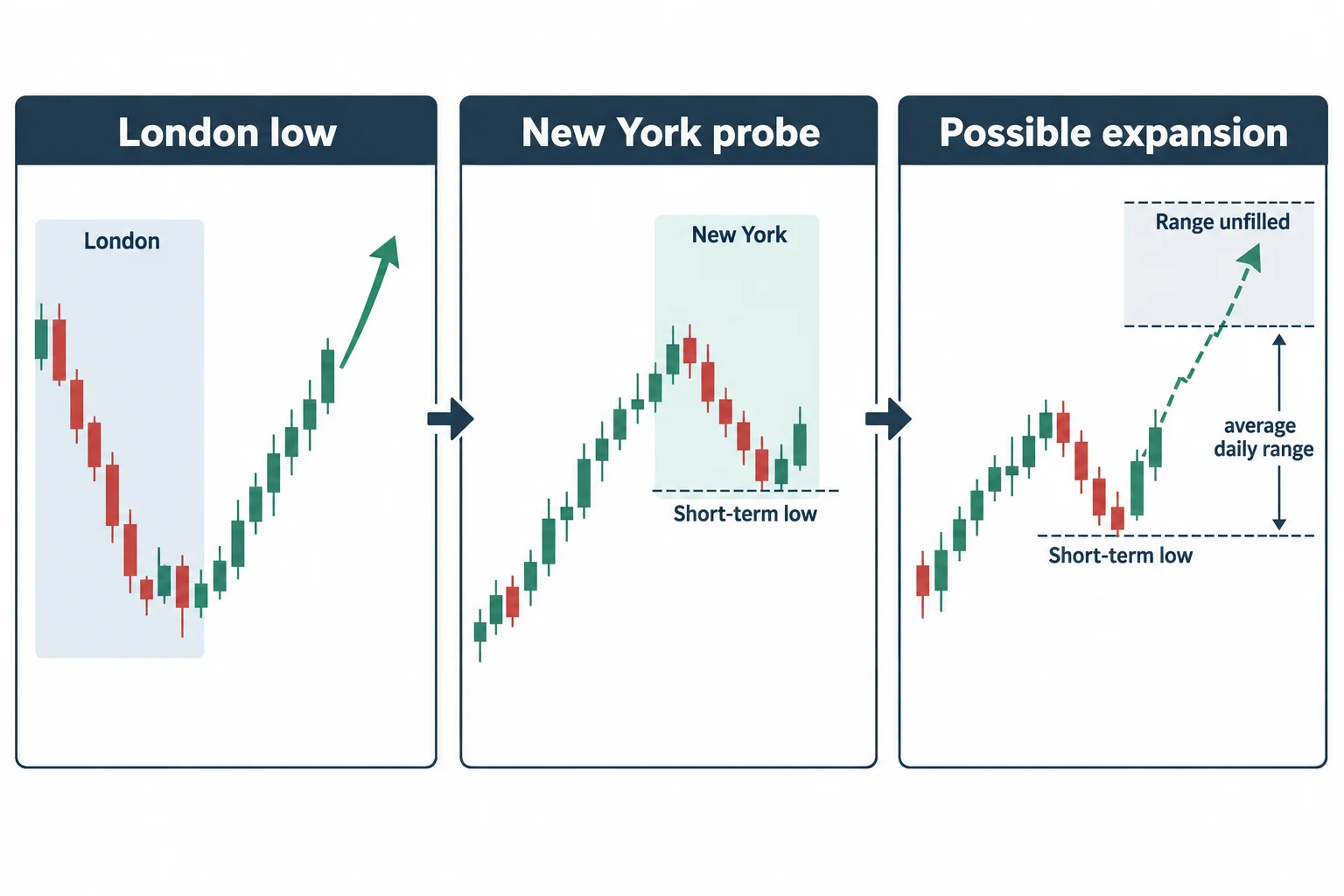
He describes the second model as applicable to all pairs rather than a favoured one (11:35). The buy setup runs during the New York session up to 10:00 a.m. New York time: scout short-term lows formed in the New York open, go long after New York probes below one, with London having posted the day’s low and the 5-day average daily range still unfilled (11:55, 12:07). His description of the sequence is that London makes the low so far, price rallies from it, New York retraces and trades below a 5-minute short-term low, and that is where he buys, reading the move as a run on short-term sell stops ahead of expansion toward the 5-day average daily range (12:19, 12:31).
The sell setup is the reverse: during the same New York window, scout short-term highs formed in the New York open, sell after New York probes above one, with London having posted the day’s high (and he adds the qualification that London should be “highly favorable” for being the high of the day) and the 5-day average daily range still pending. The probe above the 5-minute swing high is read as taking out buy stops (12:39, 13:02, 13:21).
The timing and risk rules are restated identically: 5-minute chart, 20-pip target, 20-pip stop (13:35).
His examples here include an Aussie-dollar chart where price violates a 5-minute short-term low and also trades back into a 5-minute fair value gap and an order block before expanding, and he notes that it ran well beyond 20 pips, while pointing out that this is why he expected the higher high he had described in a live session that Friday (13:47, 14:00, 14:11). Another example has London creating a potential low of the day, expansion into New York, then a break below a 5-minute low that rejects quickly and runs past 20 pips (14:34). A euro-dollar example reverses the premise with a London high and a New York retracement above a 5-minute high, and he notes that the 20 pips is taken easily there, adding that not all of them pay like that (15:03, 15:22, 15:28).
He finishes this section with a dollar-CAD chart that he says produced two separate setups in one day, describing a London low, an early Frankfurt high taken out, a New York violation and two distinct 5-minute lows being run, and he makes the point that even a generally low-volatility pair can offer this if the London premise is right (15:40, 16:06, 16:50).
He states the underlying premise of the whole model explicitly: you have to have strong conviction about what London has already done, and you are looking for continuation of that in New York. The ideal version, in his words, is to look for a 5-minute low, let price break below it, and read that move as an attempt to entice short sellers and breakout traders while knocking out longs that would otherwise profit from the next leg up (16:59, 17:09).
How the Two ICT Scalp Models Differ
The Asian model is a rotation idea. A level left behind by the previous session gets probed, and the trade expects price to turn back into the range that is forming. The New York model is a continuation idea. London supplies the directional premise for the day, New York retraces through a local 5-minute level, and the trade expects expansion in the direction London established.
Both share the same scaffolding: a named session, a named reference level, a probe of that level as the trigger, and a fixed distance on both sides. Neither is presented as sufficient on its own. The swing violation is the entry trigger, not the reason for the trade.
Where the ICT 20 Pips Model Can Work
He extends the New York pattern beyond currencies, saying it is a good pattern for S&P trading, for Dow futures and for the triple Qs, and that stock day traders can use it on a 5-minute chart, though he adds that he does not advocate day trading stocks because the volume usually is not enough to push price around (17:38, 18:07). He calls it a universal pattern that can be applied to commodities and bonds as well.
That generalisation is his assessment of the pattern’s applicability, not a measured result. The recording supplies narrated chart examples and his interpretation of them. It does not provide a controlled test, and captions alone cannot confirm the prices, fills or subsequent outcomes of any example.
ICT 20 Pips Per Day Limitations
The lesson ends by returning to the same caveat it opened with. He says the opportunities are not always there, but that if you look across a lot of pairs (he mentions 10 or 15) you can find something like this most trading days. Crucially, he uses the word practice: he does not want the viewer thinking they can go in every single day and take 20 pips (18:26, 18:36, 18:44).
Practical ICT 20 Pips Takeaways
- Treat the 20-pip figure as a target the lesson hunts for, not a forecast. The speaker’s own opening statement is that it will not be achieved every day.
- Profile the market regime first. Both models are conditional on the market being in a state that suits them (rotation for the Asian setup, continuation for the New York one).
- Name the reference level precisely. The trigger is a probe of a specific short-term high or low formed in a specific session, not any swing in the vicinity.
- Note the fixed 20:20 structure. A symmetrical target and stop does not by itself establish a positive expectancy, and a fixed pip distance means quite different things across instruments and volatility regimes.
- Account for the costs the lesson does not. Spreads, commission and slippage are absent from a “straight 20 for 20” construction, and the five-pip entry preference in the Asian model can mean the trade simply does not trigger.
- Plan for the failure case he names: price can keep running through the level, in which case the stop is taken.
ICT 20 Pips Scalp Checklist
- Decide what the market regime is: consolidating, reversing or expanding.
- Pick the model that fits the session you can actually trade.
- For the Asian model, mark the short-term high or low left by the late New York session.
- For the New York model, confirm London set the day’s high or low and that the 5-day average daily range is still unfilled.
- Wait for the probe beyond the level rather than anticipating it.
- Time the entry on the 5-minute chart, allowing for the roughly five-pip penetration he prefers.
- Set the target and the stop at 20 pips and do not graduate the target.
- Accept that the probe may keep going and the stop may be hit.
- Check more than one pair if nothing presents itself in the first.
- Treat the whole exercise as practice, not as a daily obligation to trade.
This checklist is an educational summary of the rules ICT describes in the recording. It is not investment advice, and nothing in the recording establishes the models’ profitability or their ability to predict future market behaviour.
Caption Notes for the ICT Scalp Lesson
The transcript used for this article is the automatic YouTube caption track. It handles most of this lesson’s terminology well, but it renders the pattern name as “turtle soup” at about 4:34 and then as “turtle suit” at about 12:30. The second of those is a recognition error for the same phrase, and the described idea is a failed break of a recent short-term high or low. It also splits spoken numbers and times, so the Aussie-dollar example appears as “aie dollar” at about 13:47, and it writes the 5-day average daily range inconsistently as “five day” and “5day”. The terms used in this article are the ones the surrounding context supports.
Watch the ICT 20 Pips Lesson
ICT Mentorship Core Content – Month 09 – 20 Pips Per Day
The Inner Circle Trader · published 10 October 2022 · about 19 minutes. This recording is the primary source for every timestamp link above.
The recording is not embedded here because the video owner has disabled playback on other websites. That was tested directly on 15 September 2026 from a BestProps page origin at both desktop and mobile widths: the embedded player loads, then reports “Playback on other websites has been disabled by the video owner” with no duration and no playback progress, while the video itself plays normally on YouTube. No empty or half-working player is left on this page.
The watch page was read on 15 September 2026 and is publicly listed as ICT Mentorship Core Content – Month 09 – 20 Pips Per Day by The Inner Circle Trader, upload date 10 October 2022, listed duration 1,135 seconds, about 18 minutes, 55 seconds. The caption track used for this article runs to 1,136.3 seconds, so the transcript and the listed duration agree.
ICT 20 Pips Scalp Resources
These are the sources checked for this article. The regulator and investor-education pages are general material about short-term trading and about how systems and advisory services sold to the public should be assessed; neither one evaluates this speaker, verifies any level, entry or outcome described above, nor endorses anything said in the recording. Any ICT, smart-money or third-party indicator, script, note set, chart annotation, transcript pack or re-upload circulating outside the publishing channel’s own page is unofficial and has not been tested here.
- [1] ICT Mentorship Core Content – Month 09 – 20 Pips Per Day The Inner Circle Trader (primary source; watch page read 15 September 2026, listed duration 1,135 seconds).
- [2] The Inner Circle Trader (official YouTube channel) (read 15 September 2026), the publishing channel for the recording used here.
- [3] CFTC (Fraud Advisory: Commodity Trading Systems Sold on the Internet) (read 15 September 2026), the regulator’s guidance on assessing trading systems and advisory services sold to the public, including its warning that hypothetical results are typically simulations calculated over prices that occurred in the past.
- [4] Investor.gov (SEC) (Day Trading) (read 15 September 2026), investor education describing day trading as extremely risky and capable of producing substantial losses over a very short period.
Source: ICT, ICT Mentorship Core Content – Month 09 – 20 Pips Per Day, The Inner Circle Trader, 10 October 2022. Automatic YouTube captions were the transcript used for this article; the two terms the track mishears are noted above. This commentary is educational and is not investment advice.