
Key takeaways
This is lesson five of the January 2017 ICT Mentorship, and it is about money management for higher-time-frame, or position, trading rather than about entries (0:16).
Read the full summary
This is lesson five of the January 2017 ICT Mentorship, and it is about money management for higher-time-frame, or position, trading rather than about entries (0:16). He frames the subject around drawdown control, saying about 15% annually is a realistic objective and that most people start to object somewhere above 25% (2:00, 2:08). His stated allocation rule is to use only 30% of total account equity, so on a hypothetical $100,000 account the trading base is $30,000 and percentage risk is calculated on that smaller number rather than on the balance (4:18, 4:30, 4:53). He sets 1% as his maximum risk per trade, which on a $10,000 account means a $3,000 base and a $30 planned loss (6:32, 6:47, 7:09), and he targets at least three-to-one reward to risk on higher-time-frame setups (8:25). He expects very few opportunities – he says he looks for two, and at best three, good position-trade setups in a year (24:18) – and warns that open profit will be handed back during retracements lasting days or weeks (11:00). He also describes trading a closely or inversely correlated pair while a long-term position retraces, which he calls one way to work around the North American hedging rule (13:56), and he insists that stops be proportionate to the timeframe rather than a fixed small pip number (16:41, 17:17). Every figure below is his own benchmark, arithmetic example or interpretation; it is not independently verified performance.
How we researched this article
BestProps used document-based research from primary firm sources, checked September 24, 2026. The complete source list, scope, limitations, and commercial-state record appear near the end of this article.
In ICT Mentorship Core Content – Month 05 – Money Management, the speaker sets out a deliberately restrictive money-management framework for long-term and position trading, and spends most of the lesson on why he sizes exposure the way he does. This article follows the recording in order and links each substantive point to the passage it comes from.
Two limits apply throughout. First, everything here is his framework as he states it: the percentages, the reward-to-risk relationship, the frequency estimate and the return figures are his benchmarks and illustrations, not results anyone measured in this recording. Second, the transcript is an automatic speech-to-text rendering of the audio rather than a human-checked caption track, so wording is normalised for readability and the passages where the speech-to-text is ambiguous are flagged near the end rather than silently corrected.
What the lesson says it is
He opens by identifying the session as lesson five of the January 2017 mentorship and announcing that the topic is money management and higher timeframe analysis (0:16, 0:23). He is explicit that the treatment is a broad-brush view rather than a technique lesson, and that the working assumption is students who are contemplating long-term trading, or position trading (0:31, 0:49). He also recommends spending real time in that horizon even for traders who expect to specialise elsewhere, suggesting at least a year working on higher time frames, because some students may be preparing to manage other people’s money or to work for a firm (1:07).
The bridge he draws to a live account is a sequencing point rather than a money point. He says there is no better experience than applying practised concepts in a demo account with positive results and then moving into a live setting with live funds (1:40), and that the size of the account is not the important variable, because what the trader is focusing on is control over drawdown (1:53, 3:04).
Drawdown first, returns second
The organising idea of the lesson is that a small account is not the obstacle; uncontrolled drawdown is. He says what matters is keeping drawdown manageable and tolerable (1:53), and he puts numbers on that: about 15% annually is, in his words, a realistic objective, while most people start to cringe over 25% or so (2:00, 2:08, 2:08). He then qualifies the benchmark in the same passage – about 15% as a maximum is, he says, absolutely amazing, but 20% is probably okay if the annual return still comes out positive (2:17, 2:23). Those are the speaker’s stated comfort levels, not regulatory or industry limits, and he does not derive them from data in the recording.
What he says drawdown control buys is credibility. He describes a consistent equity curve that improves slowly, with very little drawdown and very few erratic or slow periods, as attractive to investors (3:11, 3:19), and says the result does not need to be a high rate of return – a steady increase across a calendar year is what he says attracts capital (3:29). He frames that as a realistic expectation to carry into trading rather than a promise, and repeats that a trader does not need a large account (3:04).
The 30% allocation and the arithmetic he works through
The most concrete rule in the lesson is the allocation base. He says he does not want to allocate every possible dollar to the marketplace (4:09) and states that he limits allocation to only 30% of total equity, acknowledging that this may sound shocking to some listeners (4:18, 4:22). He then walks through a hypothetical $100,000 account, in which $30,000 is what he would use to meet whatever margin requirements and trade parameters apply (4:30, 4:34).
The allocation matters because his percentage risk is charged against it. Using the industry-standard 2% as his example, he says the calculation is 2% of $30,000 rather than 2% of $100,000 (4:53). He describes the consequences as he sees them: he is never going to have to worry about margin calls, never over-leveraged, and never exposed to wild dips in equity (5:03). He adds a second argument for the reserve – investors, he says, like to see that a trader is not 100% exposed and is holding a good reserve of cash (5:18) – and a third: unused equity leaves room to take an opportunity that appears later (5:51).
He then restates the framework as a definition: what the trader is doing is determining maximum risk exposure on a percentage basis of the 30%, which he describes as a very drawn-down approach in risk terms – not maximising risk for maximum return, but holding risk at the low end in exchange for respectable percentage returns across a calendar year (5:59, 6:13, 6:26). His stated maximum is 1% of that 30% base as the most risk per trade (6:32). The arithmetic he gives is a $10,000 account, a $3,000 trading base, and 1% of it – a $30 maximum planned loss per trade (6:41, 6:47, 7:01, 7:09).
What he concedes the approach will not do
He addresses the obvious objection before moving on, voicing the imagined response that you cannot get rich this way – and agreeing with it: not now, not tomorrow, and not next month (7:16). He also says plainly, from his own experience, that managing other people’s money is not fun for him and is very stressful (7:41), while still noting that it can pay well relatively quickly and can fund a trader’s own investing and speculation with other people’s capital rather than their own (7:51).
Three to one, low accuracy, and the annual return he names
For higher-time-frame setups he says he targets a three-to-one reward-to-risk relationship (8:25), and he notes that three-to-one setups still appear on those charts for traders who prefer that horizon (8:41). The logic he offers is that low risk against high reward permits a very low accuracy rate – the requirement he substitutes is patience, not precision (8:50, 8:55) – and that low risk leaves equity available for more setups, because not all of the money is in one trade (9:02, 9:08).
He then names the return he considers respectable: 18% to 25% a year, which he describes as something like an industry standard for managed funds (9:29). That figure is his characterisation of managed-fund expectations. The recording contains no track record, no audited statement and no sample of trades behind it.
Infrequent setups, and profit that goes backwards
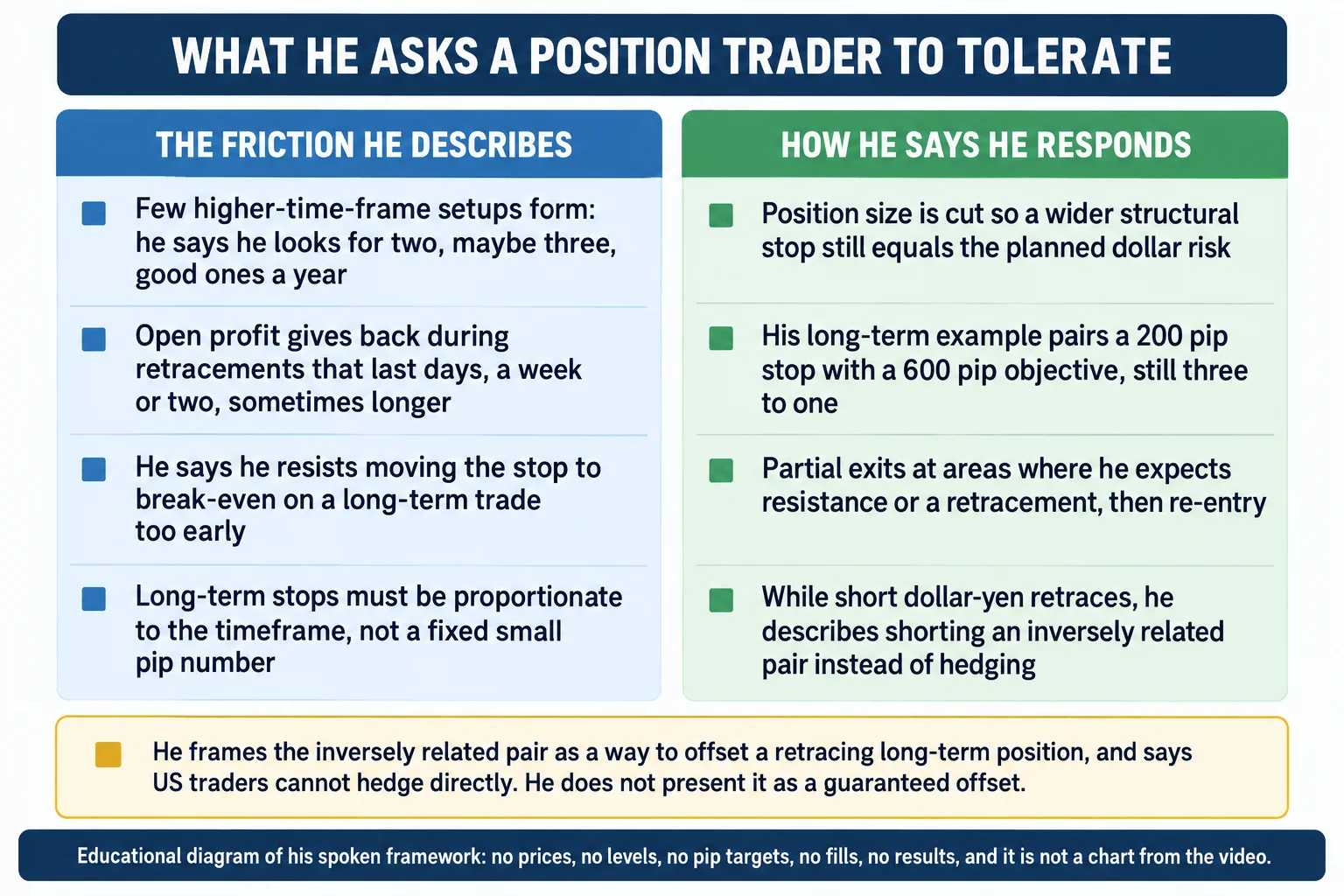
Frequency is the next constraint. He says there is very little in the way of frequency with higher-time-frame setups, that long-term setups form infrequently annually, and that there are not a great many trades across the year on those charts (10:45, 10:50, 10:53). The behavioural consequence is the part he spends most time on: on this horizon the trader has to learn to allow short-term drawdowns in open profit (11:00) and to weather retracements, sitting through several days, perhaps a week or two (11:14). He stresses that this profit is not realised until the trade is closed (11:18), and that once position sizes grow, the give-and-take can be large enough to be emotionally testing, with tens of thousands of dollars moving in and out of the account over several weeks (11:36, 11:43).
This is also where he returns to the 30% rule and gives it a second purpose: allocating only 30% towards long-term trades leaves equity and margin to trade short-term alongside them (11:53, 12:02).
Related pairs, and the hedging rule he works around
He explains the short-term sleeve with a worked scenario. In the United States, he says, traders cannot trade like a hedger – they cannot hedge their trades – but they can trade markets that are closely correlated, or inversely correlated, with the long-term position they are holding (12:13, 12:21). His example is dollar-yen: if a long-term short position on dollar-yen starts to retrace, and the trader can anticipate that, the give-and-take on the profit and loss is going to be bothersome for most people (12:29, 12:56). The counter-measure he describes is trading an inversely related pair in the opposite direction – if dollar-yen is retracing higher against a short, he suggests going short euro-dollar, or possibly British pound-dollar, to capitalise elsewhere while the long-term position gives back profit (13:31, 13:36, 13:42). He calls this one way to beat the North American hedging rule, and says it requires an understanding of simple intermarket analysis, which he had covered in the previous lesson (13:56, 14:03).
Two qualifications belong with that scenario. The speaker presents it as a way to offset a retracing long-term position, not as a guaranteed hedge, and he does not quantify what it would have returned. Related pairs can also diverge when the relationship they have historically shown changes, so an apparently offsetting position is additional or concentrated exposure rather than the absence of exposure. He says separately that he would use shorter-term swing trades or short-term trades to compensate for drawdown in open profit on the long-term trade (14:21), which is the same idea without a named pair.
Stops are sized to the timeframe, not to a pip count
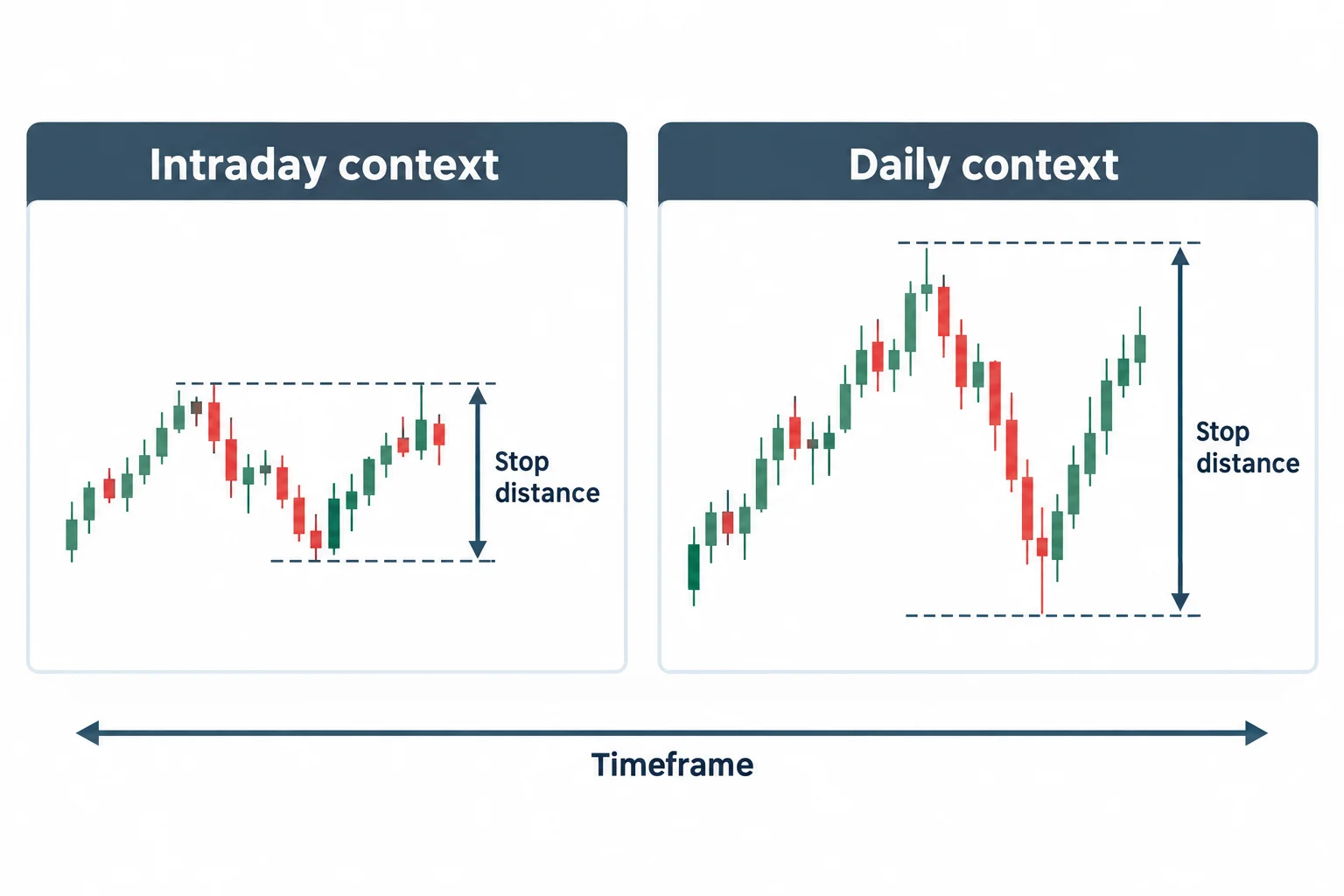
He is blunt that stop-loss orders are not a measure of ability (14:54), describing how stop sizes have come to be treated as a way of knowing how good a trader is, so that anyone trading a ten-pip stop must be elite (15:14, 15:23). He says that attitude does not belong in long-term trading, where he does not limit a trade idea or opportunity by a set number of pips (15:32). For context he gives his own intraday habit – about 35 pips, roughly a third of a 100-pip average daily range, rounded, with 30 pips the general rule of thumb (15:40, 15:46, 15:53, 16:02) – and immediately says that 30 pips will not do on a long-term trade, particularly when the daily chart is the executable timeframe because work or family life prevents intraday charting (16:14, 16:22).
The instruction that follows is the one that matters: stops have to be proportionate to the timeframe being traded (16:41). The example he gives is a setup requiring a 200-pip stop, which he acknowledges sounds unreasonable to traders conditioned on lower time frames, paired with an objective of a 600-pip win – still three-to-one (16:56, 17:00, 17:17). He calls that the minimum, and says he would look for higher reward-to-risk relationships on higher-time-frame charts (17:37). The educational point is not that 200 pips is correct for any particular trade; it is that position size is what brings a wide structural stop back to the planned dollar risk.
Why he says to resist moving the stop to break-even
His next rule is psychological: resist the impulse to move the stop to break-even, or even to reduce the risk, and suppress that desire on a higher-time-frame position trade (17:48, 17:53). His stated reason is that position trading requires a great deal of patience, which he says cannot be manufactured quickly – a trader either develops it over a long period or will find position trading unsuitable (18:04, 18:12). On lower time frames he is willing to move a stop sooner, but on the higher timeframe he says to wait until the market has moved a significant measure of pips before considering moving the stop from the original entry point (18:33, 18:48).
Partial exits at anticipated resistance, then re-entry
The alternative he offers to sitting through drawdown is taking part of the position off. He says the trader must learn to exit at logical targets and look to re-enter at a later time (18:51), and that positions can be reduced at logical areas of resistance within a long-term trend instead of absorbing the full drawdown on the profit and loss (19:04). He illustrates with a long dollar-yen position: at a level where he would reasonably expect resistance or a retracement with high probability, he may take off a quarter, a third, three quarters or half the position and bank it as profit, then add it back – or a little more – once price retraces to where another leg higher looks logical (19:35, 19:38, 20:02). He says the aim of that sequence is to end up with a larger position into the next leg than the original gearing and entry point would have produced (20:26).
He sums the whole lesson up with the line that long-term trading is not get-rich-quick but get-rich-steady (20:41).
Velocity, temperament, and the two-or-three-a-year expectation
He is explicit that these higher time frames will not produce velocity – his term for how fast money goes to work and comes back with a profit, which is why he says he personally likes day trading (21:01, 21:08). He still says handsome returns are available on long-term position trading, but only if the style fits the trader’s temperament, because a risk plan that runs against how someone thinks is one they will not sit through (21:29, 21:37). He tells students to apply long-term position trading to some degree for the remainder of the mentorship, and says entry technique on this horizon needs very little skill (22:10, 22:20).
He also restates why the money-management ground had to be covered first: it is the mindset a trader needs before going into entry techniques, stop-loss orders and the question of how much money to risk, on the understanding that there will not be many trades and the account will not be parlaying quickly (22:56, 23:10). He notes in the same passage that what is seen on the higher time frames is what directs the lower time frames (23:33).
The frequency estimate is concrete. He says the career of managing other people’s money is lucrative if the rate of return is consistent, citing 20% or 25% every single year from only a handful of trades (23:51, 23:57), and he rejects the idea that a trade could be expected every three months, saying it does not work like that (24:14). What he says he looks for personally is two, and if he is lucky three, good position-trade setups a year – two very simple, easy-to-find long-term setups between January and December, with a third only if he is dialled in and the market is symmetrical, and rarely four in a full year that he was actually able to participate in (24:18, 24:44).
He then anticipates the arithmetic objection and works it through: three-to-one at 1% risk caps a single winner at roughly 3%, so two setups suggest about 6% for the year on that basis alone (25:40, 25:48). His answer is that risking 1% per trade leaves equity intact, that a position which moves into profit creates new equity that can itself be put to work, and that missing the lowest possible entry into a long-term trend does not prevent entering later with a long-term mindset (25:55, 26:10). He also notes that taking two trades at a 2% maximum exposure changes the numbers, though he frames that as a modification of the rules rather than the default (26:43).
The goal, as he states it, is not to maximise how much can be earned but to manage how much drawdown is taken while producing a rate of return over the full calendar year (26:57, 27:06). The homework he sets is at least one long-term trade executed and held through a long period, a minimum of three months (27:10, 27:20).
Managing other people’s money and the 18–20% figure
The last third of the lesson turns to the fund-management case. His stated version is risking 2% of 30% of total equity as a maximum per trade when several opportunities appear through the year, and using short-term or swing trades during drawdown periods, after which he says 18% to 20% on equity for the year is very achievable (27:36, 27:44, 28:03).
The lifestyle consequence he draws is low activity. He says the trader will not be doing a lot of trades, will not be forced in front of the marketplace every single trading day, and will be free with personal time – which is why, in his framing, large fund managers always seem to be on vacation (28:11, 28:13, 28:21).
He gives a risk argument for that low frequency rather than only a lifestyle one: the more often a trade is taken with other people’s money, the more often the client is exposed to risk, and he says that exposure eventually grows teeth – the client feels it monetarily and becomes upset, particularly if a drawdown continues and erodes the equity base they entrusted (28:42, 29:04). His prescription is to keep frequency low, focus on high-odds potential setups and keep risk light, at which point he say