
Key takeaways
ICT’s fifth teaching in Month 02 says that after a bullish order block trade is stopped out, traders should reassess whether the premise remains valid, move the next stop below the relevant order block, and use half the original position size, leverage, and risk rather than increasing exposure.
Read the full summary
ICT’s fifth teaching in Month 02 says that after a bullish order block trade is stopped out, traders should reassess whether the premise remains valid, move the next stop below the relevant order block, and use half the original position size, leverage, and risk rather than increasing exposure. A 2% initial loss leads to 1% risk on the next attempt, while a 1% loss leads to 0.5% risk. At 1% risk, a 2R gain offsets the earlier 2% loss before commissions, spread, slippage, and taxes. Developing traders can close at 2R and return to breakeven, particularly late in the week, while experienced traders may lock in the recovered amount with a trailing stop and consider closing at 3R for a new equity high. Further failed attempts should prompt additional risk reductions, and recovery can occur across multiple trades. ICT calls equity preservation the number one rule and warns that maintaining or raising risk after losses can amplify losing streaks and fear-based trading. The YouTube lesson was published by The Inner Circle Trader on 29 August 2022 and runs about 17 minutes 34 seconds, but it provides hypothetical arithmetic, not verified trades, fills, account results, or tested performance.
How we researched this article
BestProps used document-based research from primary firm sources, checked September 25, 2026. The complete source list, scope, limitations, and commercial-state record appear near the end of this article.
How ICT Mitigates Losing Trades
He opens by placing it as the fifth teaching of the mentorship’s second month and says the session will look back at the same sample size of price action as before, but work through it differently (0:23, 0:36). The setup is stated as already framed: a bullish order block, the mean threshold inside it, and a hypothetical long entry on the secondary bullish order block (0:48). Everything after that depends on the trade going wrong.
The First ICT Losing Trade
He frames the problem at 1:35: he says he does not want to see the middle of the down candle on a bullish order block violated, and notes that a newer trader will often place a stop just below that mean threshold – which he says is fine, normally. Then he assumes the stop is hit: the trader is stopped out and takes a full two percent loss (2:02).
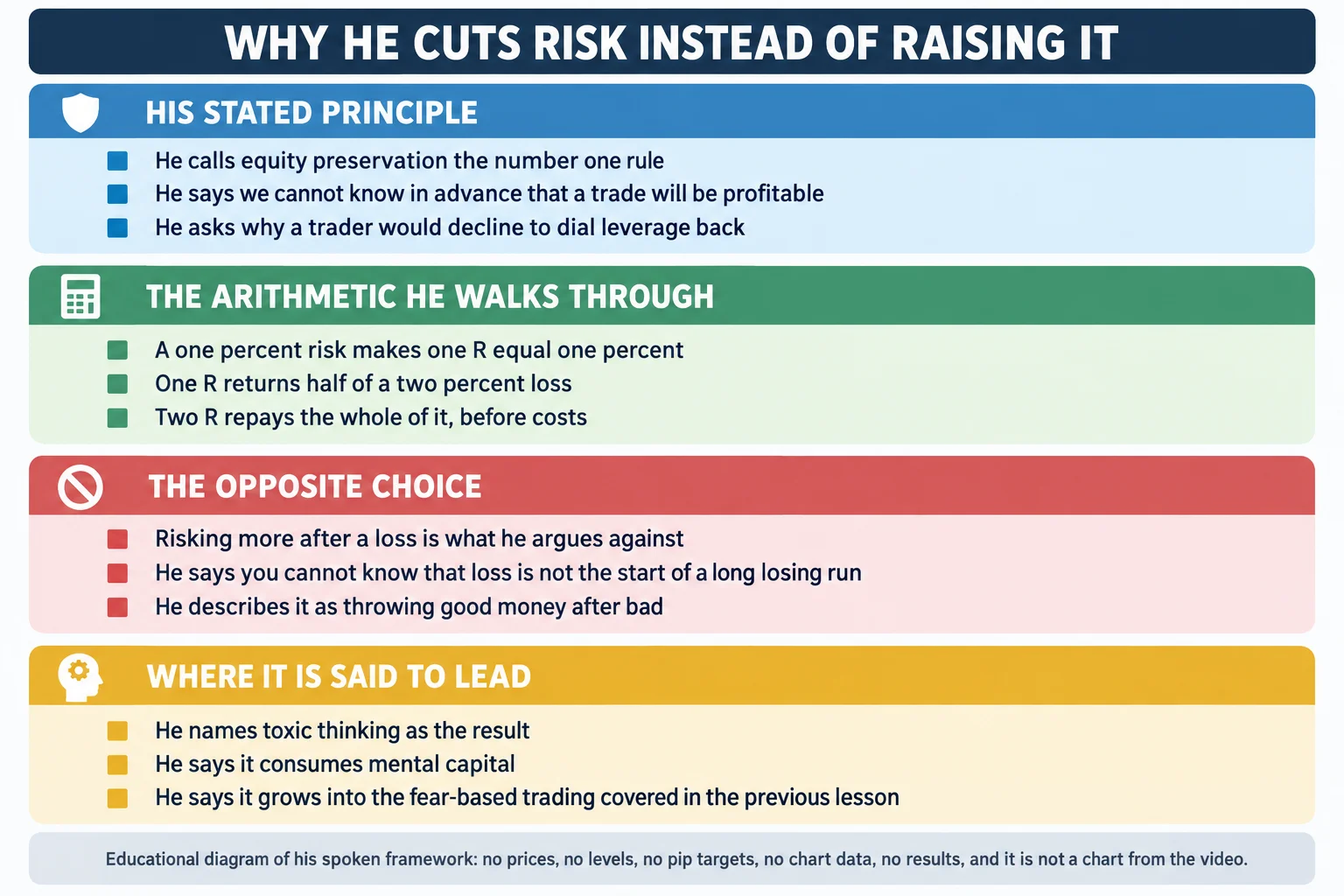
He uses that figure as a ceiling rather than a target. He says a trader who risked more than two percent would have been “burned pretty bad”, and that a trader who risks a lot and feels no pain has a problem (2:23). His stated position is that big risks are unnecessary and that losing trades are expected: “we don’t need to take huge risks and we don’t need to take a lot of trades, but we will encounter losing trades” (2:34).
Why an ICT Trade Can Survive a Loss
The pivot of the lesson is at 3:29. He argues that being swept out below the mean threshold on the first attempt does not mean the trade is no longer viable – it more likely means the stop was placed inaccurately (3:49). He then looks for a new down candle, price trading away through it and above it, and treats that as authorising a further return into that candle as a buying opportunity (3:59, 4:09).
That sequence of order-block and candle labels is his framework, and the recording is narration over a chart rather than a demonstration that can be checked here. What he does state plainly is the condition for continuing: the premise has to still hold.
Cutting ICT Trade Risk on the Second Attempt
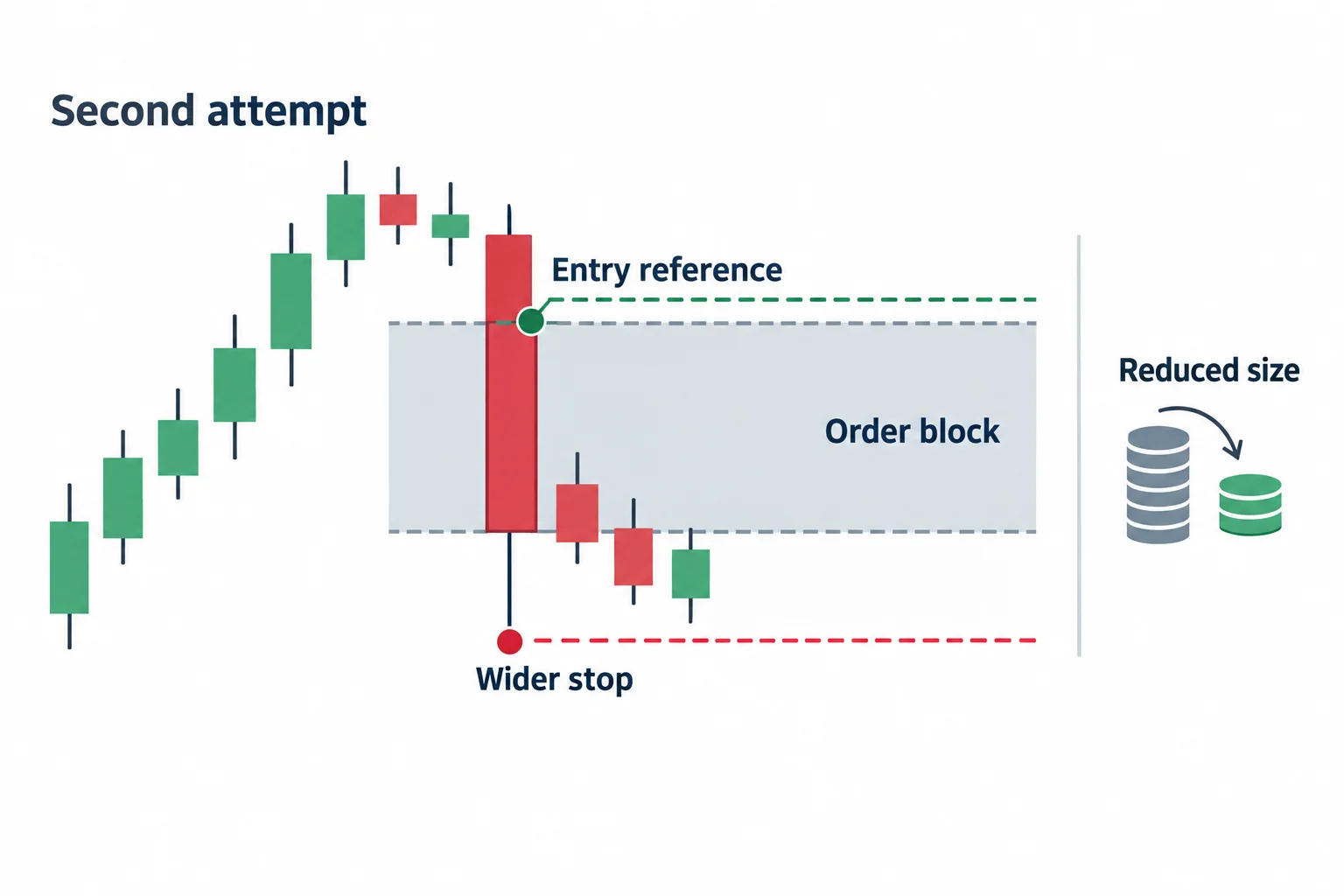
For the second attempt he changes two things. First, the stop moves: it goes below the order block the trade is framed around instead of sitting ultra-tight near the midpoint, and he says he would allow more movement against the position because the conviction is still there (4:25, 4:49). The entry is the top of the down candle body, or the range defined by its opening (5:08, 6:11).
Second, the size is halved. His words at 5:20 are that the trader goes long with half the position size used on the initial loss, and he gives the two cases explicitly: an initial loss of two percent leads to one percent of risk on the next attempt, and an initial loss of one percent leads to half of one percent of the equity base (5:33). He restates the point as using half the leverage and position size used on the losing trade (6:28).
How 2R Recovers an ICT Trade Loss
The arithmetic is the part he works through most slowly. With one percent at risk, defined by the entry and the stop, a move of one R puts the trade one percent in profit – half of the earlier loss returned in open profit (7:01, 7:19). One further multiple of risk takes it to two percent, at which point the earlier full loss has been made back using only half the risk (7:26, 7:34). He points out that this does not require price to trade above the old highs where the buy stops rest (8:47).
He restates the same conclusion in reverse later: because the leverage was cut in half, a multiple of two R is enough to pay the trade back regardless of what the original percentage loss was (10:31).
Two boundaries belong with that arithmetic. It is stated before any costs – commissions, spread, slippage or taxes – and nothing in the recording shows that a two-R outcome is available on demand or that the trade will continue higher. He says as much at 8:35: “there’s nothing saying this is going to continue going higher”. The illustration is about the relationship between risk and reward multiples, not about the likelihood of the outcome.
When to Close an ICT Recovery Trade
At 7:46 he recommends a new trader consider closing the trade once the earlier loss has been offset. He says it is “good to get back to even and relax and then regroup”, and gives the concrete case of being late in the week – a loss taken on a Thursday or Friday, then the chance to take that two percent back (7:59). He says to close the week flat and move to the sidelines rather than assume the move continues (8:13).
For a trader who does not take it off, he describes trailing the stop until the position can no longer give back the recovered amount, and adds that if it stops you out, it stops you out – the point is not being willing to go back below the pre-drawdown equity reference (9:30, 9:43). He says that at three R he would consider taking profits and squaring the position off, and repeats that a developing trader can take it off at two R instead (10:03, 10:12). At three R, he says, the position is in new territory beyond the original loss (9:05).
He distinguishes two stages of development here rather than giving one rule: as a developing trader, take the recovery off the table and start fresh; later, start locking the stop in after the loss is mitigated and see whether there is more room to go (11:14, 11:26). In the example where the position is allowed to run, he says the trader ends with a new equity high inside the same trade (12:08, 12:22).
Recovering an ICT Loss Across Multiple Trades
From around 12:53 he plays devil’s advocate and walks a case with more than one failed attempt, cutting risk again at each stage. He is explicit that the recovery does not have to arrive in a single trade: “one trade doesn’t have to erase all of your losses”, and he says the losses can be mitigated without increasing risk by reducing it (14:57, 15:10, 15:23).
One caution about that passage: the percentage sequence he speaks while reducing risk across successive attempts is not internally consistent in the transcript against the halving rule he states clearly earlier, so this article reports the principle from 5:20 and does not present the later percentages as a formula.
The ICT Rule for Cutting Trade Risk
His stated reason for cutting rather than adding risk is at 15:37: “equity preservation is the number one rule in this game”, alongside the admission that there is no certainty a trade will be profitable (15:51). He says he taught the principle years earlier and got pushback on it (15:30).
His case for halving is the losing streak, not the single loss. He asks how a trader knows the two percent loss is not the beginning of a long run of losses, and says it can happen to anyone (16:41, 16:47). What he sets against that is a description of the alternative rather than a measurement: keeping the risk at two percent or more, he says, is throwing good money after bad, building toxic thinking, spending mental capital, and growing into the fear-based trading covered in the previous lesson (17:12, 17:20).
He also names the emotional mechanism directly at 16:03: a new trader who has just taken a loss is likely to be in a rush to get back to square one, and he says it is not necessary to get it back on the next trade. He adds that he does not want to see the recovered amount surrendered, and that the trader should not obsess about the loss once it can be repaid (10:42, 10:57).
Limits of This ICT Losing Trade Lesson
The recording is an illustration, not a test or a track record. It contains no statement of which trades were taken, no account statement, no fills and no realised result, and nothing in it measures the outcome of continuing after a loss, of halving risk, or of taking the recovery off at two R. The two percent figure, the one percent figure and the R multiples are hypothetical inputs the speaker supplies for the arithmetic.
The order-block, mean-threshold and buy-stop constructions are his framework for reading a chart he is looking at, and the audio does not establish the candles, levels or timing behind his narration. His descriptions of what a losing trader is likely to feel, and his claim that equity is easy to build back, are his reading of trading psychology rather than findings. None of this is investment advice, and none of the rules described has been tested or verified here.
ICT Losing Trade Date and Transcript Notes
The upload date and the series position are separate facts. The YouTube watch page shows this recording published on 29 August 2022 and listed at 1054 seconds, about 17 minutes 34 seconds, while the recording introduces itself as teaching number five in the second month of the mentorship (0:23). No contradiction is asserted between the two, and nothing in the audio dates the chart shown.
This article was written from automatic speech-to-text of the original audio rather than from a checked caption track, so a few renderings are ambiguous and are flagged rather than silently corrected. The transcription reads “buy stocks” where buy stops are meant (8:47), and “the stock” in a passage that is clearly about price (14:20). One phrase about a ten-loss run is transcribed in a form that does not parse cleanly (16:37), so it is described in this article rather than quoted. A short stretch of the recording is missing from the transcript around 3:04, between his statement of the two percent ceiling and the reassessment that follows; the gap is left visible rather than filled in.
Watch the Original ICT Losing Trade Lesson
ICT Mentorship Core Content – Month 02: How To Mitigate Losing Trades Effectively
The Inner Circle Trader · published to YouTube on 29 August 2022 · listed at 1054 seconds, about 17 minutes 34 seconds. This video is the primary source for every timestamp link above.
The recording is not embedded here because the video owner has disabled playback on other websites. That was tested on 15 September 2026 from a BestProps page origin at both desktop and mobile widths: the embedded player loads and then reports “Playback on other websites has been disabled by the video owner”, with no playable stream and no duration reported in either case. The link above opens the recording on YouTube itself.
ICT Losing Trade Resources
These are the sources checked for this article. The CFTC pages are the regulator’s own advisories – one on trading systems sold to the public, one on foreign currency fraud – and they are relevant context for reading any rule-based model or recovery scheme, including this one. Neither assesses this speaker or tests anything he says. Any ICT, smart-money or third-party indicator, script, note set, transcript pack or re-upload circulating outside the publishing channel’s own page is unofficial and untested here.
- [1] ICT Mentorship Core Content – Month 02: How To Mitigate Losing Trades Effectively The Inner Circle Trader (primary source; watch page and metadata read 15 September 2026, published 29 August 2022, listed at 1054 seconds).
- [2] The Inner Circle Trader (official YouTube channel) (read 15 September 2026), the publishing channel for the Month 02 mentorship series this teaching belongs to.
- [3] U.S. Commodity Futures Trading Commission, Commodity Trading Systems Sold on the Internet (read 15 September 2026), the regulator’s advisory on claims made for trading systems sold to the public. Context for reading any rule-based model, including this one; it is not a finding about this speaker.
- [4] U.S. Commodity Futures Trading Commission, Foreign Currency (Forex) Fraud (read 15 September 2026), the regulator’s advisory on forex fraud, including recovery schemes. Background on how losses are marketed to retail traders; it contains none of the lesson’s rules or figures.
Source: ICT, ICT Mentorship Core Content – Month 02: How To Mitigate Losing Trades Effectively, The Inner Circle Trader, published 29 August 2022. Captions were not available for this recording, so the transcript is automatic speech-to-text of the original audio under SHA-256 04aa6209abd5c37740a73e18da2a98a041e7ef32a29af47527f6cdff5bd8ffb4. Educational write-up of the speaker’s own stated method; it is not trading advice, and no rule, percentage or outcome described above has been tested or verified here.