
Key takeaways
In ICT Mentorship Core Content – Month 02: Growing Small Accounts, the speaker frames account growth as a risk-management problem rather than a race for large short-term gains (0:32).
Read the full summary
In ICT Mentorship Core Content – Month 02: Growing Small Accounts, the speaker frames account growth as a risk-management problem rather than a race for large short-term gains (0:32). He recommends well-defined risk on every setup — 2% of equity ideally for a new trader and no more than 2% on average (3:44) — and says he looks for setups permitting three units of reward for one of risk or better (5:22). He states the arithmetic plainly: at 25% accuracy, a three-to-one payout is roughly the minimum ratio for profitability before costs (8:46, 9:01). He also reports his own results for the mentorship: a goal of 50 to 75 pips a week, an average win of 51.80 pips, and 518 pips across ten trades in the month he shows (14:35, 14:42, 14:51). Those are his reported figures about his own account, not verified evidence, and he says the outcome is possible but not a standard (13:15). The narrated setup is a daily bullish order block taken down to the one-hour chart, a wait for a stop run below an old low, and then staged exits with the stop moved to break-even after a later objective.
How we researched this article
BestProps used document-based research from primary firm sources, checked September 25, 2026. The complete source list, scope, limitations, and commercial-state record appear near the end of this article.
In ICT Mentorship Core Content – Month 02: Growing Small Accounts, ICT presents account growth as a risk-management problem rather than a race for large short-term gains. He opens the session by naming it as the first of eight teachings in the second month of his mentorship, on the subject of growing small accounts without high risk (0:24, 0:27, 0:32).
The lesson combines general principles about position risk and reward-to-risk ratios with a narrated chart example built around ICT concepts such as order blocks, liquidity pools and graduated exits. The central message is educational: a trader should first control potential losses, then allow time and compounding to work. The figures in the presentation are illustrations and targets proposed by ICT, not evidence that a particular return can be achieved consistently.
ICT Growing Small Accounts With Controlled Risk
ICT opens by warning against chasing dramatic pip totals or percentage returns. At 0:38, he describes how seeing profits arrive quickly can give a beginner the false impression that trading works like a lottery. In his interpretation, that mindset encourages oversized positions and attempts to transform an account through one or two trades.
His alternative is to define each trade’s risk as a small portion of total equity and evaluate growth over a longer period. Although he says an account can begin with as little as $100 (2:33, 2:37), that statement should be understood as an example of starting capital, not a guarantee that a small balance will grow or remain viable after losses, costs and other constraints.
Protect Small Accounts by Defining Risk Before Reward
At 3:19, ICT argues that poor planning should not be allowed to consume trading equity. He proposes well-defined risk parameters and says a new trader should ideally risk no more than 2% of equity on an average trade (3:44). Later, at 5:16, he states the reasoning behind the ceiling in one line: in his words, nobody gets broke by taking profits, but they go broke by taking too much risk.
This is ICT’s stated ceiling in the lesson, not a universally safe figure. Even a small percentage can produce a substantial drawdown when losses occur repeatedly, while gaps or execution problems can make an actual loss exceed the intended amount.
ICT also discusses the emotional transition from entering because of greed or fear of missing out to worrying about the position once it is open. His practical response is to decide several points in advance:
- How much account equity is at risk?
- Where would the trade thesis be invalidated?
- What prospective reward is available relative to that loss?
- Where are logical profit objectives located?
- What action, if any, will be taken as each objective is reached?
Why Risk and Reward Matter for Small Accounts
Beginning at 5:22, ICT recommends looking for opportunities offering three units of potential reward for one unit of risk, or higher. He then uses simplified win-rate examples to show why a trader does not necessarily need to win most trades if average winners are sufficiently larger than average losses.
His worked example is a 25% accuracy rate. At that rate he says the minimum payout ratio for profitability is three to one, because three of every four trades are expected to be losses (8:46, 8:53, 9:01). Four equal-risk trades at that ratio would produce one three-unit winner and three one-unit losses, which leaves no net gain before spreads, commissions, slippage or other costs. He walks through the same logic at higher accuracy rates too, where the required ratio falls: he puts 50-50 at roughly one-to-one and 33% at about two-to-one (8:21, 8:39).
This distinction matters because a quoted 3:1 setup is only a planned ratio. Partial exits, missed targets, slippage and losses larger than planned can change the realized ratio.
Growing Small Accounts With a 6% Monthly Illustration
At 15:21, ICT turns to what a new trader should focus on and gives the figure he wants attention paid to: 6% of equity compounding per month (15:30). He says that target needs only about 20 pips a week, roughly 1.5% account risk and a one-to-one ratio to reach (15:39, 15:42, 15:45). Mathematically, compounding exactly 6% for 12 consecutive months would approximately double a balance, which is the point he makes with it.
That arithmetic is not a forecast. It assumes the target is achieved every month without interruption and does not model losing streaks, variable position sizing, transaction costs, taxes or withdrawals. ICT also cautions against interpreting the example as a reason to trade every day. At 16:28 he says in plain terms that he does not think it is something that can be done consistently every single day, and that doing it invites losses. He instead advocates waiting for highly selective conditions.
The Results He Reports for His Own Account
Partway through the lesson ICT describes his own results. At 11:40 he sets out a hypothetical $5,000 account and a 50% return in one month; at 12:49 he says the record he shows for this mentorship returned over 50% on comparatively few trades, with profit growing past $2,500. Later, at 14:35 and 14:42, he gives the figures behind one month: a stated weekly goal of 50 to 75 pips, an average win of 51.80 pips, and 518 pips across ten trades (14:51).
These are reported results about the speaker’s own account, taken from the audio of the recording. Nothing in the available source lets a reader verify the fills, the account statements, the broker or the period those numbers cover, and the recording itself does not present them as a measured edge. He also says directly that the 50% month is possible but not a standard and tells the audience not to expect it as a normal monthly outcome (13:15). Readers should treat the figures as attributed claims rather than as a track record they can check.
How ICT Selects Small Account Setups
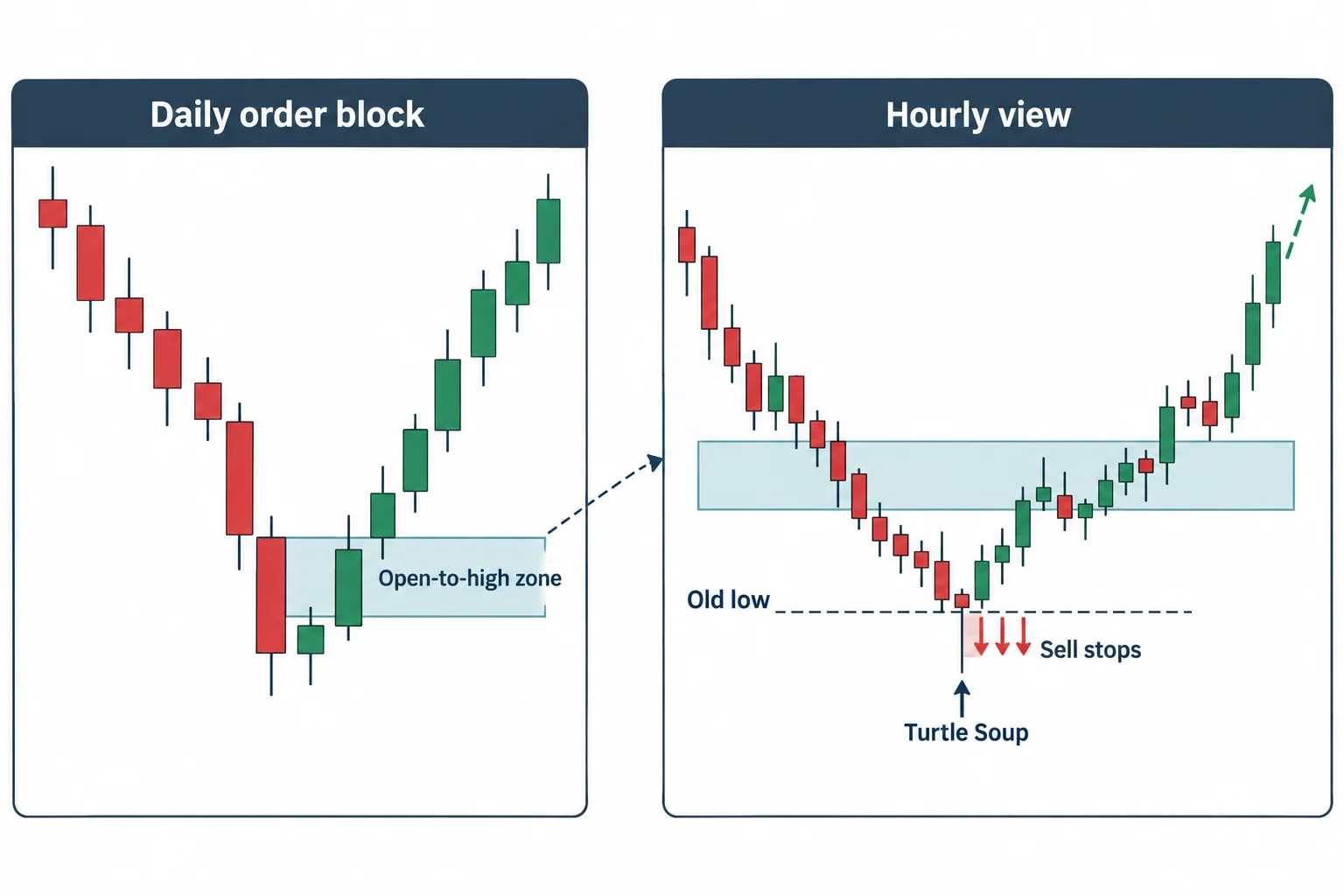
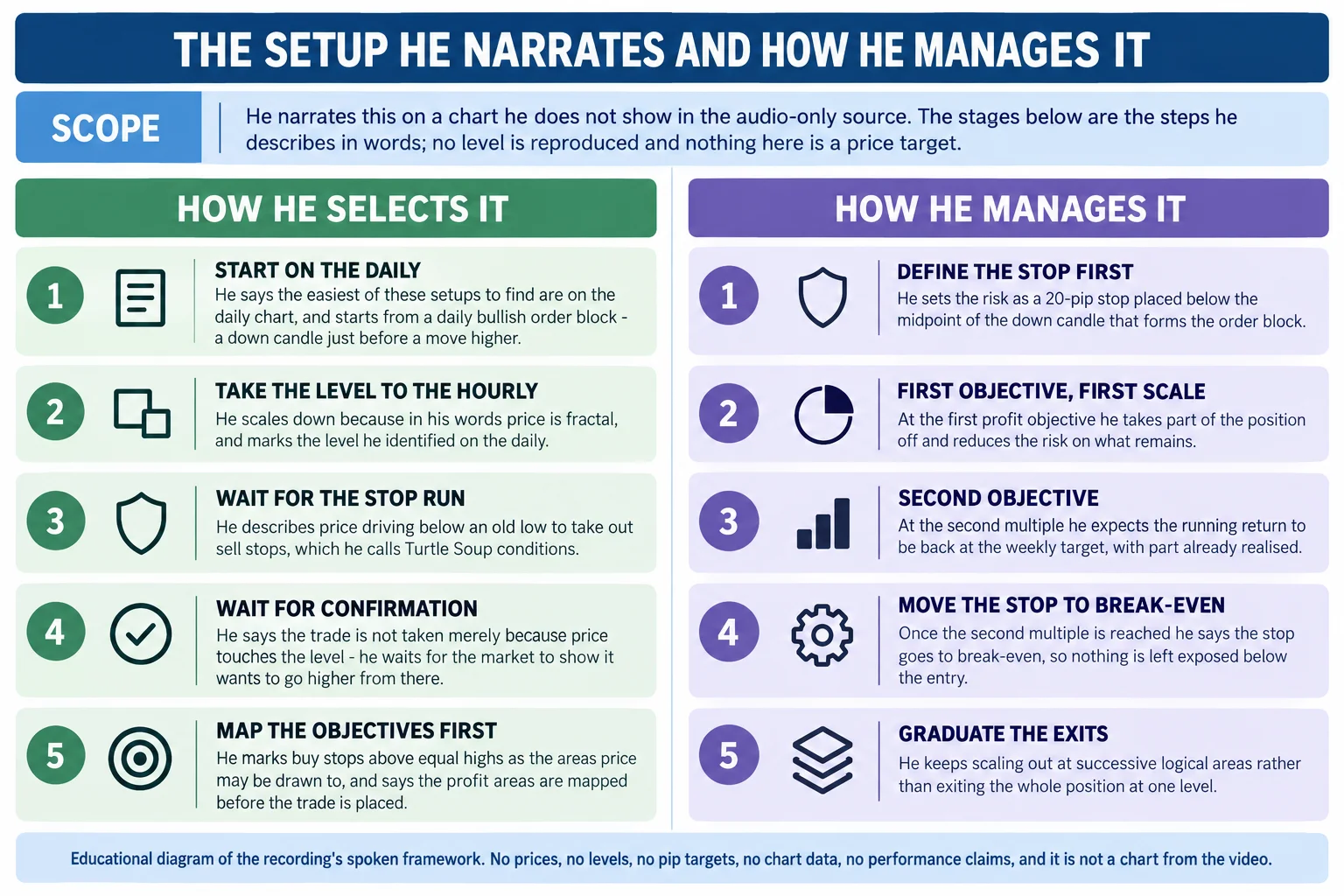
The chart discussion starts around 17:40, where ICT says the easiest of these setups to find are on the daily chart. He begins with what he calls a daily bullish order block: a down candle that sits immediately before a move higher, which he marks from the opening of that candle up to its high (18:05, 18:30). He then scales down to a one-hour chart, on the argument that everything in price is fractal (19:01).
He describes price moving below an old low into that previously identified daily level, with sell stops resting beneath the lows (19:26). He characterizes that as a stop run or “Turtle Soup” condition (19:42).
According to ICT’s narration, the trade is not taken merely because price touches the level. At 18:51 he waits for the market to show it wants to go higher from there, which he describes as waiting to see whether the level is sponsored. He then identifies buy stops above equal highs as the places price may be drawn to, and says those profit areas are mapped before the trade is placed (20:12, 20:27). At 20:34 he emphasizes knowing both the risk being taken and where price may be drawn.
ICT narrates an example entry near 0.7542 and a stop near 0.7522, producing a stated 20-pip risk (21:16, 22:05, 22:31). He says his stop sits below the midpoint of the down candle that forms the order block, so that the level is invalidated if price returns beneath that midpoint. The ASR renders those two levels as “75.42” and “75.22”; the chart itself is not shown in the audio source, so the levels, the instrument and the candle relationships cannot be independently confirmed from the transcript alone, and no chart or fill is reproduced here.
Manage ICT Setups With Graduated Exits
From about 23:11, ICT explains how a position might be reduced at successive objectives. He says that once price reaches his first profit objective he can start taking risk off and reduce some of the position (23:21). At the second multiple he expects the running figure to be back at his weekly target, with part of it already realised rather than still open (23:40, 23:45, 23:54). At the third multiple, once the buy stops he identified have actually been reached into, he takes another portion off (24:13).
After the second multiple is reached he says the stop moves to break-even, so nothing is left exposed below the entry (24:47). He is explicit that he is not handing over a fixed structure for how much to scale at each stage, only that the exits should be graduated at logical areas rather than improvised (24:29).
The broader educational idea is to plan position management around predefined levels rather than making improvised decisions under pressure. Scaling out can reduce exposure and realise some profit, but it also reduces the size participating in any later move. Moving a stop to break-even can limit loss on the remainder, yet it may also close a trade before the anticipated target is reached.
ICT Small Account Risk Takeaways
ICT’s account-growth framework prioritizes survival: avoid oversized bets, express risk as a percentage of equity, seek favorable asymmetry and trade selectively. The narrated setup then illustrates how he applies his own price-action terminology to entry, stop placement and staged exits.
The most transferable lesson is not the projected compounding figure. It is the discipline of specifying risk, invalidation and exit logic before exposure begins. The video does not establish that the illustrated setup was filled as described, that similar patterns will repeat, or that the proposed monthly return can be maintained. It should be studied as ICT’s market interpretation rather than as investment advice or a performance promise.
About this source
This article is written from the recording’s own audio. The source used here is an automatic speech-to-text transcript of the full original audio, not human-corrected captions, and the speaker’s identity, words and reported results are attributed to that recording rather than verified independently. The watch page lists the upload date as 27 August 2022, which the recording’s own opening does not contradict: the speaker introduces the session simply as the first of eight teachings in the second month of his mentorship and names no calendar month (0:24, 0:27). The transcript is not reproduced here and remains private.
Watch the source recording
ICT Mentorship Core Content – Month 02: Growing Small Accounts
The Inner Circle Trader · watch page lists upload 27 August 2022 · 1747 seconds, about 29 minutes 7 seconds · public, not unlisted. This recording is the primary source for every timestamp link on this page.
The recording is not embedded here. An embedded player was tested directly on 15 September 2026 from a BestProps page origin: the frame loads and then reports “Playback on other websites has been disabled by the video owner”, with no playable stream and no duration reported. The link above opens the recording on YouTube itself.
Resources
These are the sources checked while preparing this article. The CFTC pages are the regulator’s advisories on forex fraud and on commodity trading systems sold on the internet; the CME Group page is the exchange’s own FX education material, and the Investor.gov glossary entry defines leverage. None of them evaluates this speaker, tests whether an order block, a 3:1 ratio or a 6% monthly target provides an edge, verifies the results he reports, or endorses anything said in the recording. Any ICT, smart-money or third-party indicator, script, note set, chart annotation or re-upload circulating outside the publishing channel’s own page is unofficial and untested here.
- [1] ICT Mentorship Core Content – Month 02: Growing Small Accounts — The Inner Circle Trader (primary source; watch page read 15 September 2026, published 27 August 2022, listed at 1747 seconds).
- [2] The Inner Circle Trader — official YouTube channel (read 15 September 2026) — the publishing channel for the Core Content mentorship series this module belongs to.
- [3] U.S. Commodity Futures Trading Commission — Fraud Advisory: Foreign Currency (Forex) Fraud (read 15 September 2026) — the regulator’s advisory warning that the forex market is volatile and carries substantial risk and that promises of profit from already-public news are a common sign of a fraudulent pitch.
- [4] U.S. Commodity Futures Trading Commission — Fraud Advisory: Commodity Trading Systems Sold on the Internet (read 15 September 2026) — notes that technical analysis attempts to predict future price movements from historical prices, price relationships and price trends, and that hypothetical trading results are typically simulations over historical data rather than real fills.
- [5] CME Group — Introduction to FX (course page read 15 September 2026) — the exchange’s own introductory course on how listed FX futures work, quoted here only as contract-market background. It contains none of the lesson’s rules or figures.
- [6] U.S. Securities and Exchange Commission, Investor.gov — Leverage glossary entry (read 15 September 2026) — the regulator’s plain-language definition of leverage and its warning that borrowing to invest magnifies both gains and losses. Background only; it does not address this lesson.