
Key takeaways
In ICT Mentorship Core Content – Month 1: Elements Of A Trade Setup, ICT frames a trade setup as two components rather than a pattern: the market’s current condition, and a matching reference point from his methodology.
Read the full summary
In ICT Mentorship Core Content – Month 1: Elements Of A Trade Setup, ICT frames a trade setup as two components rather than a pattern: the market’s current condition, and a matching reference point from his methodology. He says there are only four conditions — expansion, retracement, reversal and consolidation — and that you get one of them at a time (2:35). Expansion is price moving quickly from a level of equilibrium and he pairs it with an order block (10:26); retracement is price moving back inside a recently created range, paired with liquidity gaps and voids (13:01); reversal is price moving against its prior direction, paired with the liquidity pools just above an old high and just below an old low (15:48); and consolidation is price held in a clear range, paired with equilibrium, the halfway point of that range (17:09). He says markets start from consolidation, that the first expansion is the clue to direction, and that he waits for a retracement or a new consolidation rather than chasing a move that has already run (9:43). He also states near the close that finding just one condition that suits a trader can be enough (19:48), while presenting no fills, no performance record and no mechanical rules.
How we researched this article
BestProps used document-based research from primary firm sources, checked September 25, 2026. The complete source list, scope, limitations, and commercial-state record appear near the end of this article.
In ICT Mentorship Core Content – Month 1: Elements Of A Trade Setup, the opening tutorial of the September 2016 mentorship module, ICT sets out how he decides what kind of setup is even available. The lesson is a classification exercise rather than an entry system. He argues that a trade idea needs context first, because in his words “my indicator tells me this” or a support-and-resistance level is not by itself a reason to act (1:38).
Everything below is written from the recording’s own audio. The source used here is an automatic speech-to-text transcript of the full original audio rather than human-corrected captions, so the words were read, not the charts. This is his stated framework for organising price behaviour; it is not evidence of an edge, and the recording contains no verified results.
The Two Components of a Setup
He names the first component at 1:21 as the context or framework surrounding an idea — in his words, what makes the idea favourable for a trade — and distinguishes that from acting on an indicator or a support-and-resistance level alone. The second component, introduced at 3:02, is a set of specific reference points in institutional order flow.
He presents the four conditions as the first characteristic: expansion, retracement, reversal and consolidation (2:00). He is emphatic that they are mutually exclusive at any moment — the market can only be in one of the four — and describes them as either expanding and running away, which he equates with trending, a retracement or pullback, a reversal, or consolidating (2:35). On consolidation he adds a caveat carried over from his earlier material: he says there is really no such thing as the market doing nothing in consolidation, because it is accumulating orders (2:51).
The reference points form the second characteristic: order blocks; fair value gaps and liquidity voids; liquidity pools and stop runs; and equilibrium (3:20). He says the two characteristics taken together give a fuller understanding of what he calls the market efficiency paradigm — how the smart money interprets price and how, in his account, it influences what he calls the speculative uninformed money (3:46).
The practical claim he attaches to the framework is speed: at 4:15 he says it takes a second or two to look at the market and determine which characteristic is being traded, so that a context can be built. He also allows that the answer is sometimes to do nothing — if the market is consolidating, his stated response is to wait, while the other three conditions offer something to act on relative to the tool he couples with them (4:21).
Why He Says the Conditions Interchange
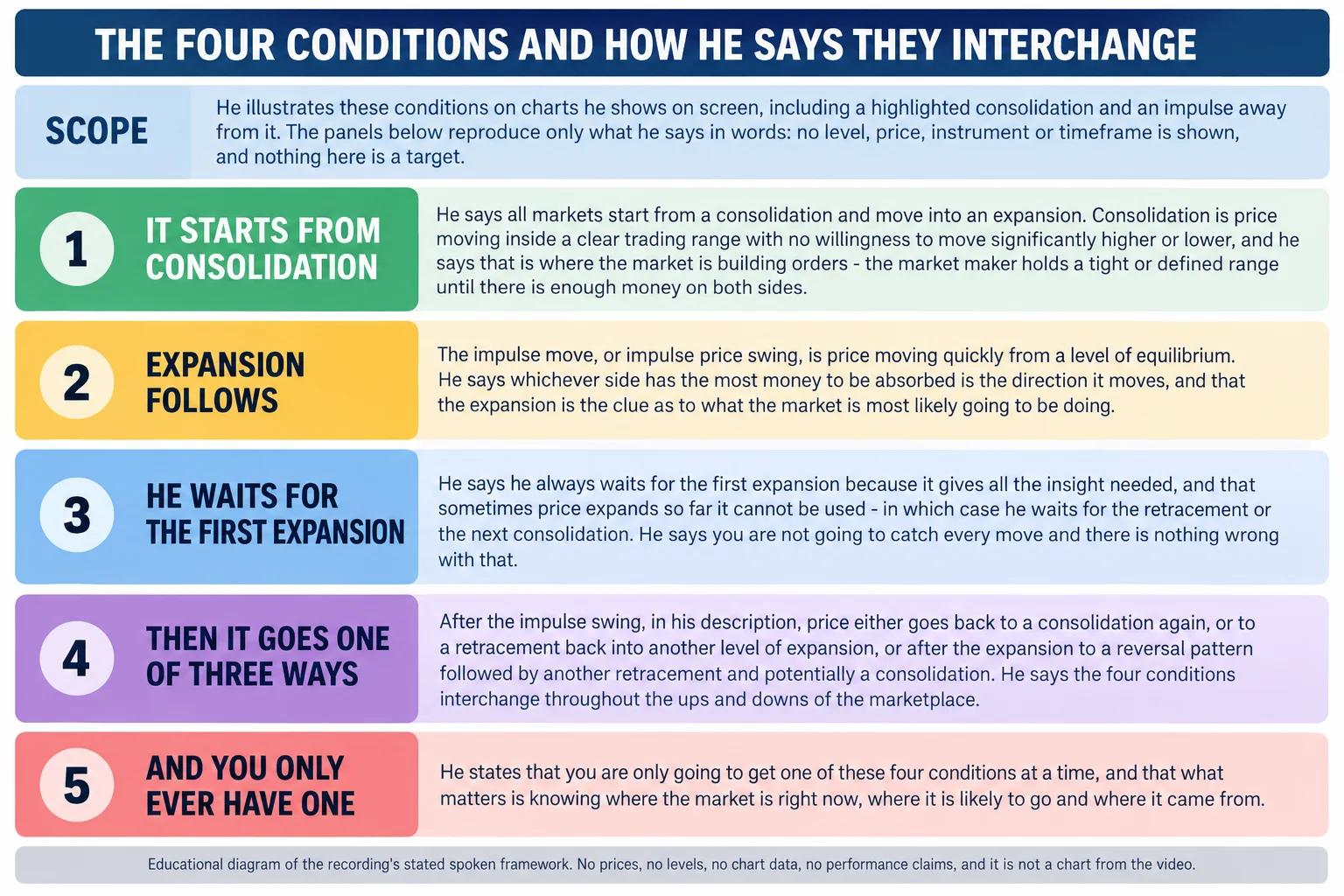
From 7:36 he describes the sequencing. Markets go sideways in a consolidation, which he also calls a holding pattern, and the market is then looking to expand: all markets start from a consolidation and move into an expansion, which is an impulse move or impulse price swing (7:42).
After that impulse swing he gives three possibilities: a return to consolidation, a retracement back into another level of expansion, or — after the expansion — a reversal pattern followed by another retracement and potentially a consolidation (8:03). He summarises this as the four conditions interchanging through the ups and downs and ebbs and flows of the marketplace, and repeats that you are only going to get one of them at a time (8:28). His answer to the objection that this is a lot to track is that you do not need all of it: you need to know where the market is now, where it is likely to go and where it came from (8:38).
The mechanism he offers for consolidation is order accumulation: he says the moves all start from a measure of consolidation because that is where the market is building orders, and that the market maker keeps the market in a tight or defined range until there is enough money on both sides of the upper and lower end of the range being defined. Whichever side holds the highest amount of money to be absorbed is, in his account, the direction it will move — though he concedes they do not always know which side that is, which is why they wait for the expansion (9:03).
That wait is the operational point of the lesson. At 9:43 he says the expansion is when the clue appears about what the market is most likely going to do, and at 9:52 that he always waits for the first expansion because it provides all the insight needed. He then adds the practical limit: sometimes price expands so far that nothing can be done with it, in which case he waits for the retracement or the next consolidation. His comment is that there is nothing wrong with it, it is normal, and you are not going to catch every move (9:59).
Expansion, Paired With the Order Block
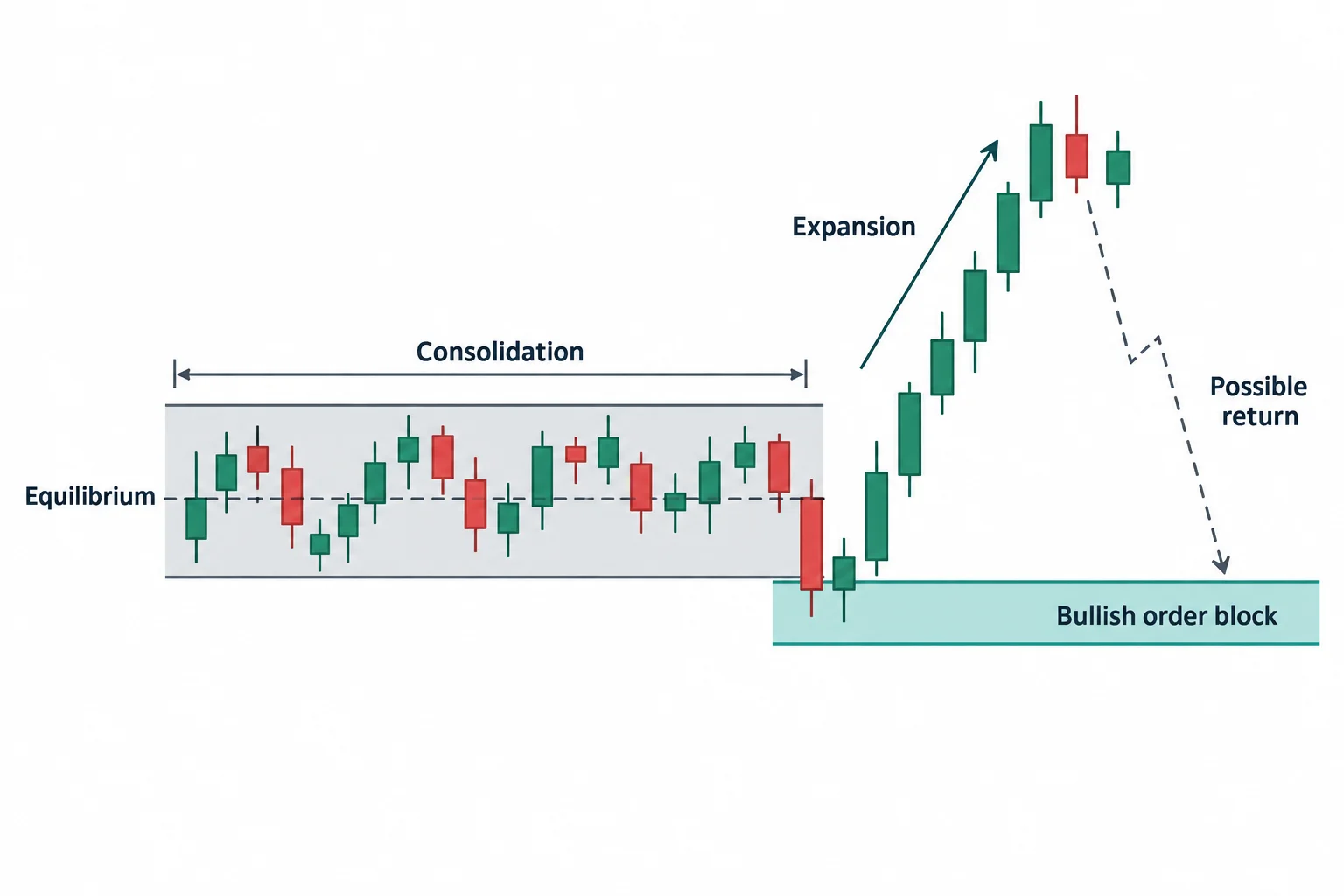
His definition at 10:26 is that expansion is price moving quickly from a level of equilibrium, and it couples directly with the order block. He attaches a purpose to the speed: a quick departure from a level indicates, in his reading, a willingness by the market makers to reveal their intended repricing model (10:37).
The actionable consequence he draws is directional and passive: if price moves up quickly out of a consolidation or a point of equilibrium, that indicates looking for a bullish order block, and he says he does not want to chase price — he waits for price to come back down into the order block (11:05).
For the chart example he walks through, he identifies a clearly defined consolidation with a discernible high and low, notes that the equilibrium point sits directly in the middle of the range, and suggests using the Fibonacci tool laid from high to low to find that midpoint, or checking it by counting how many times price touches and hangs around the level (11:33).
He then describes the impulse leaving that consolidation and the next step: go back to the down candle immediately before the up move and mark that candle as the bullish order block, waiting for price to return to it (12:04).
He reports that price hit that level and then expanded upward “over a hundred pips,” calling it a simple principle that repeats itself all the time (12:29). That is his account of one illustrated historical example, not a verified or repeatable result: the instrument, prices, entry, stop and any fill are not established by the audio, and the chart he is describing is not visible in it. He also points to a second consolidation on the sell side, to the left of the one shaded on screen, where price broke down, returned to the equilibrium point and sold off, and leaves that one for the viewer’s own study (12:42).
Retracement, Paired With Liquidity Gaps and Voids
At 13:01 he defines retracement as price moving back inside the recently created price range, and he pairs it with liquidity gaps and liquidity voids (14:17). He pauses to recall a 2012 webinar he called “trading inside the range,” saying that traders who learned they could define a range by a high and a low and trade inside it without needing a breakout or a trend were the starting point of how he brought people to understand the order block (13:11). The order block itself, he notes, was only named later in his free sniper series; before that he gave clues about it without spelling it out (13:48).
The stated importance of a retracement is that when price returns inside a recent range it indicates a willingness by the market makers to reprice to levels that were not efficiently traded for fair value (14:03). His go-to tools for that condition are liquidity gaps and liquidity voids: when price rallies or declines very quickly, the range that is created can contain pockets where price was not at every available level, so it skipped or created gaps (14:26).
His handling of that condition is again to wait rather than chase. In the example he walks through, the quick sudden movement away from a price level creates what he calls a liquidity void, and the trader then waits either for an indication that the market is trying to fill the range or for price to come all the way back to it and fill the void, after which he expects it to probably resume going lower (14:57).
Reversal, Paired With Liquidity Pools and Stop Runs
He defines reversal at 15:48 as price moving in the opposite direction to the one the market has taken, and couples it directly with the tool of liquidity pools (15:55). The stated importance is that when price reverses direction, in his words the market stops and a significant move should unfold in the new direction (16:01).
What he says he looks for in price is the liquidity pools just above an old high and just below an old low (16:13). In the examples he narrates, each marked level shows where stops would be and price goes just above those levels and rejects to go the other way, or just below them and rejects to go the other way (16:26).
He points out how many such opportunities appear on the single chart he is showing and remarks that it is a pair he does not like to trade — US versus the Swiss franc — describing it as choppy with a lot of this type of price action, which he says makes it favourable if that is the style of trading you are drawn to. He labels these as Turtle Soup and false breaks on that pair (16:40).
Consolidation, Paired With Equilibrium
Consolidation, the fourth condition, is tied directly to equilibrium (17:09). He defines it at 17:21 as price moving inside a clear trading range with no willingness to move significantly higher or lower (17:25).
The interpretation he gives it is that consolidation indicates the market makers are allowing orders to build on both sides of the market, and he says to expect a new expansion near term (17:29).
What he waits for is the impulse move, or impulse swing, away from the equilibrium price level, which he locates exactly at the halfway point of the consolidation range (17:40). In the example, he identifies a range defined specifically by the bodies of the candles, then notes price moving out expansively, coming right back down to the equilibrium price point and expanding to the outside again (17:53).
His Closing Argument: One Condition Is Enough
The lesson ends with what ICT frames as encouragement rather than rules. He says understanding these characteristics gives a framework to practise and study price action and eventually work toward consistent setup discovery, and that repetition plus the daily time with him is what builds retention (18:09).
His claim is that one of the four conditions will become a trader’s bread-and-butter condition: some will trust equilibrium, some the order block, some will look for the void or the liquidity gaps to trade into, and some will eventually grow into being universal across all of them. He is explicit that having all four mastered is not a prerequisite, saying that if you find just one that suits you, you can start being consistently profitable, and that it only takes one setup (18:57).
He also attaches a frequency expectation: know the context you are going to trade in, couple it with a tool, wait for those conditions, and while you will not trade every single day you can get a couple of them every week. He says if you look at four major pairs with one criterion you will find a trade every single day, but immediately qualifies that this is not what the viewer is trying to do at that stage — they are to grow into it over time (19:40).
The profitability and frequency statements are his assertions. Nothing in the recording tests them: there is no track record, no win rate, no account data and no mechanical rule set, and the “over a hundred pips” figure comes from a historical chart he narrates rather than from an executed trade. Treating the four-condition vocabulary as a study aid is a different proposition from treating the outcome claims as established.
What He Asks the Student to Actually Do
The assignment he gives at the end is deliberately historical rather than live: go through your charts, look at the examples that have already happened on the left side of the chart, and outline them individually according to the characteristics and elements identified in the teaching (20:00).
- Mark a clearly defined range and find its equilibrium — the halfway point of the high and low — using a Fibonacci laid from high to low, or by counting touches (11:33).
- Identify whether price expands away from that level, and if it does, look back to the down candle immediately before the up move as a candidate order block (12:04).
- Where price moves back inside a recently created range, look for the quick one-way run that left pockets of untraded price and mark it as a liquidity void (14:57).
- Where price reverses, mark the liquidity pools just above an old high and just below an old low, and study the breaks that reject (16:13).
- Note that consolidation is where orders are said to accumulate, and wait for the impulsive move away from equilibrium rather than treating the range as inactivity (17:29).
What the Recording Does and Does Not Establish
The lesson is a taxonomy. It says that price is always in one of four conditions, what he thinks each condition means, and which of his tools he associates with each. It supplies no objective thresholds — not for how fast price must move to count as expansion, how large a void must be, how long a consolidation must last, or when an idea becomes invalid — and no entry, stop or confirmation rules. He is candid that some of this will go over a viewer’s head on a first pass and points them to three earlier free series as prerequisites (6:44).
Two of his claims are broader than the taxonomy and are worth separating from it. First, he describes an interbank price delivery algorithm and says that roughly 90 percent of currency pricing is done by electronic algorithms, that markets are highly manipulated, particularly in foreign exchange, and that the operation leaves fingerprints or clues a trader can learn to read (4:49). Second, he asserts that one suitable condition can make a trader consistently profitable and that a couple of trades a week are available (19:28). Neither is demonstrated in the recording. The algorithm and manipulation account is his assertion about how markets are run, and the profitability statement is an expectation he states rather than a measured result.
There is also a limit on how far this article can check the examples themselves. The consolidation, the impulse, the candle bodies used to define the range and the void are all described out loud from charts that are not in the audio, so their coordinates, instruments and any outcome cannot be confirmed here. What is checkable is that he states these relationships, in this order, in this recording.
About This Source
The primary source for every timestamp link on this page is the recording itself. It is presented on the channel as 2016 ICT Private Mentorship Core Content, Month 01, and the watch page lists the upload as 22 August 2022 with a duration of 1,219 seconds, about 20 minutes 19 seconds. The recording’s own audio places the session in the September 2016 mentorship module and calls it the first of eight tutorials (0:35), which is a different calendar month from the 2022 upload date; those two dates describe different things and no contradiction between them is asserted here.
The transcript used is an automatic speech-to-text rendering of the full original audio, not human-corrected captions. No part of it was flagged low confidence by the recognition model and the audio was verified as complete, but that is a quality measure of the transcript rather than a verification of the lesson’s content. The full transcript is retained privately as the working source and is not reproduced here.