
Key takeaways
ICT Mentorship Core Content – Month 1 – How Market Makers Condition The Market is the second teaching in his eight-part September 2016 month 0:22.
Read the full summary
ICT Mentorship Core Content – Month 1 – How Market Makers Condition The Market is the second teaching in his eight-part September 2016 month 0:22. He opens by drawing what he calls the market efficiency paradigm: a large crowd he labels uninformed money and a much smaller circle he calls smart money, which he says contains the banks 0:35, 0:43, 3:25. He says the retail crowd’s belief that its sheer size drives price is a facade, calls supply and demand, trend lines and moving-average crossovers facades too, and says price is delivered by what he names an interbank feed and describes as an artificial intelligence controlling it down to the minute 2:02, 9:46, 10:01, 10:10. His practical teaching is a four-condition model — consolidation, expansion, retracement, reversal — paired with order blocks, fair value gaps, liquidity voids, liquidity pools, stop runs and equilibrium, plus an ordering rule he repeats several times: price always starts in consolidation, the next stage is always expansion, and only after expansion is there a choice between a retracement and a reversal 12:41, 12:48, 17:21, 17:39, 18:34, 18:41. He then lays that sequence over one foreign-exchange day: Asian-session consolidation, a post-midnight false move he calls the Judas swing, a London reversal and expansion into the pre-New-York window, consolidation between five and eight in the morning New York time, a possible retracement in the eight to eight-thirty window he ties to a news embargo lift, another expansion, a possible reversal around the London close, and consolidation into the daily close at 19:00 on his platform 13:49, 13:54, 14:05, 14:26, 14:35, 16:15, 16:23, 16:41, 16:46. He sketches the same shape over a weekly range beginning at the Sunday open 24:01, 24:06. The recording offers no test, no chart verification and no independently verified result for any of it: its strongest statements — that he has shown something that went right to the pip or offered fifty to sixty pips 21:58, and that this process of price delivery cannot be changed 22:47 — are his own claims, not performance evidence.
How we researched this article
BestProps used document-based research from primary firm sources, checked September 25, 2026. The complete source list, scope, limitations, and commercial-state record appear near the end of this article.
In ICT Mentorship Core Content – Month 1 – How Market Makers Condition The Market, the speaker opens by placing the recording as the second teaching of eight for September 2016 and saying he wants to revisit a drawing he has shown before 0:22, 0:31, 0:35. Everything below comes from an automatic speech-recognition pass over the full original audio rather than human-verified captions, and the reviewer read that transcript rather than watching the charts, so each statement is attributed to what he says aloud and no level, price or chart shape on this page is offered as checked against a chart source.
The Market Efficiency Paradigm He Draws
He divides participants into two groups. The large one he calls uninformed money, and he says new traders are part of it whether or not they realize it 0:43. The small circle he calls smart money, and he puts the banks inside it, while the social-media crowd, every retail account and the gurus and teachers selling services sit in the larger group 3:25, 3:32. His claim is that the crowd believes its size drives price while the small group is the actual drive shaft, and he states it as a position rather than an inference: the banks drive price whether you want to accept it or not, price is not delivered for your well-being but the bank’s, and the banks are the liquidity provider 6:01, 6:20, 4:53.
He pairs that with a rejection of the usual retail explanations. He calls supply and demand, trend lines driving price when price touches them, and moving-average crossovers causing price to move the facade of the market, and says the same of the belief that collective buying and selling interest pushes price around 1:55, 2:02, 5:24. He then uses his own history as the illustration: he says he once believed indicators drew price up and down, that he discussed stochastic, RSI and Williams percent R with crowds in chat rooms, and that if you are going to follow momentum you only need one such tool rather than several expressing the same information 2:23, 2:32, 2:41.
The distinction worth keeping is narrower than the rhetoric. An indicator does transform and display price data, and asking where orders and liquidity may be concentrated is a reasonable study question. What the recording does not do is identify any institution, present any data, or show how the described influence on price was measured, so the step from “indicators are not the cause” to “banks control the movement” is his assertion and not something this source establishes.
What He Says Is Delivering Price
He describes the market as manipulated and controlled to the minute, in his words “to the degree of every single minute detail” and “absolutely controlled”, attributes it to what he calls an AI, and says you are no longer trading against a person but against a computer program that understands human behaviour through fear and greed 10:01, 10:10, 10:22. Earlier in the same passage he points at the interbank feed as the thing that drives price, and later he repeatedly names the interbank price delivery algorithm as the object his model describes, asks what that means for us, and says the model comes by way of his understanding of how the interbank feeds price to everyone 9:46, 12:55, 14:52, 15:03, 17:21.
Those are strong claims, and the recording supports none of them with evidence. There is no description of the mechanism, no source for the artificial-intelligence assertion, and no measurement of any kind; the passage is his characterization of how he believes the market operates. It is reproduced here as his position, not as an established fact about market structure.
The Four Conditions and the Order He Insists On
Around twelve and a half minutes in he refers back to a previous lesson on the elements of a trade setup, which he says had two characteristics — context and framework around the trade — and says you have to bridge the two 12:31, 12:41. He then pairs four conditions with a set of tools: expansion, retracement, reversal and consolidation applied respectively to order blocks, fair value gaps, liquidity voids, liquidity pools, stop runs and equilibrium 12:41, 12:48. He does not define those tools here; this lesson is about the order in which the four conditions are said to arrive.
That order is his central point, and he states it as a rule without exceptions. It all starts with a consolidation; nothing can happen until consolidation; consolidation is when the market is quiet because that is when orders are building up, and he says the market makers allow those orders to build above and below the range 17:21, 17:26, 17:35, 17:37. The next stage, in his words, is always expansion 17:39. Consolidation cannot be followed directly by a retracement or a reversal in his account, because price has not moved anywhere yet and has to come out of the range first, so a holding pattern is followed by what he calls an explosive move or an impulse leg 17:42, 17:45, 17:51, 17:57.
Once price has expanded he says the market gets a choice between two outcomes. It can retrace back to the order block it just left behind and then make another leg in the same direction, or it can reverse, in which case he says another expansion follows and price then returns to consolidation 18:13, 18:23, 18:28. The restatement at roughly twenty and a half minutes is the shortest version: from expansion, price either retraces back into where it just came from or reverses 20:28.
The Order He Says Never Happens
He repeats the negative version of the rule more often than the positive one, and he uses it as the practical test of whether a reader has understood the model. In his words it never goes consolidation to retracement, it never does consolidation to reversal, it is always consolidation then expansion, and from expansion it goes either into a retracement or into a reversal 18:34, 18:38, 18:41, 18:43. He also rules out a sequence that many traders would consider ordinary, saying it does not do consolidation, expansion, consolidation 18:48, and he describes the whole thing as generic and systematic with only a few possible options that are time-sensitive and intermarket related 19:11, 19:26.
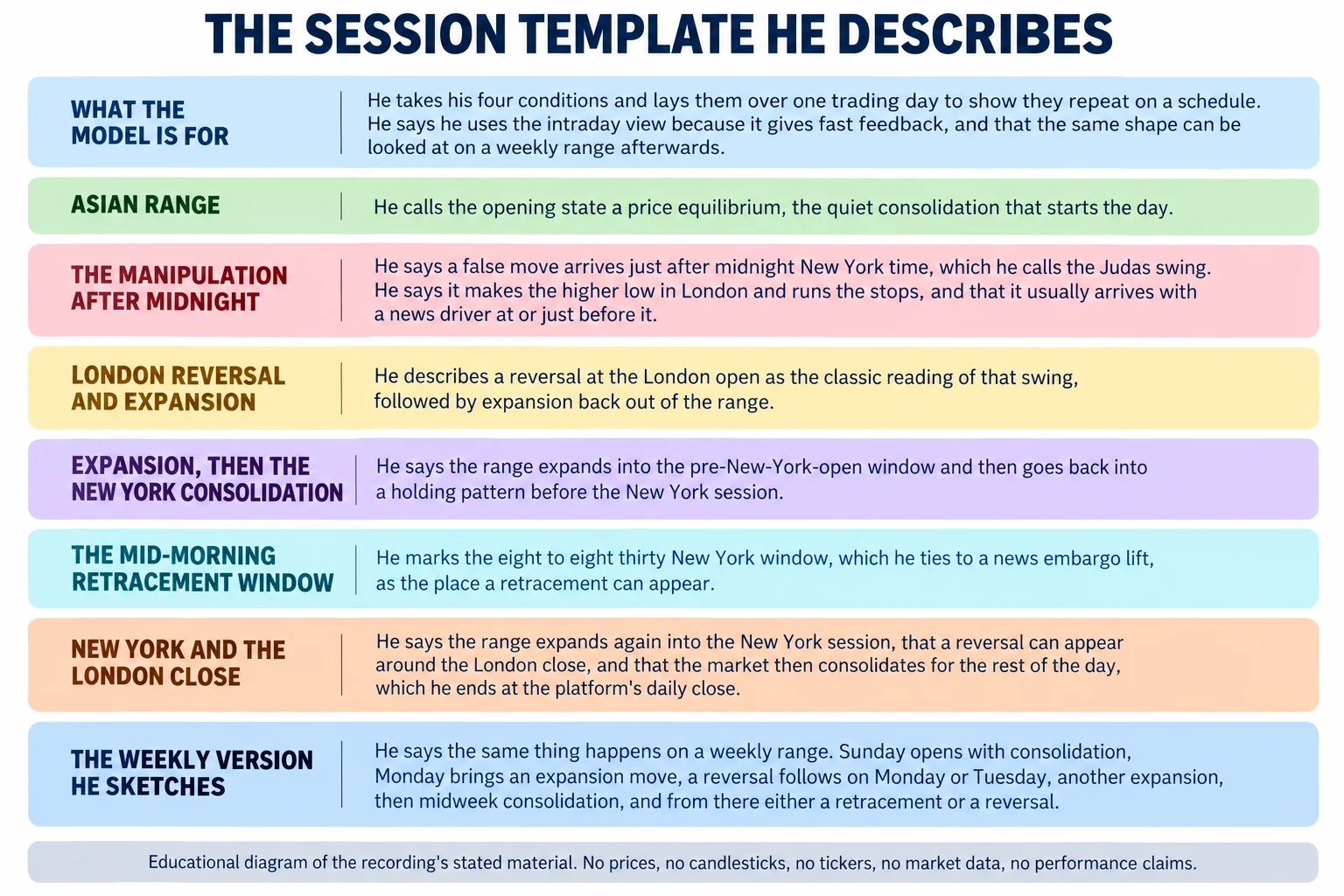
The Session Template He Lays Over One Trading Day
He explains why the teaching starts on intraday charts: intraday study gives a lot of feedback, and he says long-term trading on daily charts cannot be taught adequately inside twelve months because you would only be looking at a year of data 13:15, 13:25, 13:30. He tells the viewer to use it as a model that repeats itself over and over once the higher-time-frame directional premise is understood 21:38.
The daily template itself is one sentence in his telling: every day starts with consolidation, which he calls the Asian range 13:49, 13:54. After midnight, he says a manipulation takes place that is an expansion in the form of a Judas swing, which he says makes the higher low in London, acts as the London swing and runs the stops 13:59, 14:05, 14:11. That is followed by another expansion down into the New York session, another consolidation going into the eight to eight-thirty news embargo lift where there can be another injection of liquidity or a reversal, another expansion, London close as another reversal condition, and then consolidation for the rest of the day 14:16, 14:21, 14:26, 14:35, 14:41.
His longer restatement adds the mechanics and the clock. He calls the opening state a price equilibrium and repeats that the manipulation is always going to come by way of some news event or driver, either at the time of the manipulation or just before it 15:03, 15:10, 15:18. Using what he calls a buy-day perspective, he says the Asian range has a small consolidation, then right after midnight New York time price drops in the manipulation that makes the false move for the low, and the range then expands into what he calls the classic London open scenario, where it shoots down, runs the stops and expands again 15:42, 15:49, 15:54, 16:01. That expansion carries into five o’clock in the morning New York time, price goes back into consolidation between five and eight, a retracement can appear between eight and eight-thirty, then there is either a reversal in the New York session or another expansion move into ten or eleven o’clock, which he says is the London close and another reversal, after which the market consolidates and the true day ends at 19:00 on his platform 16:10, 16:15, 16:23, 16:27, 16:33, 16:37, 16:41, 16:46.
The compact recap near twenty-one minutes is the same shape in fewer words: consolidation in Asia, expansion and a reversal in London that makes the higher low, expansion into a small consolidation in New York, a retrace between eight and eight-thirty in the morning New York time, another expansion move and a reversal back into consolidation 21:01, 21:10, 21:16, 21:23. The times in this template are New York time as he states them, and the day is bounded by the close on the specific platform he names; both details belong to his presentation rather than to a universal market calendar.
The Weekly Version He Sketches
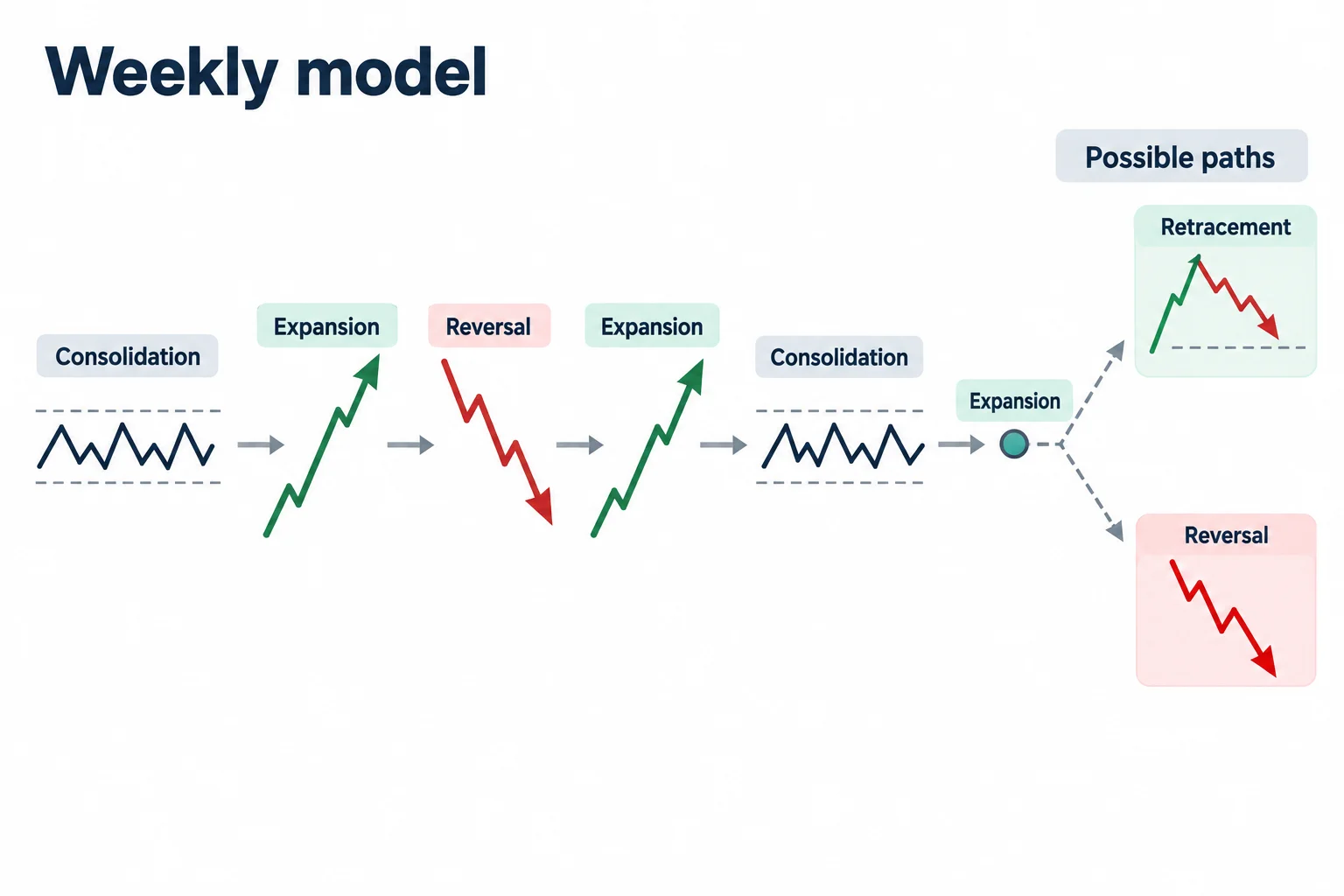
Near twenty-four minutes he applies the same template to a weekly range: the Sunday open is consolidation, an expansion move follows on Monday, then a reversal on Monday or Tuesday, another expansion, and then back into consolidation midweek 24:01, 24:06, 24:09, 24:15. From there, in his words, it either reverses or retraces, and he repeats the ordering rule in that context too — never consolidation straight to retracement, never consolidation straight to reversal, always consolidation then expansion and only then a choice 24:20, 24:26, 24:31. This is the only part of the recording where the model is extended beyond the daily template, and he presents it as an illustration of how the same four conditions repeat rather than as a separate tested model 21:38, 23:54.
What “Conditioning” Means in This Lesson
Two related meanings run through the recording. The first is that conventional retail education conditions traders to treat indicators, patterns and collective supply and demand as the drivers of price, which is the argument he makes in the opening minutes 1:55, 2:02, 2:07. The second is behavioral: a recurring sequence of ranges, expansions and stop runs draws traders into predictable decisions at predictable places, and he describes the accumulation of orders above and below a range as what happens while the market is quiet 17:35. Under the second reading the educational content is not the claim that every tick is controlled but the question the template raises after a break — whether price is returning toward the origin of the move before continuing, or transitioning into a reversal.
He says the answer depends on higher-time-frame direction, on time of day and on relationships between markets, and he defers the intermarket detail: he tells the viewer that if they understand the relationships he is going to teach in a couple of months they will know where a trade is setting up, and he mentions the euro and the pound as an example of instruments moving together 19:26, 19:32, 19:43. That detail is not in this recording, so the checklist here stops at identifying consolidation, waiting for expansion and then classifying the response.
How to Read This Lesson Without Overreading It
- Consolidation first, expansion second, classification third. The only ordering claims the recording actually supports are that consolidation precedes expansion in his model and that retracement or reversal comes after expansion 18:34, 18:43. Everything else about the model depends on discretionary labelling.
- The tools are named, not defined. Order blocks, fair value gaps, liquidity voids, liquidity pools, stop runs and equilibrium appear in a single list and are not explained in this session 12:41, 12:48. Treating them as defined mechanisms reads more into the transcript than it contains.
- The session clock is his, not universal. The windows are stated in New York time and the day is bounded by the close on the platform he names 16:46. Nothing in the recording tests whether the same windows behave the same way on other instruments or venues.
- The market-control and AI statements are unsupported here. He describes price as controlled to the minute and delivered by an artificial intelligence 10:05, 10:10, and the recording offers no mechanism, source or evidence for either claim.
- The outcome figures are his, and they are not results. He says that every day he has given the viewer something that went right to the pip or offered fifty to sixty pips 21:58, and that the process cannot be changed 22:47. The recording shows no fills, no position sizes, no costs, no losses and no sample, so none of that can be read as a track record.
- The claimed mechanism was reserved for later. The intermarket relationships he says answer the retracement-or-reversal question are promised for a couple of months later and are absent here 19:32, which is why the transcript cannot be used to justify a trade decision on its own.
- This is not instruction to trade. The material is an explanation of one trader’s descriptive framework. Nothing here is investment advice, a recommendation, or a claim of profitability.
Watch the Original Recording
ICT Mentorship Core Content – Month 1 – How Market Makers Condition The Market
The Inner Circle Trader · watch page lists upload 23 August 2022 · 1,522 seconds, about 25 minutes 22 seconds. The recording identifies itself as the second teaching of the first month of the mentorship, and it is the primary source for every timestamp link on this page.
The recording is not embedded here. An embedded player was tested directly on 15 September 2026 from a BestProps page origin at desktop and mobile widths: the frame loads and the player reports “Playback on other websites has been disabled by the video owner”, with no duration reported and no playback progress, while the video itself is publicly playable on YouTube. The oEmbed endpoint answers 401 Unauthorized for this video for the same reason. No half-working player is left on this page.
The watch page was read on 15 September 2026 and is publicly listed as ICT Mentorship Core Content – Month 1 – How Market Makers Condition The Market by The Inner Circle Trader, not private and not unlisted, with an upload timestamp of 23 August 2022 and a listed duration of 1,522 seconds. The recording places itself in September 2016 as the second of eight teachings, which is a different calendar date from the upload; both are reported as they are, and neither is treated as a contradiction.