
Key takeaways
The Inner Circle Trader’s public YouTube recording presents an approximately eleven-minute narrated NQ Nasdaq-100 futures premarket short using ICT concepts, beginning with an unfilled limit order in a smaller fair value gap above price and interpreting the missed retrace as evidence of a possible breakaway gap.
Read the full summary
The Inner Circle Trader’s public YouTube recording presents an approximately eleven-minute narrated NQ Nasdaq-100 futures premarket short using ICT concepts, beginning with an unfilled limit order in a smaller fair value gap above price and interpreting the missed retrace as evidence of a possible breakaway gap. The speaker then enters near an inversion fair value gap, places the stop around its consequent-encroachment midpoint and volume imbalance, reports a fill at four minutes 57 seconds, observes immediate responsiveness lower, and tightens the stop above the inversion gap. He takes the first partial near minor sell-side liquidity and a 15-minute inefficiency identified around 18,307 and 18,304.75, then scales out one contract at a time at the lower blue line near 18,304.75 until three contracts remain for a lower smooth-price liquidity target. His fee arithmetic assumes ten US dollars per contract and references covering ten contracts, but the transcript does not establish total position size or actual costs. He claims the execution uses live TradingView price action rather than market replay, yet no chart, account, order routing, fills, final result, win rate, drawdown, or performance record was independently verified, and the recording ends before the remaining three contracts’ outcome is known.
How we researched this article
BestProps used document-based research from primary firm sources, checked September 24, 2026. The complete source list, scope, limitations, and commercial-state record appear near the end of this article.
NQ May 13, 2024 Premarket Short Live Execution is a public first-party upload on the YouTube channel The Inner Circle Trader. Its watch page, read on 14 September 2026, reports the title above, a page duration field of 661 seconds, a publication and upload field of 2024-05-13T05:56:27-07:00, and a video that is neither unlisted nor private with a playability status of OK. The locally transcribed audio runs 660.5 seconds, about eleven minutes, which matches that duration field. The title dates the upload; the recording itself never states a calendar date, and it opens with a good-morning greeting before a premarket short rather than with any session label. Every statement below is taken from the recording’s spoken narration, produced by local automatic speech recognition of the complete original audio rather than from YouTube captions, so ambiguous terms and numbers are flagged rather than smoothed over. No chart, order panel, clock or account in the video was examined by this review.
ICT Premarket Short Setup From the 15-Minute Imbalance
He opens by saying he is going to try to put a short on using what he calls the 15-minute SIBI, his own term for a sell-side imbalance (0:00). The sequence he lays out is deliberately two-sided. He says he initially wants to see price try to trade down into a discount fair value gap, and that he already has a limit order in, placed with the expectation that price could instead trade up into a smaller fair value gap above (0:24, 0:31). Later he refers back to the price where his limit orders sit, saying it looks as though price may run lower without trading up into that inefficiency; the automatic transcript garbles the middle of that sentence, so only the part the surrounding narration supports is reported here (2:31).
He then reads recent structure as a reason to doubt his own resting order. He notes that repeated attempts to trade higher than what the automatic transcript renders as “the 320 level” look jagged, and says he runs the risk of not getting a fill there (0:43). The transcript renders that level loosely, so it is quoted as spoken rather than resolved to a specific price. The load-bearing part of the passage is the conclusion he draws from a possible miss: the nearby imbalance could become a breakaway gap, so the failure to retrace is itself useful information rather than a reason to wait indefinitely (0:53). He also points to a volume imbalance sitting to the left of the area he is considering (1:00).
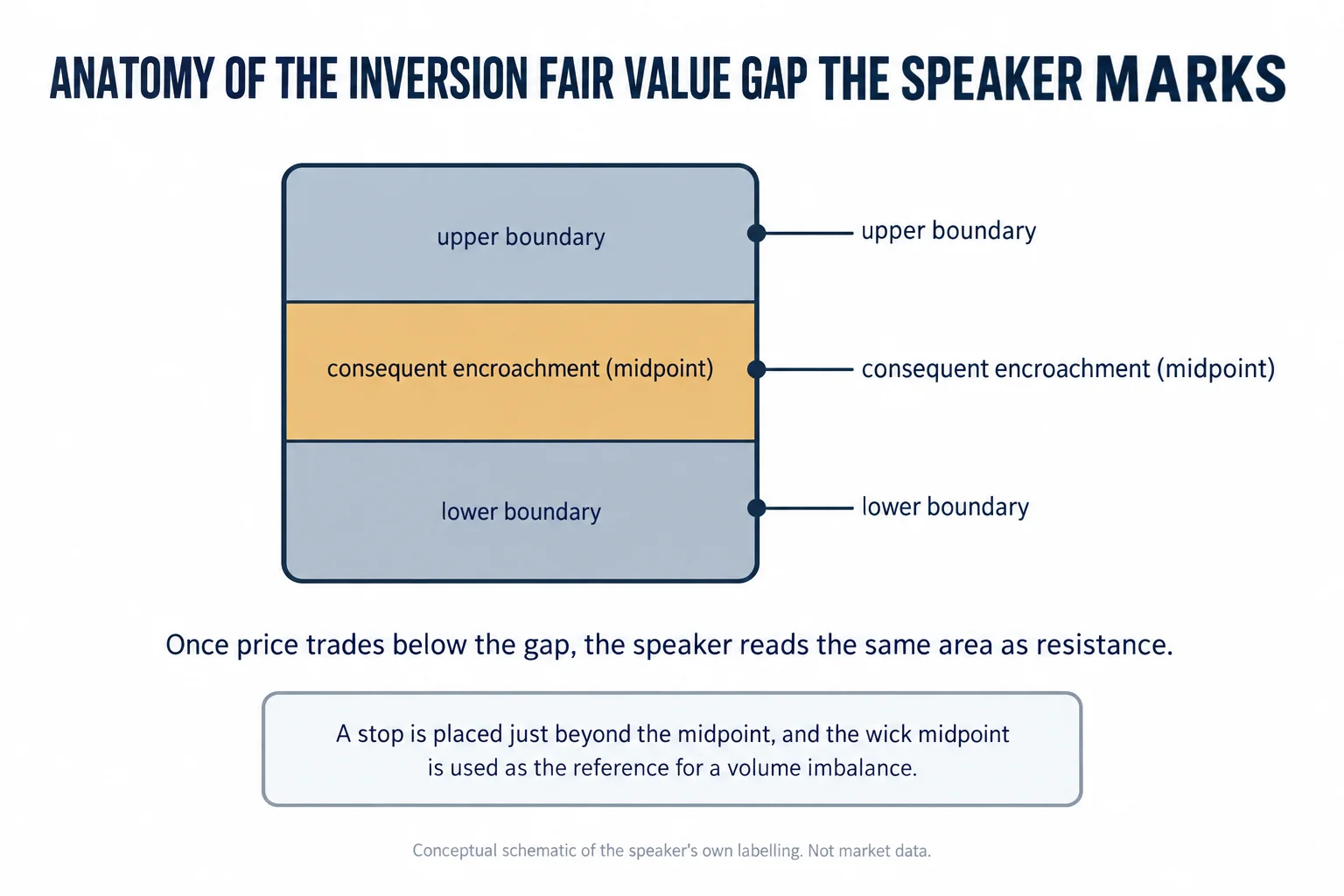
For risk placement he describes measuring the wick and trying to get the stop just above the midpoint of it, the level his framework calls consequent encroachment, which the transcript renders as “consequent encouragement” (1:08). That misrendering is a caption artefact rather than a distinct concept, and it is the same midpoint reference he returns to when he places the stop on the second entry. If no fill comes he says he will have to take something lower, and adds that this is fine because a potential inversion fair value gap is available (1:38).
He names a first partial-profit reference early as well, saying he is noting a fair value gap on the 15-minute timeframe and that he wants to see price reach at least that price or lower before taking the first partial (1:52). That is a plan stated ahead of execution, not a description of something already done.
ICT Premarket Short Entry After the Missed Fill
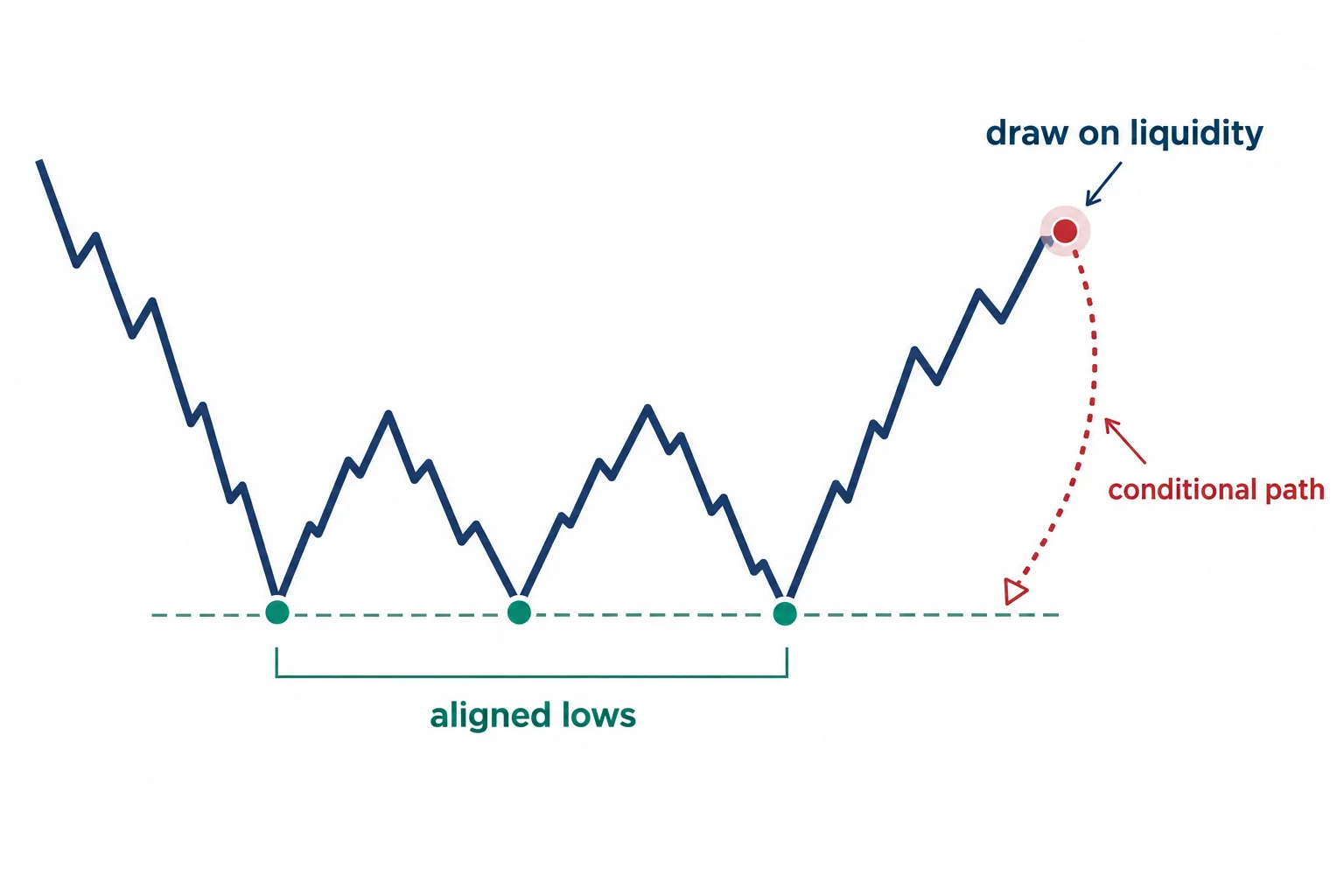
By 2:23 he observes that price looks as though it may run lower without first trading up into the inefficiency where his limit orders sit. He shifts to reading the levels below. Pointing at an area of aligned lows, he says he likes it because it is “a little too smooth,” describing how his eye goes straight to smooth stretches in price after years of looking for them, and calls the area a draw on liquidity (2:47, 2:54).
He is explicit that this is a conditional read rather than a prediction. He says price could go lower, that those are the levels he is watching for how the market might reach for a discount, and that price is currently at a premium where it looks as though he is not going to get the retrace he originally wanted (3:18, 3:27).
He then marks the inversion fair value gap (3:34) and notes in passing that an inversion is usually shown with an orange hue in his examples, saying that loosely because the colour is only a labelling convention (3:38). For the lower entry he says he wants to get in right above a previous down-close candle, then refines it to a little above the consequent encroachment of the inversion gap, and says he will decide the stop only once the second order fills, expecting it to be tighter than the earlier one (3:52, 4:00). If that second order also fails to fill, his stated fallback is the low of the same gap (4:27). He adds that he is trying not to be too demanding because it is a day with no news (4:34); which calendar, if any, he checked is not established by the recording.
ICT Premarket Short Fill and Stop Management
He reports the fill at 4:57 with “there we go,” adding that they are now “at the dance.” He places the stop up where the volume imbalance sits, just to the left of the pink inefficiency marker, and says he suspects the gap is now a breakaway gap while he keeps monitoring price (5:00, 5:11). He notes that the first partial may graduate lower depending on how price behaves (5:21).
What he describes next is the response he was looking for. He calls the situation an immediate rebalance, with an up-close candle trading into the bottom of the inversion fair value gap, and reports “immediate responsiveness lower” (5:32). He then lowers the stop to just above the inversion gap, reasoning that price should not return to the upper side of that gap now (5:51). He recolours the gap to yellow purely to draw attention to it as the trade develops (6:06).
At that point he makes a claim about the demonstration itself. He says the session is not using market replay, that he does not look at fake results to build an audience, and that the countdown to the candlestick close is visible on the right-hand price axis of a TradingView chart, so that it is market open, nothing is delayed, and these are live executions over live price action (6:16, 6:33). That is his assertion inside the recording. The transcript cannot authenticate the clock, the platform, the order routing or the fills, so it is reported here as the speaker's claim and not as verified fact.
ICT Premarket Short First Partial
Around 6:58 he says he is contemplating lowering the first partial. He identifies a swing low formed between 7:30 and 7:40 a.m. and describes it as sell side (7:06). He then annotates it explicitly as minor sell-side liquidity, taking care to distinguish it from the determinant of the move, and calls it the initial minor sell-side target while short (7:35). That distinction (an initial objective rather than the principal objective) is the point of the passage, and it is why the level he names next reads as an intermediate reference rather than a target for the whole position.
He ties the partial to the 15-minute inefficiency he had annotated before switching to a one-minute chart, describing it as the blue levels and citing 18,307 and 18,304.75 (8:02, 8:13). Those two numbers are reported as he spoke them; the automatic transcript cannot be checked against the chart, so they are quoted rather than used to reconstruct the setup. He adds that price traded down through roughly half of that 15-minute inefficiency and that the level sits in the 7:30 to 7:40 a.m. area (8:17).
He then does fee arithmetic out loud. He says that unless there were a crazy gap higher, risk would be removed and commission costs and fees would be covered, and he works with a figure of ten US dollars per contract, saying that is why what the transcript renders as “” covers ten contracts at ten dollars each and still leaves “basically a pizza dinner” even if he were stopped out (8:27, 8:46, 8:54). The distance figure is ambiguous in the automatic transcript and the ten-dollar figure is his own, so neither is presented here as a calculated cost, a per-contract rate, or evidence about the size he was trading.
After saying the order “should have really filled” him, he remarks that it must be random (9:09). The aside is noted rather than interpreted.
ICT Premarket Short Scale-Out and Open Outcome
After the first partial he says he wants to see price get “real heavy” because it is inside the 15-minute imbalance, notes that there is a gap in the blue on the one-minute chart so there is not much ground to stand on there, and says he is preparing to take partials off one contract at a time (9:18, 9:35). He names the lower blue line at 304.75 as the place to take one off, reports doing so, takes more, and says he now has three left, which he intends to let ride toward the lower target where price is “too smooth” (9:40, 9:58).
His assessment at that stage is positive: everything he was looking for is in motion and in striking distance, and he calls it “a real dandy of a trade” (10:11). He then annotates the chart playfully, saying he will put some lipstick on it and drawing a small smiley face while joking about a twist of the knife, and closes by saying the chart carries no graffiti, only the visual aids showing what he was looking for and why (10:26, 10:47).
The recording ends there (10:52). Nothing in it establishes what happened to the three contracts he was still holding, what the final result of the session was, or whether the sequence he narrates repeats. A narrated live execution is not a performance record: the transcript carries his statements about a fill, a stop adjustment and partials, but no account statement, order ticket, size figure or independently verifiable outcome. Short-horizon leveraged futures trading is also high risk and unsuitable for many people, and nothing here is a signal or a recommendation to place a trade.
Any ICT, SMC or third-party indicator, script, transcript, note set, spreadsheet or social summary circulating outside the publishing channel’s own upload page is unofficial and untested here. The 15-minute SIBI, the discount fair value gap, the inversion fair value gap, the breakaway-gap reading, the consequent-encroachment midpoint, the volume imbalance, the “draw on liquidity” and the minor sell-side liquidity label are all the speaker’s own framework and terminology. No performance test, win rate, drawdown figure or account result is claimed anywhere in this article.
Watch the original recording on YouTube
The video cannot be played inside another website. When its embedded player was loaded from a bestprops.com page origin and clicked on 14 September 2026, the player itself reported “Playback on other websites has been disabled by the video owner” and settled on a “Watch on YouTube” prompt, with no duration and no playback progress reported. That is why this article carries a watch card instead of an embed. The recording runs about eleven minutes and is available at the link below, where every timestamp reference above can be checked.
Watch NQ May 13, 2024 Premarket Short Live Execution on YouTube ↗
ICT Premarket Short Source and Further Reading
These references support specific points above. None of them is an ICT publication, none endorses or tests the approach described, and none is offered as evidence for the session’s reasoning or its outcome.
How Live Execution Differs From a Performance Record
A live commentary is not a performance record, and it is worth knowing how regulators describe that distinction. 17 CFR 4.41 sets out the statement that advertising of simulated or hypothetical performance must carry, including the observation that simulated or hypothetical trading is designed with the benefit of hindsight and may have under- or over-compensated for market factors such as lack of liquidity.[4] That rule governs advertising and sales literature, so it is cited here only for its plain description of hindsight bias; this article is not advertising and makes no performance claim about the session.
Why ICT Fee Arithmetic Is Quoted Not Calculated
The SEC’s investor education pages describe day trading as “extremely risky” and note that it can result in substantial financial losses in a very short period of time, and the CFTC’s fraud-center material advises readers to be suspicious of any message promising guaranteed oversized returns.[3][2] Both are the reason the commission figure the speaker states is reported as his own number, with no cost model derived from it and no return implied.
Why This Live Execution Uses a Watch Card
The embedded player for this recording was loaded from a bestprops.com page origin on 14 September 2026 and clicked; instead of playback, the player itself reported “Playback on other websites has been disabled by the video owner” and offered only a “Watch on YouTube” prompt, with no duration and no playback progress. YouTube’s own documentation explains that an uploader can turn embedding off for a video so that it plays only on YouTube, which is the behaviour observed here, so a visible watch card is used in place of an embed.[5] No claim is made about why the setting is as it is.
ICT Execution Method and Limits
This article is grounded in the full timestamped transcript of the mapped upload.[1] The transcript was produced by local automatic speech recognition of the complete original audio and is not human-reviewed captions; the recording's charts, order ticket and on-screen clock were not examined by this review. Automatic transcription renders several of the speaker's terms and numbers inconsistently (the midpoint vocabulary, the “consequent encouragement” phrase, the “320 level” and the distance figure behind the fee remark), and each ambiguous passage above is described in words the surrounding discussion supports rather than silently corrected. Reported entries, a reported stop adjustment and reported partials are the speaker's statements about his own actions; no account size, position size, fill price or net result is asserted anywhere on this page, and no outcome is claimed for the session.
ICT Premarket Short Sources
- [1] Primary source: NQ May 13, 2024 Premarket Short Live Execution (The Inner Circle Trader) The passages each timestamp link above points into.
- [2] CFTC: Customer Advisories and Articles
- [3] Investor.gov (U.S. Securities and Exchange Commission): Day Trading
- [4] eCFR: 17 CFR 4.41 (Advertising by commodity pool operators, commodity trading advisors, and the principals thereof)
- [5] YouTube Help: Embed videos & playlists (turn off embedding for your videos)
Futures and leveraged trading involves substantial risk and is not suitable for everyone. This article is educational commentary on one recording: it describes how the speaker says he reasoned about and managed a short, does not verify his fills or results, and is not investment advice.