
Key takeaways
ICT’s NQ Live Execution and Commentary Final Trading Day of 2023, published 29 December 2023 and lasting 1 hour 32 minutes 29 seconds, shows a claimed live one-minute Nasdaq futures feed paired with simulated execution in a $100,000 paper account.
Read the full summary
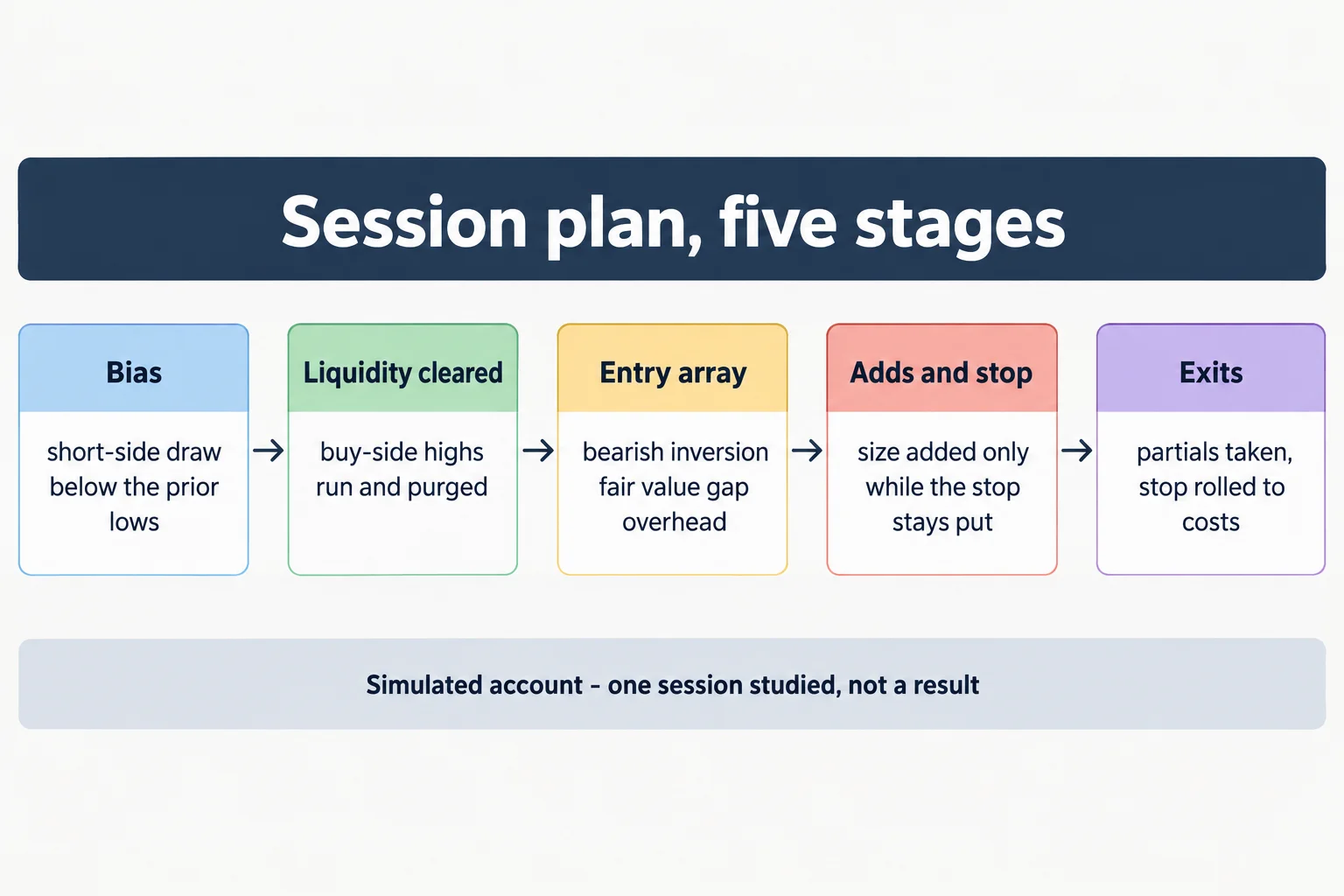
ICT’s NQ Live Execution and Commentary Final Trading Day of 2023, published 29 December 2023 and lasting 1 hour 32 minutes 29 seconds, shows a claimed live one-minute Nasdaq futures feed paired with simulated execution in a $100,000 paper account. ICT builds a short thesis after repeated runs above prior highs purge buy-side liquidity, targets sell-side below an older low in the ambiguous 17,000 area, and treats a bearish inversion fair value gap and its midpoint as resistance while accepting a small overshoot. He declines to chase a missed volume-imbalance entry, later adds 5 contracts without moving the stop, reports 12 and then 13 contracts, and estimates stop risk at roughly $2,000 or 2% with invalidation above the day’s initial high. His staged plan removes 3 contracts near the older low for about 26.25 handles each, rolls the stop to cover costs, reduces 6 more below the old low, and later leaves 2 runners after banking most exposure. He warns that year-end sessions can break familiar rules, frames ten thirty New York time as an untested time-distortion hypothesis, and recommends fixed invalidation, paper practice, case-by-case journaling, acceptance of missed entries and losses, and avoiding heavy leverage. The article does not authenticate the live feed, prices, fills, balance, performance claims, or alleged third-party results and stresses that the account and execution were simulated rather than independently verified.
How we researched this article
BestProps used document-based research from primary firm sources, checked September 24, 2026. The complete source list, scope, limitations, and commercial-state record appear near the end of this article.
ICT Live Feed and Simulated Execution
At 0:03 he says he is watching a recent high and intends to go short, and immediately identifies the account as a paper-trading account. He explains the reason himself at 0:09 and again from 0:17: he is not a licensed trade adviser in the United States, so he teaches through a demo account. Later, at 6:39, he adds that the same account is being used to teach his son.
The market feed is presented as genuinely live. From 0:34 he points out that he is not running market replay, that he is recording the whole screen, and that the chart is a one-minute chart. From 0:47 he reads out the platform clock moving through 9:56 and 9:57 with a countdown to candle close, and argues that market replay separates the time axis and window border and removes the green ball he can see. Those are his on-screen observations; the captions cannot authenticate the platform state, and this article does not. The recording was published on the channel on 29 December 2023 with a stated duration of 1:32:29, and the watch page reported it as public and playable at the time of this review.
He also spends several minutes answering viewers who alleged the screen was edited. At 5:01 he says he was asked to show the full screen and treats the allegation as a compliment to his supposed ability to manipulate a live platform. That passage is a response to criticism, not evidence about the chart.
ICT Trade Commentary on the Bearish Thesis
At 1:33 he names a downside objective in the 17,000 area, and at 1:43 he says a large pool of sell-side liquidity is resting below it. The auto-generated captions render that same objective as “177,000” at 51:31 and 1:00:05, so the exact figure is treated as ambiguous here rather than stated as a level.
His reading of the preceding price action is that repeated small runs above prior highs had cleared the stops resting there. From 1:52 he describes the market “taking highs, highs, highs”, and at 2:04 he walks through a specific sequence: buy-side resting under one high, that high cleared, shorts trapped and stopped out, then a further high taken “for good measure”. His conclusion, stated at 2:30, is that a lot of buy-side had been taken out and purged, so the next draw is the sell-side liquidity below a low he marks at 2:38.
He extends that logic later. From 17:00 he argues the smooth relative-equal highs had been made jagged, calls the resulting upside “suspect rallies” that are knocking out traders trying to establish shorts, and says that if he were stopped out he would re-enter with half the position rather than force his will on the market. At 28:22 he argues a purged liquidity pool should be extended forward because it gets reused, the way a fair value gap does, and at 30:59 he explains this as the market repeatedly referring back to one reference high because the algorithm has no knowledge of how many contracts rest above it. That is his algorithmic interpretation, offered from this one session; it is not a measured result.
ICT Trade Entry and Execution
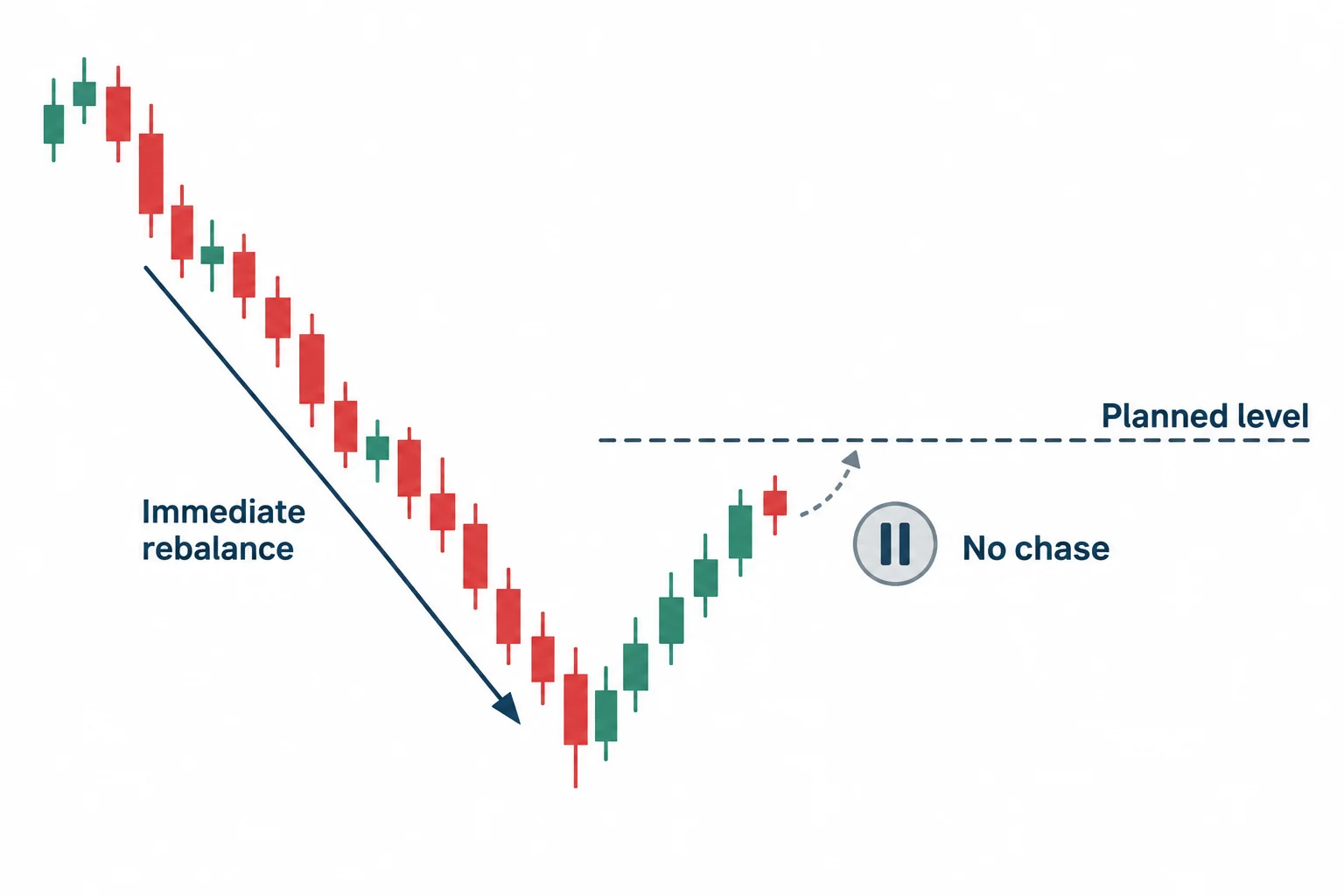
At 3:02 he describes the level he wanted price to trade up into, calling it both an immediate rebalance and a volume imbalance, and says plainly that he is willing to miss the entire opportunity rather than chase it. He enters with on-screen hot buttons, which he notes is another thing market replay cannot do (3:16).
The retracement fell just short of his level. From 4:00 he notes it did not quite reach the low, then acknowledges at 4:16 that he was “a little too overzealous” trying to get that volume-imbalance entry, while still calling the move a perfect immediate rebalance. The useful part for a student is not the vocabulary: a pre-defined entry can go unfilled, and declining to chase is itself a decision that can be reviewed afterwards.
ICT Trade Commentary on Fair Value Gap Resistance
At 4:26 he says the market is trading into an inversion fair value gap, and from 4:31 he explains that orange rectangles on his charts always denote that structure, that “negative” means bearish, and that he expects it to act as real resistance rather than retail resistance. From 5:57 he says he wants price to trade up into the consequent encroachment (the midpoint of the gap) and to be rejected there.
He also allows for a small overshoot. At 6:08 he calls that a “Mohawk”, colouring outside the lines, and says it would not by itself invalidate the idea. He returns to the same tolerance at 9:44, just before adding to the position, and again at 17:48 and 1:02:03, where he says he would prefer a small bump above the area followed by a sell-off.
ICT Trade Execution With Stops and Staged Exits
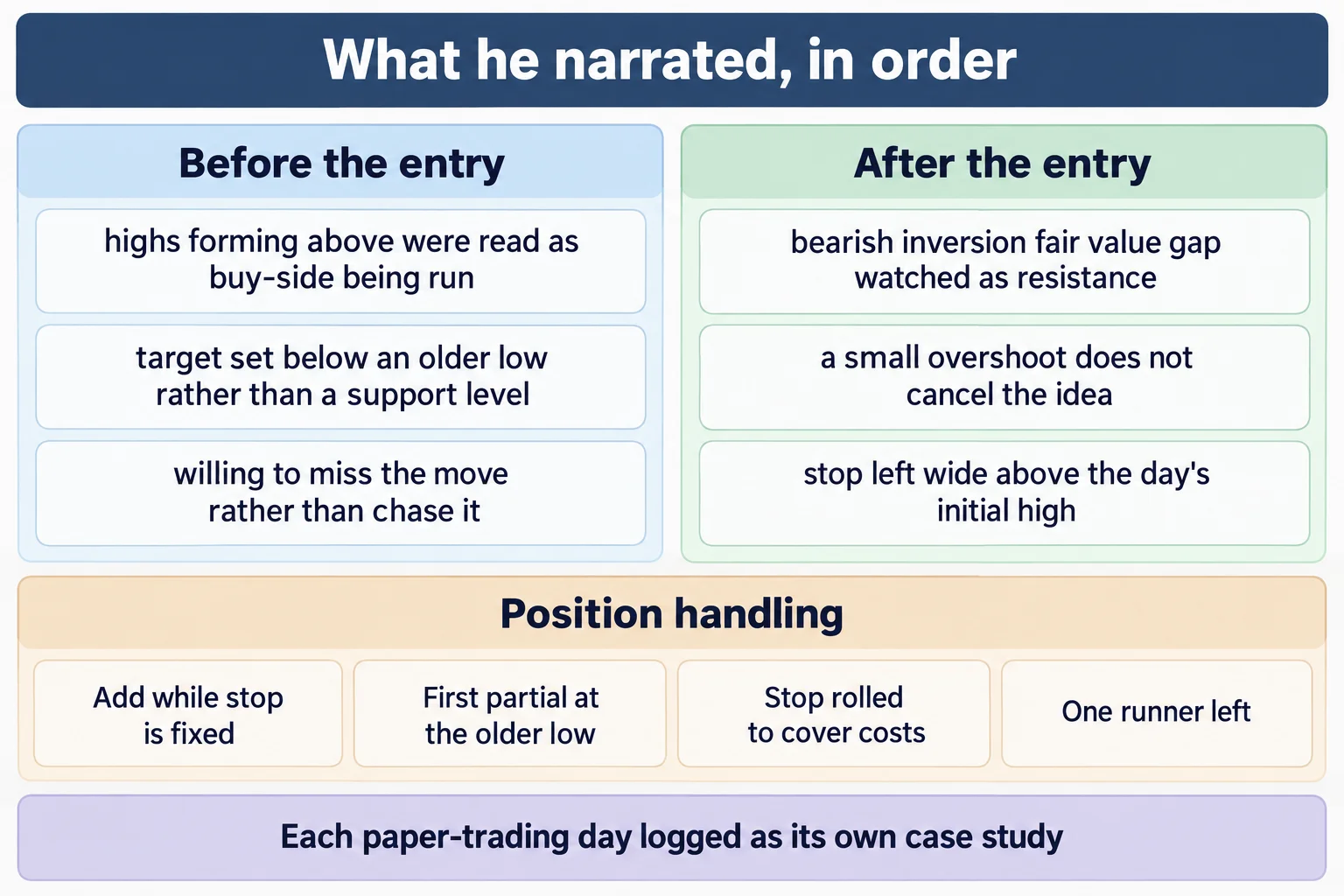
Position figures appear throughout the recording, all of them narrator-reported. At 9:51 he says he is adding five more contracts and that the stop has to stay where it is, then at 10:02 he reports that a stop-out at that point would be roughly 2% of the displayed $100,000 paper account, which he restates as about $2,000 at 10:14. At 17:27 he says he is holding 12 contracts, and at 21:22, 13 contracts.
The exit plan is stated before it is described as happening. At 21:22 he says he will take three contracts off at the initial low and estimates that partial as “26 and a quarter or so handles” on three contracts at 21:41; at 21:49 he says that once the low is taken and the partial books, the stop rolls down to cover costs. Later he reports the sequence as it unfolds: a first partial at 37:41 and again at 38:16, a rolled stop that covers costs at 38:19, six more contracts reduced below the old low at 38:30, and finally two contracts remaining at 46:09.
He is explicit that the numbers are not the lesson. From 45:48 he asks whether he is worried about being stopped out and answers that most of the position has already been banked. The transferable part of the sequence is structural: a stated invalidation above the day’s initial high, size added only while that stop stayed put, exits staged at a pre-defined level, and exposure reduced as the move developed. Those are described decisions; the fills, the balance and the outcome are not independently verifiable from a caption track.
ICT Commentary on the Final 2023 Session
Two warnings frame the session. From 13:58 he says the last few trading days of any year break the rules traders are used to, which is why he kept the stop above the day’s initial high, and at 22:05 he says explicitly that viewers should not treat the recording as an enticement to trade the final session of the year.
The time claim comes later. At 47:56 he says the market consolidated in what he calls time distortion, then at 48:27 links that to a measure of time he says must elapse after 60 minutes (the 9:30 opening bell plus one hour, which he gives as 10:30 New York local time, where he says the market started to “spool”). This is his interpretation of one session. A reader studying it as an idea would need an objective definition of the setup and a sample of independent sessions that includes the failures; nothing in this recording establishes it as a rule.
ICT Trade Practice Risk and Journaling
The most directly transferable material comes after the trade discussion. At 7:51 he states the underlying rationale for the demo account bluntly: if it cannot be done on paper, it will not be done with a live account, and at 14:36 he frames the session as teaching the management of risk rather than a setup. From 1:16:17 he recommends treating each paper-trading day as an individual case study. Log what you anticipated, compare it with what occurred, and ask whether the result at least warrants continued study. At 1:19:20 he says plainly that this does not guarantee profits, that losing trades will happen, and that viewers have watched him get stopped out and reverse an initial expectation. At 1:23:50 he adds journaling to that discipline, and at 1:24:49 warns that heavy leverage burns accounts.
Those statements sit alongside promotional material that the recording does not substantiate. He reports, without supporting records, a prior live account that he says went to roughly 30% drawdown and then returned over 100% trading one contract (8:38); he criticises vendors who advertise unrealistic returns (10:48) and asserts that his students have produced third-party confirmed results (13:24); he describes a prop-firm competition he wants critics to enter, characterising it as third-party audited and CFTC regulated (58:17); and he asserts he no longer needs to trade (1:29:23). These are his claims, some of them about his own commercial position and disputes with other educators, and none of them can be established from captions. They are reported here so a reader can separate them from the trading instruction, not repeated as fact.
ICT Live Trade Takeaways
- Separate the live market feed from the execution venue: a live chart does not make a simulated fill real.
- Write the invalidation level before adding size, and keep it fixed while the position is built.
- Decide in advance that a missed entry is an acceptable outcome, then review whether you honoured that.
- Stage exits and reduce exposure as a move develops rather than holding full size into the target.
- Treat a narrative rule such as a specific clock time as a hypothesis to test across many sessions, including the failures.
- Log losing trades and reversed expectations as carefully as the favourable ones.
ICT Live Trade Primary Source
The timestamp links above point at the passages being described, and the recording itself is the only source for the chart detail behind his annotations. Watching the marked passages is the way to compare his spoken explanation with what the screen actually showed.
ICT Live Trade Resources
These are the sources checked for this article. The CFTC and Investor.gov material is regulator background on how simulated and hypothetical trading results must be presented and on the risk of leveraged futures and systems sold online. None of it is an assessment of ICT, of this recording or of anything said in it.
- [1] NQ Live Execution & Commentary \ Final Trading Day Of 2023 – The Inner Circle Trader (primary source; watch page read 15 September 2026, 1H32M29S)
- [2] 17 CFR 4.41 – Advertising by commodity pool operators, commodity trading advisors and their principals (the rule on presenting simulated or hypothetical performance; read 15 September 2026)
- [3] CFTC – Commodity trading systems sold on the internet (fraud advisory describing how hypothetical results are presented; read 15 September 2026)
- [4] Investor.gov – Futures glossary (regulator description of futures contracts and leverage; read 15 September 2026)
This is independent educational commentary on one recorded session. It is not official ICT material, it is not a tested trading system, and it is not investment advice. The recording is a simulated account: contract counts, handle figures, account balance and outcomes are the speaker’s own statements and are not verified here. Leveraged futures trading involves substantial risk and is not suitable for everyone.