
Key takeaways
The Inner Circle Trader’s public YouTube upload is a 16 minutes 17 seconds transcript-based live analysis of a bearish NQ Nasdaq Turtle Soup setup published June 24, 2024, not a verified performance record.
Read the full summary
The Inner Circle Trader’s public YouTube upload is a 16 minutes 17 seconds transcript-based live analysis of a bearish NQ Nasdaq Turtle Soup setup published June 24, 2024, not a verified performance record. The speaker seeks a short while price remains below a midpoint, targets a low formed just after 8 a.m. and a farther intermediate-term swing objective, places the stop at the high, and considers adding if price sweeps into the last large up-close candle he labels a rejection block. He treats a broken support area as a premium array expected to become resistance and wants a buy-side imbalance and sell-side inefficiency to morph into an inversion fair value gap divided into the upper quadrant, consequent encroachment at the midpoint, and lower quadrant. Price may reach the upper quadrant but should not close above it, then should accelerate lower through minor sell-side liquidity with large down-close candles rather than return into the gap. A newer student might take a partial below the nearer low, while he says he will hold for the longer-term target and place a limit slightly above it for a cleaner exit. Turtle Soup is illustrated as price probing above a high, failing to hold, and rotating toward sell-side liquidity, but the full rule set is deferred to a later lecture. The recording ends without confirming any fills, position size, entry or stop prices, account balance, limit execution, net result, contract month, or final outcome, and its spoken numeric levels cannot be validated because no price scale was reviewed. He also warns that he is not on Instagram and does not offer a paid mentorship, while the article treats that as an unverified warning rather than a finding.
How we researched this article
BestProps used document-based research from primary firm sources, checked September 24, 2026. The complete source list, scope, limitations, and commercial-state record appear near the end of this article.
June 24, 2024 NQ Turtle Soup Short is a public first-party upload on the YouTube channel The Inner Circle Trader. The watch page reports a publish and upload time of 2024-06-24T06:41:24-07:00 and a runtime of 977 seconds, or 16 minutes 17 seconds, which matches the length of the audio that was transcribed. The title dates the upload; the recording itself never states a date, and it opens with a good-morning greeting rather than a session label. This is transcript-based educational commentary on the recording, not an ICT publication and not a record of verified results.
ICT Turtle Soup Session Open
He begins with a short personal note, saying he has been unwell and that he believes it relates to blood sugar, with some vision and dizziness issues, before turning to the chart (0:01). That is context for the delivery, not trading content, and nothing in the session depends on it.
On the market, his stated bias is simply that he likes the idea of the Nasdaq trading down for a while (0:32). He points to what he calls the buy side looking safe, notes a sell-side imbalance, and sets one clear condition: he wants to see price stay below the midpoint (0:45). He then says he is willing to take a short and aim for a low formed just after eight o’clock in the morning, and mentions an 8:30 a.m. Eastern reference point for the same area (0:55).
ICT Short Targets and Stop Placement
He separates his first target from a larger one. He calls the nearer level the initial draw, says he expects price to reach it but would like to see it go lower, and names an intermediate-term swing objective (1:45). He says he will sell short there and put the stop loss at the high (1:48).
Both objectives are voiced rather than written. The nearer one is described as a low formed after eight o’clock, and the intermediate one is spoken as a number the automatic transcription renders as a three-digit figure. Because the transcript gives no instrument, no contract month and no price scale, this article deliberately does not reproduce that number as a tradeable level; the session is a narration of chart references, and the same digits cannot be checked against a scale that was never read.
He also says he does not think the midpoint of one of the gaps under discussion will be a factor for this particular trade. The transcription renders that term as “consequent encouragement”, and the surrounding discussion supports consequent encroachment, which he defines later in the session as the midpoint (2:01).
ICT Turtle Soup Rejection Block and Adding
His next reference is described as a rejection block. He says he is watching the last up-close candle (the big bold green one) as it closes, and that if price can stab one more time up into it he will add, framing the addition as a way to prove the method and the concept rather than as a discretionary extra (2:30). He expects a decline from around that point and describes adding into the area, noting that price might not even reach the rejection block (2:52).
He then explains why he is comfortable with these zones being crossed. He says volume imbalance is the weakest of what he calls his PD arrays in terms of flexibility, and that he is entirely comfortable letting price go through one and then come back to it, either as a target or as a way of managing a stop loss (3:22). The remark that follows (that these levels always “get it where I want it” and it is never where he wants it) is delivered as an aside about how price behaves around them (3:55).
He returns to the same large up-close candle and says that if price sweeps into it before rolling over, he will take that as an additional short entry, and he notes again that the stop looks safe at that point (4:15). He describes wanting price to turn immediately and, if the area really is a rejection block, to fall away from it and gravitate toward the low he identified earlier (4:59).
ICT Short Resistance Zone
When price trades away from the zone, he reclassifies it. He says it now becomes a premium array, and that if price returns into it the zone should act as resistance because, as he puts it, the narrative is now in play (5:29). He acknowledges the reading out loud when price behaves as he described, calling it almost like voodoo (5:40).
That shift (the same area treated as a support-then-support-break structure and then as resistance) is the mechanism he is teaching here, and it is stated as his interpretation of the chart rather than as a tested rule. Nothing in the recording measures how often it holds.
ICT Turtle Soup Inversion Gap and Internal Levels
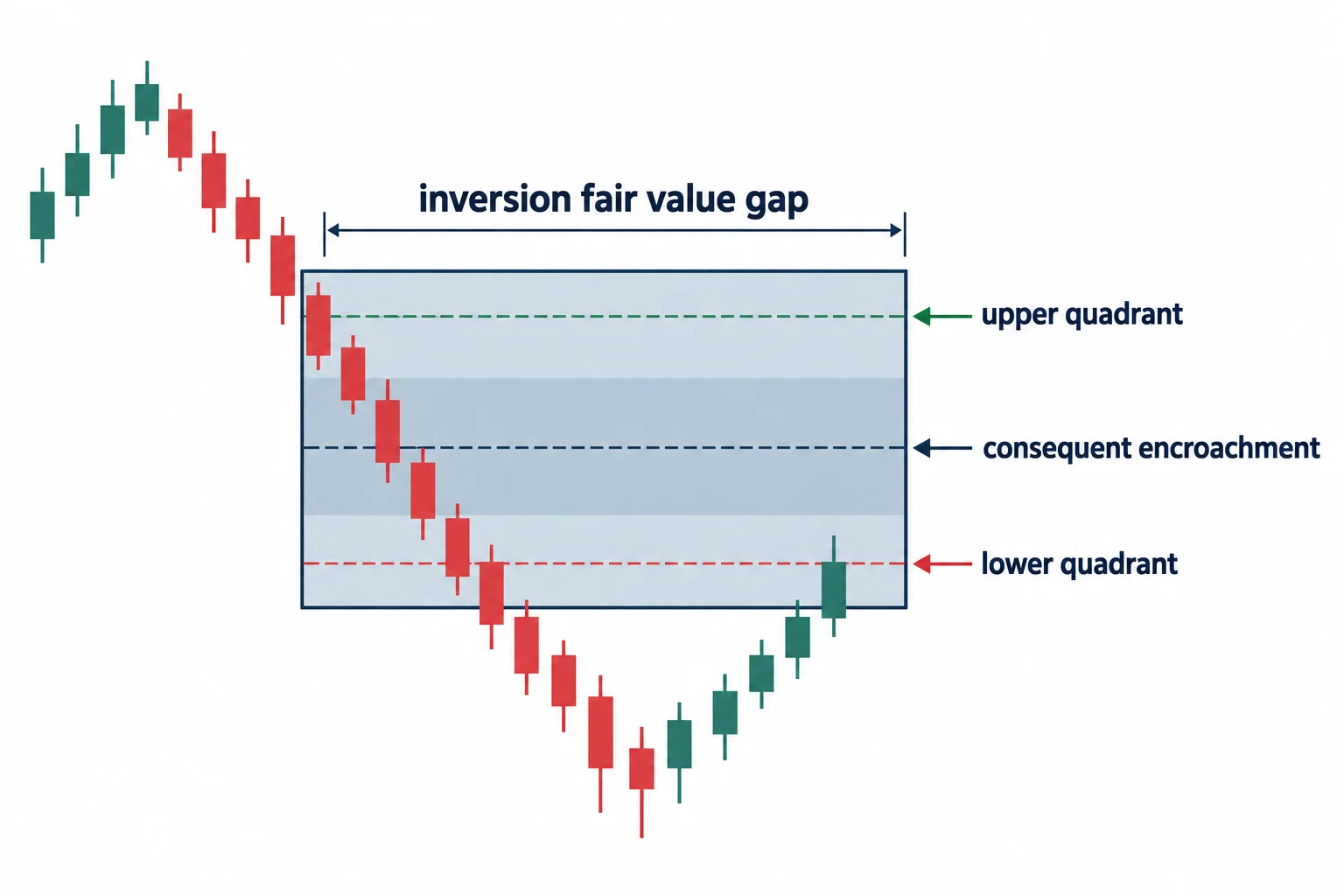
The central teaching passage starts when he identifies what the transcript renders as a buy-side imbalance and sell-side inefficiency just to the left of current price, and says he wants that area to morph into an inversion fair value gap (5:47). He explains why the label matters: traders who treat such a zone as a liquidity void to be traded back down into and then bought will look at it as a reason to go long and, in his words, lose their shirt there (6:56). This article is not endorsing either reading; it is recording that he distinguishes them and that the distinction carries a directional implication.
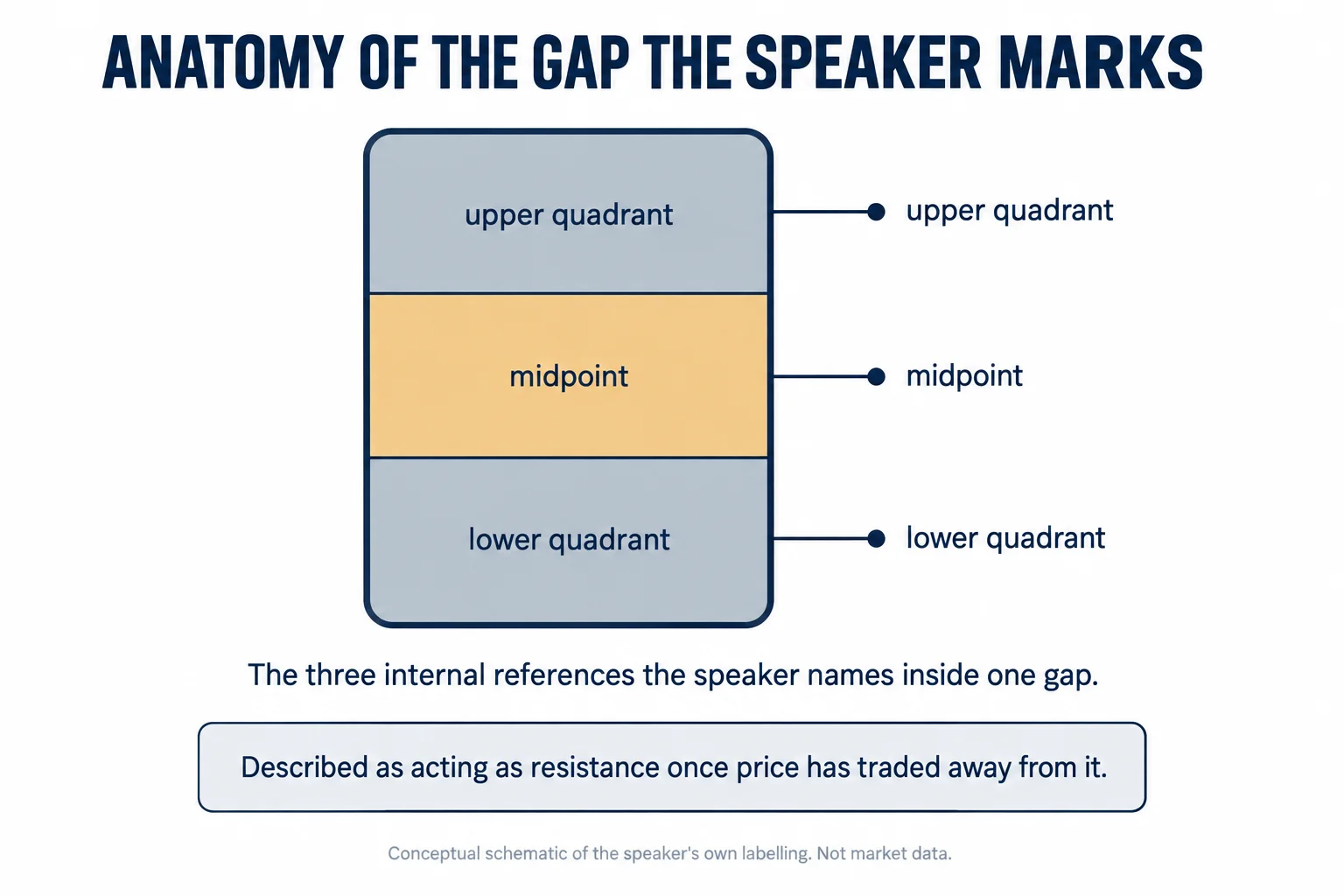
He says inversion fair value gaps are normally annotated in his teaching examples as an orange-hued rectangle and that he wants gradients inside them, then divides the gap into three parts: the upper quadrant, consequent encroachment which he states is the midpoint, and the lower quadrant including its low (7:28). He walks through the high and low of successive candles to define the zone and shows a Fibonacci tool configured to produce those internal levels, telling viewers to screenshot the settings (7:46).
His stated expectation is that price may shoot up into the gap, possibly reaching the upper quadrant, but that he does not want to see a candle close above it, and that contact with the upper quadrant should be sufficient (8:15). He then looks for the algorithm to begin spooling lower (8:33).
Two asides belong with this segment because they are part of the recording. He distinguishes the internal levels from what he calls quarters theory, saying it is a joke and a gimmick and asking viewers to stop asking him about it in the comments, and he claims the technique is not taught outside his own material (“you’ll never see anyone teaching this outside of me and my lectures”, 8:01). He also refers to a named third party as not teaching it and to another named author’s version of turtle soup. The automatic transcription renders both names loosely, so this article records the comparison without repeating either name as fact.
ICT Short Liquidity Targets and Profit Taking
He identifies a short-term low around what the transcript renders as “820” as minor sell-side liquidity, and says he does not expect the gap above it to act as an inversion fair value gap. He would rather see price melt straight through (8:38). He then makes a distinction that is genuinely useful to a reader: he says a new and developing student would be extremely insecure at this point and would look to take a partial under that low, whereas he has been around the block a few times and intends to hold for the target below, because he has a longer-term objective he is reaching for (9:02). That is a statement about his own risk appetite and holding period, not evidence that holding is superior to taking a partial.
He is specific about the confirmation he wants: if the algorithm wants to go lower, price should run down through the level and accelerate rather than briefly poke at it and return into the inversion fair value gap (9:42). He asks for large down-close candles and expansion lower, saying that would confirm to him that a farther level is reachable, and mentions placing a limit order a little below it (10:02). As with the earlier objective, the number is spoken and cannot be checked against a price scale that the transcript does not provide.
ICT June Video Comments Screens and Impersonation Warning
In the middle of the session he pauses to address viewers. He says the comment section is open but that it is open for him to read, that he blocks anyone who asks why there are no comments, and that those individuals are usually not subscribed (10:57). He also says he does not play the market-replay game, telling a viewer who asked him to move a screen element that he is hiding nothing and that the visible clock is New York time, with a countdown to the candle close that replay cannot show (11:33). Those are his own assertions about his setup; the transcript cannot verify a clock, a countdown or a platform mode, and this review did not attempt to.
He adds an explicit warning about impersonation: he says there are scammers on Instagram, that one account with a large following pretends to be him, and that he is not on Instagram and is not running a paid mentorship (13:30). Because that is a claim about other accounts which this review cannot check, the article reports it as his warning rather than as a finding, and the reference section below points to the regulator material on imposter fraud.
He returns to the chart, saying price is going up into the most recent down-close candle and that he wants to see it stay inside that range and not take out the candle’s open, focusing on heaviness and on price failing to overcome the previous candle’s body, ideally not even returning to its wick (12:08). He notes a small fair value gap that price has traded up into, and says with that in place he wants to see a fast, aggressive drop toward the initial draw on liquidity after 8:30 a.m. Eastern (12:55).
Why ICT Calls It Turtle Soup
He asks viewers to think back to what he was walking through while price was trading up at the highs, and says that is actually turtle soup, adding that he will be teaching it in an upcoming lecture (13:52). He follows that with a pointed remark about people scrambling to make a name on what he calls borrowed hand-me-down logic from him (14:19), and with a self-aware aside about preparing for “another random act of precision” and a joke that this guy gets lucky all the time (14:36).
As a definition, the term is used here for the sequence he was narrating near the highs: price probing above a high, failing to sustain it, and rotating toward sell-side liquidity. He explicitly defers the full lecture, so this recording is an example of his usage rather than a standalone rule set, and it should not be generalised to every high.
ICT Short Final Target and Unanswered Outcome
Once price starts moving his way, he says he will finally show what he is really aiming for, and that he might not get it, but that because he has done fairly well by that point it does not matter if he is right on this (15:37). He restates the intermediate objective, says that to get a clean exit without babysitting the position all day or into the next day he will place the limit slightly above it, and ends by saying lectures are coming and to be patient (15:51).
The clip stops there. It does not show whether the limit was filled, what the position size was, what prices the entries and stop were at, or how the session finished, and the narration never states an account balance or a net figure. The “done fairly well” remark is his own characterisation of the run at that moment, not a measured result, and this article does not treat it as one. What can be said is that the recording demonstrates his process for building a directional idea out of chart references, and that a process narrated live, without statements, fills or an outcome, is not a performance record.
Watch the June 2024 NQ Turtle Soup Short
The recording mapped to this article is June 24, 2024 NQ Turtle Soup Short, a public upload on the channel The Inner Circle Trader, published 2024-06-24T06:41:24-07:00, 977 seconds long. Every timestamp link above points into that recording. The transcript used for this guide was produced by local automatic speech recognition of the complete original audio rather than from YouTube captions, and it renders several numeric levels and two third-party names loosely, which is why none of those values or names is repeated here as fact. No chart, order panel or on-screen clock in the recording was examined by this review.
ICT Turtle Soup Sources and Provenance
These references support specific points in the guide above. None of them is an ICT publication, none endorses or tests the approach, and none is offered as evidence for the session’s reasoning or its outcome.
ICT Guidance on Simulated and Narrated Results
A live commentary is not a performance record, and it is worth knowing how regulators describe that distinction. 17 CFR 4.41 sets out the statement that advertising of simulated or hypothetical performance must carry, including the observation that simulated trading is designed with the benefit of hindsight and may have under- or over-compensated for market factors such as lack of liquidity.[1] That rule governs advertising and sales literature, so it is cited here only for its plain description of hindsight bias; this article is not advertising and makes no performance claim about the session.
ICT Imposter Accounts and the Speaker's Warning
The recording contains a warning that accounts on another platform impersonate the speaker. The U.S. Commodity Futures Trading Commission describes imposter fraud as scammers impersonating “government officials, law enforcement officers, billionaires, or celebrities in order to steal money from unsuspecting victims”, and notes that to build credibility imposters use “fake social media profiles” and “fake trading records, websites, and financial documents”.[2] The CFTC’s guidance also advises checking whether an entity or individual is registered and only trading markets and products you fully understand. This article reports the speaker’s warning as his own statement; this review cannot verify which accounts exist, and the regulator pages below are the place to check an entity rather than any page here.
How to Verify People and Firms Linked to ICT
Because the session discusses a futures market and refers to a broker relationship in other videos, the ordinary due-diligence route is the relevant one for a reader. The National Futures Association publishes BASIC, described as “a free tool that NFA Members and investors can use to research the background of derivatives industry professionals”, with a route onward to FINRA’s BrokerCheck for securities licences.[3] Nothing on this page asserts that any person or firm mentioned in the recording is or is not registered.
Why This ICT Video Uses a Working Player
The embedded player for this recording was loaded from a bestprops.com page origin on 14 September 2026, clicked, and confirmed to be playing: the player element reported a duration matching the 977-second upload and an advancing playhead. Because the authored and saved embed actually plays, a player is used rather than a watch card. Where a recording returns “Playback on other websites has been disabled by the video owner”, a watch card is substituted instead.[4]
ICT Source Method and Limits
This article is grounded in the full timestamped transcript of the mapped upload. The transcript was produced by local automatic speech recognition of the complete original audio and is not human-reviewed captions; the recording’s charts, order ticket and on-screen clock were not examined by this review. Automatic transcription renders several of the speaker’s terms and numbers inconsistently (the midpoint vocabulary, the three-digit price levels and two third-party names), and each ambiguous passage above is described in the words the surrounding discussion supports rather than silently corrected. No account size, position size, entry, stop or fill price is asserted anywhere on this page, the additions discussed are reported as the speaker’s stated intentions at the time, and no outcome is claimed for the session.
ICT Sources
- [1] eCFR: 17 CFR 4.41 (Advertising by commodity pool operators, commodity trading advisors, and the principals thereof)
- [2] CFTC: Imposter Frauds (Learn & Protect fraud center)
- [3] National Futures Association: BASIC (background research tool for derivatives industry professionals)
- [4] YouTube Help: Embed videos & playlists (turn off embedding for your videos)
- Primary source: June 24, 2024 NQ Turtle Soup Short (The Inner Circle Trader)