
Key takeaways
ICT’s 39 minutes 35 seconds YouTube lesson follows a self-reported NQ short during the 7 to 9 a.m.
Read the full summary
ICT’s 39 minutes 35 seconds YouTube lesson follows a self-reported NQ short during the 7 to 9 a.m. Eastern premarket window on August 25, 2026, using New York opening gaps, new-week opening gaps, consequent encroachment, fair value gaps and external sell-side liquidity to explain consolidation trading. He reports starting with six contracts, moving the stop above a referenced imbalance and later above consequent encroachment, taking a partial and locking in $5,640 before commissions, then reducing exposure and cancelling the final buy limit, although the transcript’s contract counts are internally inconsistent and no chart, prices, tickets or fills are available for verification. His three-stage fair value gap model treats a down-close candle’s gap as bearish, reclassifies it as an inversion fair value gap when price trades above and finds support, and restores the bearish role after price penetrates the zone without bouncing from its upper half, closes below its low and then closes below the creating candle’s high. The strongest bearish response leaves the gap without returning, the second best retests its low and sells off, while a midpoint wick with the body remaining in the lower half is acceptable but weaker. ICT expected a boxy session because London had already trended and cited Jackson Hole week, late August and summer doldrums as reasons to remain nimble, use selective exits and wait for reaction plus breakdown rather than shorting the first gap retest. The review process is to fix the session window, define the range, distinguish the New York opening gap from the new-week opening gap, wait for expansion toward external liquidity and journal the conditional confirmation and invalidation plan. All performance figures and tape interpretations are ICT’s unaudited account, and one leveraged futures session does not establish repeatability.
How we researched this article
BestProps used document-based research from primary firm sources, checked September 25, 2026. The complete source list, scope, limitations, and commercial-state record appear near the end of this article.
In PreMarketSession NQ Consolidation August 25, 2026, ICT narrates a live NQ short through the 7:00–9:00 a.m. Eastern pre-market window and uses the position to explain how he reads opening gaps, fair value gaps and session type. The recording is dated 2026-08-25 in its own title and publish metadata, and that metadata shows a publish time of 06:35 Pacific (09:35 Eastern), the same morning, minutes after the window it covers closes. He places the session in the last part of August, during the Jackson Hole Symposium week (22:55).
Two limits apply throughout. The captions are machine-generated, they mangle several of his terms, and they contain no chart, so the annotations he points at, the price levels behind them, any order tickets and any fills cannot be reconstructed from the transcript. Every reported action and reported figure below is his own account of his own session, not an audited record.
Educational review only. Futures trading carries a substantial risk of loss, and one recorded session cannot establish that any of these readings will work again.
ICT Premarket Short Setup and Consolidation Invalidation
ICT opens by saying he is attempting a short because price traded above what he calls the New York opening gap and then failed to hold there. He describes a six-contract position with the stop placed just above a referenced imbalance (0:01), and states his objective as a run down into a prior low where he expects sell-side liquidity (0:26).
He then separates two gaps that are easy to confuse. The retracement candle he is watching sits at the low of the New York opening gap and is anchored to the upper quadrant of a daily buy-side imbalance / sell-side inefficiency (1:09). He also marks the regular-session opening range gap and notes that the 9:30 Eastern open is about an hour and six minutes away (1:43), which places the start of the recording at roughly 8:23 a.m. Eastern. The new-week opening gap he treats separately: he says a prior high had been taken and rejected, and that the new-week gap could not support price at either its high or its upper half, with price closing below it (3:00).
The levels he uses to manage the trade are defined out loud rather than left implicit. He marks the high of the 7:00–:00 window (3:35), identifies a consequent encroachment taken from that wick plus a small volume imbalance sitting inside the new-week opening gap (4:01), and then lowers his stop to just above that consequent encroachment (4:26). Later he states the trade’s purpose plainly as liquidity outside the range below, and names a close above a nearby reference as the event that would end his interest in the position (20:38, 20:57).
He also narrates two aggressive moves he attributes to other participants rather than to his model: price stretching below the new-week opening gap low, which he calls a “dog squeeze” (5:29), and a reversal he reads as manual intervention rather than algorithmic flow (6:41). Those are his interpretations of the tape, not observable facts the captions can settle.
How Fair Value Gaps Shift Roles
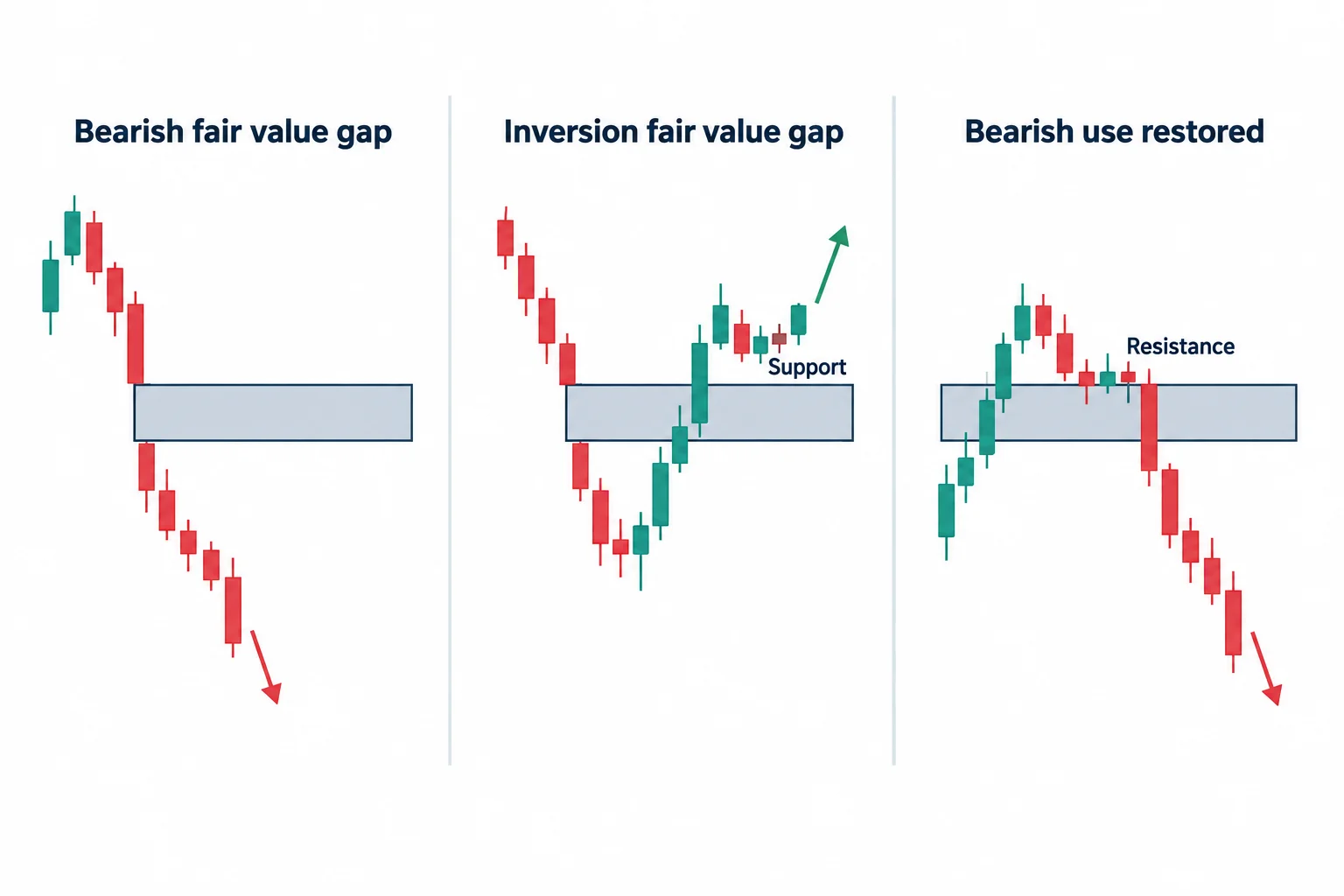
The longest teaching block concerns a three-candle inefficiency that he first classifies as a bearish fair value gap. He flags the ambiguity himself: the same area could be argued to be an inversion fair value gap, but he says he does not like anchoring the read back to an earlier candle even though that candle created the displacement leg (8:31).
His general model, stated between 8:51 and 11:07, runs in three stages. A down-close candle produces a gap whose first use is bearish. If price instead trades above it and is supported there, the same area is then used from the opposite side as an inversion fair value gap. If price subsequently works back through it and continues lower, he says it returns to its original bearish use. For the bearish case to be reclaimed he wants price to dig into the zone without finding a bounce in the upper half, reach the low of it and close below it, then a close below the high of the candlestick that created it.
He reports that last confirmation arriving at 11:58, and in the meantime reads price as having entered the new-week opening gap and given up, failing to reach its consequent encroachment (11:17).
The more useful part for review is the ranking he attaches to the reaction. His strongest bearish presentation is price leaving the zone and never coming back to it. Second best is a return to the low that then sells off. A wick up to the midpoint with only the body in the lower half is permissible but weaker, and he says he often takes something off when the reaction is that permissive (13:03). He redraws the whole sequence afterwards and stresses that the important events are the closes above and below the area, not the existence of the area itself (14:41).
Managing Trade Size in Premarket Consolidation
Position management takes up more of the recording than the initial setup, and he treats it as the lesson rather than an aside. He says he takes six contracts off (16:36), says the partial was missed while he was talking, and states that he has now locked in $5,640 on the position while describing the remainder as having no risk left in it (17:26). Both the amount and the risk-free description are his characterisation of his own position; the transcript cannot verify the fill, the account value or the displayed position.
He then says he has closed six contracts and does not want to hold as aggressively while consolidation remains likely until 9:30 (21:34). A little later he describes reducing size further and staging two exit orders below successive lows, with the idea of keeping one contract as a runner (24:05, 25:25). He aims an order just above a lower level of the range he calls an octant (25:37), lowers the stop again because he is not interested if price returns above that high (27:18), and closes the section by cancelling the remaining buy limit and saying he is done: “Done in the books” (28:51, 28:56).
One caveat on the captions is worth stating, because it affects any attempt to rebuild the trade. The reported contract arithmetic is internally inconsistent: six contracts are described at the open, six are described as closed around 21:34, and four are then described as still on at 24:05. This article therefore describes the sequencing of his decisions rather than restating contract counts as fact.
Why Premarket Consolidation Formed a Tight Range
The session context is what he uses to justify smaller expectations. He explains at 2:46 that because London had already been allowed to trend, the 7:00–:00 window was likely to be boxy rather than directional, and he says later that London’s 2:00–:00 a.m. window is the reason (29:48). When price refuses to extend, he reads that reluctance as consistent with the time of day rather than as a reason to demand more from the trade, and says that being stopped out would simply mean he is paid and finished (27:43).
He also names the week's calendar conditions (the Jackson Hole Symposium, the last part of August, the summer doldrums) as a reason to be nimble (22:55), and he generalises the point into treating consolidation as its own protocol that calls for different expectations and more selective exits than a trending session (30:01).
His stated confirmation for momentum was a close below a reference he describes as the midpoint of two opposing wicks, which the captions render as “obsidian” (31:32). He returns to that reference twice more, wanting a candle to close below its low and then reach the sell-side objective and a lower octant area (33:47), and observing that price was holding inside the two lines he had drawn on those wicks (34:29). The caption’s word for this reference is not a standard ICT term; the structure he describes is the midpoint of two wicks, and this article uses the description rather than the label.
One observation he offers as forward-looking rather than hindsight is that the bodies of the candles were not touching the level while the wicks were, which he treats as an early warning that a retrace higher was likely (37:29). He stays with the position until 9:00 to close out the 7:00–:00 window (35:31), marks the session close at 38:40, and says one-directional runs become more plausible after that window even though he expects price to keep meandering until the 9:30 open (38:50). He signs off reporting a gain on the day before commission costs; the caption renders that figure as “ 30”, which is too ambiguous to restate here as a dollar amount.
Confirming Fair Value Gaps Before Entry
After saying he is finished with the position, he records a continuation lesson rather than a new trade. If price revisits the reclaimed bearish fair value gap, he says he would not act on the first touch: he would want the reaction, then a breakdown, then evidence of something beyond that reaction, because consolidation makes it likely that price works deeper into the whole gap before rolling over (29:01). The same chart feature is therefore handled differently depending on the session type he thinks he is in, a distinction that matters more than any single gap on the chart.
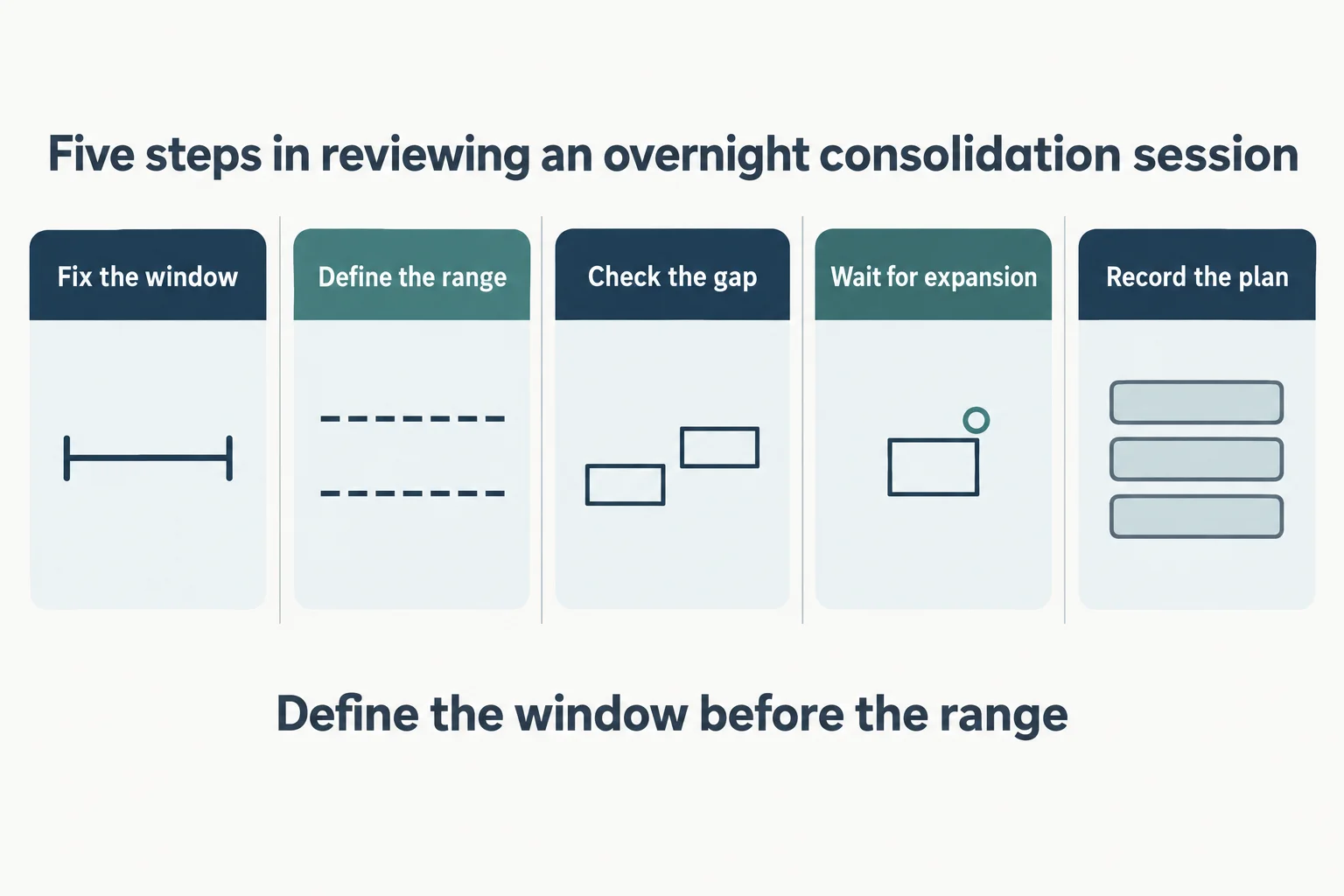
Five Steps to Review ICT Premarket Consolidation
- Fix the window first. He anchors everything to named clocks: 7:00–:00 Eastern, the 2:00–:00 London window, and the 9:30 open (1:43, 29:48). A range drawn on a chart set to another time zone is not the same range.
- Define the range before judging it. He marks the high of the 7:00–:00 window out loud and asks what travel inside it would still count as non-trending (3:35).
- Check the gap, and say which gap. The New York opening gap and the new-week opening gap are treated as separate references with separate behaviour (3:00, 8:31).
- Wait for expansion rather than trading the middle. The range is context, not signal, and he repeatedly declines to reposition inside it while waiting for the session to change character (20:15, 30:01).
- Record the plan. His most direct instruction in the recording is to listen back to the gap explanation, write it out in your own words, keep it in a journal, and photograph the screen so the scenarios can be redrawn by hand (18:31).
ICT Premarket Consolidation Trading Lessons
Read as a study exercise, the recording is a demonstration of writing a conditional thesis before evaluating candles: name the session type you expect, define the range and the gap you are watching, state what would confirm or invalidate the read, and separate an internal range move from a break toward external liquidity. He also makes the point that the same gap is handled differently depending on whether he believes the market is consolidating or trending, which is a statement about context rather than about the gap itself.
The limits are equally instructive. The reported partial, the locked-in amount and the day’s result are self-reported and cannot be checked from captions; the captions cannot supply the price levels or the fills; and a single recorded session, narrated while it was happening, cannot demonstrate that the sequence is repeatable. Anything in the recording about how other participants are positioned is his reading of the tape, not an observed fact.
ICT Fair Value Gap and Range Terms
- NQ: the ticker commonly used for E-mini Nasdaq-100 futures. Futures are leveraged and can produce losses quickly.
- New York opening gap: the gap between the prior settlement and the 9:30 a.m. Eastern opening price, used here as a reference area.
- New-week opening gap (NWOG): the area between the prior week’s close and the new week’s opening, divided into quadrants, with the midpoint called consequent encroachment.
- Fair value gap: a three-candle imbalance in which part of the first and third candles does not overlap.
- Inversion fair value gap: the same imbalance interpreted from the opposite direction after price trades through it under the analyst’s chosen criteria.
- Consolidation: price rotating inside a contained area rather than progressing in one direction; visible only relative to a chosen timeframe and range definition.
- Liquidity: a broad market term for the ability to transact; in ICT commentary it often refers to areas where orders or stops are believed to cluster.
Watch the Original ICT Premarket Lesson
Watch the original lesson on YouTube
This recording cannot be played inside another website. The player was loaded here in a browser on the standard embed address and reported “Playback on other websites has been disabled by the video owner”, so no player is embedded above. YouTube’s own oEmbed response for this video returns 401 Unauthorized while an embeddable control video returns a normal JSON payload, which matches what the player shows. The full lesson is available directly on YouTube.
Watch PreMarketSession NQ Consolidation August 25, 2026 on YouTube ↗
ICT Premarket Sources and Reference Material
The recording is the only source for the session itself. The other links below are reference material for the session clock, for replaying the window without hindsight, and for the third-party summary that paraphrases the same video.
Start With the ICT Recording
The upload titled “PreMarketSession NQ Consolidation August 25, 2026” is public and credited to The Inner Circle Trader.[1] It is 39 minutes and 35 seconds long, runs from the pre-market window to just after the 9:00 session close, and its own metadata dates it 2026-08-25. Contract month, chart timezone and data provider are not stated in the captions and would have to be read off the video.
Treat the ICT Community Summary as Unofficial
The ICT Archivist entry for this recording is a community-run archive that summarises the video in its own words and links to it.[2] It is not the original lesson, not an official ICT publication, and BestProps is not affiliated with it or with the Inner Circle Trader. Its summary broadly matches the recording on a short taken after a failed gap, the fair value gap role change, partials and tightened stops in a range, and a reported locked-in profit of about $5,640, but it is a paraphrase of reported remarks and is not the source of any claim in this article.
Define the Premarket Session Clock
CME Group publishes holiday and trading hours for CME Globex, shown in U.S. Central Time unless stated otherwise and subject to change.[3] “Pre-market” and “London” are only meaningful against a named session template and time zone: the 7:00–9:00 Eastern window referenced throughout this recording is 6:00–8:00 Central time, and it will not contain the same candles on a chart left in another time zone. Note that this page could not be loaded from our test system, which the publisher blocks; the link is retained because it is the exchange's own session-hours reference and was already cited here.
Replay Premarket Consolidation Before Judging the Range
TradingView’s help page How do I turn Bar Replay on? documents opening the replay panel, choosing a starting point and advancing bar by bar.[4] That is the practical test of whether the window was as narrow and range-bound as described, and whether the closes he cites were visible before the move rather than only afterwards.
ICT Premarket Sources
- [1] YouTube: PreMarketSession NQ Consolidation August 25, 2026 (The Inner Circle Trader, source recording)
- [2] ICT Archivist: PreMarketSession NQ Consolidation August 25, 2026 (unofficial community summary)
- [3] CME Group: Holiday and Trading Hours (CME Globex)
- [4] TradingView Help: How do I turn Bar Replay on?
BestProps is not affiliated with CME Group, TradingView, ICT Archivist or the Inner Circle Trader, and no source listed here endorses this article or any setup. New-week opening gap, opening range gap, fair value gap, inversion gap, consequent encroachment, octant and obsidian are used only as descriptive study terms. Nothing on this page demonstrates a tested, repeatable or profitable result, and nothing here is a recommendation to trade NQ or to copy any position discussed in the recording.