
Key takeaways
ICT’s 64-minute 8-second first 2023 mentorship recording outlines weekday ES and NQ commentary, two live streams a week lasting up to two hours, no signals or on-screen order execution, and regular real-time analysis beginning 7 February 2023, with additional coverage of DXY, EUR/USD, and GBP/USD.
Read the full summary
ICT’s 64-minute 8-second first 2023 mentorship recording outlines weekday ES and NQ commentary, two live streams a week lasting up to two hours, no signals or on-screen order execution, and regular real-time analysis beginning 7 February 2023, with additional coverage of DXY, EUR/USD, and GBP/USD. ICT distinguishes directional bias from narrative, which describes a session’s likely structure and sequence, defines sell-side liquidity below old lows and buy-side liquidity above old highs, treats an imbalance as untraded price between surrounding candles and a liquidity void as an actual gap, and traces nested fair value gaps from four-hour through hourly, 15-minute, five-minute, and one-minute charts using New York time. The ES case study treats 2022’s final session as an inside day within Thursday’s range and focuses on the three to four o’clock New York window, especially 3.15 to 3.45, targeting buy-side liquidity near 3864 above relative equal highs. He describes buying at the top of an hourly fair value gap, adding twice, placing the stop below the gap, experiencing one point of drawdown, and missing his expected four o’clock liquidity fill by almost two minutes, while noting one ES mini earns $50 per one-handle move and suggesting five handles as a realistic study target. Beginners should stay out rather than reverse when the narrative fails, funded traders should never reverse within the failed plan, and no setup by ten minutes before the hour means observe only. All executions, fills, prices, drawdown, and performance claims are ICT’s unverified account from the caption track, not independently confirmed results or financial advice.
How we researched this article
BestProps used document-based research from primary firm sources, checked September 24, 2026. The complete source list, scope, limitations, and commercial-state record appear near the end of this article.
This article is a source-grounded reading of 0:00, the first mentorship video of 2023. The recording runs 64 minutes and 8 seconds, the video’s watch page gives an upload time of 1 January 2023, 6:42 a.m. Pacific, and the article is built from that recording’s full timestamped English caption track rather than from the title or the video description. It is one presenter’s chart commentary: a description of how he says he marks up markets, not evidence that the framework produces a repeatable edge, and not a recommendation to copy any position described in it.
ICT Mentorship Plan for 2023
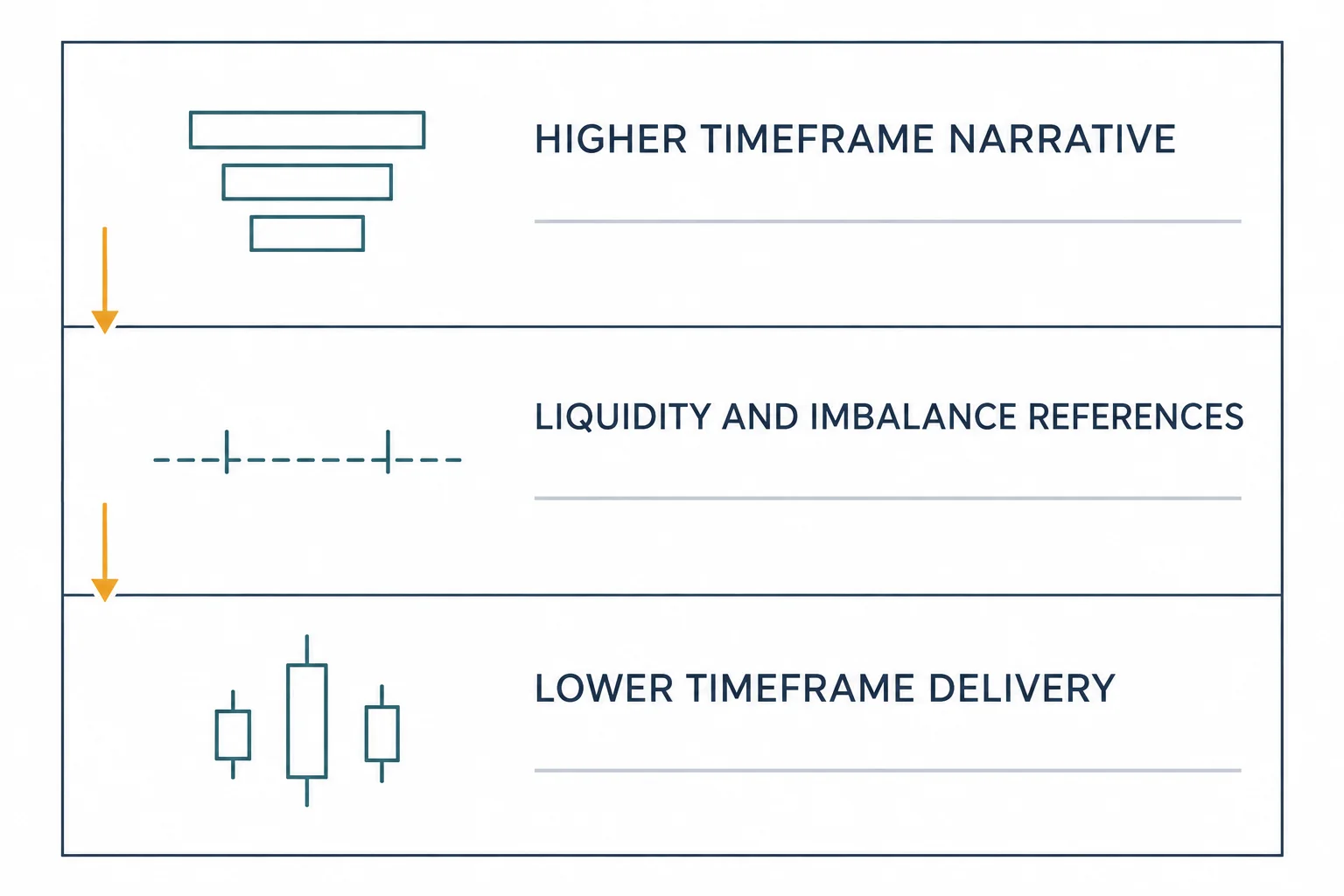
The recording opens as an orientation. At 0:39 he points new viewers to a viewing order rather than to this video: the market-maker primer and pattern-recognition series first, then the geometry and scalping material, and then the numbered core-content lessons (“so one until you get to the last one”) before the live material of 2023 begins (0:49).
He states the 2023 focus plainly at 1:56: index futures, with commentary every weekday “or the equivalent thereof”, barring holidays and personal schedule conflicts, plus coverage of the dollar index, EUR/USD and GBP/USD on the currency side (2:09). The intraday work, he says, will be on the ES and NQ contracts (2:14).
The live arrangement is described at 2:35: two streams a week of up to two hours each, with the whole session uploaded afterwards for anyone who could not attend (2:58, 3:08). He says the schedule will vary with the economic calendar (3:33). He is explicit that it is not a signal service and that he will not place or demonstrate trades in front of viewers (“you will not see me press a button”) but that he will call the market live on a five-minute basis (2:41, 2:46, 2:50).
A long passage covers channel administration rather than trading. He names his official Twitter account as the channel for schedule changes and urgent notices, points to a pinned post as the way to confirm the account is his, and states he will never send direct messages (3:45, 3:58, 4:18), describing Twitter as an alert system rather than a place to post schedules (9:37, 1:03:50). He adds that nothing taught that year is paid, that there is no upsell or follow-on mentorship, and that the only future paid items will be books (4:25, 4:29, 4:34). These details describe the channel as it stood in January 2023 and are recorded here as context, not as current fact.
He also dates the material: this is one video a week while things warm up, with the regular real-time analysis and markups starting on 7 February 2023 (1:02:38, 1:02:48).
ICT Mentorship Narrative and Directional Bias
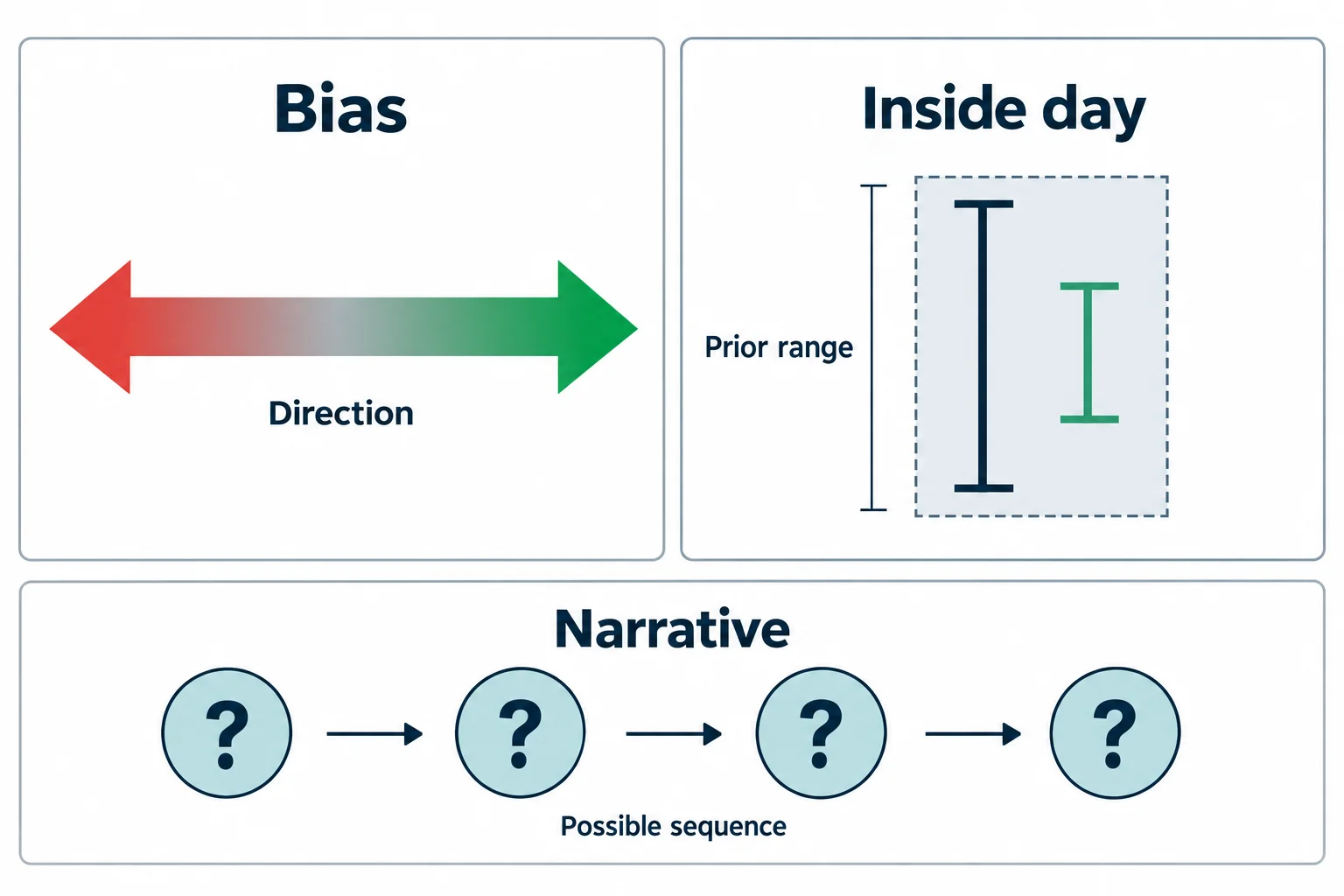
The chart discussion starts with the last trading day of 2022. At 11:43 he says he had expected an inside day, because funds would be squaring positions into year-end rather than pushing price, and notes he had said so on Twitter beforehand (11:48). He describes December as a down month with no late-year rally, price just “banging around” in a small range (12:11, 12:21), and says Friday printed a lower high than Thursday’s high and a higher low than Thursday’s low, the inside day he had described (12:31, 12:25).
The distinction the video is remembered for is stated at 17:30 and 17:35. In his terms, bias is the direction a trader intends to participate in; narrative is how the session is likely to trade, what it is aiming for, and which events would plausibly come first. His inside-day expectation was a narrative, not a bias: it bounded the day by Thursday’s high and low without saying whether to buy or sell (17:09, 17:15).
He develops the comparison further, likening a narrative to a route between two points: someone who has travelled it before can describe the road and the alternatives, while still having to change plan when conditions change (18:09). That qualification is the useful part for a reader. At 19:26 he says he does not always know what the narrative will be, that he sometimes enters with an expectation and has to adjust and adapt because intervention can upset what he believed the algorithm would do (19:30).
ICT Liquidity and Market Inefficiency Terms
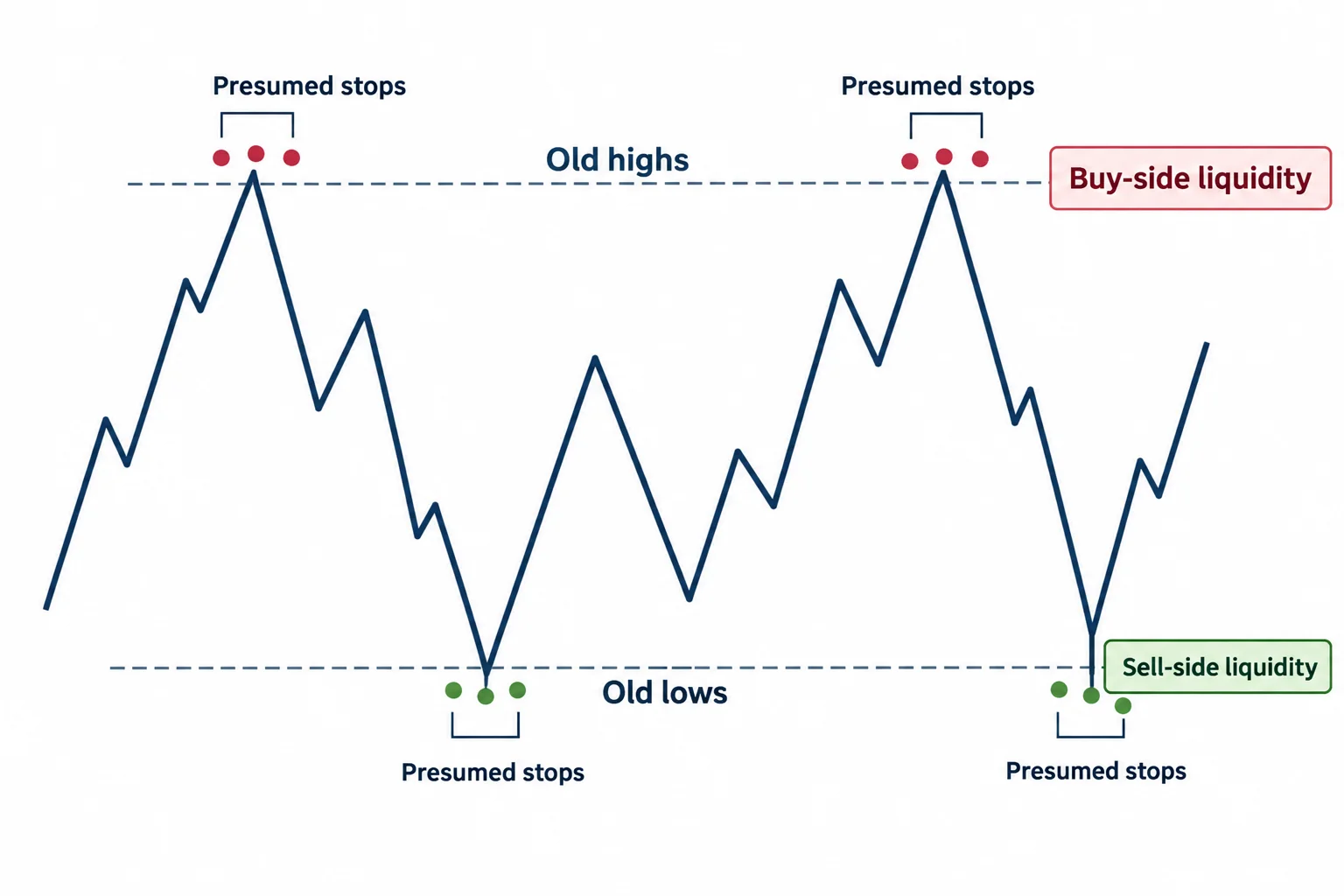
On the four-hour chart he gives his working definitions at 13:09: stops presumed to rest below old lows are sell-side liquidity, and stops presumed to rest above old highs are buy-side liquidity (13:17). When he is not referencing old highs and lows, he says he is looking for inefficiencies instead (13:32).
He then separates two terms that are easy to confuse. The imbalance he marks in the example is a single candle passing between the low of one candle and the high of another, leaving that stretch of price untraded; a liquidity void, in his words at 13:50, is “an actual gap” between candles (13:26, 13:38). He describes the market returning to the void, taking buy-side liquidity above a short-term high along the way, trading to the midpoint of the range (which he calls consequent encroachment) and then completing a full return, at which point the area becomes what he calls a balanced price range (14:53, 15:23, 15:31). The captions here are dense and partly garbled, so his wording is quoted rather than smoothed over.
The same references are then traced down through the hourly, 15-minute and five-minute charts, which he describes at 23:10 as “nested” arrays: a fair value gap on the four-hour chart containing the same structure on the lower timeframes all the way down to five minutes (16:43, a 15-minute pass at 20:02). He is careful about one point of housekeeping: chart time is always New York local time, whatever the viewer’s own timezone (26:58).
ICT Mentorship 2023 ES Case Study
The worked example is the New York afternoon of that final session. At 27:26 he frames the window as three o’clock to four o’clock, calling it a small window that can offer a five-handle move, his example being a run from “36 even down to 31 even” (27:47). What he was looking for at three o’clock, he says at 28:33, was a reason to expect a run into the buy-side liquidity pool he identifies as 38.64, a level he had published that morning so that, in his words, everyone knew by noon where his attention was (28:52, 30:11).
He also corrects a mistake from that morning, telling viewers he had named the wrong contract month in a tweet and that the correct front-month symbol was ESH2023, not an expired 2022 contract (29:36). That correction is worth noting because it is one of the few places the recording tests its own published claims.
His reasoning for the move up is stated as a market-model claim rather than an observation: at 35:17 he says the down closes were small and few while the up closes carried the movement and velocity, and that the last trading day of the year is when participants square up and get paid (35:30). He concludes that short sellers would be drawn to cover because of repricing higher, and that the pool of liquidity above 3864 was the bias of the analysis (39:34, 31:25).
The one-minute review follows the same references: price leaving a balanced range, breaking a low, failing to re-enter it, running down through the hourly imbalance to the low he had marked (“touched it right there, perfect”) and then rallying back up into the combined hourly, 15-minute and five-minute ranges (35:52, 38:57, a five-minute breakaway gap he says should not be traded back into at 44:03).
He then describes how he says he traded it. At 38:57 he says he hit the level as price came down into it and bought first at the top of the hourly fair value gap, then added more at 39:09 and once more at 44:59 (the second of those he calls a breaker) because, as he puts it, the 60-minute fair value gap was by then supporting price and he was not afraid of the stop being hit (39:15). He says the stop sat just below a candle’s opening (38:28), quotes a drawdown of one point on the move with his entry reported as 38.47 and the candle low at 46 (56:14), and later works through a $50 profit for a one-handle move on a single mini ES contract (55:36). The captions render these numbers inconsistently (38.47 in one place alongside “4847” in another, and a level spoken as “38 39 and a quarter” then restated as “39.25”) so the figures are quoted as spoken and no price is asserted here as exact.
He is candid about the one miss he claims: the liquidity was filled “almost two minutes late” against the four o’clock hour he had expected, and he calls that a miss rather than a success (46:18, 46:31). Nothing in the captions can confirm order submission, fills, account type, slippage or the outcome of any of it: they record what was said and when. The entries, the stop and the reported drawdown are his account of his own trading, not verified results.
ICT Mentorship Advice When the Session Plan Fails
The most transferable guidance comes in the last third of the recording. He says the decision after a failed expectation is between reversing and staying out, and that a beginner should stay out and observe rather than flip direction (47:35). He is more absolute for traders with funded accounts: “never ever” reverse, wait for the next session instead (48:19, 48:46).
He illustrates the point with the image of a bird faking a broken wing to draw a predator away from its young, his description of the market’s apparent easy reversal that is meant to be chased (49:06). He also maps the day into sessions: the morning window for the first attempt, then the afternoon from two to four o’clock, or the final hour, which he calls the most reliable part of the day (his description, not a verified tendency) for a run to an old high, an old low or an imbalance (49:58, 50:03, 50:08).
Near the end he narrows that further: a setup forms in the last hour between three and four o’clock, and if there is no setup ten minutes before the hour he says to do nothing and just observe (1:00:40, 1:00:45). The window he says he studies most closely is 3:15 to 3:45 New York time (1515 on a TradingView chart set to New York), describing it as a small sweet spot in which he looks for liquidity above, below, or an imbalance to act as a draw on price (1:01:00, 1:01:07). That is his stated preference about timing, not a claim that a setup appears every session.
He closes by describing how he intends to run the live sessions: annotations placed top-down on a split screen with a five-minute and a one-minute chart, no higher timeframes needed because the reference points have already been transferred, and no button pressed in front of viewers because he does not want to be accused of front-running (53:04, 53:20, 53:51).
ICT Mentorship Disclaimers for 2023
Two statements in this recording matter for how a reader should take everything above. First, he says he is not a licensed financial advisor and that he works from price action, which he equates with demonstration and paper trading, done for compliance reasons (58:40, 58:46). Second, he says that until this year he had always taught in demo, and that he showed a live account with “ return in five weeks” (54:51). That performance statement is his own, is not shown in the captions, and cannot be checked from the transcript; it is reported here so that it is attributed rather than repeated as fact.
He also advises against treating his own executions as a benchmark. Near 55:19 he says viewers should not measure themselves against what he posts, and that a realistic starting target is finding five handles, which he says is enough to do well if it can be repeated a few times a week (55:19). This article takes no view on whether that is achievable, and nothing in the recording tests it.
Watch the ICT Mentorship 2023 Recording
Watch the original lesson on YouTube
This recording cannot be played inside another website. Its embedded player was loaded from a BestProps origin and clicked on 15 September 2026: it reported “Video unavailable” and “Playback on other websites has been disabled by the video owner”, with no duration and no playback progress. The recording’s own watch-page data agrees that it is not playable in an embed, so no iframe is placed here. The video itself is public and available directly on YouTube.
ICT Mentorship 2023 Sources and Further Reading
- ICT Mentorship 2023 Ep 01 The primary source and the only recording used here. Uploaded 1 January 2023; watch page read 15 September 2026. Use the timestamp links above to compare each step with what he actually said.
- The Inner Circle Trader YouTube channel The publisher’s own channel, where this recording and the concept lessons it references are posted. Unofficial reuploads and summaries are not the source used here.
- CFTC (Forex Frauds) The US regulator’s material on patterns common in retail forex promotions, including presented results. General context for reading a chart-review video of this kind; it does not assess this presenter, this session or any figure quoted above.
- CFTC (Fraud Advisory: Commodity Trading Systems Sold on the Internet) Regulator guidance on retrospectively presented results and on the execution, cost and risk assumptions such presentations tend to omit. Relevant to any claim of precision or of a five-handle target.
BestProps is not affiliated with the Inner Circle Trader or the CFTC, and no source listed here endorses this article. Sell-side liquidity, buy-side liquidity, fair value gap, imbalance, liquidity void, consequent encroachment, balanced price range, breaker and narrative are used as descriptive terms for what the recording teaches. The levels, session timings, trade descriptions and reported figures are the speaker’s own account of his own charts and are not verified here: the caption track contains no order tickets, statements or results, and the chart markings a reader would need are not visible in it. This is independent educational commentary, not official ICT material, not a tested trading system and not investment advice. Leveraged futures and forex trading involves substantial risk and is not suitable for everyone.