
Key takeaways
The Inner Circle Trader’s public YouTube lesson reviews the June 2023 E-mini S&P futures contract and rejects requests to pass a funded evaluation, favoring ES shorts during May through the first two weeks of June while stressing that seasonality is only a higher-time-frame roadmap requiring technical confirmation.
Read the full summary
The Inner Circle Trader’s public YouTube lesson reviews the June 2023 E-mini S&P futures contract and rejects requests to pass a funded evaluation, favoring ES shorts during May through the first two weeks of June while stressing that seasonality is only a higher-time-frame roadmap requiring technical confirmation. His framework uses the New Day Opening Gap between the pre-shutdown close near 5 p.m. and reopening near 6 p.m. Eastern, the New Week Opening Gap between Friday’s close and Sunday’s first tick, at least the five most recent weekly gaps, and volume imbalance defined as separation between consecutive candle bodies rather than a chart gap or order-flow signal. He advises beginners not to trade the Thursday and Friday of non-farm-payroll week, warns against combining every ICT concept in a kitchen sink approach, and describes price as moving toward liquidity or inefficiencies or consolidating. From about 46 minutes 48 seconds he narrates simulated ES executions, building from six contracts to three more and then one for ten total, taking three off at a first target, manually closing two groups of three, being profitably stopped on the final three, and later re-entering short at the New Day Opening Gap. He says the demo began at the 150,000-dollar challenge size with a 9,000-dollar target over five days and claims a single-day result above 19,000 dollars, but the automatic captions garble the exact total and provide no verification of fills, balance, arithmetic, risk, or drawdown. He warns viewers not to copy the ten-contract sizing, declines funding-company representation or affiliate relationships, claims he could meet the requirements in one day without substantiation, and notes that his son failed a funded evaluation seven times before returning to trading basics.
How we researched this article
BestProps used document-based research from primary firm sources, checked September 24, 2026. The complete source list, scope, limitations, and commercial-state record appear near the end of this article.
Every chart level, structure reading and execution in this article is his own narration of what he was showing on screen. The captions establish what he said; they cannot confirm a chart, a fill or an outcome, and the reviewer did not watch the video frames.
ICT Discussion of Seasonal Limits in 2023
He opens on a daily chart of the June delivery contract and explains that he follows seasonal tendencies from a daily and weekly macro perspective, and that there are times of year he prefers certain setups to form. For May and into the first and second week of June he says he favours shorts in stock index futures, and he names the familiar “sell in May and go away” expression as the popular version of that idea (2:09 and 2:41). He says the tendency has shown up for decades rather than a handful of years and calls it a higher-time-frame roadmap for where significant price moves can form (4:30).
Then he spends a full minute taking that back down to size, and it is the most quotable passage in the recording. He says seasonality by itself is not a panacea or a be-all, that the futures market is not guaranteed to deliver based on past performance, that this is why the risk disclaimer is read every time, and that the tendency only justifies more investigation of that specific period (4:36, 4:44 and 4:56). At 5:20 he adds the condition directly: you have to add technicals to it.
He also flags the calendar. The recording is made during non-farm-payroll week, with the May 5 release the next morning, and he says new traders should not be trading the Thursday and Friday of that week because it is very difficult to trade without the skill set and amounts to a gamble after the numbers are released (5:26 and 20:37). That is a caution rather than a signal, and it is directed at beginners.
ICT Discussion of What Price Can Do
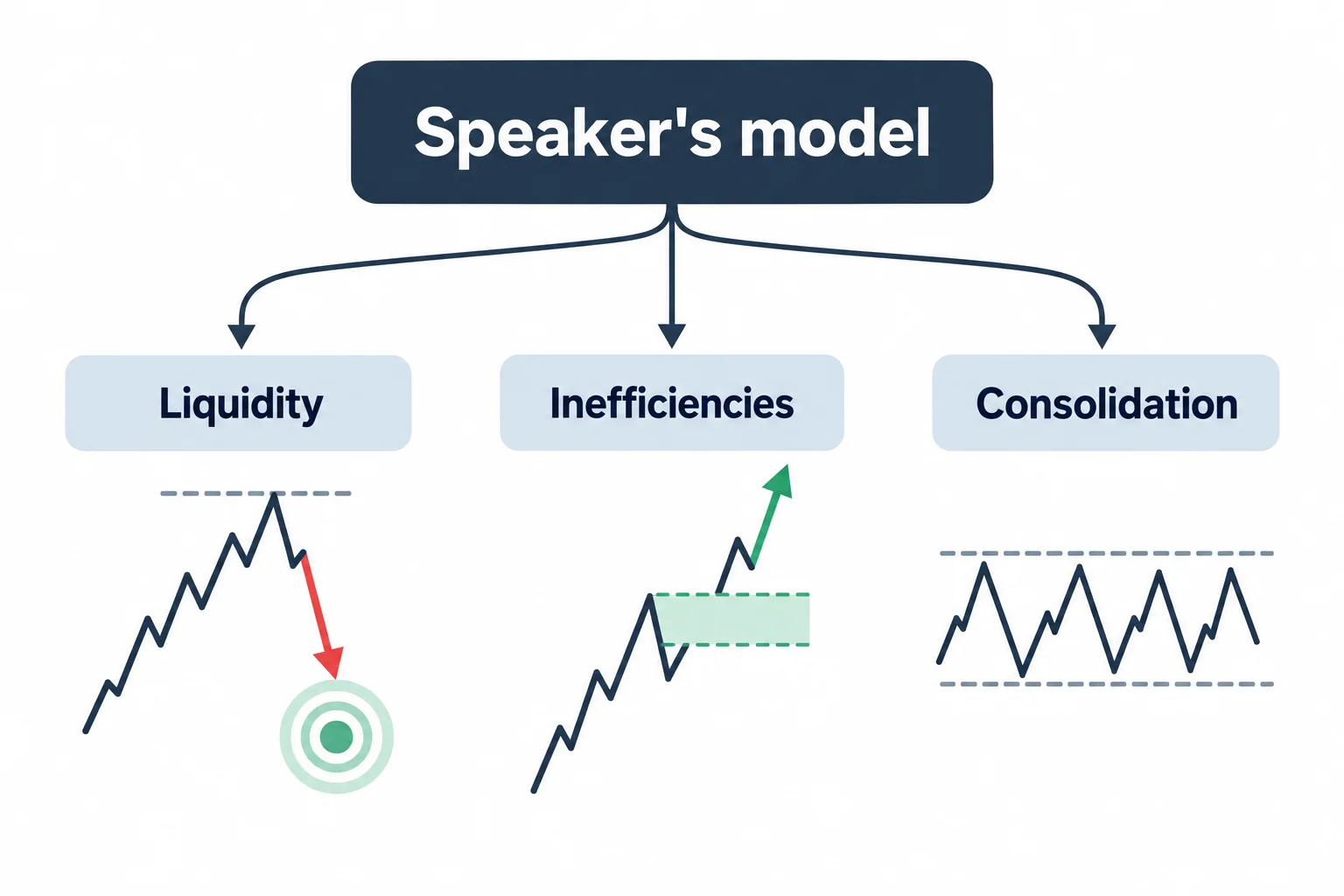
The conceptual frame he gives the review is short. He says the market does one of two things: it gravitates toward liquidity or toward inefficiencies, and if it is doing neither it goes sideways and consolidates until the criteria for one of those two appear (7:59 and 8:08). This is his model of price delivery, stated as such, not an established property of markets.
Watch the original lesson on YouTube
The video cannot be played inside another website. The embedded player for this recording was loaded and clicked on 15 September 2026: it reported “Video unavailable” and “Playback on other websites has been disabled by the video owner”, with no duration and no playback progress, at both desktop and mobile widths. The recording’s own watch-page data agrees that embedding is unavailable, so no embed is placed here. The lesson is public and playable directly on YouTube.
Watch ES Review & ICT Funded Challenge Discussion 05/04/2023 on YouTube ↗
He also makes a small detour into contract symbols, listing the four index futures delivery months (March, June, September and December) and the month codes H, M, U and Z (11:44 and 11:51). It is general background he gives before returning to the chart, and it is factual rather than interpretive.
ICT Discussion of Two Opening Gaps
Moving down time frames, he points to two recurring references and defines both. The New Day Opening Gap is the separation between where the market closed before a one-hour shutdown around 5 p.m. and where it reopened at 6 p.m. Eastern, which he calls New York local time (13:17 and 13:27). The New Week Opening Gap is the separation between the previous Friday’s closing price and the Sunday opening price (the first tick when the market comes alive again) with a note that this particular New Week Opening Gap was a price and a time he was working with during the session (14:23 and 17:43).
He credits the New Week Opening Gap to Twitter Spaces in February 2023 rather than to a video, saying it was coined publicly there and has been his concept since the 1990s, and he notes there is no dedicated video for it at that point (15:28 and 15:42). The process point he gives is concrete and worth keeping separate from the analysis: he tells viewers to hold at least the five most recent weekly gaps and to journal, on every Sunday entry, the opening price and the previous Friday’s closing price, so the data is at hand if a template is later deleted or something changes on the chart (16:01 and 16:23).
He also states the reason he keeps extending gaps rather than retiring them once price trades through, at 54:01: in his words the algorithm is going to refer back to the same price level again, and anyone who tells you a gap is finished once it fills is, in his framing, wrong. That is his belief about how price is generated; the recording offers no evidence for it beyond the charts he is annotating.
ICT Discussion of Volume Imbalance Warnings
On the lower time frames he introduces the volume imbalance and defines it carefully: it is the separation between one candle’s body at the close and the next candle’s open, not a technical gap in the sense other people use that word, and he distinguishes it from an order flow reading (25:16 and 25:20). He expands the definition later, saying it means the algorithm has not offered price efficiently between those two points, and calls it a kind of micro fair value gap (26:53 and 27:05). He is also explicit about ownership of the term, saying it is not in books and that he authored it (34:44).
The methodological warning that follows is arguably the most useful thing in the session. He says the mistake is reaching for everything he has ever taught and trying to apply it all to the current price action, calls that a kitchen sink approach, and says it produces frustration rather than analysis; the point of a model is to select a small number of compatible tools (19:04 and 19:16). He frames that section itself as the heart of the teaching: he is telling viewers what not to do.
ICT Discussion of the 5 May 2023 Session
The market walkthrough ties the references together. He describes price finding support at the low of the older New Week Opening Gap he had carried forward, rallying back into the volume imbalance, and then, at the payroll release, trading up into a level he says was not random, with the volume imbalance and a 15-minute order block as the context he was watching for a rejection (40:14, 40:31 and 42:05).
He returns to the same levels twice more, noting that a later rally came back to the same New Week Opening Gap and New Day Opening Gap area and that the algorithm was going back to the same price levels, and describing a move that takes sell-side liquidity and then returns to buy-side and to the midpoint of a gap (55:53 and 56:17). He also mentions a short he says he would have taken but did not, because he had left to go shopping with his wife (56:08). That is reported as his account of his own session, not as a verified trade.
ICT Demo Session Results Discussion
From roughly 46:48 he shows an execution history with arrows and insists it is not market replay. He describes the sequence: selling short into a breaker on the five-minute chart, building to a ten-contract position, taking three off at the first target, closing three manually at one level and three at another, then being stopped out on the final three while still in profit, and later re-entering short at two o’clock when price returned to the New Day Opening Gap (52:01, 53:02 and 53:17).
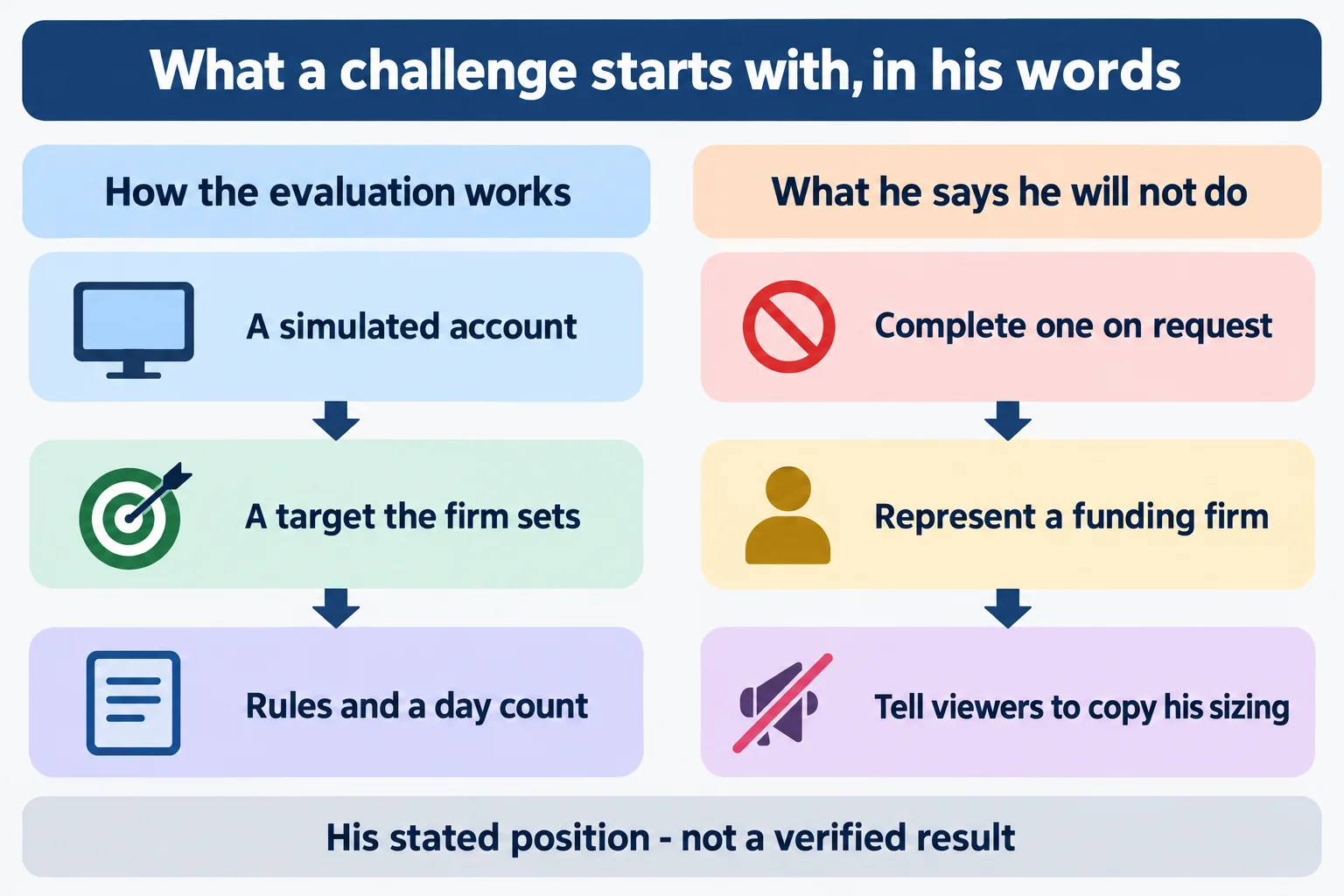
He then walks the individual executions and states an account result. He says the account started with the amount a 150,000-dollar funded challenge would give, that the target would be to make nine thousand dollars in five days, and then gives a much larger figure for his own day. That figure cannot be quoted reliably here: the caption track renders his spoken dollars-and-cents as the run-together string “sixteen thousand nineteen thousand nine hundred and thirty seven dollars fifty cents”, which does not resolve cleanly into one number (59:29, 59:33 and 59:39). The point that matters is larger than the digits. He states in the same passage that the account is a demo: that every funded challenge starts with a demo, that the viewer is trading a demo account too, and that it is not real (44:57 and 45:02). He also says he does not need a live account to demonstrate that the approach works (44:53).
So the honest summary is this: the recording contains a large self-reported simulated result attached to a stated logic, and it contains no statement, no third-party verification, no risk-per-trade figure and no drawdown. Captions cannot authenticate a simulated fill, an account balance or an arithmetic total, so the figure is reported here as his account of a demo session and not as verified performance.
He is also candid that the sizing is not a template. His stated method is to build a trade in pieces (six contracts, then three, then one, for a ten-lot) and he says directly that this does not mean the viewer should trade that way or with ten contracts, and that he has the experience for it (50:10 and 50:16).
ICT Funded Challenge Refusal
The closing section is a refusal, delivered at length. He says he is asked repeatedly to do a funded account or a live account, that he has already traded a live account and posted it, and that he does not want to represent a company or do affiliate arrangements because it would look like he was in bed with a firm (46:20, 57:46 and 57:55). He calls the challenge objectives trivial relative to what he is doing, says he could meet the funding requirements in a single day with one account, and asks viewers to stop asking (65:46 and 68:26). Those are claims about his own capability, stated without supporting evidence in the recording, and they are not verified here.
The part of that section with actual teaching value is about someone else. He says his son failed a funded evaluation seven times, that he failed because he did not yet know how to trade, and that his son needed to go back to the basics rather than continue taking on something he was not equal to; he adds that he needs to see a student’s errors to fix them (45:16, 45:24 and 68:11). Read plainly, that is a warning that simulated funding targets can be attempted long before the underlying skill exists, and it is the most self-limiting statement in the recording.
He also previews what comes next, saying two lectures would follow that weekend (one on the New Week Opening Gap and one on the New Day Opening Gap) as his 2023 mentorship installments for the channel (70:44 and 71:07).
ICT Discussion Transcript for the 2023 Review
This article was written from the recording’s own automatic English captions, which are machine-generated and not human-checked. They misrender several of his terms and numbers: “volume and balance” for volume imbalance, “cell side” and “South Side” for sell-side, “Excel side” for sell-side liquidity, “by side of balance” for buy-side imbalance, “Fairway Gap” for fair value gap, and the dollar figures at 59:36–:41 are run together into digit strings. Where the intended term is unambiguous from the surrounding sentences it has been normalised; the numbers he reads out are reported as the captions render them, and the large day figure above is flagged rather than smoothed into a clean number. The caption track establishes what he said; it cannot establish a chart level, a fill or an account result, and the reviewer did not watch the video frames.
ICT Funded Challenge Discussion Resources
These are the sources checked for this article. The regulator pages below are general investor-education and fraud-warning material about leveraged retail trading and about performance claims; they are not assessments of ICT, of this recording, or of anything said in it, and none of them verifies a statement made here. Any ICT, smart-money or third-party indicator, script, note set or transcript circulating outside the publisher’s own channel is unofficial and untested here.
- [1] ES Review & ICT Funded Challenge Discussion 05/04/2023, The Inner Circle Trader (primary source; watch page read 15 September 2026, 4,503 seconds, published 4 May 2023 at 8:31 p.m. Pacific)
- [2] The Inner Circle Trader (official YouTube channel) (read 15 September 2026)
- [3] YouTube Help, Embed videos & playlists (read 15 September 2026; the platform documentation relevant to the disabled-embedding notice above)
- [4] CFTC Learn & Protect, Forex Frauds (read 15 September 2026)
- [5] CFTC, Fraud Advisory: Commodity Trading Systems Sold on the Internet (read 15 September 2026)
This is independent educational commentary on one speaker’s framework and on his own account of one session in a simulated account. It is not official ICT material, it is not a tested trading system, it is not investment advice and it is not a claim that any result can be reproduced. Leveraged index futures and foreign-exchange trading involve substantial risk, most retail foreign-exchange traders lose money over time according to the regulator’s published data, and past or hypothetical performance does not indicate future results.