
Key takeaways
In 2022 ICT Mentorship Market Review – July 27, 2022, a brief review recorded around that day’s FOMC announcement 0:05, ICT walks through the dollar index 0:10, the euro 1:04, cable 2:00, the Nasdaq 3:11 and the E-mini S&P 5:07, and then explains why he took no trade at all 7:46, 10:00.
Read the full summary
In 2022 ICT Mentorship Market Review – July 27, 2022, a brief review recorded around that day’s FOMC announcement 0:05, ICT walks through the dollar index 0:10, the euro 1:04, cable 2:00, the Nasdaq 3:11 and the E-mini S&P 5:07, and then explains why he took no trade at all 7:46, 10:00. His plan had been a specific sequence: sell-side liquidity taken first, a bullish shift in market structure, then a fair value gap to form and be retraced into 6:24, 6:48. He says neither of the downside levels he had given on the Nasdaq or the S&P was reached because the market stayed firm 6:55, and that price instead pushed into what he called a pretty good premium ahead of the release and never came back into a short-term discount between the low and the high he had marked 7:35, 7:42. He describes it as a complete missed run 7:52, says there was no live trade loss and no position that day 9:59, 10:01, and treats the episode as a demonstration that looking for specific levels and not seeing them traded to is a normal part of the process 8:02, 8:05.
How we researched this article
BestProps used document-based research from primary firm sources, checked September 25, 2026. The complete source list, scope, limitations, and commercial-state record appear near the end of this article.
In 2022 ICT Mentorship Market Review – July 27, 2022, the speaker opens by calling it a brief review on FOMC Wednesday and starts with the dollar index on the left-hand side 0:05, 0:10. The whole recording runs about ten and a half minutes and contains no chart that can be inspected in the audio, so everything below is attributed to what he says aloud. Numerals are especially exposed here: several of the levels he speaks come through as bare digit strings without a decimal point, and those renderings are quoted as they stand rather than converted into prices this review cannot establish.
The Dollar Index Review
He begins with the dollar index and says the market had come back down and revisited a level that he had been referring to in previous commentaries, which in the transcript is rendered as “10642” 0:22. He then says price had the ability to get up into a small fair value gap and take buy-side liquidity before the FOMC release sent it lower 0:34, 0:39. He notes a small pool of liquidity resting in the form of sell-side liquidity below and says he thinks that is where the dollar is going 0:45, 0:51.
That is a chart reading, not a measured result, and the recording supplies no value, sample or verification for it. It is reported here as the interpretation he gives on the day.
Euro and Cable
Moving to the daily euro chart, he says the euro had finally moved down into the fair value gap, much as cable had already done 1:04. In his account it traded down into that area at the release, rallied through it and took out the short-term high, with buy-side liquidity in the same area, which he calls promising on the upside 1:42, 1:44, 1:46, 1:49. He says he likes an imbalance above and an old low the transcript renders as “1.0340”, and the idea of the gap being revisited and sending price up into that area 1:22, 1:31.
Cable gets its own chart review 2:00. He says the market had already traded through an old imbalance, that the only feature he saw that day was a run on sell-side liquidity, and that the release then sent it higher, adding that nothing in that sequence would have been an obvious entry for him 2:14, 2:20. He says the daily fair value gap shown on the slide is what he would call a nice “opt-in” trade entry, and repeats his earlier point that cable or pound dollar had the better technical condition of the two 2:35, 2:41. He draws the contrast explicitly, describing cable trading into its fair value gap and starting to move away while the euro only reached its own area a day later before finding its low and rallying 2:48, 2:59.
Nasdaq and E-mini S&P
On the Nasdaq daily chart he points to relative equal highs and says that if price takes off above them and keeps rallying, that is where it could ultimately be drawing to 3:11, 3:16. He flags a small divergence between the S&P and the Nasdaq 3:28, says he thinks it will be short-lived 3:35, and describes wanting Nasdaq to trade down into an area first before running the relative equal highs, with the transcript rendering the intended levels as “12 973”, “12 800” and “12 975” 3:40, 4:00.
He reminds viewers that he had said in the previous night’s recording that the Nasdaq had completed its imbalance and that he had anticipated the same in the E-mini S&P 4:17, 4:24. Because the S&P failed to go lower instead, he says he created what he calls an SMT divergence 4:35, and describes price moving higher, consolidating, and then taking off at the release without giving a real setup or even taking out the short-term high 4:40, 4:47. He calls the session one-sided and says that even if he had been focusing on the Nasdaq, he would have missed the move 4:56, 5:00.
The E-mini S&P review follows 5:07. He notes a short-term high and says price dug up into an imbalance, with a midpoint area the transcript renders as “40 75” as the next upside draw and, in his opinion, the target to reach for if price is going to continue higher 5:16, 5:28, 5:37. He says he had mentioned the fair value gap the previous Friday and expected price to drop into it, which happened on Monday and Tuesday, and that today price was sent higher to take out the short-term high and trade up into the imbalance 5:43, 5:49, 5:54. He also says he had put a note on Twitter to take short covering at a level the transcript renders as “39.20”, calls it a really nice level, and observes that the market went below it once more in the afternoon and then rejected it 6:10, 6:16, 6:18.
The Setup He Was Waiting For
The substantive teaching begins around six and a half minutes in. He says that initially he had sell-side liquidity in mind and wanted the release to drop down ahead of time and run it, which would start setting up a shift in market structure to the bullish side, followed by a fair value gap to form and a potential run based on that gap 6:24. He had given levels on the Nasdaq and on the S&P for the sell side to be tagged first 6:48, and says neither of those levels was tagged and the market simply remained firm 6:55.
He then describes approaching the two o’clock hour in his local time, which he identifies as the first of two stages of the FOMC event, the second being half past two 6:59, 7:09. He says that the candle for the two o’clock hour started to drop and that he was watching the level based on the hourly fair value gap, and that a trade down into it would have been a long for him 7:15, 7:22, 7:27. Instead, he says price kept driving higher, that it pushed into a pretty good premium ahead of the release while leaving the short-term high behind, and that the market did not drop back into a short-term discount between that low and that high 7:35, 7:42. His conclusion is short: he did not participate, it did not give him the opportunity he was looking for, and it was a complete missed run 7:46, 7:48, 7:52.
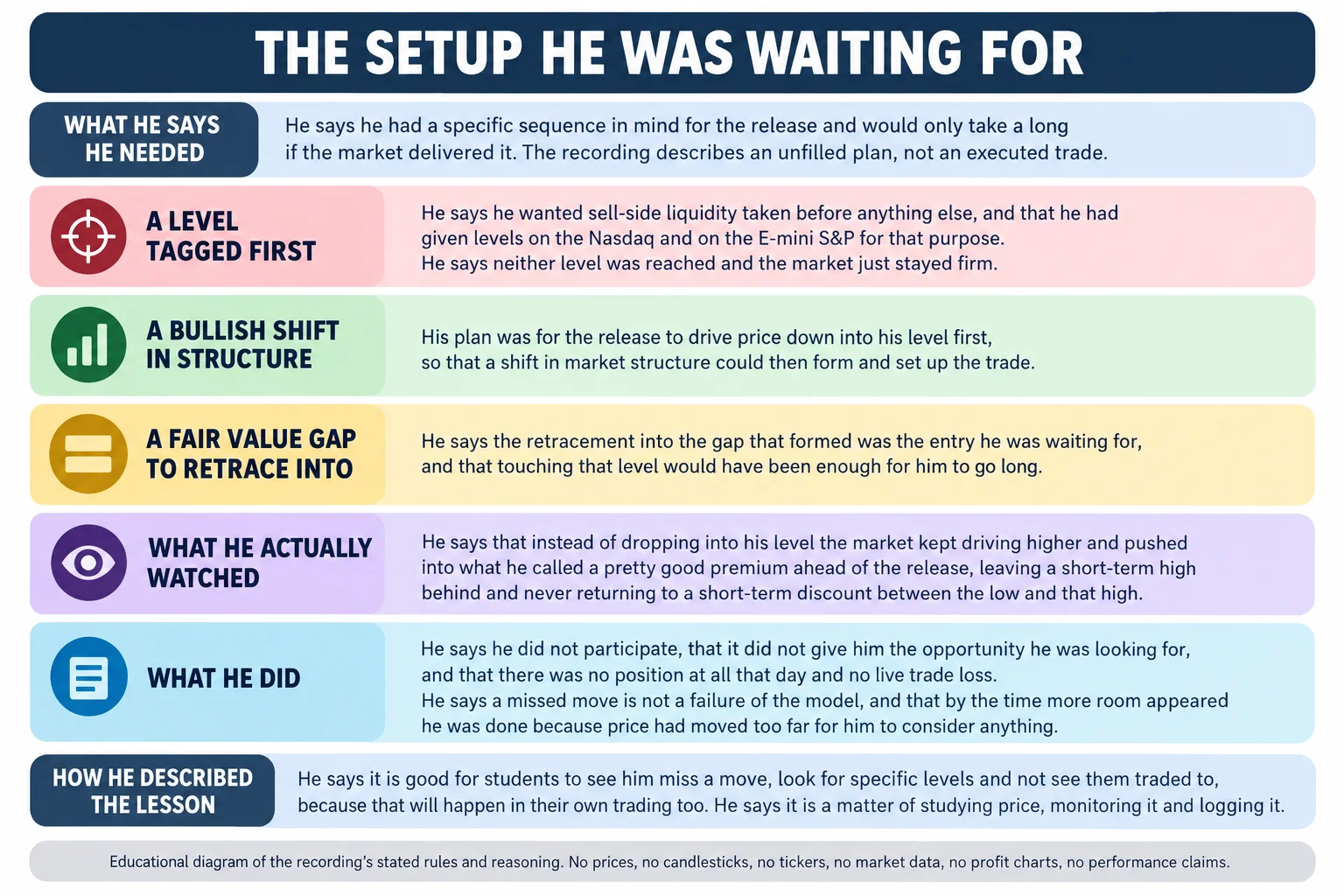
He then walks through what he had been looking at on the hourly chart. He says that had price dropped down into the gap he would have taken a long and aimed for partial exits, getting out above a level the transcript renders as “41.31”, at which point he would have been completely out of the trade 8:28, 8:30, 8:39, 8:43. He says the reason he was watching that area is that he examined it after the run-up into the two o’clock hour, and that he had said on Twitter to monitor the level rendered as “39.62” because it was a fair value gap 9:02, 9:06. He then reconstructs the pattern: a low with sell side, sell side taken, a shift in market structure, and a Fibonacci placed between that low and the high with equilibrium somewhere in the middle, followed by the fair value gap 9:08, 9:11, 9:22, 9:25, 9:27, 9:30. His conclusion is that if price had dropped into that gap and simply touched the level, it would have been enough for him to go long, and that it did not do it 9:34, 9:40.
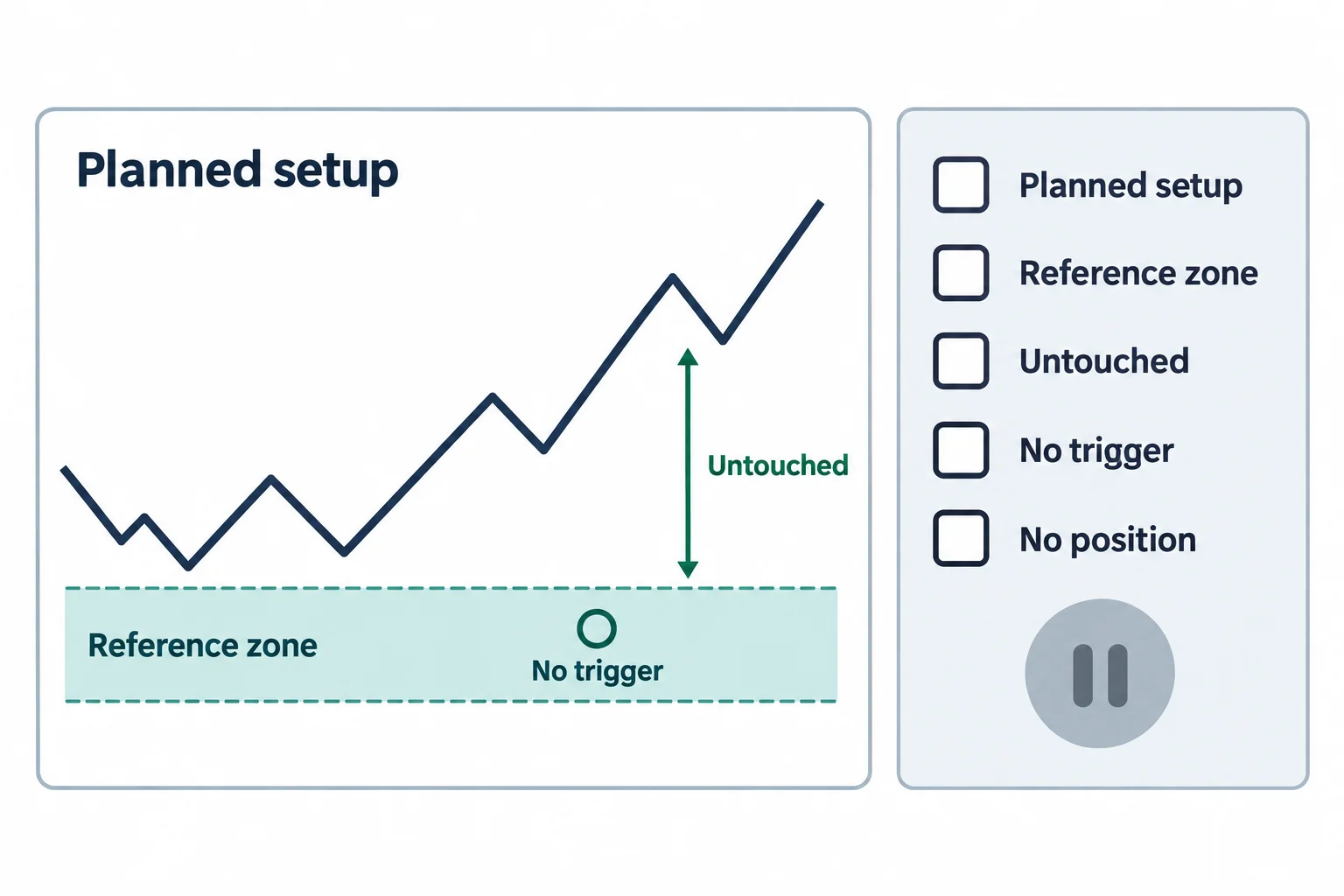
Two things need saying about that sequence. It is a retrospective description of an unfilled plan, not a record of an executed trade, and the partial exits, the exit level and the Fibonacci placement are all conditions he describes in hindsight while talking over a chart that is not present in the audio.
What He Says the Miss Means
Most of the closing minutes are devoted to the miss itself. He says it is good for viewers to see him miss something and to see him look for specific levels that are not traded to, because the same thing will happen in their trading, and that there is no harm, no foul and no failure of the model 7:55, 8:02, 8:04, 8:05. He adds that this does not mean the system, the idea or the concepts are failed or flawed 8:08, and that it simply means this is an FOMC day, which he says sometimes wants to rip everybody’s face off, so a trader may not get an opportunity to participate 8:12, 8:14, 8:16.
He is explicit about the position: he says it is no skin off his back, that sometimes he looks for setups and they simply will not give him the price he is looking for, that there was no live trade loss, and that there was no position at all that day 10:01, 10:04. He says that later, going into three o’clock and half past three, he was done and not interested in doing anything because price had already moved too far for him to consider it 10:09, 10:14. His summary is that it comes down to studying price, monitoring it and logging it, and he calls the session a missed opportunity for himself before signing off until the next day 10:19, 10:25.
What the Recording Does Not Establish
There is no verified result anywhere in this material. The recording contains no executed entries, no fills, no position sizes, no risk figures and no account statement, and the trade he describes is a plan that never triggered 9:34, 9:40. His level references are spoken chart annotations rather than data, and several of them reach this article as bare digit strings with no decimal point, so this review quotes those renderings rather than supplying a decimal placement the audio does not state. Automatic speech recognition of the audio also cannot independently establish fills, real-money performance or why a market moved, and nothing here was checked against the charts he was describing.
One rendering note belongs with that caution. The cached quality record for this transcript reports the audio complete at a maximum level of −1.2 dB and flags no low-confidence characters across its 121 segments, so no passage above rested on a doubtful rendering of a spoken term. That is a statement about the transcript’s quality, not about the claims it carries.
Watch the Source Recording
2022 ICT Mentorship Market Review – July 27, 2022
The Inner Circle Trader · watch page lists upload 27 July 2022 · 631 seconds, about 10 minutes 31 seconds. The recording is the primary source for every timestamp link on this page.
The recording is not embedded here. An embedded player was tested directly on 16 September 2026 from a BestProps page origin at desktop and mobile widths: the frame loads and the player reports “Playback on other websites has been disabled by the video owner”, with no duration reported and no playback progress. The oEmbed endpoint answers 401 Unauthorized for the same reason, while the video itself is publicly playable on YouTube. No half-working player is left on this page.
The watch page was read on 16 September 2026 and is publicly listed as 2022 ICT Mentorship Market Review – July 27, 2022 by The Inner Circle Trader, not private and not unlisted, with a listed duration of 631 seconds. The upload date and the FOMC Wednesday discussed in the recording are the same calendar day, and no separate spoken date is claimed here.
Resources
These are the sources checked while preparing this article. The CFTC advisories are general regulator material on how trading-system and forex claims should be assessed, including the advisory that lists firms claiming you can or should trade in the interbank market among its fraud red flags. Neither evaluates this speaker, tests any level or pattern he describes, or verifies anything he reports. Any ICT, smart-money or third-party indicator, script, note set, chart annotation, transcript pack or re-upload circulating outside the publishing channel’s own page is unofficial and untested here, and no claims are made about its accuracy or repainting behaviour.
- [1] 2022 ICT Mentorship Market Review – July 27, 2022 — The Inner Circle Trader (primary source; watch page read 16 September 2026, listed duration 631 seconds, about 10 minutes 31 seconds).
- [2] The Inner Circle Trader — official YouTube channel (read 16 September 2026) — the publishing channel for the 2022 mentorship review series this recording belongs to.
- [3] CFTC — Fraud Advisory: Commodity Trading Systems Sold on the Internet (read 16 September 2026) — warns that hypothetical trading results are typically based on simulations using historical or “real time” computer trading, and that such results often show large net profits with only a few small margin calls.
- [4] CFTC — Fraud Advisory: Foreign Currency (Forex) Fraud (read 16 September 2026) — describes the forex market as volatile and carrying substantial risks, and lists firms that claim you can or should trade in the interbank market among its red flags for identifying foreign-currency trading scams.
Source: ICT, 2022 ICT Mentorship Market Review – July 27, 2022, The Inner Circle Trader, watch page upload date 27 July 2022. Local automatic speech recognition of the full original audio was the transcript used for this article, and it is not human-verified captions. No fill, position size, cost or performance figure is asserted anywhere in this article, and this commentary is educational and is not investment advice.