
Key takeaways
This is the first of a four-part “Ends Series” from the 2022 ICT Mentorship, published on the watch page at 29 July 2022 20:06 PDT — which is 30 July 2022 in UTC, the date the inventory carries.
Read the full summary
This is the first of a four-part “Ends Series” from the 2022 ICT Mentorship, published on the watch page at 29 July 2022 20:06 PDT — which is 30 July 2022 in UTC, the date the inventory carries. It is not a chart-pattern lesson. The speaker sets out the problem he says the series exists to answer: ends have to be met every month, income is the only working resource unless there are extra streams, and lifestyle spending stacked on top of living expenses is the pressure he says gets carried into the chart. He lists the monthly ends he counts — mortgage or rent, transportation with insurance and fuel, utilities, healthcare, childcare and family costs, and then clothing and entertainment, which he says is where young men spend most ( 10:00 , 12:05 , 14:06 , 15:36 ). He describes what he says that pressure does to a trader: entering before the criteria are present, abandoning the rules, over-leveraging, chasing the feeling of a previous winner, treating a funded-account evaluation like a lottery ticket, and expecting trading to replace a job on a schedule he calls arbitrary ( 23:47 , 29:40 , 30:56 , 32:52 ). The exercise he assigns is a financial audit done away from the charts: record what comes in, take a conservative low-end baseline when income varies, list what the month costs, trim what is not needed now, then take the smallest unavoidable monthly expense as the month’s objective and divide it across the weeks, starting with one expense and adding others only after consistency ( 23:58 , 24:27 , 26:15 , 34:53 ). The $300 figure and the roughly $100,000 account size he names for considering trading for a living are his own illustrations and opinions, not tested thresholds, and the recording supplies no account statements, fills, chart prices or verified results ( 24:27 , 27:56 ).
How we researched this article
BestProps used document-based research from primary firm sources, checked September 25, 2026. The complete source list, scope, limitations, and commercial-state record appear near the end of this article.
In 2022 ICT Mentorship – Ends Series Vol. 1, the speaker opens what he calls a four-part “Ends Series” about applying his mentorship material to real financial circumstances rather than to the image side of trading. This first volume is deliberately not a chart-pattern lesson. It is about how bills, lifestyle expectations and the desire for fast financial relief can shape a trader’s decisions.
The central message is cautionary: financial pressure should not be carried into the market as a demand that a trade produce a particular amount by a particular deadline. He presents budgeting and gradual objectives as ways to recognize that pressure before it turns into impulsive risk-taking. He states his aim as being a voice of reason rather than selling a promise, and he says plainly that nothing he taught will help a student who does not believe the solution is possible for them ( 2:57 , 3:57 , 31:50 ).
On the source and its date. The watch page lists the publish timestamp as 29 July 2022 at 20:06 PDT and a length of 2,211 seconds, about 36 minutes 51 seconds, and the video as public. Because 20:07 Pacific on 29 July falls on 30 July in UTC, an inventory entry can legitimately carry either calendar day; this article keeps the watch-page timestamp explicit instead of treating the two as a contradiction. The source behind every timestamp link here is an automatic speech-to-text transcription of the recording’s own audio, produced locally with a Whisper large-v3-turbo model. It is not a human-verified caption track, its timestamps are automated, and no visual chart verification was possible. The transcript is not reproduced here and stays private. Every claim below is attributed to what the speaker is transcribed as saying.
One limitation shapes the piece. The speaker makes confident claims about what trading can accomplish, credits his own students with making real money and getting funded, and describes accounts he says blew up. An audio-only source can preserve what he says; it cannot confirm an account statement, a fill or a result. It is not presented as verified performance data, and it is not a recommendation to copy ( 20:07 , 30:03 ).
2022 ICT Mentorship Ends Series Volume 1 Overview
At 2:03 he outlines the four-part structure. This volume addresses the problem of making ends meet. He describes later installments as covering a solution, then an individualized plan, then the process of putting it into action, and he frames the whole series as a transitional state of mind rather than a set of patterns ( 3:32 , 4:36 , 5:26 ).
He contrasts his approach with aspirational marketing built around cars, affluence and rapid success, and says he deliberately avoids that image so the material stays practical. His stated aim is to move attention toward the ordinary financial obligations that may be shaping a student’s behavior. He also names what he says caught him when he was young: spending on clothing and entertainment and on image while he owned no home, describing himself at twenty as “new money” who thought he could rule the world ( 2:27 , 8:43 , 16:54 , 17:22 ).
ICT Mentorship Budget Decisions for Income and Expenses
Beginning at 10:00 with the question “What are your ends?”, he asks viewers to work out what their lives cost each month. He recommends writing down everything coming in and everything being spent, then separating what is required from what he calls excess. He describes income as the only working resource unless there are additional streams, and says it has to be increased ( 6:02 , 7:17 , 11:31 ).
The expense categories he works through, in the order he lists them, are:
- Mortgage or rent, the top of his list, and property taxes for owners ( 12:05 , 13:01 )
- Transportation — a vehicle or vehicles, with insurance, fuel and premiums ( 12:15 )
- Utilities, which he calls static costs he has to pay regardless of income ( 12:26 , 12:33 )
- Healthcare, which he says has become expensive and may get more so ( 13:29 )
- Childcare and family costs — daycare, diapers, formula, doctor visits and clothing that has to be continually replaced ( 14:06 )
- Clothing and entertainment, which he names as the two categories where he says most money is spent, even by traders who are profitable ( 15:36 , 16:00 , 16:38 )
His practical point is that an unclear budget creates a vague but persistent sense of urgency, and that this pressure follows a person into trading even when it never appears in a trading plan. He says something on that list is driving developing traders to make irrational, impulsive decisions, and that for the men he teaches it is usually the bottom two categories ( 11:05 , 17:45 , 18:44 , 18:55 ).
Part of this discussion is a set of broad gender- and age-based generalizations — for example, his claim that women are better at discerning risk because of what he calls a nesting trait, and his claim that young men pour money into image and nightlife. Those are his personal interpretations, offered from his own experience as a mentor; the transcript establishes only that he said them. The more generally applicable takeaway is that personal obligations and emotional priorities differ, so each person has to examine their own circumstances ( 14:36 , 14:52 , 16:11 ).
How Budget Pressure Affects ICT Trade Decisions
At 20:33 he describes the chart as the battlefield where all of that personal pressure arrives. In his framing, a trader looking for an escape from bills or from a rut may impose an unrealistic return target on the market instead of responding to the conditions a tested plan allows. He says fear and uncertainty about the ends have to be disconnected before a trade is placed, and that when he did not do that he blew accounts more than once ( 21:44 , 23:47 , 30:03 ).
He associates the pressure mindset with these specific behaviors:
- Entering before the criteria are present, or not holding for the stated objective ( 30:56 )
- Abandoning the rules and over-leveraging ( 30:56 , 31:02 )
- Chasing the feeling of a previous winning trade, which he compares to wanting a repeated dopamine hit ( 29:40 , 29:51 )
- Treating a funded-account evaluation like a lottery ticket, paying for attempts and blowing the account by ignoring the firm’s rules ( 32:37 , 33:37 , 33:57 )
- Expecting trading to replace a job on a schedule he calls arbitrary ( 32:05 , 32:11 )
He also draws a line between simulated and live trading. At 24:46 he asks how well a student has done the same things in a live account, and says that having margin for large positions does not mean having the psychological makeup, which he says is developed over time by trading small size, with little margin and little leverage. He returns to the point at 32:05, saying it is easy to sit in a demo account and conclude a job is no longer needed. In his interpretation, demo success does not demonstrate readiness to manage leverage and monetary fluctuation with real funds ( 25:10 , 25:23 , 30:03 ).
ICT Mentorship Budget Exercise for Small Expenses
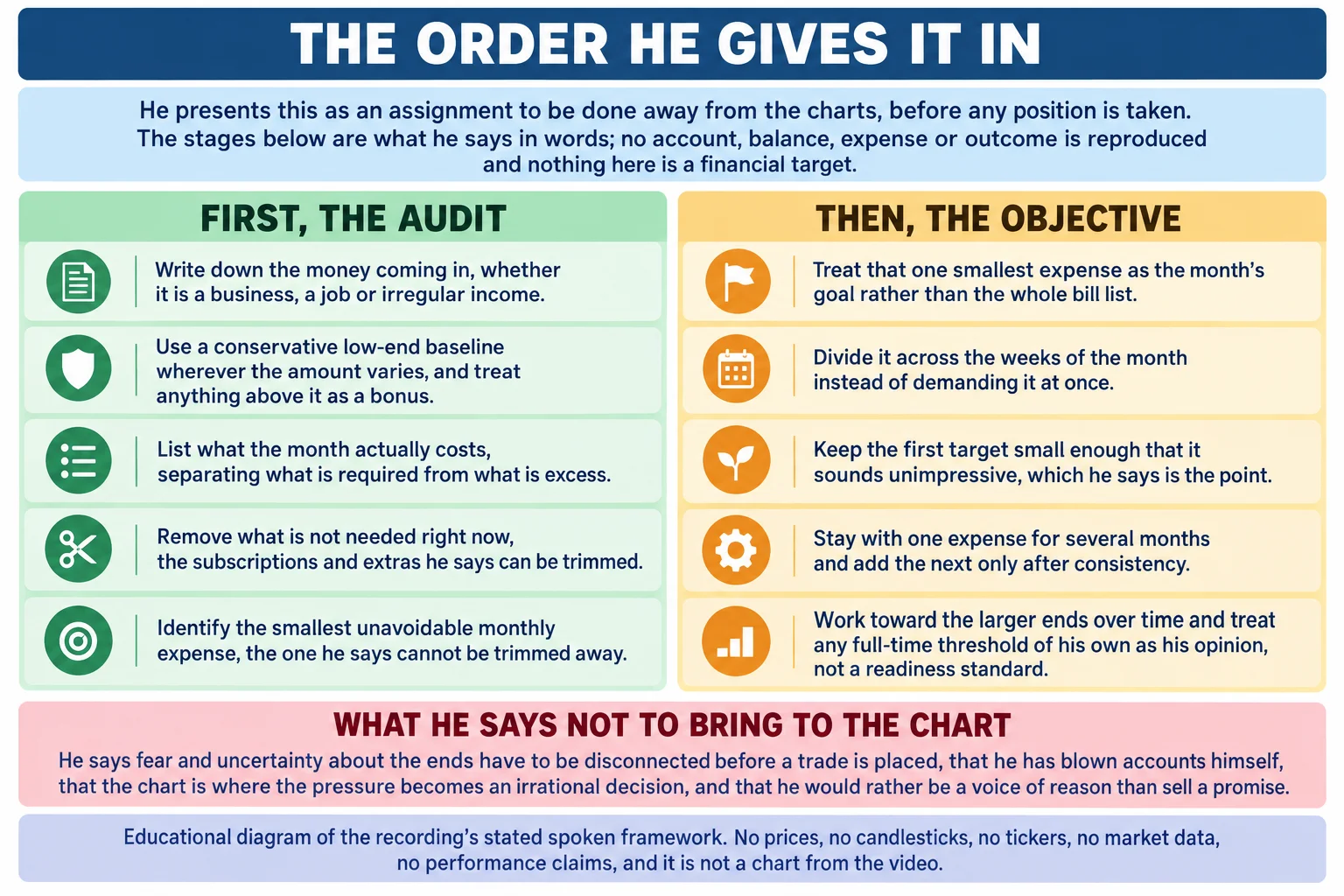
The exercise is introduced at 23:58. After the unnecessary spending has been removed, he tells viewers to find the least of their expenses — the smallest bill they have to meet every month and cannot trim away, which he distinguishes explicitly from subscriptions such as Netflix or Amazon Prime. That one expense, he says, is what to go into the month looking to trade for ( 24:07 , 24:11 , 24:17 , 24:22 ).
His proposed progression, in the order he gives it:
- Treat that smallest unavoidable expense as the month’s objective, rather than the whole bill list ( 24:22 )
- Divide it across the four weeks instead of demanding it at once; his illustration is $300 spread across four weeks ( 24:27 )
- Work out what that amount actually requires of the trading, which he says will sound unimpressive to newer traders ( 24:36 , 24:41 )
- Stay with one expense for a few months, then add the next one and build over time ( 26:15 , 26:27 , 27:06 )
- Aim eventually at the top of the list — mortgage or rent first — and treat covering about half of it as a meaningful step, then work toward covering the whole list and then doubling it ( 27:13 , 27:19 , 27:28 , 27:43 )
He then gives his own threshold: once that is consistent and the trader is properly funded, which he puts at about $100,000 or more, he says trading for a living is probably worth considering — and that anything before that is not ready ( 27:51 , 27:56 , 28:01 ). Both the $300 illustration and the $100,000 figure are his own numbers and opinions. They are not validated readiness standards, they are not derived from any account in the recording, and nothing in the transcript shows a trader reliably producing the returns they would imply.
ICT Mentorship Lessons for Better Trade Decisions
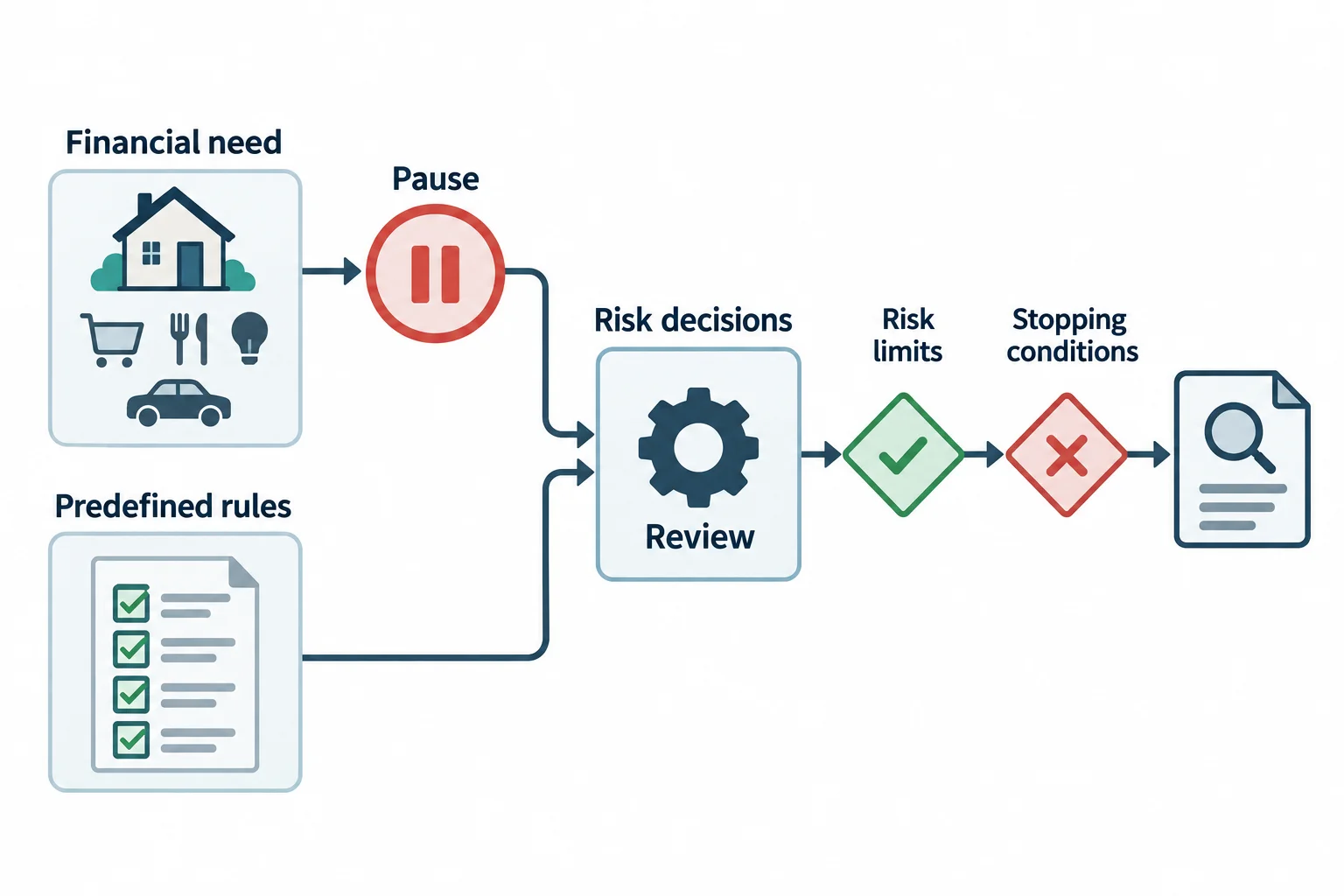
The most transferable lesson is not that trading should be expected to pay a bill. It is that a trader should identify the conflict between financial need and risk decisions. A market cannot be required to produce a predetermined return because rent, transportation or another expense is due, and a self-imposed deadline attached to that need is what he says turns a plan into an impulse ( 21:44 , 23:47 , 31:09 ).
A conservative reading of the exercise is therefore to use budgeting as a self-awareness tool rather than as a promise of trading income. Before risking capital, the question the recording raises is whether an intended position follows predefined rules or is being motivated by an urgent need for money. Risk limits, stopping conditions and a separation between essential expenses and speculative capital remain important regardless of the trading model being studied.
He closes at 34:53 by returning to the assignment: go through the personal finances, write down everything spent and everything coming in, use a conservative low-end baseline where income is variable such as tips, and remove what is not needed right now. He adds that this path should sit second only to family in a person’s life ( 35:35 , 35:57 , 36:09 ). This volume works as a financial-pressure audit that the later installments build on.
Watch the source recording
2022 ICT Mentorship – Ends Series Vol. 1
The Inner Circle Trader · watch page lists publish 29 July 2022 20:06 PDT, which is 30 July 2022 in UTC · 2,211 seconds, about 36 minutes 51 seconds · public, not unlisted. This recording is the primary source for every timestamp link on this page.
The recording is not embedded here. An embedded player was tested directly on 16 September 2026 from a BestProps page origin: the frame loads and then reports “Playback on other websites has been disabled by the video owner”, with no playable stream and no duration reported. The link above opens the recording on YouTube itself.
Resources
These are the sources checked while preparing this article. The CFTC pages are the regulator’s fraud advisories on commodity trading systems sold online and on forex, and the Investor.gov page is the SEC investor-education entry on day trading. None of them evaluates this speaker, tests any of the budgeting or readiness claims made in the recording, or endorses anything said in it. Any ICT, smart-money or third-party indicator, script, note set or re-upload circulating outside the publishing channel’s own page is unofficial and untested here.
- [1] 2022 ICT Mentorship – Ends Series Vol. 1 — The Inner Circle Trader (primary source; watch page read 16 September 2026, published 29 July 2022 20:06 PDT, listed at 2,211 seconds).
- [2] The Inner Circle Trader — official YouTube channel (read 16 September 2026) — the publishing channel for the 2022 mentorship series this recording belongs to.
- [3] U.S. Commodity Futures Trading Commission — Fraud Advisory: Commodity Trading Systems Sold on the Internet (read 16 September 2026) — notes that hypothetical trading results are typically simulations over historical data rather than real fills, which is the standard this article applies to unverified claims.
- [4] U.S. Commodity Futures Trading Commission — Fraud Advisory: Foreign Currency (Forex) Fraud (read 16 September 2026) — warns that the forex market is volatile and carries substantial risk, and that promises of profit are a common scam marker.
- [5] U.S. Securities and Exchange Commission, Investor.gov — Day Trading (read 16 September 2026) — the regulator’s plain-language warning that day trading is extremely risky and that most day traders lose money, relevant to any expectation of replacing employment income.
Primary source: ICT, “2022 ICT Mentorship – Ends Series Vol. 1”, The Inner Circle Trader; watch page publish 29 July 2022 20:06 PDT (30 July 2022 UTC), listed at 2,211 seconds. The transcript used was local automatic speech recognition of the recording’s full original audio and is not human-verified captions, so ambiguous wording is qualified rather than corrected silently. The recording’s charts are not reproduced anywhere on this page.
This commentary is for education only and is not investment advice. Trading involves risk, and neither the video nor this summary establishes that any model, target, budget or account progression will be profitable.