
Key takeaways
This is the fourth and final episode of the speaker’s four-part Ends series (0:10), and it is the one where he turns the 2022 mentorship model into a written plan rather than a chart lesson.
Read the full summary
This is the fourth and final episode of the speaker’s four-part Ends series (0:10), and it is the one where he turns the 2022 mentorship model into a written plan rather than a chart lesson. He frames it as an income exercise: a monthly dollar target, one E-mini S&P contract per trade, no scaling and no pyramiding, a single fixed target closed in full, and one fixed stop used on every trade, inside a morning and an afternoon window in New York time (3:47, 4:11). The selection logic is a checklist: decide whether the current weekly candle is likely to expand higher or lower, pick a reference extreme – previous week, previous day, previous session (5:06) – wait for price to reprice through it and then displace the other way with a market-structure shift, and take a fair value gap inside that displacement leg (7:00, 7:23). One condition overrides everything: if no fair value gap allows the fixed stop, he says do nothing rather than force a wider one (8:52). He closes with loss protocol, a one-trade-per-week limit, and an explicit statement that the approach is deliberately low frequency (41:36). Everything here is his stated illustration: the recording contains no fills, no results and no test of the plan.
How we researched this article
BestProps used document-based research from primary firm sources, checked September 24, 2026. The complete source list, scope, limitations, and commercial-state record appear near the end of this article.
In 2022 ICT Mentorship – Ends Series Part 4 of 4, the speaker converts the earlier 2022 model material into a set of operational rules. This article follows the recording in order and links each point to the passage it comes from.
Two limits run through it. He is describing his own method and his own hypothetical illustration, so everything below is reported as what he says rather than as a verified result, and the article does not repeat his dollar or point figures as performance. And the transcript is automatic speech-to-text of the audio rather than a checked caption track, so the renderings that are ambiguous are flagged near the end.
Who he says the lecture is for
He opens by warning that this material is useless to anyone who has not done the work – training, studying and backtesting the 2022 model the series is built on (0:36, 0:43). He says students in his private mentorship went through versions of this repeatedly and that a few complained the material was too vague, and he takes that complaint head-on: the rules only become meaningful once you have logged examples in hindsight and can recognise the formation (1:05, 1:26).
That framing matters for reading the rest of the lesson. What follows is not a demonstration on live charts; it is a specification of a process, and he presents it as the bridge between the plan and the practice of actually covering a monthly bill (2:13).
The plan he sets out
The illustration is deliberately concrete. He takes the cost of groceries as the case study, says it can be replaced with anything, and sets a monthly pre-tax target with roughly four opportunities per month (2:42, 2:54). He uses index futures – specifically E-mini S&P – as the vehicle for the example (2:58), and states a hypothetical starting account balance and a hypothetical per-trade commission, noting that the same approach could be run on personal funds or a prop account (3:12, 3:29).
The trade itself is fixed. One contract per trade, no adding, no pyramiding, and no increasing size as the account grows, because in his words this is an income approach (3:53, 3:56). He states a single objective in points or ticks, closed in full with no partials – one and done – and a hard stop that is static for every trade (4:22, 4:25, 4:14). His approximate after-commission figure per contract is offered as an illustration of the arithmetic, not as a result (4:07).
The operating hours are the regular-hours index futures sessions in New York local time: a morning window and an afternoon window, four hours in total, split in two (4:38, 4:43). One setup is enough: if it comes in the morning, he says, you do not trade the afternoon (4:56).
Where the setups are stalked
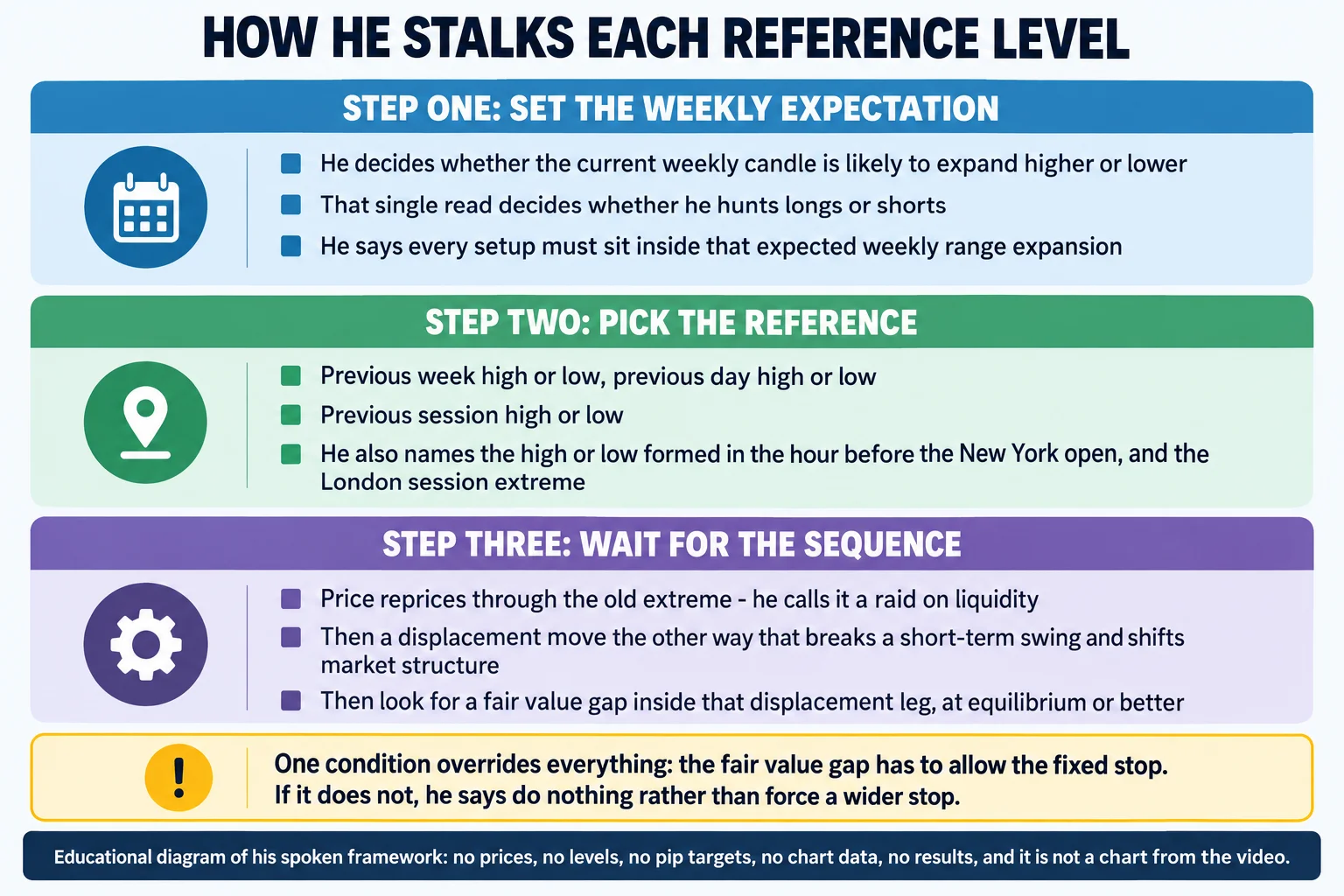
The selection rule is that every setup has to sit inside the expected range expansion of the current weekly candle (5:20). That one read decides the direction of the hunt, and he then walks the same logic through four reference types.
Previous week high. If he expects the weekly range to expand lower, he waits for price to reprice above the previous week’s high, moves down to the five-minute chart for setup formation, and treats that reprice as a raid on buy-side liquidity (5:43, 6:22, 6:48). He is explicit that he is not trying to short the run itself: he waits for price to break back below the high and take out a short-term swing low, which he reads as a bearish market-structure shift, and only then looks for a fair value gap (6:48, 8:02).
Previous week low. The long side is the same sequence inverted: when he expects expansion higher, he waits for a reprice below the previous week’s low, and looks in the displacement swing for a fair value gap (9:37, 10:17). Previous day high and previous day low follow the identical template with the day’s extreme substituted for the week’s, confirmed by displacement in the expected direction, then the same fair value gap search (11:04, 11:57).
Previous session high and low. Here he gets specific about what a session extreme is. For a morning setup he points to the high or low formed between 8:30 and 9:30 New York local time on the intraday chart, which he calls a key time because those are opening prices (13:24, 13:37). He says he will then look further back into the London session for a sweep of the London high, and notes that the day’s high is not always in that session – sometimes it comes just after midnight rather than in the pre-London window he calls his London open kill zone (14:12, 14:21). For an afternoon setup, the previous session is the morning, and he adds the lunch hour as another extreme the afternoon can run before continuing (14:34, 14:55).
In every one of those cases the instruction narrows at the same point. He drops from the five-minute chart into the four, three, two or one-minute to refine and select a fair value gap that permits the fixed stop, and if none does, the rule is to do nothing rather than force a wider stop (8:34, 9:01).
Why he wants the liquidity taken first
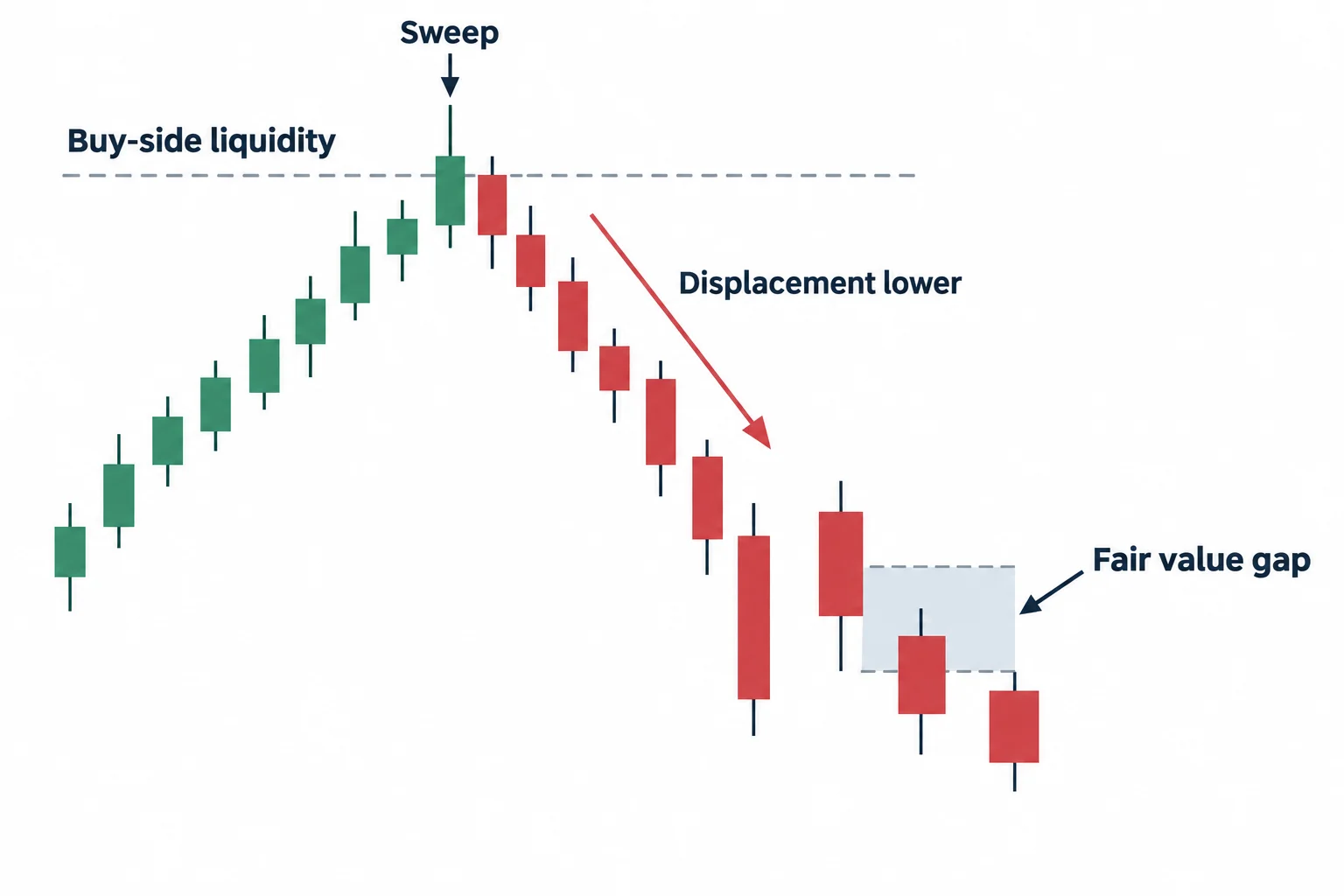
He gives the reasoning behind the ordering rather than leaving it implicit. When stalking shorts he wants to be engaging price after a raid on buy-side liquidity, because the buy stops resting above an old high are what set up the likelihood of a displacement lower; if the displacement happens and a fair value gap then forms, he says the likelihood of being onside improves (16:47, 18:06). The long side is the same logic inverted, after a raid on sell-side liquidity (19:33).
He adds a practical preference inside that: he likes to see an important high taken out or at least probed and then quickly rejected, because he is only looking for a small fraction of any larger draw on liquidity, and smaller objectives occur far more often during a day than large ones (18:39, 19:12). He also notes that he keeps his own chart essentially bare while recording, so the logic has to come from the setup list rather than from annotations (17:18).
This is also where his wider claims sit, and they are worth separating from the rules. He argues that the logic cannot stop working because markets are booked on liquidity and there will always be liquidity, that there will always be a larger entity using it, and that these are the core underpinnings of the marketplace rather than a fad (21:00, 21:08, 21:41). He illustrates the booking argument with limit-up and limit-down days in commodities, where price can lock at one level despite a crowd of participants wanting the other side, and concludes that moves are controlled rather than driven by aggregate buying and selling pressure (23:46, 26:22). Those are his assertions about how markets work; the recording offers no data to test them.
The two adjustments to the entry rule
He then adds two refinements for cases the base rule does not cover. The first covers a missed entry. After a significant setup has formed and the draw on liquidity has not yet been reached, a newly formed one-minute fair value gap can be used in the same direction, provided the gap is at or under five handles wide – most gaps, he says, do not fully close on re-delivery of price (29:23, 30:12). He notes he has used exactly this logic to add to positions, which is the one place the no-pyramiding rule is explicitly set aside.
The second covers a gap that is too wide to trade with the fixed stop. If the gap is wider than five handles, entering at its edge risks being stopped out on a return to the other side of the gap, so he says to place the entry at the midpoint of the gap – consequent encroachment – and add the fixed stop to that (34:24, 34:31, 34:36). If that attempt also fails, the protocol he gives is to wait for price to return to the gap edge, take the entry again on the retest if it comes back, and be done if it stops out (35:45).
The loss protocol and the weekly cap
He deals with the psychology of a stop-out directly. He says it will feel bad, that the response is not to add a contract to get it back, and that the rule is to wait and see whether the idea is still viable (31:58, 32:06). If the original idea is intact, the second attempt is taken at the fair value gap’s edge with the fixed stop, and if that fails too he says stop trading for the week, for two stated reasons – time to decompress, and the arithmetic of a third loss (32:47, 32:57).
The cap that results is one trade per week, and he keeps the objective small on purpose: a single strike, no doubles or home runs, and a clear refusal to compete on anyone else’s leaderboard (33:09, 33:33). If a week passes with no valid setup at all, he permits looking for a second setup the following week if there is a suitable news driver, and stops after that (39:10, 39:21).
What he says about frequency and preparation
He tells the viewer to expect to miss entries and to accept it, describing the approach as an income method rather than a competition, and repeating that the aim is one qualifying trade rather than participation in every move (36:25, 37:10). He says the plan requires patience for the specific combination of a fixed stop and a small yield on one contract, and that a wider gap may simply run without you (37:28, 38:05).
His preparation sequence is stated plainly: backtesting, understanding what you are looking for, then tape reading as price delivers, using live or replay study, then a demo period of about six months, and only after that a personal decision about live funds which he explicitly says he does not make for the viewer (39:58, 40:13, 40:30). He closes by calling the model a simple, rule-based, deliberately boring process that carries the load if used properly and causes trouble if overloaded (40:45).
What this article is not claiming
The recording is a specification, not a test. It contains no fills, no statement of which setups were taken, no realised outcome and no evidence that the fixed target is reached often enough to produce the illustrative monthly figure. The account balance, the commission and the per-contract dollar amount are inputs and arithmetic the speaker supplies for the example, and they are reported here as illustrations rather than as results or recommendations.
The liquidity, controlled-market and smart-money statements quoted above are his interpretation of how markets work. Nothing in the recording measures them, and they should not be read as established fact. His preparation advice – backtesting, replay, a demo period – is his own sequence, not a guarantee of anything.
Date and identity note
The upload date and the series position are separate facts. The YouTube watch page shows the recording published on 6 September 2022 and running about 42 minutes 46 seconds, while the recording introduces itself as the final episode of a four-part series titled Ends and refers throughout to the 2022 mentorship model (0:10, 2:02). Nothing in the audio dates the charts referenced, and this article does not date them.
A note on the transcription
This article was written from automatic speech-to-text of the original audio, not from a checked caption track, so a few renderings are ambiguous and are flagged rather than silently corrected. The word for the reference levels is transcribed as “stock” in the phrase “we’ll stock setups”, where “stalk” is meant (5:06). “Rate” appears where “raid” is meant (11:23), and “the quid” appears in one place where the sell-side extreme is meant (32:19). The term he uses for the midpoint of a wide gap is transcribed both as “consequent encroachment” and as “consequent encouragement” (38:00). Where the meaning was clear from context the normal term is used in this article; where it is not, the ambiguity is left visible.
Watch the original recording
2022 ICT Mentorship – Ends Series Part 4 of 4
The Inner Circle Trader · published to YouTube on 6 September 2022 · listed at 2566 seconds, about 42 minutes 46 seconds. The recording identifies itself as the final episode of a four-part Ends series. This video is the primary source for every timestamp link above.
The recording is not embedded here because the video owner has disabled playback on other websites. That was tested directly on 15 September 2026 from a BestProps page origin at both desktop and mobile widths: the embedded player loads and then reports “Playback on other websites has been disabled by the video owner”, with no playable stream and no duration reported in either case. The link above opens the recording on YouTube itself.
Resources
These are the sources checked for this article. The CME page is the exchange’s own contract overview for the instrument the illustration uses, and the CFTC advisory is the regulator’s note on trading systems sold to the public – relevant context for any plan of this kind, published by the body that regulates the market the example trades. Neither assesses this speaker or tests anything he says. Any ICT, smart-money or third-party indicator, script, note set, transcript pack or re-upload circulating outside the publishing channel’s own page is unofficial and untested here.
- [1] 2022 ICT Mentorship – Ends Series Part 4 of 4 — The Inner Circle Trader (primary source; watch page and metadata read 15 September 2026, published 6 September 2022, listed at 2566 seconds).
- [2] The Inner Circle Trader — official YouTube channel (read 15 September 2026) — the publishing channel for the 2022 mentorship series this episode closes.
- [3] CME Group — E-mini S&P 500 Futures overview (read 15 September 2026) — the exchange’s own contract overview for the instrument the illustration trades. Background on what that contract is; it contains none of the lesson’s rules or figures.
- [4] U.S. Commodity Futures Trading Commission — Commodity Trading Systems Sold on the Internet (read 15 September 2026) — the regulator’s advisory on claims made for trading systems sold to the public. Context for reading any rule-based plan, including this one; it is not a finding about this speaker.
Source: ICT, 2022 ICT Mentorship – Ends Series Part 4 of 4, The Inner Circle Trader, published 6 September 2022; the recording identifies itself as the final episode of the four-part Ends series. Captions were not available, so the transcript is automatic speech-to-text of the original audio under SHA-256 ed5dbf71c002b26f4c4f3104ec03073e0f09fea18976ca96c8bc41d340d7b2e8. Educational write-up of the speaker’s own stated plan; it is not trading advice, and no rule, fig