
Key takeaways
ICT’s 2022 Mentorship Ends plan targets one monthly household expense, illustrated by $1,000 in groceries before tax or $12,000 gross annually, using four theoretical E-mini S&P 500 futures trades per month in a $25,000 account.
Read the full summary
ICT’s 2022 Mentorship Ends plan targets one monthly household expense, illustrated by $1,000 in groceries before tax or $12,000 gross annually, using four theoretical E-mini S&P 500 futures trades per month in a $25,000 account. Each trade uses one ES contract, a fixed 5.25-point or 21-tick target, a static 4-point or 16-tick stop, no partial exits, no stop adjustments, an assumed $4 commission, and trading only from nine thirty to eleven thirty a.m. or one thirty to three thirty p.m. New York time. The bullish setup requires expected weekly expansion toward a premium array, a medium or high-impact news day, waiting until after the release, a five-minute sell-side liquidity sweep and upward displacement, then a buy limit at the fair value gap high on a lower time frame that permits the fixed stop, otherwise the trade is skipped without chasing. Bearish setups reverse the rules. One assumed winning setup per week produces about $250 per trade and $1,000 per month, described as 1% weekly and 4% monthly, while later examples scale to two or three daily wins, but these are theoretical calculations with no chart, fill, loss, slippage, tax, or verified outcome. Micros are suggested below $10,000, while personal capital or $20,000 to $50,000 funded accounts may substitute, though ICT reports no prop-firm experience or endorsement. The plan is intended only after studying, backtesting, forward-testing, and achieving four to six profitable demo months, with each account restricted to one expense-focused purpose rather than aggressive compounding.
How we researched this article
BestProps used document-based research from primary firm sources, checked September 25, 2026. The complete source list, scope, limitations, and commercial-state record appear near the end of this article.
This is the third installment of the four-part series he titles Ends. The first two parts covered the problem and the solution; this one he calls the plan 0:26, and he introduces it as determining a starting point and attacking one financial end 0:31. It is best read as a written mandate for a single account rather than as a strategy with a claimed edge. Everything below is attributed to the speaker: the recording states rules, a schedule and an objective, and contains no executed trade and no market data.
2022 ICT Mentorship Plan for One Monthly Expense
The plan inherits the framing of the earlier parts. He repeats that the problem is household income that does not cover recurring expenses, and that surplus money is bled away by nonessential items such as streaming services, which makes meeting those ends harder 1:26. The exercise he set earlier was to list every monthly bill and then choose the single lowest expense to attack first, and he is explicit that the reader’s chosen expense will probably differ from his own 1:57.
For his example he chooses food, in practice the grocery bill for the month 2:06 2:13, and sets a budgeted cost of one thousand US dollars a month before tax 3:11. He multiplies that out to twelve thousand dollars of gross annual income 3:20, notes that the amount would be taxed and that he is not working with a net result 3:25, and describes it as an initial objective to grow from rather than a permanent ceiling 3:33.
He also describes the expectations a beginning trader has to unlearn. He names social media promoters he calls frauds and scammers who present figures such as half a million dollars in a week from demo accounts or rented MetaTrader servers at offshore brokers, and says that is not what his channel is about 4:04. In place of that he describes a model built on a repeating price-action phenomenon, which he says is the 2022 mentorship model this series is applying 4:34 4:39.
The parallel example is personal. His son Caleb is using the same one-thousand-dollar figure for a car expense 4:55, building toward adding a utility bill, then car insurance, then fuel, then a rental or mortgage payment, for a working monthly figure he puts at somewhere between 3,600 and 3,900 dollars 5:26. The point he draws from it applies to everyone: an account built to meet ends is not intended to double every month or quadruple in six months 5:51, only to harvest the amount tied to those expenses, so that the accounts being grown are not traded under pressure to produce income 5:59.
2022 ICT Mentorship Account and Trading Schedule
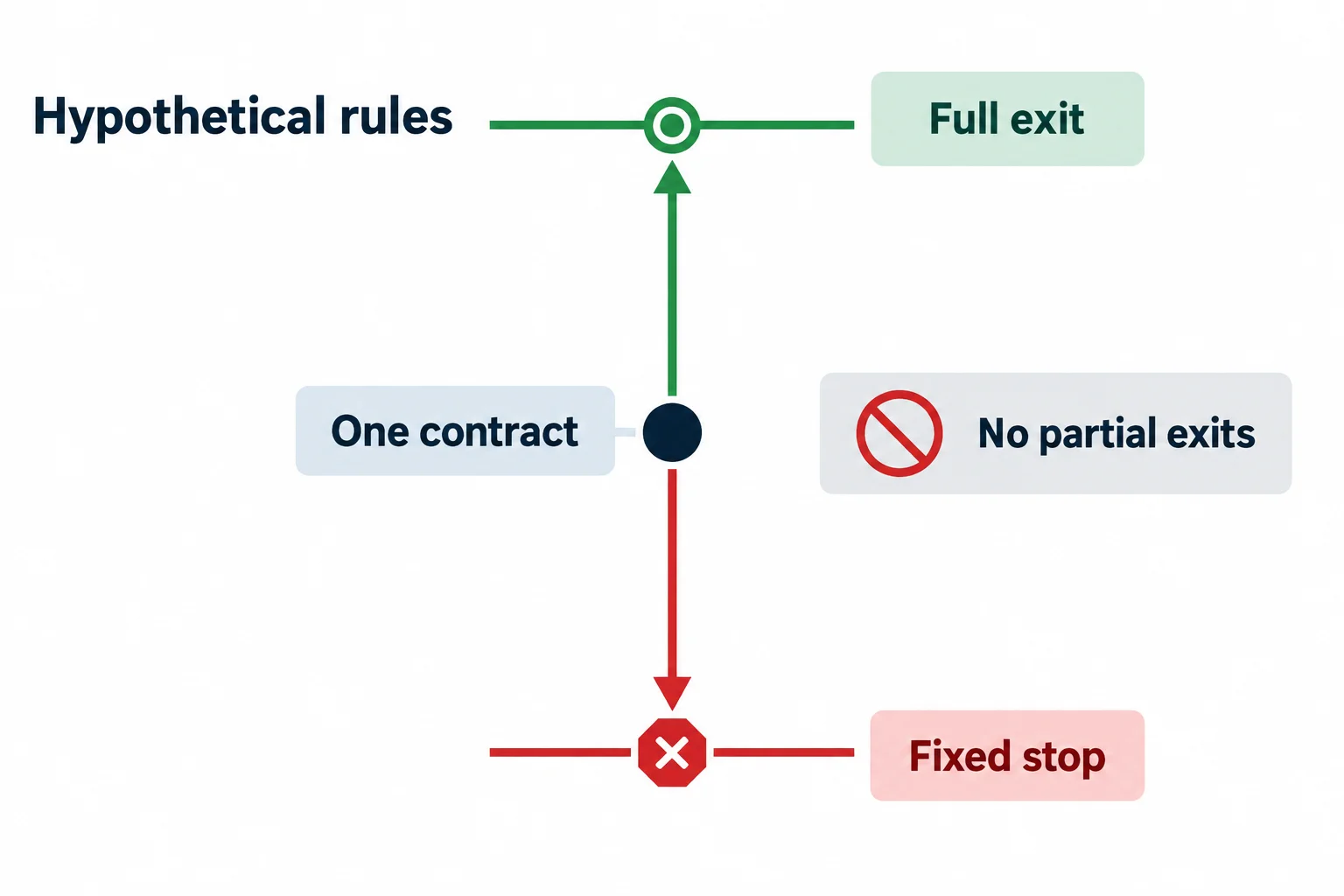
He narrows the case study to four intraday stock-index futures opportunities per month 6:41, says the reader can substitute forex if that is where they trade 7:02, and explains that he is sharing conversations he has with his son privately, in a way that keeps the reasoning on record 7:16. The stated assumptions are:
- A discount broker assumed to clear at four dollars of commission per trade, with the broker left unnamed 7:31 7:41.
- A starting account size of twenty-five thousand US dollars 7:46.
- One E-mini S&P 500 futures contract per trade 12:03, explicitly not multiple contracts 12:07.
- A target of five and a quarter points, or twenty-one ticks, per trade 12:15.
- A hard stop loss of four points, or sixteen ticks, static for every trade, never widened, never tightened 12:26 12:37.
- The full position closed at the objective, with no partial exits 12:47 12:52.
He raises the obvious objection himself: someone who cannot make ends meet does not have twenty-five thousand dollars. His answer is that funded and prop-firm accounts are a growing route to that capitalization, and he is careful about what he is and is not saying. He states that he has zero experience with them, that he has never used one and neither has his son 8:15, that he is deliberately not representing any provider and declined approaches to advertise them 8:23, while acknowledging that students of his have used several. He leaves the decision to the reader and suggests asking the community directly 8:43. The account could also be funded by personal savings or by withdrawals from a funded account 9:20 9:54, and he says an existing funded account of twenty to fifty thousand dollars would serve the same purpose 10:03. Traders with smaller balances can adapt the illustration by trading micros rather than minis, which he repeats for accounts under ten thousand dollars 10:53 10:59 11:07. None of that is due diligence on any broker or funding company, and he says as much.
The schedule is as fixed as the risk parameters. He states the monthly goal again as one thousand dollars 11:56, then restricts trading to two windows in index hours: 9:30 to 11:30 in the morning and 1:30 to 3:30 in the afternoon, both New York local time 13:11 13:25. He says no trade can be taken before or after those specific windows 13:32, calls it a four-hour window broken over two sessions in the same trading day 13:40, and if the five and a quarter points are not available inside them the instruction is to stop and move to the next opportunity 13:49.
2022 ICT Mentorship Plan Setup
The model section is a stripped-down application of the framework he taught through 2022. The directional premise comes off the weekly candle: he will look for buys only when he expects that weekly candle to expand higher toward what he calls a premium array 14:04 14:07, listing an old high or a fair value gap as examples. One phrase in that passage is rendered by the transcript as “bear shoulder block” 14:14, and it is clearly a misrecognition: the sense of the surrounding sentence is a draw on liquidity that leads price higher, not a shorting opportunity 14:22. No close above the weekly open is required 14:28, only an expectation of volatility and range expansion to the upside 14:35 14:43. For periods when he expects the weekly candle to draw to a discount array and expand lower, the instruction is simply to reverse every rule 20:42 20:47.
Day selection is news-driven. He screens the economic calendar for medium or high impact news drivers to narrow the week 14:55, does that analysis over the weekend for the coming week 15:09, and says he would focus primarily on the morning releases 15:39. He gives the reason: afternoon events are often interest-rate or Fed-related, and the volatility can make the four-point stop a problem in the afternoon session 15:58, whereas the morning is more forgiving once 9:30 has passed 16:03 16:09. Crucially, the plan does not pre-position. He says he is not trying to predict the reaction to the news; he waits for the news to hit the market and only then starts hunting a setup 16:20 16:23 16:30 16:34.
From there the sequence is the one he says he has been teaching, only shortened. On the five-minute chart he waits for sell-side liquidity to be taken 16:40 16:43, then for displacement higher in price 16:46, then hunts a fair value gap within that displacement leg 17:33 and places a buy limit order at the high of the gap 17:41 17:47 17:52. The fixed stop is what selects the time frame rather than the other way round: he steps down through the lower time frames and uses whichever one permits the four-point stop 18:01 18:11 18:28 18:38, and if none of them does, the trade passes with no exceptions 18:05. Exit is a sell limit order at five and a quarter points, which he says covers the commissions and nets the five-point goal per trade 18:52 18:57.
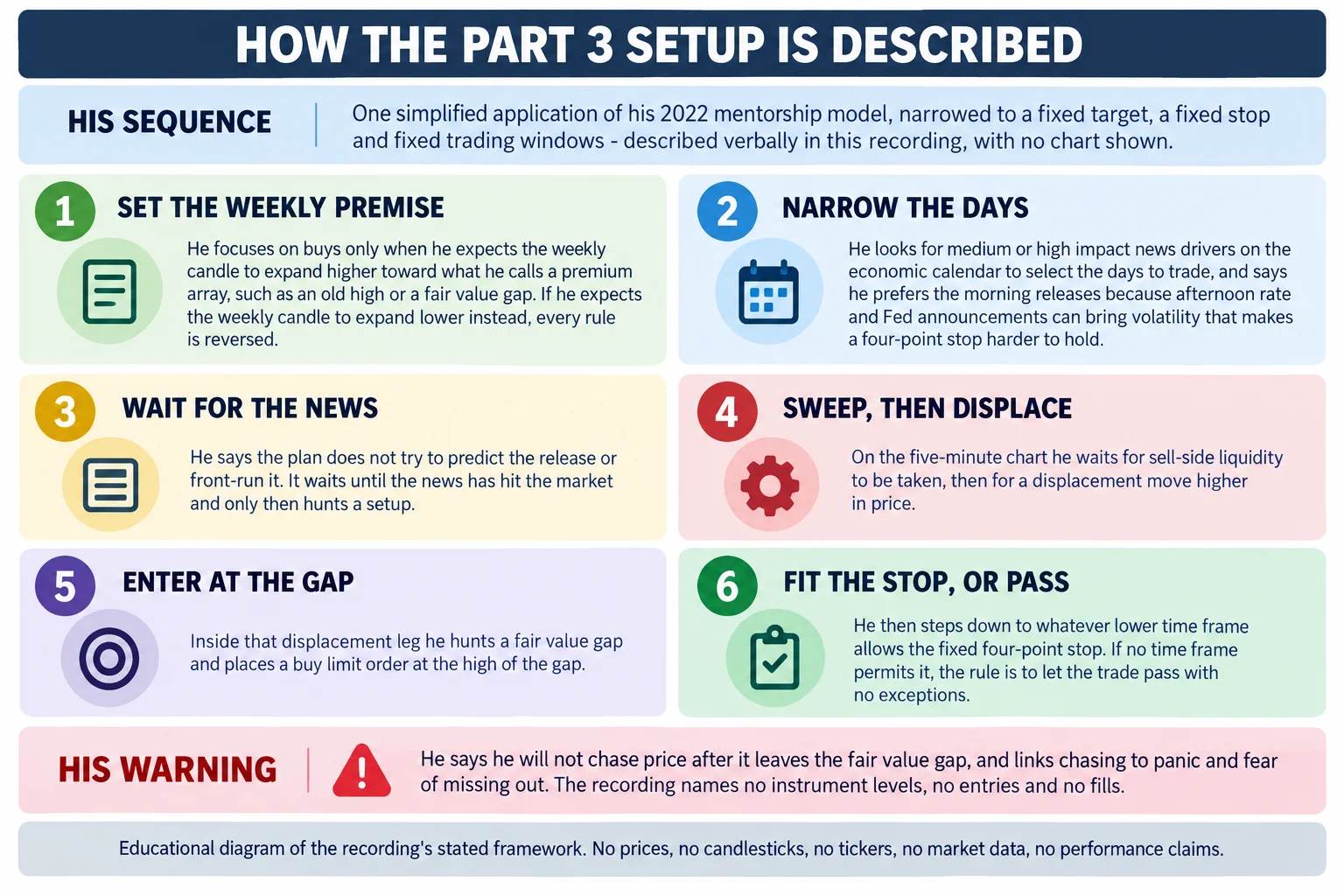
The behavioural rule he spends the most time on is the refusal to chase. If price leaves the fair value gap without filling the limit order 19:08 19:15, or stays just close enough to tempt an entry after the fact, the instruction is still to let it pass 19:28. He explains that he added the rule because he expects the trader to be panicked 19:39, says fear of missing out leads to an impulsive entry that will not honour the four-point stop 19:44 19:50, and describes the outcome as either a stop-out or a worse placement 20:01. His reasoning here is psychological rather than technical, and he states it as his expectation of how traders behave.
2022 ICT Plan Profit Calculations
He proposes hunting a single five-point setup per week, harvesting it, and stopping for the week 20:23 20:27, saying that one such setup a week is all he thinks a trader needs to find 20:18. Four weeks at one setup each, he says, nets one thousand dollars “in theory” 20:35. He then reworks it against the twenty-five-thousand-dollar account: five and a quarter points after commissions is a two-hundred-and-fifty-dollar net per trade 21:53, four of them is a thousand dollars a month 22:01, and that is one percent a week, or four percent a month 22:18, which he calls not an Olympic-level feat 22:26.
That is the point in the recording most likely to be misread, so it is worth being precise about what it is. It is arithmetic on an assumed win, not a result. There is no losing week in the illustration, no slippage, no change to the assumed commission, no tax on the twelve thousand dollars of gross groceries, and no allowance for weeks in which no qualifying setup appears inside the two windows, a real possibility, given that the four opportunities are drawn from named news days rather than from every session. His own wording is “in theory” 20:35.
What a reader can check independently is the contract arithmetic underneath it. The CME Group’s published specification for E-mini S&P 500 futures lists a contract unit of fifty dollars times the S&P 500 index and a minimum price fluctuation of 0.25 index points, which the exchange values at twelve dollars and fifty cents. Applying that published unit to the numbers he uses, twenty-one ticks of a quarter point each is five and a quarter points, and five and a quarter points on a fifty-dollar multiplier is two hundred and sixty-two dollars and fifty cents gross before costs. That derivation is ours from the exchange specification, not a figure he states; his own net estimate of about two hundred and fifty dollars already accounts for his assumed four-dollar clearing cost.
Later he extends the same arithmetic upward as experience grows: one setup in the morning plus one in the afternoon doubles the monthly figure 25:43 25:47, adding a second morning setup takes it to three thousand 25:59 26:07, and he suggests those hauls could accumulate further 25:36. He supports the plausibility with his own read that five and a quarter points of movement is easy to find several times on a volatile day 26:53, and that the calendar spreads qualifying days across the week rather than clustering them 26:32. Those are his interpretations of market behaviour. The recording does not demonstrate them, and this scaling section assumes every additional trade wins.
Who the ICT Mentorship Plan Is For
He is direct that this is not a beginner’s plan. He says a viewer who has just found the channel, never backtested and never studied the 2022 mentorship model will not find this easy 22:37, and that it is intended for someone who has gone through the mentorship, backtested it, forward-tested it and been profitable on demo for a few months 22:44 22:50, which he puts at four to six months 22:56. He warns that wanting to move faster is a route to losing, and names the flawed logic of concluding that the model does not work because it did not work quickly enough 23:14. He also says the model is not intended to beat any other trader or to be weighed against someone else’s course or market-replay routine 23:14.
The organising idea of the closing section is that an account should have exactly one function. Growth accounts, and a competition account if he ever ran one, would carry their own unique rules and expectations rather than sharing one 24:14. He compares each account to a storefront: a shop that sells shoes does not also sell pizza 24:26 or ice cream 24:35, and an account is not a kitchen-sink operation 24:46. The idea he wants taken from it is limiting an account to one specific endeavour 24:52. The account in this plan exists to make ends meet, is never designed to multiply, and is harvested every single month back to a set working balance 25:09.
2022 ICT Mentorship – Ends Series Part 3 of 4
The Inner Circle Trader · watch page lists upload 26 August 2022 · 1762 seconds, about 29 minutes 22 seconds. This is the recording every timestamp link on this page points at.
The recording is not embedded here. An embedded player was tested directly on 15 September 2026 from a BestProps page origin at desktop and mobile widths: the frame loads but then reports “Playback on other websites has been disabled by the video owner,” with no duration and no playback progress, while the video itself is publicly playable on YouTube. No half-working player is left on this page.
What the 2022 ICT Plan Does Not Prove
Part 3 is a rulebook, not a demonstration. He closes by saying the final part will show what the ideas look like in chart form and in execution format 28:56 29:04, which tells you what this installment is missing: no chart, no named instrument level, no entry, no fill and no result. The four-trades-a-month route to one thousand dollars, the one-percent-a-week framing and the four-percent-a-month comparison are hypothetical arithmetic on assumed wins. The labels he uses (premium and discount arrays, fair value gaps, sell-side liquidity, displacement) are his own vocabulary, and this recording does not test them as predictive phenomena. Nothing in it is a recommendation to take a position, and an account harvested monthly to cover living expenses is by design an account that is exposed to the market every month.
More on the 2022 ICT Mentorship Plan
The sources below were checked on 15 September 2026. The first is the primary source; the rest are official or regulatory references that bear on how the figures here should be read.
- [1] ICT, 2022 ICT Mentorship – Ends Series Part 3 of 4 The Inner Circle Trader (watch page read 15 September 2026; upload date listed as 26 August 2022; listed duration 1762 seconds; publicly playable). The primary source for every claim in this article.
- [2] CME Group, E-mini S&P 500 Futures Contract Specs (read 15 September 2026), the exchange’s official specification for the contract used in this illustration, listing a contract unit of 50 dollars times the S&P 500 index and a minimum price fluctuation of 0.25 index points valued at 12.50 dollars. Cited for the tick and multiplier arithmetic only.
- [3] U.S. Commodity Futures Trading Commission, Fraud Advisory: Commodity Trading Systems Sold on the Internet (read 15 September 2026), states that signals from trading systems are typically technical analyses of trading data, that technical analysis attempts to predict future price movements from historical prices, and warns that hypothetical trading results are typically simulations over historical data rather than executed trades. Directly relevant to reading a monthly income figure built on assumed wins.
- [4] U.S. Securities and Exchange Commission, Investor.gov, Day Trading (read 15 September 2026), describes day traders as rapidly buying, selling and short-selling throughout the day over very short holding periods and states that day trading is extremely risky and can result in substantial financial losses in a very short period of time. Relevant to a plan built on frequent intraday index trades.
2022 ICT Mentorship Transcription Note
The narrative above was written from a local automatic speech-recognition transcript of the full original audio, not from human-verified captions, and the review did not watch the recording. All 282 segments covering the