
Key takeaways
This is part two of the four-part series ICT titles Ends 0:00:07, and after part one described the problem, this installment is what he calls the solution 0:02:27: additional income 0:02:38.
Read the full summary
This is part two of the four-part series ICT titles Ends 0:00:07, and after part one described the problem, this installment is what he calls the solution 0:02:27: additional income 0:02:38. The lesson contains no chart analysis at all. His advice is to keep the job while the skill is built 0:11:48, cut expenses first 0:10:17, and treat trading as one business activity rather than an urgent source of bill money 0:03:13. He sorts income into employment, investment and business categories 0:08:39 and argues that most of the effort belongs in long-term tax-deferred retirement accounts rather than in drawing spending money out of a small retail account 0:16:52 0:17:19. From there he describes income that can be earned from the skill itself before any live trading — commentary, videos and livestreams, advertising, affiliate arrangements, analysis and signal services 0:27:15 0:27:33 — and treats funded-account programs as one route to size that he does not endorse by name 0:44:24 0:45:12. Throughout he is explicit about limits: he says no mentor can promise success or that a listener will get there 0:02:07 0:12:01, states that he is not a CPA or tax adviser and that listeners should take the questions to licensed professionals 0:13:55 0:14:27, and closes with a warning against importing outside methods wholesale 1:10:45 1:10:58. The recording reports no fills, no account results and no verified earnings; the income figures he quotes are his own account of his own channel.
How we researched this article
BestProps used document-based research from primary firm sources, checked September 25, 2026. The complete source list, scope, limitations, and commercial-state record appear near the end of this article.
In 2022 ICT Mentorship – Ends Series Part 2 of 4, the material is personal finance and mindset, presented as a companion to what he teaches about reading charts rather than as chart instruction itself 0:00:23 0:01:12. He frames it as a creative prompt rather than a formula, saying his intention is to spur the viewer’s own creativity and that trading is a solo activity the viewer has to tackle alone 0:00:42 0:00:48. He also says plainly that the series will not match everyone’s personal circumstances or limitations 0:00:36.
He positions the series as the one he would recommend to someone who has already tried and lost 0:01:50, and specifically to people who have not yet traded live money 0:01:54. The honesty about outcomes is worth recording because it shapes everything that follows: he says he cannot promise success and that no mentor can 0:02:07, and that he will not co-sign a guarantee of making money 0:02:10. What he does claim is that these insights give a better starting position than none 0:02:15.
Part one was the problem; this is the solution
He recaps the first episode as the problem: with a job there is only so much income, which he describes bluntly as just over broke 0:03:37, and living expenses vary from person to person, with some people carrying far more extravagant lifestyles and costs 0:03:49. He speaks from his own history here, describing a period where he had very little understanding of what it felt like to have money in the bank and used a cheque-cashing service that charged a fee 0:03:59 0:04:10. The conclusion he draws is that more income has to come from somewhere 0:02:38 0:04:16.
He is realistic about the obvious alternatives. Employment income is static, limited to whatever the employer values the skill at, with overtime as the only extension 0:04:22, and he describes working a second job as genuinely hard from experience — two full-time jobs leave no life and run the body down, and a full-time plus part-time arrangement is also difficult 0:04:47. If a second job is not practical, he says not to be ashamed or discouraged, because what he is proposing could open a broader set of options 0:05:10 0:05:13.
The solution he proposes is an additional income source through learning to read these markets 0:02:54, and he is careful with the framing: it could be a possible income stream, not a promise or a guarantee 0:02:54. He also warns about the emotional trap of early success, saying that most people meet a bout of initial luck and mistake it for skill, as he did when he was too immature to understand what the markets would likely do 0:05:59 0:06:11 — and that once someone has felt a profitable live account, that experience is hard to forget 0:06:22.
Keep the job, trim the costs, invest in yourself
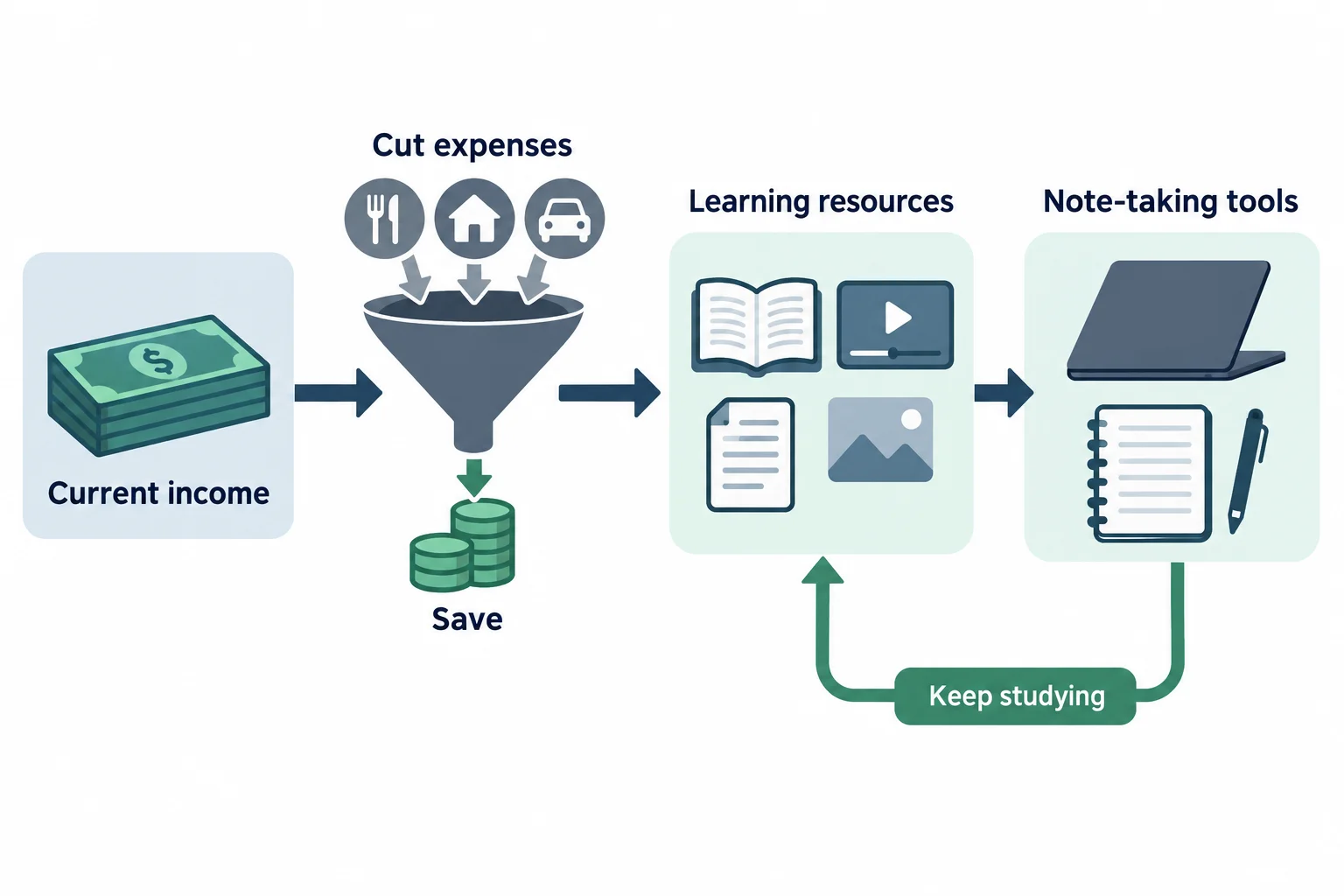
The first practical instruction is to keep the current income. He says to be thankful for a paying job even while acknowledging it may be unsatisfying 0:06:57, reminds viewers that trading is not yet an income stream while they are still learning or breaking even 0:07:10, and calls someone who is not blowing accounts a good position from a career standpoint 0:07:21. He points out that a spouse or children rely on that income as much as the earner does 0:07:53, and says it is normal to want out of the rat race but not to be so impatient as to leave before being ready 0:08:01.
He tells viewers not to spend frivolously, to save, and to cut expenses, repeating the episode one instruction to trim the fat 0:10:06. The money saved should partly go into study: he names computers, learning resources and note-taking tools rather than courses, and describes those as modest but real costs 0:10:22 0:10:31. His argument for the free teaching is that he is giving away experience he gained by losing and making real money, and that a mentor who cannot earn from what they teach is limited as an educator 0:11:42. The instruction is unambiguous: keep the job 0:11:48, because it is going to be needed, with the ideal being to replace that income over time rather than immediately 0:11:52 0:09:28.
He does add one qualification that is easy to miss. Replacing the paycheck may seem impossible right now, and he says it is possible — but not for everyone, and he is not guaranteeing it 0:12:01.
Three categories of income
He then lays out three broad classifications of potential income 0:08:39: employment income from the job, investment income from money put to work, and business income generated by a skill or an audience. His framing device is the idea of incorporating yourself — treating yourself as the entity, with streams pouring into that entity and being used to create more income, rather than being limited to whatever an employer pays 0:08:44. The goal, stated as an aspiration rather than an expectation, is that this builds up until it can replace the necessity of employment income, and he says explicitly not to expect that right away 0:09:20 0:09:28.
Investment income: speculation versus the long game
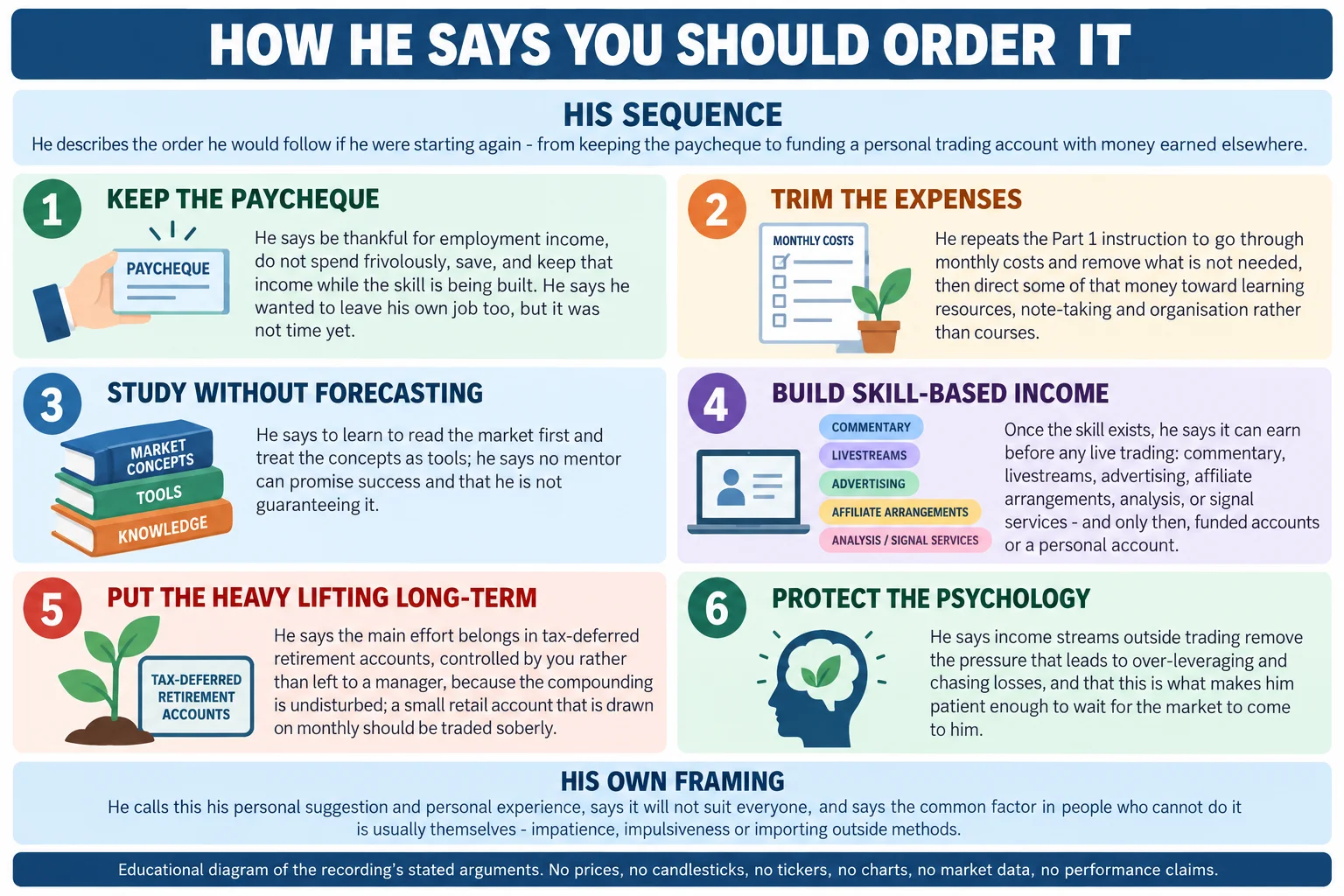
Within investment income he draws a sharp line. On one side is straightforward retail speculation, where someone opens an account and tries to make money with it 0:16:12. On the other are tax-deferred vehicles such as IRAs, Roth IRAs and 401ks, which he says can build very large retirement sums, where the untaxed growth compounds because large portions of the gain are not handed over each year 0:16:17 0:16:27. His conclusion is that the heaviest lifting should go into accounts like that, not into repeatedly drawing on a small retail account 0:16:52. He says accounts used to meet monthly expenses should be traded soberly, in the manner this series has been describing, while the compounding work happens in the long-term vehicles 0:17:19 0:17:52.
He also gives a specific instruction about workplace accounts: if a company IRA exists that the person does not actively invest in, he says to roll it into a self-directed IRA where the trading decisions are under the owner’s control, and to maximise contributions each year 0:26:34. He argues this returns control that would otherwise sit with a money manager, and criticises managers who take credit when markets rise and tell clients to average in when they fall 0:31:59 0:32:07.
He acknowledges how seductive the alternative is, describing his own younger self projecting returns from a small account the way a new forex trader projects pip income 0:18:44, and naming the twelve percent average stock return that mutual funds sold on 0:18:37. The contrast he wants drawn is between chasing immediate wealth and meeting needs modularly, one bill at a time 0:19:07 0:19:18.
One important limit on all of this: he states that he is not a CPA, not a tax adviser and not a financial adviser 0:13:55 0:14:07, and that the purpose of the discussion is to hand viewers the right questions to take to the professionals who handle taxes and entity formation 0:14:27. He also confines his specific knowledge to the United States, saying he is speaking directly to the American audience and cannot advise elsewhere 0:15:36. Everything in this section should be treated as his personal understanding in 2022 rather than as tax guidance.
Business income from the skill, before any live trading
The most distinctive argument arrives when he turns to business income: once someone learns to do this, he says, they do not have to trade a live account 0:26:51. He raises students in impoverished countries with very little money and asks how they are supposed to fund trading 0:27:00, then gives the answer he says he gives them: publish trade calls or analysis on their own channel, where sharing an opinion grows an audience, and an audience can translate into advertising revenue 0:27:15 0:27:20 0:27:33. His point is that this income can exist before any live account does 0:26:51.
He extends the list to signal services 0:28:58, which he says he does not run himself and explicitly declines to offer 0:28:58, while acknowledging that many of his former students do because it is, in his words, easy money 0:29:08. He says the skill required is consistency: calling key levels where price should react and where it should draw next 0:29:26 0:29:36. He argues that market reviews are a weaker route precisely because he himself publishes them 0:39:35. On growing an audience he says the best rule is to be genuine — talk about limitations, show weaknesses, and be consistent and honest 0:30:06 — and he suggests giving signals away free for at least a month so people can test them before paying 0:30:28.
He then gives his own figures, which should be read as reported personal experience rather than as a benchmark. He says his YouTube channel currently averages about fifteen thousand dollars a month, that it was once fifteen hundred dollars or less when he was not publishing 0:34:01, and that monetisation only happened later on his son’s suggestion 0:34:07. He attributes the earnings partly to keeping overhead thin, saying he carries no advertising expenses and pays nobody to promote him 0:35:18. He also describes advertising and affiliate arrangements as available avenues 0:37:31 0:38:04, including offers he says he received and declined 0:38:15 0:38:33, and states that a channel can eventually approach companies for placements 0:38:04.
Two of his claims in this section need separating from the rest. He says a signal provider who is genuinely good can make six figures a month without trading live 0:36:20; that is an assertion about other people’s income, not a verified figure, and the recording offers no evidence for it. And when he says viewers do not need money to start, only the skillset 0:37:18, the context is business income such as content or services rather than trading returns.
Partnerships and funded accounts
He describes a further consequence of having the skill: people with capital looking for a partner who understands markets 0:41:51, with offers he says he has received at 60–40 or even 70–30 terms 0:42:14. He says trading other people’s money is not the approach he takes and he describes it as very stressful 0:42:34, and for anyone who does want it he is specific about the conditions: proper accreditation such as the Series 3 or Series 7, and a lawyer-drafted partnership agreement setting out the limits, so that acting outside those limits has defined consequences 0:42:48 0:43:10.
Funded accounts are then offered as a pragmatic alternative to capitalising a retail account by hand. He says to put a large personal deposit off for now and go through the funded-account route if it suits the person’s situation 0:44:24, on the argument that the capital outlay is minuscule compared with opening an account with ten or twenty thousand dollars 0:44:37. He suggests using payouts from a funded account to seed a personal retail account 0:45:41, calls it a better approach than funding that account directly 0:45:17, and is explicit that he is not recommending any particular firm 0:45:12. The recording evaluates no provider, contract, fee structure, failure condition or payout record, so none of that should be inferred from it.
Running it like a business, and the psychology it buys
The stated end goal is a personal retail account funded by money earned from one or more of these streams 0:46:36, and he argues that having those streams removes the excuse not to learn 0:46:47. His reasoning is psychological and he returns to it repeatedly: tell someone to stop worrying about money and they cannot, because scared money makes no money 0:46:54 0:47:04. He paints the alternative vividly — a mortgage payment due in two weeks, money spent over the weekend, over-leverage and a missed payroll — and contrasts it with having enough income coming in that a single trade does not matter 0:47:28 0:47:50. In that state, he says, the trader does not need the trade to work 0:47:50, and will not feel rushed to win a loss back 0:48:20.
He illustrates the business mindset with a personal anecdote about a property purchase. He says he offered a hundred and twenty thousand dollars below the asking price 0:48:53, was kept waiting until twenty minutes before his offer expired, and then declined to raise it, letting the offer lapse 0:49:41. His stated point is that a younger version of himself, not money-management minded, would have paid the asking price just because he could 0:50:00. The lesson he draws is about predetermined limits rather than about the property, and the property itself is not something a reader can verify from the recording.
He also makes a broader claim about tax treatment that should be flagged as opinion rather than established advice. He says business ownership lets him write off vehicle costs 0:59:17, utilities such as his phone bill 0:59:40, healthcare 1:00:04 and, for 2021 and 2022, restaurant meals 1:03:42; he describes company vehicle leases as fully deductible in his situation 0:57:26, and says his tax preparation costs about seven thousand dollars a year and is itself deductible 1:11:46. His general conclusion is that he pays less tax than someone on a high salary and that this is legal 1:03:01 1:03:15. He also states a specific contribution figure he associates with owning a business 0:53:00 and again with his own salary arrangement 1:01:03. These are his personal circumstances as he describes them in 2022, not tax advice, and he says so.
His summary of the mindset is to enter this as a business rather than as an image project: not the Instagram-rich version, but the question of how many income streams the skill can generate so that everything depends on one retail account 1:08:21 1:08:35. He says confidence from those streams does not become overactive or over-leveraged trading but a sober, principle-oriented approach that acts when it is the best time rather than from fear of missing out 1:08:55 1:09:02 1:09:17.
2022 ICT Mentorship – Ends Series Part 2 of 4
The Inner Circle Trader · watch page lists upload 5 August 2022 (19:59 US Pacific) · 4586 seconds, about 76 minutes 26 seconds. This is the recording every timestamp link on this page points at.
The recording is not embedded here. An embedded player was tested directly on 15 September 2026 from a BestProps page origin at desktop and mobile widths: the frame loads but then reports “Playback on other websites has been disabled by the video owner,” with no duration and no playback progress, while the video itself is publicly playable on YouTube. No half-working player is left on this page.
Debt, and who this is really for
Near the end he returns to the costs he skipped in part one, starting with credit card debt. He says he did not forget it, and that a striking number of people use credit cards to pay the very bills being discussed 0:51:39 0:51:44. His advice is to route one of the new income streams at the debt 1:14:04, and he calls credit card debt a stranglehold that has to be escaped 1:13:57. He also discloses his own history, saying he filed bankruptcy in 1998 for personal reasons he describes as selfish rather than because he could not afford it 1:13:34.
The closing section is unusually candid about who will get value from this. He says he intends to be retired in his forties and that he did it, but also that a viewer may not get there as quickly and that he genuinely does not know how long it will take 1:09:42 1:10:02. He says some people may not be able to do it at all, and that this is not the fault of the system or the market but something the person is wrestling with 1:10:05 1:10:11, and he names the common pattern he sees: impatience, impulsiveness, or arriving with an established method and refusing to set it aside 1:10:34 1:10:45. He offers his own channel’s results as the closest thing to evidence he provides, saying students have been passing funded accounts and taking real withdrawals rather than demo dollars 1:15:35 1:15:37.
He closes by previewing the rest of the series: the third episode gives the plan, meaning how he would personally approach the money-making side after becoming a consistently good analyst, and the fourth covers live executions and the real-money part of it 1:15:49 1:16:09 1:16:14. That preview is the clearest statement of what this installment is not: there is no trading plan, no entry rule, no stop, no target and no reported trade anywhere in it.
What this recording does not establish
Almost everything in part two is argument rather than demonstration, and the distinctions matter. There is no chart analysis, no entry, no fill and no account result in the recording. The c