Buyer-first forex comparison · reviewed July 25, 2026
FTMO vs The Trading Pit Buyer’s Scorecard
Compare the same account size and the same evaluation type. Then compare total attempt cost, how daily and maximum loss are calculated, whether drawdown is static or trailing, the funded-account rules, platform fit, and evidence of trust. Branded challenge names identify products; they are not decision criteria by themselves.
| Decision point | FTMO | The Trading Pit |
|---|---|---|
| Profit target (2-Step) | 10% (Challenge), 5% (Verification) | Varies by program and tier (confirm on official site) |
| Daily loss limit | 5% of initial capital (2-Step) | Varies by program and tier (confirm on official site) |
| Profit split | 80% (2-Step), up to 90% with Scaling/Premium; 90% on 1-Step | 50–80% on CFDs and up to 70–80% on Futures, depending on Scaling Plan progress |
| Payout cadence | After becoming an FTMO Trader, on a regular withdrawal cycle | Every 14 days for amounts above $100 once requirements are met |
Advanced checks before paying
- Calculate all-in attempt cost: evaluation or subscription fee, resets, activation, data or platform fees, and payout charges.
- Convert drawdown into a per-trade loss budget and model your normal losing streak.
- Audit funded-stage consistency, qualifying days, minimum balance, payout cap, number of payouts, scaling, and live-account transition.
- Check the contracting entity, recent complaint themes, support answer for your strategy, and a smaller first payout before scaling purchases.
This scorecard surfaces only decision rows without unresolved verification placeholders. Keep each row tied to the exact account size and program described; verify current checkout and official rules before purchasing.
Last verified: June 2026. Prop-firm rules, fees, and country access change often, so confirm current terms on each firm’s official site before buying.
Choosing between The Trading Pit and FTMO comes down to one question: what do you actually trade, and how do you want to get paid for it? FTMO is built around forex and CFD traders who want a clean, well-known two-step evaluation and a high profit split. The Trading Pit is built for traders who want choice, especially futures traders, with separate CFD and futures programs and a scaling plan that grows your account as you stay profitable. This guide compares both firms on evaluation rules, account sizes, profit splits, payouts, scaling, and the markets they support, so you can match the firm to the way you trade.
The Trading Pit vs FTMO at a Glance
| Feature | FTMO | The Trading Pit |
|---|---|---|
| Evaluation model | 2-Step Challenge + Verification (1-Step also offered) | Challenge with a Scaling Plan (CFD and Futures tracks) |
| Account sizes | $10,000, $25,000, $50,000, $100,000, $200,000 | Multiple tiers across CFD and Futures (e.g., Futures Classic from $20,000; CFD plans scaling from $100,000) |
| Profit split | 80% (2-Step), up to 90% with Scaling/Premium; 90% on 1-Step | 50–80% on CFDs and up to 70–80% on Futures, depending on Scaling Plan progress |
| Markets | Forex, indices, commodities, crypto, stocks (CFD) | Forex, CFDs, crypto, and a dedicated Futures program |
| Scaling | 25% balance increase and 90% split when Scaling Plan conditions are met | Tiered scaling: e.g., $100K account scales +$25K per payout (first four), then +$50K |
| Payout cadence | After becoming an FTMO Trader, on a regular withdrawal cycle | Every 14 days for amounts above $100 once requirements are met |
| Profit target (2-Step) | 10% (Challenge), 5% (Verification) | Varies by program and tier (confirm on official site) |
| Daily loss limit | 5% of initial capital (2-Step) | Varies by program and tier (confirm on official site) |
Note: exact fees, drawdown percentages, and tier names change often. Treat the table as a structural comparison and verify the current numbers on each firm’s official pages before purchasing.
Can US Traders Use Both Firms?
This is the first thing many US-based traders need to know, and the answer changed recently. As of a strategic partnership announced in 2025, FTMO offers a dedicated pathway for US residents through FTMO US, operated in collaboration with the regulated broker OANDA. According to FTMO’s own eligibility information, FTMO US is open to US residents and US-incorporated entities aged 18 or older who have a valid US Tax ID, a US bank account, and can submit IRS Form W-9 to receive a first reward. A small number of states are excluded from entity participation, so US traders should confirm their own state and personal eligibility directly on FTMO’s official site before signing up.
The Trading Pit also accepts traders from many countries, but availability and the specific products offered can vary by region. Because country and state access rules shift frequently for every prop firm, treat this section as a starting point and verify your eligibility on each firm’s official site. The point for US readers is that FTMO is no longer simply off-limits in the US the way it once was, because there is now an official route with its own requirements.
How Each Firm’s Evaluation Works
FTMO’s challenge model
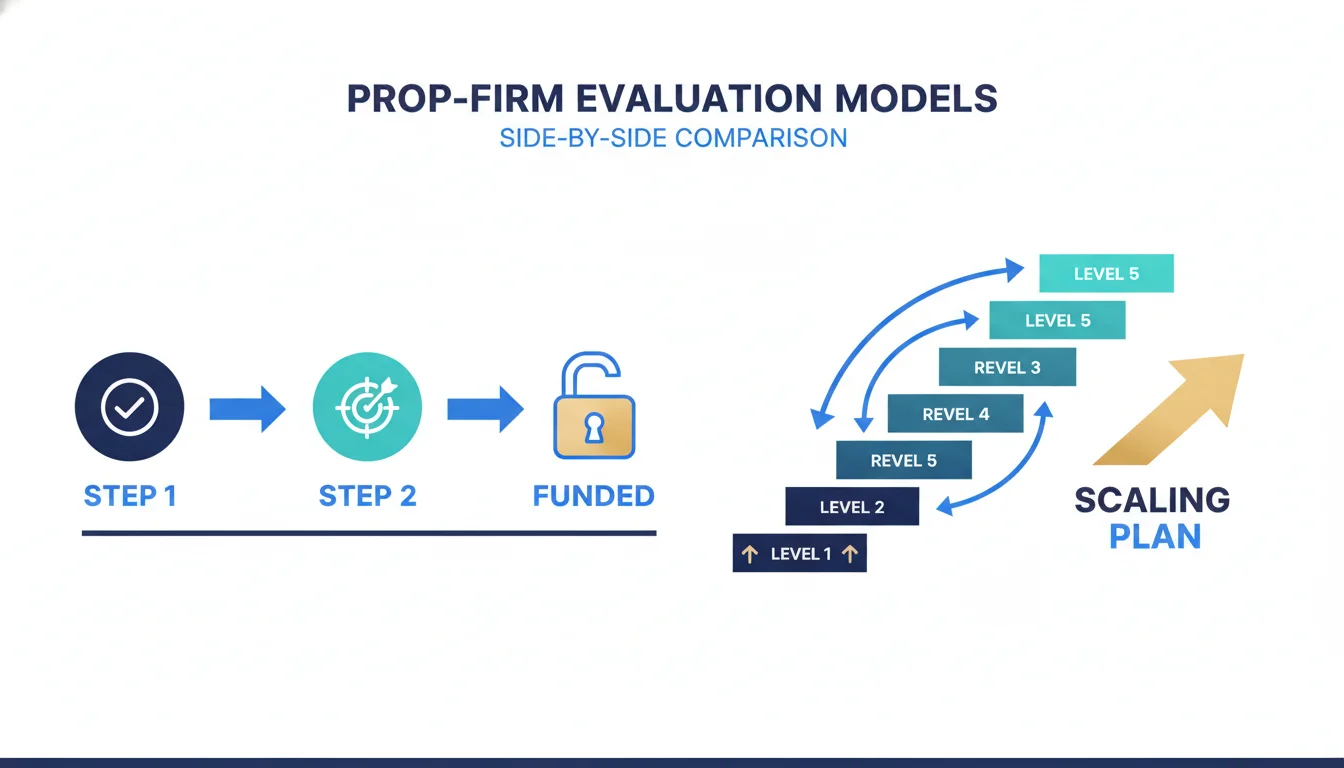
FTMO’s best-known path is its two-step evaluation. You start with the FTMO Challenge, where the profit target is 10% of your initial simulated capital, then move to a Verification stage with a 5% profit target while the other rules stay the same. The maximum daily loss is 5% of initial capital, alongside an overall maximum loss limit. Once you clear both stages, you become an FTMO Trader and trade a funded simulated account. FTMO also offers a 1-Step Challenge for traders who prefer a single evaluation phase with a higher headline profit split.
The appeal here is consistency. The rules are the same regardless of which account size you pick, the platform support is mature, and the process is one of the most documented in the industry, which makes it easy to prepare for.
The Trading Pit’s challenge model
The Trading Pit takes a more modular approach. Instead of one universal challenge, it separates CFD and futures into different programs, each tied to a Scaling Plan. You pick a challenge, prove your trading skill, and then progress through scaling levels that increase both your account size and your profit share as you keep performing.
For futures specifically, the Futures Classic track lets a trader starting at $20,000 climb through ten levels, gradually increasing lot size from 10 to 50 micros while raising the potential payout from $150 up to $3,500. Larger accounts scale further: a $250,000 futures account can reach payouts of up to $40,000 with a top-tier 80% profit share and up to 50 standard contracts. This structure rewards traders who want to build over time rather than cash out a fixed split immediately.
Account Sizes and Pricing at Each Firm
FTMO keeps account sizing simple with five fixed tiers: $10,000, $25,000, $50,000, $100,000, and $200,000. You choose the size that matches your risk tolerance and budget, and the rules scale proportionally.
The Trading Pit offers a wider spread of options because it runs separate CFD and futures programs, each with its own entry points and scaling ladder. Futures Classic accounts start as low as $20,000, while CFD plans scale upward from larger balances such as $100,000. Entry fees differ by program, asset class, and tier, so the right comparison is not a single price but the cost of the specific account and asset class you intend to trade. Confirm the current fee for your chosen account on the official site before buying (see FTMO’s current 2-Step table lists €89 for $10K, €250 for $25K, €345 for $50K, €439 promotional / €540 reference for $100K, and €1,080 for $200K (official price table) and The Trading Pit’s live CFD checkout showed $349 for a $50K 1-phase Prime evaluation, with a 10% target, 3% daily loss, and 6% maximum drawdown when checked July 25, 2026 (official checkout) for exact figures). If cost is your main concern, our guide on how much funded trading programs cost breaks down what you should expect to pay.
How Each Firm Handles Profit Splits and Payouts
FTMO profit split and payouts
On the 2-Step Challenge, FTMO pays an 80% profit split, which can rise to 90% once you meet Scaling Plan or Premium Programme conditions. The 1-Step Challenge starts at a 90% split. Traders who qualify for the Scaling Plan are rewarded with a 25% increase in account balance along with the higher 90% share. Withdrawals happen after you become an FTMO Trader, on a regular payout cycle.
The Trading Pit profit split and payouts
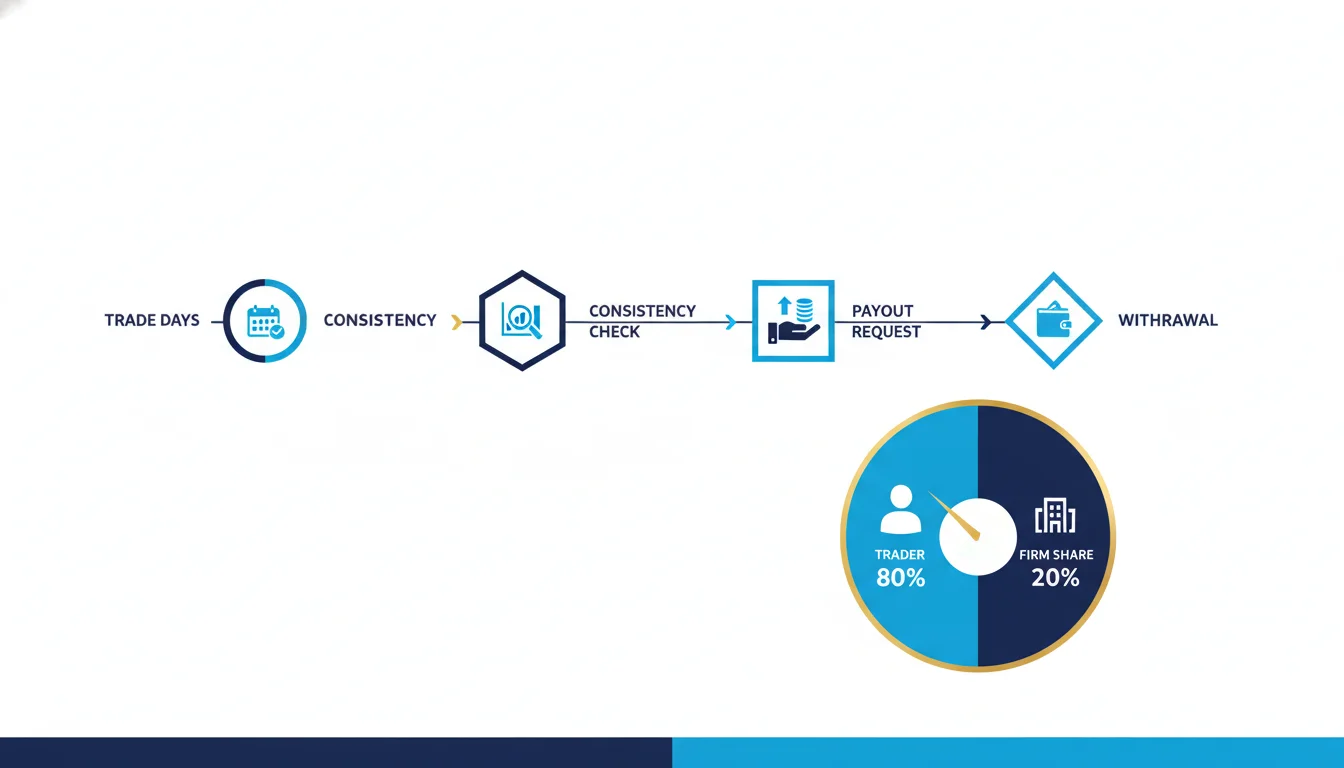
The Trading Pit’s profit share is tied to how far you climb the Scaling Plan. On CFDs, the share ranges from 50% up to 80% depending on your progress; on futures, it scales up toward 70–80% at the higher tiers. Payouts can be requested every 14 days for any amount above $100, once you meet the firm’s payout requirements. Those requirements include completing three profitable trading days with at least 0.5% profit per day based on your initial balance; for accounts created until March 5, 2026, traders also needed to complete a minimum number of trading days. Because payout rules and consistency requirements are exactly where many traders get tripped up, it is worth reading about hidden consistency rules that cause payout denials before you commit.
How Each Firm’s Scaling Plan Works
Scaling is where these two firms differ most in philosophy.
FTMO uses scaling as a reward layer on top of its core evaluation: meet the conditions and your balance grows 25% while your split moves to 90%. It is a bonus for sustained performance rather than the central mechanic.
The Trading Pit makes scaling the spine of the offer. The plan is tiered and explicit. On a $100,000 CFD account, your first four payouts each add $25,000 to your balance; from the fifth through eighth payout, based on the new $200,000 balance, each scale-up adds $50,000. On the futures side, the laddered structure raises both contract size and payout caps as you advance. If your goal is to compound a small starting account into a much larger one, The Trading Pit’s design is built around exactly that.
Markets and Platforms at Each Firm
This is often the deciding factor. FTMO centers on forex and CFDs (currencies, indices, commodities, crypto, and stock CFDs) and is a natural fit if your strategy lives in those markets.
The Trading Pit covers forex and CFDs too, but its dedicated futures program is the differentiator. If you trade index or commodity futures, or you want micro-contract sizing to manage risk, The Trading Pit gives you a purpose-built track that FTMO’s forex-first model does not emphasize. Futures day traders in particular should weigh this carefully; our roundup of the best prop firms for futures day traders puts both firms in context.
One practical cost difference to check: exchange-traded futures programs can carry separate market data fees that CFD evaluations usually do not. Before comparing prices head to head, confirm whether the futures track you’re considering charges a monthly data feed on top of the evaluation fee, because that changes the true cost of trading futures versus CFDs.
Which Firm Fits Your Trading Style?

Choose FTMO if you trade forex or CFDs, want a high and predictable profit split, and prefer a single, well-documented evaluation that does not change between account sizes. It is the cleaner path for traders who want to focus on execution rather than managing multiple program tracks.
Choose The Trading Pit if you trade futures, want the option to run both CFD and futures strategies under one firm, or you specifically want a scaling plan that grows your account and profit share as you stay consistent. It rewards patience and steady performance more than a one-time payout.
For traders who are still early in their trading and want the simplest possible ruleset, it is worth comparing both against our list of the best prop firms for beginners who want simple rules. And if fast access to your money matters most, check which firms lead on fast payout preference.
Page-one comparison check · US desktop results reviewed August 6, 2026
What to verify before choosing FTMO or The Trading Pit
Decision summary: The headline account size and profit split do not identify the better fit on their own. Compare the complete cost, loss calculation, first-payout path, platform route, and restrictions for two specific programs before paying.
| Decision point | How to compare it |
|---|---|
| Strategy restrictions | Check news, weekend holding, copy trading, automated systems, scalping, HFT, hedging, and account-sharing rules for both the evaluation and funded stage. |
| Payment, refund, and tax details | Check accepted payment methods, refund eligibility, taxes, currency conversion, chargeback restrictions, and whether a promotion changes any refund term. |
| Support and dispute path | Save the applicable rule version and confirm the support, appeal, and dispute route before buying, especially when your strategy needs written clarification. |
Promotions and program rules can change independently. Use this page to narrow the choice, then confirm every decision-critical term in each firm’s current official program document, checkout, and trader agreement. Screenshots or saved copies help if a rule changes after purchase.
Frequently Asked Questions
Is FTMO or The Trading Pit better for futures trading?
The Trading Pit is the stronger fit for futures because it runs a dedicated futures program with micro and standard contract sizing and a futures-specific scaling ladder. FTMO is more oriented toward forex and CFD trading.
What is the profit split at each firm?
FTMO pays 80% on its 2-Step Challenge, rising to 90% with the Scaling Plan or Premium Programme, and 90% on the 1-Step Challenge. The Trading Pit pays 50–80% on CFDs and up to roughly 70–80% on futures, depending on how far you progress through its Scaling Plan.
How often can I get paid?
The Trading Pit allows payout requests every 14 days for any amount above $100 once you meet its requirements. FTMO pays out after you become an FTMO Trader on a regular withdrawal cycle. Always confirm current cadence on each firm’s official site.
What account sizes can I start with?
FTMO offers $10,000, $25,000, $50,000, $100,000, and $200,000. The Trading Pit offers a range across its CFD and futures programs, with Futures Classic accounts starting around $20,000 and CFD plans scaling from larger balances.
Which firm has simpler rules?
FTMO’s rules are uniform across account sizes, which many traders find easier to learn. The Trading Pit’s rules vary by program and tier, which adds flexibility but also more to track.
Do these firms offer scaling?
Yes. FTMO grants a 25% balance increase and a 90% split when Scaling Plan conditions are met. The Trading Pit builds scaling into its core model, increasing account size and profit share as you advance through payout tiers.
Is FTMO available to US traders?
Yes, through a dedicated route. Following a partnership announced in 2025, FTMO offers FTMO US for eligible US residents and US-incorporated entities, operated with the regulated broker OANDA. Eligibility requires being 18 or older with a valid US Tax ID and US bank account, and a few states are excluded for entity participation. Confirm your own eligibility on FTMO’s official site, as access rules can change.
Do these firms actually pay out?
Both firms publish payout processes, but getting paid depends on meeting their rules. The Trading Pit requires conditions such as a set number of profitable trading days with a minimum daily profit before a payout can be requested, then allows withdrawals on a regular cycle. Missing a consistency or minimum-day requirement is a common reason payouts get delayed or denied across the industry, so read the payout rules carefully before you start trading. Our guide to hidden consistency rules that cause payout denials explains the traps to watch for.
What are good alternatives to FTMO?
If FTMO or The Trading Pit isn’t the right fit, it’s worth comparing other firms on the dimensions that matter to you, such as cost, payout speed, and rule simplicity. See our comparisons such as Funding Pips vs FTMO and our roundup of the best prop firms for beginners who want simple rules.
Are the exact fees and drawdown rules fixed?
No. Prop-firm pricing, drawdown percentages, and program names change frequently. Verify the current numbers on each firm’s official website before purchasing an evaluation.
Choosing the Right Firm for You
There is no single winner, only a winner for your style. If you are a forex or CFD trader who wants a high profit split and a straightforward, battle-tested evaluation, FTMO is the cleaner choice. If you trade futures, want both CFD and futures options under one roof, or you are motivated by a scaling plan that compounds your account over time, The Trading Pit is built for you. Your next step: list the markets you actually trade and the account size you can fund, then confirm the current fees and rules for that exact configuration on each firm’s official site before committing.
Disclaimer: This article is for educational and informational purposes only and is not financial, investment, or trading advice. Prop-firm rules, pricing, profit splits, and payout terms change frequently and vary by program and region. Trading involves substantial risk of loss. Always verify current terms on each firm’s official website and consider your own circumstances before making any decision.
Research and disclosure
How this comparison was reviewed
- Basis
- Document-based comparison of official product pages, trading objectives, and help-center material cited in this page.
- Scope
- FTMO and The Trading Pit programs and the exact account comparisons stated on this page. Other firms and changing checkout promotions are outside this comparison.
- Limitations
- BestProps did not purchase an account or perform first-hand trading, support, identity-check, or payout testing for this comparison. Recheck current terms before purchase.
- Commercial state
- BestProps currently has no active affiliate or sponsor relationship with FTMO, The Trading Pit, or any firm named on this page. Any future relationship will be disclosed next to affected links and in this record.