
Buyer-first forex comparison · reviewed July 25, 2026
FTMO vs FundedNext Buyer’s Scorecard
Start with the same account size and evaluation structure. Compare the complete cost to an eligible payout, how losses are calculated, the rules that continue after passing, platform and country fit, and the evidence behind each firm—not the branded plan name.
| Decision point | FTMO | FundedNext |
|---|---|---|
| Matched product | $100K FTMO Challenge: 2-Step | $100K Stellar 2-Step |
| Current price | €439 promotional / €540 reference | $549 |
| Profit target | 10% then 5% | 8% then 5% |
| Daily / maximum loss | 5% daily / 10% static max | 5% daily / 10% starting-balance floor |
| Minimum days | 4 per phase | 5 per phase |
| Funded reward | 80%, up to 90%; first request day 14+ | 80%, up to 90%; challenge 15% is delayed until Scale-Up eligibility and unavailable to U.S. clients |
| Platforms / U.S. fit | MT4, MT5, cTrader; U.S. path through FTMO/OANDA | MT4, MT5, cTrader, Match-Trader; U.S. clients use Match-Trader |
Advanced checks before paying
- Convert the loss limits into your normal per-trade risk and losing-streak budget.
- Include resets, rebills, activation, data, platform and withdrawal costs in the attempt price.
- Check consistency, qualifying days, buffers, payout caps, account lifecycle and scaling rules after passing.
- Verify the contracting entity, country eligibility, recent complaint themes, support answer for your strategy, and a small first payout before scaling.
Prices and rules are tied to the named products and were reviewed against linked official pages on July 25, 2026. Promotions and terms can change.

If you already know both names, the decision starts with a like-for-like account—not either firm’s branded program menu. This guide uses the $100,000 two-step CFD evaluation as the baseline, then checks whether the rules remain compatible after you pass.
The headline percentages are only the first layer. A serious comparison also tests how the daily-loss clock handles open P/L and fees, whether the funded account changes news or weekend rules, whether your EA, copier, device, or VPS is permitted, what a failed attempt costs, and how much trust evidence exists beyond company payout claims.
Disclosure: This guide is educational and does not guarantee that any trader will pass an evaluation, receive a reward, or qualify for an account.
How Advanced Traders Shop Prop Firm Challenges
The advertised account size is not your usable risk capital. Treat the challenge as a rules-based risk budget and work backward from the way your strategy loses.
1. Convert the drawdown into a per-trade risk budget
Per-trade risk should be no greater than the smaller of:
(daily loss cap − safety buffer) ÷ worst same-day losing trades(total loss cap − safety buffer) ÷ planned losing streakFor a $100K two-step account with a $5,000 daily cap and $10,000 total cap, assume a $1,000 safety buffer, four same-day losses, and an eight-trade losing streak. The limits imply $1,000 and $1,125 per trade, so $1,000 is the ceiling before commissions, slippage, correlated positions, and open drawdown. A practical risk amount would be lower. If your normal strategy needs more room, neither $100K account is a good fit despite the advertised size.
2. Price the whole attempt, not the checkout tile
Use this calculation: challenge fee + add-ons + reset or activation charges + platform or VPS costs + withdrawal and currency-conversion costs. Then estimate the cost across your realistic number of attempts. A cheaper challenge can become more expensive if the rules produce more resets; a higher-priced challenge may be better value only when its rules measurably improve your pass and payout odds.
3. Audit the funded account before the evaluation
Passing rules attract attention, but funded-stage rules decide whether the effort can produce a reward. Check news windows, weekend holding, consistency or best-day limits, strategy switching, maximum position or message limits, copy trading, EA permissions, device and IP policies, KYC, payout review, and any power the firm reserves to impose tighter risk controls.
4. Treat trustworthiness like vendor due diligence
- Identify the exact contracting and payment entities named in the checkout and terms.
- Read the most recent one-star reviews and group recurring complaints by payout denial, rule interpretation, platform problems, and support escalation.
- Send support a concrete scenario using your symbols, holding period, risk size, EA or copier, device, and news behavior; save the response.
- Save the checkout, rules, and terms that were live on purchase day.
- Start with an account size you can afford to lose and complete a smaller first reward before scaling purchases.
That process does not prove a firm will pay. It does reveal whether the rulebook, legal setup, support answers, and complaint pattern are acceptable for your strategy before you spend more.
FTMO Rules That Matter Most
FTMO’s official Trading Objectives page explains the key differences between its 1-Step and 2-Step challenge paths.
For the FTMO Challenge 2-Step path, FTMO lists a 10% profit target in the Challenge phase and a 5% target in Verification. The maximum daily loss is 5% of initial simulated capital, and the maximum loss is 10% of initial simulated capital. FTMO also lists a minimum trading days rule of 4 trading days in each evaluation phase.
For the FTMO Challenge 1-Step path, FTMO’s Trading Objectives page lists a 10% profit target, a 3% maximum daily loss, a 10% end-of-day trailing maximum loss, and a Best Day Rule. The Best Day Rule means the trader’s best day cannot represent more than 50% of positive days’ profit when passing the 1-Step Challenge or requesting a reward on the later FTMO Account.
That last detail matters. A trader who likes concentrated, high-conviction trading days may find the 1-Step path less flexible than the simple “one phase” label suggests. For a deeper explanation of why trailing limits change trader behavior, see BestProps’ guide to static drawdown vs trailing drawdown.
FundedNext Rules That Matter Most
FundedNext’s official Stellar Challenge page lists three main Stellar CFD challenge types.
Stellar 1-Step has a 10% phase-one profit target, 3% daily loss, 6% maximum overall loss, 2 minimum trading days, and a first reward listed at 5 days. Stellar 2-Step has 8% and 5% phase targets, 5% daily loss, 10% maximum overall loss, 5 minimum trading days, and first reward timing listed at 21 days. Stellar Lite has 8% and 4% phase targets, 4% daily loss, 8% maximum overall loss, 5 minimum trading days, and first reward timing listed at 21 days.
FundedNext’s Help Center also says Stellar 1-Step rules include maintaining a 3% daily loss limit, a 6% maximum loss limit, trading on at least 2 separate days, avoiding unauthorized copy trading, using a single IP or trusted VPN/VPS setup, and avoiding restricted strategies.
The main appeal is flexibility. You can choose a tighter 1-step route, a more traditional 2-step route, or the Lite version. The tradeoff is that you must read the exact model page and Help Center article for the plan you choose. “FundedNext rules” is too broad to treat as one rulebook.
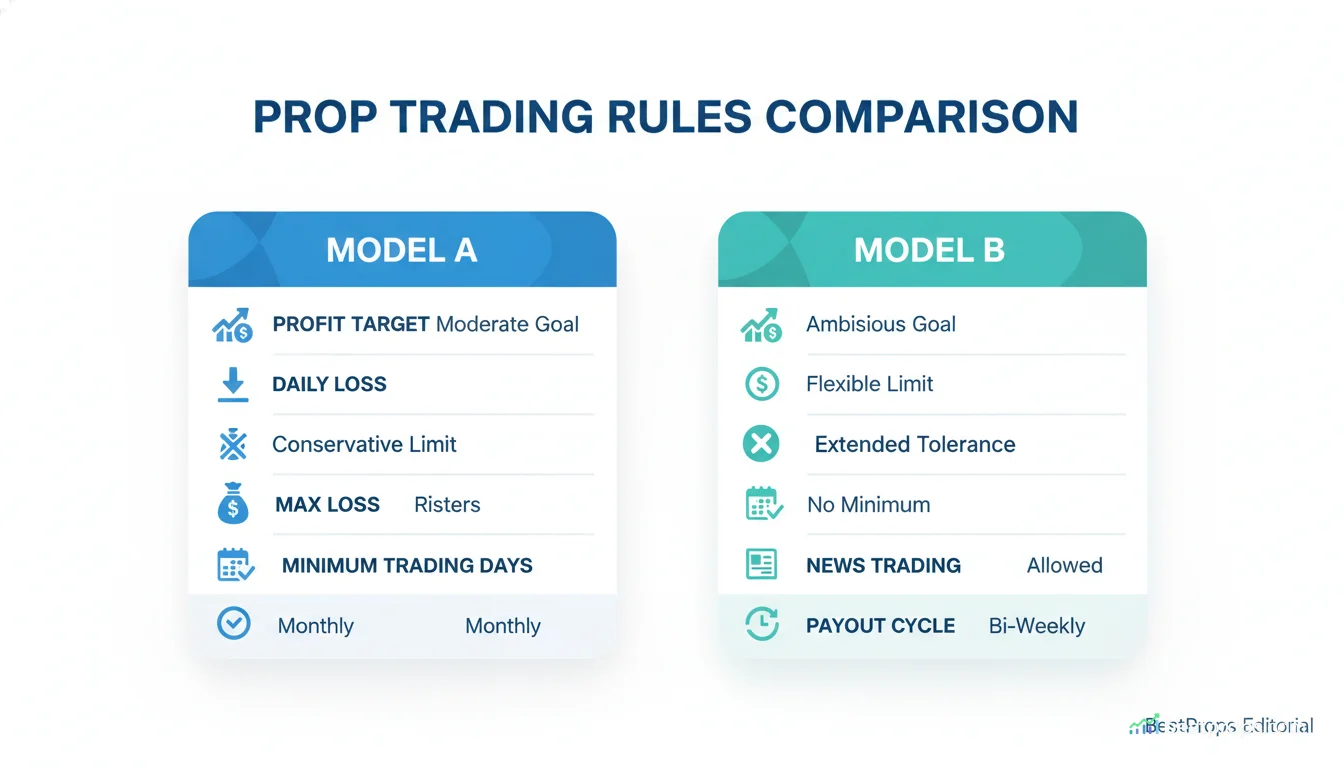
Payout And Reward Share Differences
FTMO’s official reward withdrawal FAQ says FTMO Traders can request a reward claim on the 14th day or later after the first trade on the account, with all open positions and pending orders closed. FTMO says it reviews the request and typically sends the reward within 1 to 2 business days after the invoice is approved.
FTMO’s current reward ratios depend on the product. The same FAQ says the FTMO Challenge 1-Step pays 90% of profit. The 2-Step path pays 80%, increasing to 90% if Scaling Plan or Premium Programme conditions are met.
FundedNext’s withdrawal Help Center article says profit withdrawals can be requested after a trader completes the trading cycle and meets profitability criteria, and it lists USDT, USDC, Confirmo, and RiseWorks among available withdrawal methods. It says payouts are processed within 24 hours, with transfer gateway charges borne by the trader.
FundedNext’s reward share Help Center article says Evaluation, Stellar Lite, Stellar 1-Step, and Stellar 2-Step FundedNext Accounts initially receive an 80% reward share, which can increase to 90% with Scale-Up. It also notes add-ons can increase reward share up to 95%.
This is where the decision becomes personal. Based on the official pages reviewed, FundedNext may offer an earlier first-reward path for eligible Stellar 1-Step traders than FTMO’s standard first reward schedule. That does not mean every FundedNext trader gets paid faster. The final timing depends on account model, trading cycle completion, profitability, KYC, payout request review, payment method, and any account-specific rules.
News Trading And Holding Style
FTMO’s news trading FAQ says news restrictions do not apply during the evaluation process. On FTMO Accounts, restrictions apply only to Standard accounts and selected news releases. Swing accounts do not have those news restrictions.
FundedNext’s Help Center says news trading is allowed in Stellar challenges, but funded-stage rules can adjust profits from trades opened or closed near high-impact events. For example, FundedNext’s Stellar 2-Step news article says the funded-stage News Profit Split Rule applies within 5 minutes before and after listed high-impact events, counting only 40% of profit while fully applying losses.
If you are a news trader, neither firm should be treated as “anything goes.” FTMO’s Standard funded accounts can have hard restrictions around selected events. FundedNext may allow the trade but change how the profit is counted on funded accounts. In both cases, the safe move is to check the economic calendar policy before trading major events.
Platform And Market Access
FTMO’s trading platforms page highlights FTMO cTrader and platform support for different trader workflows. FTMO is primarily a CFD evaluation firm, so it is usually the more direct comparison for forex, indices, metals, commodities, and crypto CFD traders who want a familiar prop firm structure.
FundedNext’s current site separates CFD and Futures offerings and promotes multiple platforms in its broader ecosystem. Its Stellar CFD page is the most relevant official source for this comparison because the keyword intent is mostly FTMO versus FundedNext at the firm level, not specifically futures. If your main goal is futures, compare FundedNext Futures against dedicated futures firms rather than against FTMO’s CFD product.
Which Firm Fits Your Trading Style?
FTMO may fit better if you want:
- a long-running prop firm with detailed public evaluation objectives
- a CFD-focused account rather than a broad mix of models
- a classic 2-step path with static maximum loss
- a 1-step path where you accept tighter daily loss and consistency controls
- clearer separation between Standard and Swing account restrictions
FundedNext may fit better if you want:
- the lower 8% first-phase target on the $100K two-step path
- the funded-stage news-profit adjustment does not disrupt your strategy
- you have priced add-ons, VPS fees, and currency conversion into the attempt cost
- the lower first-phase target matters more to you than FTMO’s lower displayed fee
- your platform, copier, device, and strategy setup passes FundedNext’s current rule check
Be careful with either firm if you regularly trade around high-impact news, hold large floating losses, copy trade from other accounts, use automation, or depend on one very large winning day to pass a challenge. Those are exactly the habits that turn a good-looking comparison table into a failed account or delayed payout.
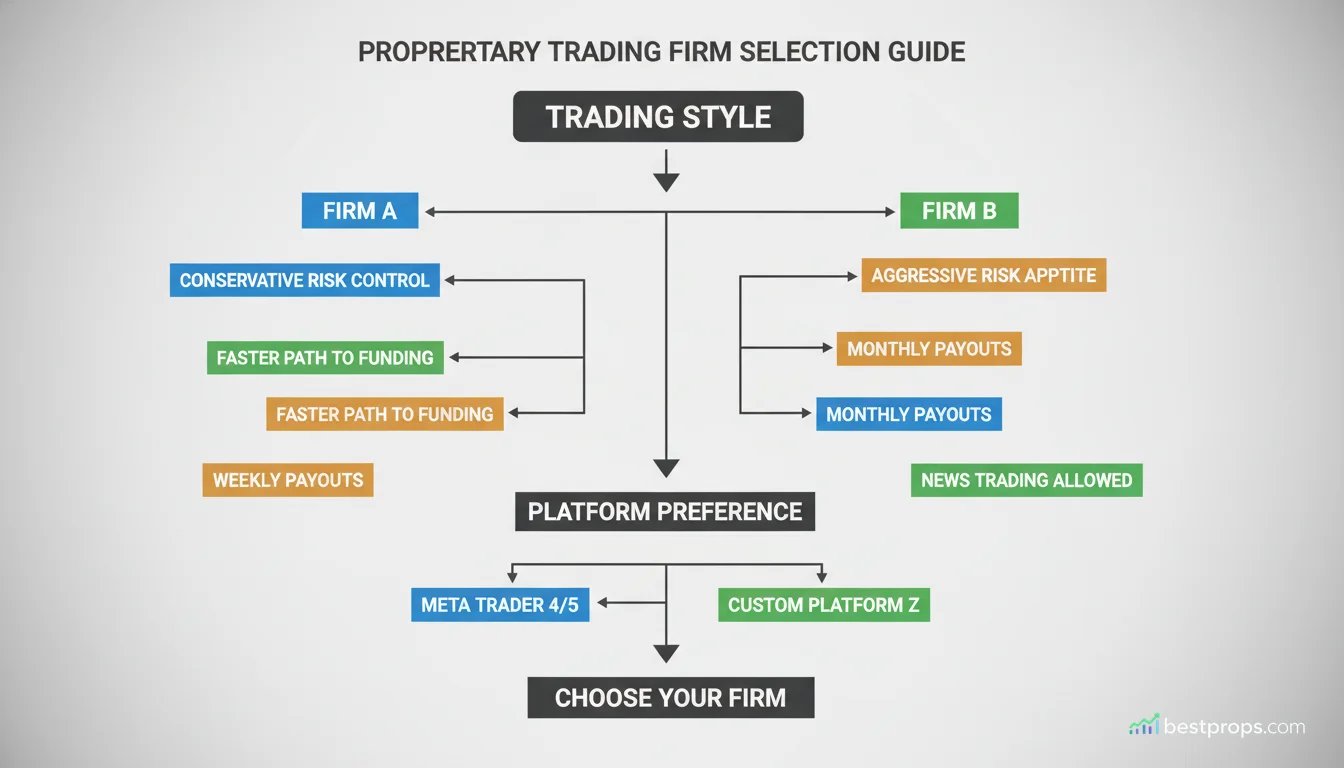
Practical Checklist Before You Buy
Before buying either challenge, run through this checklist:
- Confirm the exact account model and account size on the official checkout page.
- Save the current rules page and terms for the model you purchased.
- Check whether your preferred platform is available for that model.
- Calculate your maximum daily dollar risk before placing the first trade.
- Decide whether your strategy can pass with the minimum trading days.
- Check funded-stage news rules, not just challenge-stage news rules.
- Confirm reward timing, reward share, withdrawal methods, and KYC steps.
- Avoid assuming that a comparison article, Reddit comment, or old review reflects today’s rules.
If the rule math feels tight before you start, it will feel tighter once real evaluation pressure begins. The right firm is the one whose constraints you can follow on a bad trading day.
Final Verdict
BestProps’ default pick is FTMO 2-Step for traders who prioritize rule clarity, operating history, EA compatibility, and a defined Swing option. The tradeoff is a 10% first-phase target instead of FundedNext’s 8% target.
Choose FundedNext 2-Step instead when the lower Phase 1 target materially improves your plan and you have confirmed that its funded-news, platform, EA, copier, device, VPS, and strategy-continuity rules fit the way you trade.
Do not let a sale or a larger advertised reward share make the decision. Price the full attempt, calculate a per-trade risk budget from the loss limits, and review the funded-stage restrictions before paying.
Page-one comparison check · US desktop results reviewed August 6, 2026
What to verify before choosing FTMO or FundedNext
Decision summary: The headline account size and profit split do not identify the better fit on their own. Compare the complete cost, loss calculation, first-payout path, platform route, and restrictions for two specific programs before paying.
| Decision point | How to compare it |
|---|---|
| Total cost and fee lifecycle | Compare the purchase price with reset, activation, platform, data, add-on, tax, and fee-refund conditions for the exact account path. |
Promotions and program rules can change independently. Use this page to narrow the choice, then confirm every decision-critical term in each firm’s current official program document, checkout, and trader agreement. Screenshots or saved copies help if a rule changes after purchase.