
Matched-account buyer comparison · prices and rules checked July 25, 2026
FTUK vs FTMO: Matched 100K Two-Step Scorecard
This compares the 100K FTUK Two Step Evaluation with the 100K FTMO 2-Step Challenge. Both are static-drawdown two-phase programs, so price, target sequence, minimum days, refund terms, platform access, and payout timing are directly comparable.
| Matched 100K decision point | FTUK | FTMO |
|---|---|---|
| Current price | $366.75 promotional · $489 reference price | €439 promotional · €540 reference price |
| Profit targets | 6% phase 1 · 6% phase 2 | 10% Challenge · 5% Verification |
| Daily / maximum loss | 5% daily · 8% static maximum drawdown | 5% maximum daily loss · 10% maximum loss |
| Minimum trading days | 3 days in each phase | 4 days in each phase |
| Fee refund | Current product card labels the fee refundable; verify the payout event and conditions in the checkout terms | Initial challenge fee returned with the first reward on the 2-Step path |
| Funded reward | 80% profit share · bi-weekly payouts | 80% reward, scaling to 90% under qualifying programs · reward request from day 14 after first funded trade |
| Holding / news | Weekend holding and news trading listed as allowed | Standard and Swing account conditions differ; select Swing if holding through restricted periods is essential |
| Platform / region check | MT5, Match-Trader, TradeLocker, and FTUK XT shown; MT5 unavailable to U.S. traders | MT4, MT5, and cTrader shown; eligibility and signup path vary by country |
| Best fit | Trader prioritizing lower price, lower phase-one target, and fewer minimum days who can work within 8% total loss | Trader willing to pay more and target 10% initially for wider total loss room and deeper public rule documentation |
Advanced way to shop this comparison
- Calculate cost to first eligible payout: fee plus add-ons, resets, activation, and the likely number of attempts—not today’s coupon alone.
- Convert loss limits into trades: subtract spread, commission, and slippage from the maximum-loss budget, then divide by your normal stop size.
- Test rule interaction: replay your worst month against daily loss, trailing or static maximum loss, minimum-day, consistency, news, holding, and payout rules.
- Verify trust operationally: identify the contracting entity, read recent rule-change notices and complaint themes, get your strategy approved in writing, and test one small payout before scaling accounts.
Official sources used for this snapshot
Promotions and account terms change. Reconfirm the selected size, platform, add-ons, rule definitions, and country eligibility at checkout.
Last updated: June 6, 2026.
FTUK vs FTMO is a practical comparison if you already know you want a prop-style simulated trading account, but you are not sure whether you want FTUK’s wider menu of program formats or FTMO’s more established two-step challenge structure. The better fit depends less on which firm sounds bigger and more on how you trade, how much rule complexity you want to manage, and whether you value instant funding style options, a classic evaluation path, platform choice, or payout process clarity.
This guide compares the two firms using official FTUK and FTMO source material where current rules are specific. It also flags the areas you should verify before buying because prop firm rules, pricing, promotions, account availability, and payout reviews can change quickly.
Important: both firms describe simulated or hypothetical trading programs, not brokerage accounts where traders manage investor deposits. Verify the current official terms, eligibility rules, fee schedule, platform availability, and payout rules before buying either program.
FTUK vs FTMO quick verdict
Choose FTUK if you want several program formats to compare, including instant funding, one-step, and two-step style structures, and you are comfortable reading program-specific rules before you trade. FTUK’s official help center lists different drawdown, scaling, profit share, and payout rules by program, so it can fit traders who want more choice and are willing to manage more variation.
Choose FTMO if you want a more standardized evaluation path, broad platform support, and a firm with a longer operating history. FTMO’s official material describes one-step and two-step FTMO Challenge options, simulated account sizes up to $200,000, trading on MT4, MT5, and cTrader, and rewards of up to 90% of simulated profits after the FTMO Account stage.
If you are new to prop firms, start by comparing rule difficulty rather than advertised account size. Daily loss limits, total drawdown, minimum trading days, best-day or consistency rules, payout reviews, and platform restrictions usually matter more than the largest headline account.
FTUK vs FTMO at a glance
| Category | FTUK | FTMO |
|---|---|---|
| Main fit | Traders comparing instant funding, one-step, and two-step formats | Traders who want a classic challenge and verification path |
| Program options covered here | Instant Funding, One-Step, Two-Step | FTMO Challenge 1-Step and 2-Step |
| Official account model language | Prop firm programs with funded stages and payout rules | Simulated trading accounts and performance-based rewards |
| Published drawdown style | Varies by program, including relative and static drawdown | Varies by product, including one-step trailing maximum loss and two-step static maximum loss |
| Payout angle | Program-specific payout rules, with FTUK noting independent payout-cycle reviews | Reward withdrawal after FTMO Account stage, with up to 90% of simulated profits |
| Platform angle | Verify current platform availability before buying | MT4, MT5, and cTrader are listed by FTMO |
| Best for | Traders whose strategy fits one of FTUK’s exact price, drawdown, and payout rule sets | Traders who want a familiar evaluation flow and platform breadth |
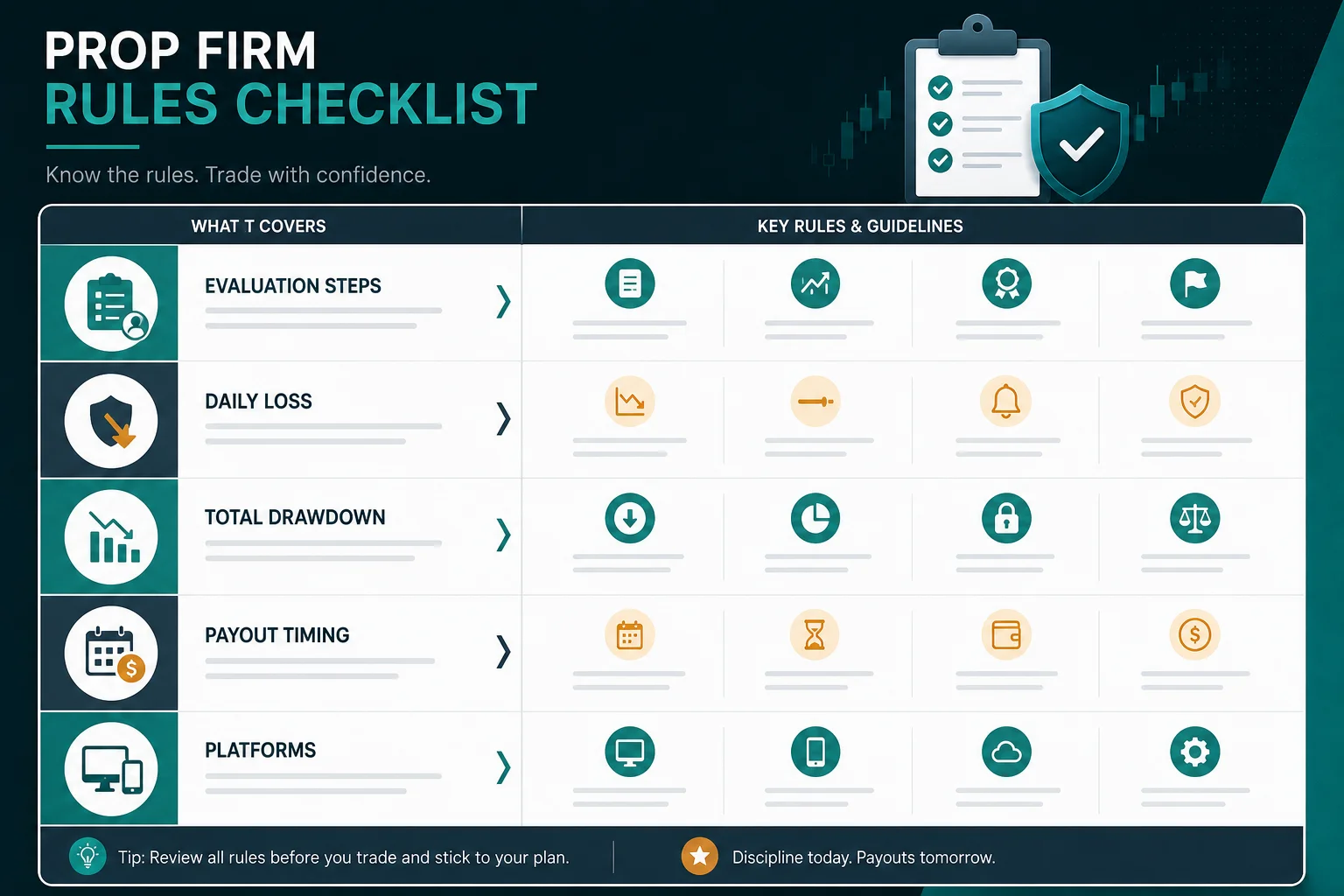
Source checks for FTUK and FTMO rules
| Claim area | Source checked on June 6, 2026 | What to verify again before buying |
|---|---|---|
| FTUK One-Step forex rules | FTUK One-Step Program Rules | Current program name, availability, and checkout terms |
| FTUK Two-Step forex rules | FTUK Two-Step Program Rules | Current profit target, drawdown, and payout cadence |
| FTUK Instant Funding rules | FTUK Instant Funding Program and FTUK drawdown limits | Current consistency score, platform, and payout eligibility |
| FTUK payout process | FTUK payout request instructions | Current payout methods, timing, and review process |
| FTMO challenge rules | FTMO trading objectives and FTMO how it works | Current account sizes, 1-Step vs 2-Step objectives, and reward terms |
| FTMO platform support | FTMO trading platforms | Current platform access by country and account type |
| US availability | FTMO country eligibility FAQ and FTUK country onboarding FAQ | Current country restrictions and any state-specific or platform-specific limits |
FTUK rules and account styles to check
FTUK is not a single-rule comparison because its official help center separates program rules. For forex programs, FTUK lists One-Step, Two-Step, and Instant Funding rules with different targets, drawdown settings, payout requirements, and scaling details.
For FTUK’s One-Step forex program, the official rules page lists a 4 trading day scale-up requirement, no maximum trading days, 8% maximum total relative drawdown, 4% daily drawdown, 10% profit target for scaling, 80% profit share on funded stages, and payout frequency every two weeks on funded stages. It also lists a 10-day minimum trading-day requirement for the first payout on funded stages.
For FTUK’s Two-Step forex program, the official rules page lists 3 minimum trading days for scale-up, 8% maximum total static drawdown, 5% daily drawdown, 8% profit target for scaling, 80% profit share once funded, and every-two-week payout frequency on funded stages. The same page states that the daily drawdown calculation uses the higher of closed balance or equity at 22:00 UTC.
For FTUK’s Instant Funding rules, the source material describes a program purchased on or after February 20, 2025, with no minimum trading days, no maximum trading days, 6% maximum total relative drawdown, 5% daily drawdown, profit share that scales by level, and a consistency score requirement. FTUK’s separate payout instructions also say payout eligibility is shown through the trader dashboard, the system calculates profit share at payment time, and payout cycles can be reviewed independently.
That last point matters. FTUK’s payout article says a previously approved payout does not guarantee that future payouts will be approved under the same conditions, and traders remain responsible for following published rules at all times. For a trader comparing FTUK vs FTMO, this makes rule discipline and audit readiness important, especially if your strategy depends on aggressive sizing, copy trading, news events, or high concentration in one trading day.
FTMO rules and account styles to check
FTMO’s official how-it-works page describes choosing an FTMO Challenge size from $10,000, $25,000, $50,000, $100,000, or $200,000 in simulated accounts for the two-step route. It explains the FTMO Challenge stage, the Verification stage, and the FTMO Account stage, where a trader earns a share of simulated profits after completing identity verification and the account agreement.
For the FTMO Challenge 2-Step route, FTMO states that the FTMO Challenge profit target is 10% and Verification target is 5%. Its trading objectives page lists a 5% maximum daily loss amount, 10% maximum loss amount, and at least 4 trading days during the two-step evaluation phases. FTMO says there is no profit target on the subsequent FTMO Account for the two-step product.
FTMO’s trading objectives page also describes a separate 1-Step version. For the FTMO Challenge 1-Step, FTMO lists a 10% profit target, 3% maximum daily loss amount, 10% maximum loss amount, and a Best Day Rule requiring the best day to be no more than 50% of positive days’ profit before passing or becoming eligible for a reward.
FTMO’s platform material lists MT4, MT5, and cTrader for trading. That can matter if you already have indicators, expert advisors, templates, or execution habits built around a specific platform. FTMO also states that all accounts are demo accounts with fictitious funds and trading occurs in a simulated setting.
FTUK vs FTMO rule difficulty
The harder firm is the one whose rules conflict with your actual trading behavior. A trader who spreads profit across many days may find consistency or best-day rules manageable. A trader who depends on one large breakout day may find those same rules restrictive.
FTUK’s main complexity is program variation. One-Step and Two-Step use different daily drawdown percentages. Instant Funding has its own consistency score mechanics and scaling terms. The result is flexibility, but the cost is that you must compare the exact program you plan to buy rather than relying on one general FTUK summary.
FTMO’s main complexity is objective discipline. The two-step product uses the familiar 10% and 5% targets, maximum daily loss, maximum loss, and minimum trading days. The one-step product changes the risk profile with a 3% daily loss amount and the Best Day Rule. FTMO may feel simpler because the paths are clearly framed, but the objectives still require close risk management.
Here is the practical rule test:
- If you need several account models to choose from, FTUK deserves a closer look.
- If you want a more established evaluation sequence with fewer product types to compare, FTMO may be easier to study.
- If you often make most of your profit in one day, read FTMO’s Best Day Rule and FTUK’s Instant Funding consistency score before buying anything.
- If you hold trades overnight or through the weekend, verify the exact account type and program restrictions before trading.
- If you use automated tools, copy trading, or high-risk news strategies, read the current official rules instead of relying on review articles.
US trader availability
For US readers, eligibility is a core part of the FTUK vs FTMO decision. FTMO’s official country eligibility FAQ says clients in the United States of America can use FTMO services through its affiliated entity at ftmo.oanda.com. That means US traders should not assume the same onboarding flow, terms, platform access, or affiliate relationship as non-US FTMO users.
FTUK’s country onboarding FAQ lists restricted countries and does not list the United States in that restricted-country list. FTUK’s older US FAQ says US-based traders can use FTUK, but only DXtrade and MatchTrader are available to US traders. FTUK’s homepage also notes that MetaTrader 5 is not available for US traders.
The practical takeaway is simple: if you are in the United States, verify the current country-specific signup flow before comparing prices or account sizes. Platform access may differ from global marketing pages.
Payouts and profit share
FTUK and FTMO both describe trader payouts or rewards, but they do not frame the process in the same way.
FTUK’s One-Step and Two-Step forex program tables list 80% profit share on funded stages and every-two-week payout frequency for funded stages. FTUK’s Instant Funding materials list profit share by level, with additional consistency requirements. FTUK’s payout instructions describe dashboard-based payout requests, Rise Works and crypto payout routes, view-only mode while payment is pending approval, and possible risk review at any payout cycle.
FTMO’s how-it-works page says FTMO Account traders can earn up to 90% of simulated profits as a reward and receive a 100% refund of the initial fee with the first reward withdrawal. FTMO also states that the FTMO Account has no profit target apart from the trader’s own, but risk limits still apply.
The key comparison is not just profit split. It is how you become eligible, whether your trading pattern can pass any concentration or consistency rules, and what happens when you request payment. Before buying either program, verify the current payout page, current terms, and whether your country, payment method, and account type are supported.
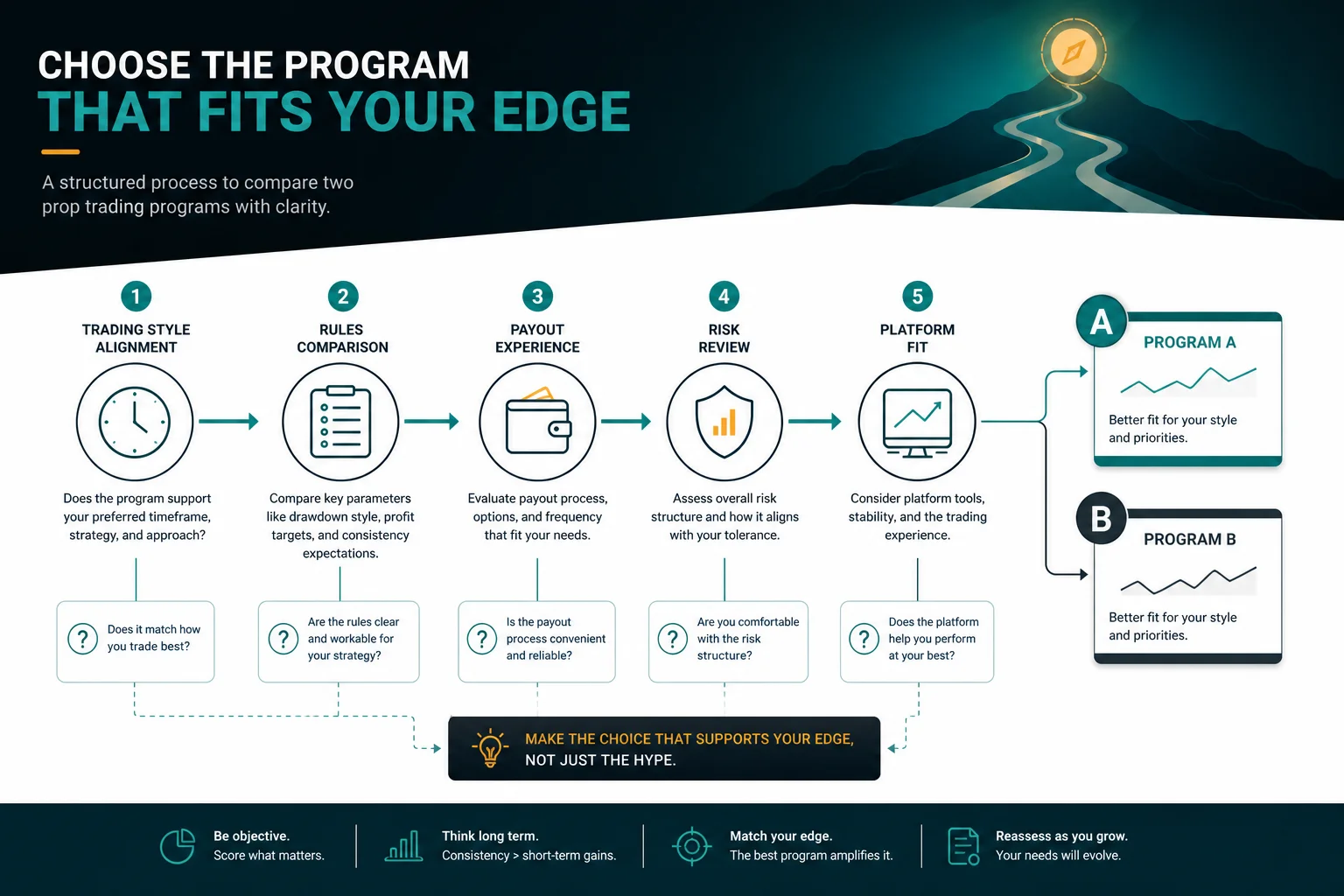
Trading platforms and trader workflow
FTMO has the clearer official platform statement in the public sources reviewed for this page. Its trading platform page lists MT4, MT5, and cTrader, and its FAQ says those platforms are available for the FTMO Challenge and FTMO Account. That gives FTMO an advantage for traders who want to stay with common retail trading platforms.
FTUK’s public homepage lists MetaTrader 5, MatchTrader, TradeLocker, and FTUK XT, but it also notes that MetaTrader 5 is not available for US traders. Because platform choice affects execution, trade copier setup, indicators, and risk tools, treat FTUK’s current checkout or dashboard platform details as a required verification step.
Use this workflow test:
- MT4 template or EA user: verify exact permissions and platform support with the firm before buying.
- MT5 discretionary trader: compare spreads, commissions, symbol list, and account type rules.
- Swing trader: confirm overnight, weekend, and news restrictions for the exact account type.
- High-frequency or news trader: read forbidden strategy, latency, arbitrage, and news rules from the official terms.
- First-time challenge buyer: prioritize the clearest rules page over the biggest headline account.
FTUK vs FTMO alternatives on BestProps
If you are still building your shortlist, compare this guide with BestProps resources that cover adjacent decisions:
- FTMO Review for Funded Traders
- How FTMO Drawdown Rules Work for New Traders
- Funding Pips vs FTMO Profit Split and Drawdown Rules Compared
- Best Prop Firm for Beginners Who Want Simple Rules
- Instant Funding vs Challenge Model Which Is Better for New Traders
These internal comparisons are useful because FTUK vs FTMO is only one match-up. Many traders make a better decision after comparing instant funding, classic challenge models, beginner-friendly rule sets, and payout timing preferences across several firms.
FTUK vs FTMO decision checklist
Use this checklist before you pay for either firm:
| Question | Why it matters |
|---|---|
| Which exact program am I buying? | FTUK and FTMO both have more than one path, and rules vary by path. |
| What is the daily loss rule? | A good strategy can still fail if position size breaks the daily limit. |
| Is the total drawdown static, relative, or trailing? | Drawdown type changes how protected profits affect risk room. |
| Are there minimum trading days? | Minimum-day rules can change how quickly a trader can pass or request payout. |
| Is there a best-day or consistency rule? | Profit concentration can delay passing, scaling, or payout eligibility. |
| Which platform will I trade on? | Platform restrictions affect indicators, automation, and execution habits. |
| How are payouts reviewed? | A high split is less useful if the payout process does not fit your strategy or jurisdiction. |
| Are current fees and discounts verified? | See the dated matched-account scorecard above and recheck the live checkout before buying |
| Does my country use the same signup path? | US traders may face different FTMO and FTUK platform or onboarding details. |
FAQ
Is FTUK better than FTMO?
FTUK may be better only when one of its instant-funding, one-step, or two-step rule sets gives your strategy a better price-to-drawdown fit; the number of formats is not an advantage by itself. FTMO may be better if you want a more established challenge and verification structure with clear public platform support. The better choice depends on your trading style and rule tolerance.
Is FTMO allowed in the USA?
FTMO’s country eligibility FAQ says clients in the United States can use FTMO services through its affiliated entity at ftmo.oanda.com. Do not rely on a generic review for eligibility. Check the current US signup flow, platform access, and terms for your location before buying.
Does FTUK offer instant funding?
FTUK’s official help center includes an Instant Funding Program page, with rules for programs purchased on or after February 20, 2025. The current details should still be verified on FTUK’s official site before purchase because program availability and rules can change.
Which firm has easier drawdown rules?
Neither firm is automatically easier. FTUK’s rules vary by program, including relative drawdown for some paths and static drawdown for Two-Step. FTMO’s rules vary between 1-Step and 2-Step, including different daily loss amounts and maximum loss mechanics. Compare the exact program, not the brand name.
Which firm has the better payout split?
FTUK’s One-Step and Two-Step forex rule tables list 80% profit share on funded stages, while Instant Funding profit share varies by level. FTMO says FTMO Account traders can earn up to 90% of simulated profits as a reward. Profit split is only one part of payout quality, so also compare eligibility rules, payout review, and payment methods.
Which firm is better for beginners?
Beginners usually need clear rules, a platform they already understand, and drawdown limits they can respect. FTMO may be easier to study because the challenge flow is familiar and well documented. FTUK may be useful if a beginner wants to compare several formats, but that also means more rule reading before buying.
Should I buy FTUK or FTMO today?
Only buy after checking the current official rules, pricing, account availability, platform support, and payout terms. If either firm’s rules require placeholders or unanswered questions for your strategy, pause and verify those details before paying.
Page-one comparison check · US desktop results reviewed August 6, 2026
What to verify before choosing FTMO or FTUK
Decision summary: The headline account size and profit split do not identify the better fit on their own. Compare the complete cost, loss calculation, first-payout path, platform route, and restrictions for two specific programs before paying.
| Decision point | How to compare it |
|---|---|
| Trust and operating-history checks | Treat review scores and testimonials as sentiment, then verify company identity, current agreements, support routes, rule-change notices, and documented payout terms independently. |
| Support and dispute path | Save the applicable rule version and confirm the support, appeal, and dispute route before buying, especially when your strategy needs written clarification. |
| Payment, refund, and tax details | Check accepted payment methods, refund eligibility, taxes, currency conversion, chargeback restrictions, and whether a promotion changes any refund term. |
Promotions and program rules can change independently. Use this page to narrow the choice, then confirm every decision-critical term in each firm’s current official program document, checkout, and trader agreement. Screenshots or saved copies help if a rule changes after purchase.
Bottom line
FTUK vs FTMO comes down to choice versus standardization. FTUK gives traders more program formats to compare, but that means more rule variation across instant funding, one-step, and two-step paths. FTMO gives traders a more familiar evaluation structure, broad public platform support, and a long operating history, but its objectives still require strict daily loss, maximum loss, minimum trading day, and best-day discipline depending on the product.
For most traders, the next step is to pick the exact account model you would buy from each firm, place the official rules side by side, and test those rules against your last 30 to 60 trading days. The firm that fits your actual behavior is usually the safer shortlist choice.
Educational disclaimer: BestProps content is for educational purposes only and is not financial, investment, legal, tax, or trading advice. Prop firm rules, fees, platforms, payout terms, and eligibility can change. Always verify current official terms and understand the risk of trading before purchasing any evaluation or funded-account-style program.