
Key takeaways
We checked 17 futures prop firms against four specific, sourced problems from Topstep’s own current rules pages: an unscoped high-frequency trading ban, a discretionary live-account move the trader cannot decline, a Maximum Loss Limit that resets to exactly $0 after the first payout, and a 30-day rolling inactivity rule.
Read the full summary
We checked 17 futures prop firms against four specific, sourced problems from Topstep’s own current rules pages: an unscoped high-frequency trading ban, a discretionary live-account move the trader cannot decline, a Maximum Loss Limit that resets to exactly $0 after the first payout, and a 30-day rolling inactivity rule. Phidias, Bulenox, and Purdia come closest to fixing all four. AquaFutures, Elite Trader Funding, Take Profit Trader, BluSky, and DayTraders each fix some of the four while keeping a real watch-out. Nine more firms, including the well-known names Tradeify, MyFundedFutures, and Apex Trader Funding, replicate most of Topstep’s own pattern and are named here honestly rather than recommended.

Freshness: checked October 3, 2026. Firms change terms without notice; re-check before you buy. Each firm’s Trustpilot figure carries the date we read it. Futures only: Topstep is a futures-only firm, so pure forex/CFD firms (FTMO, The5ers, FundingPips, Goat Funded Trader, City Traders Imperium, E8 Markets) are excluded from this comparison; where a brand runs both a forex and a futures arm, only the futures arm is checked here.
Editorial disclosure. BestProps has no affiliate or sponsor relationship with any firm in this post (Phidias, Bulenox, Purdia, AquaFutures, Elite Trader Funding, Take Profit Trader, BluSky, DayTraders.com, Alpha Futures, TradeDay, Top One Futures, Earn2Trade, Lucid Trading, FundedNext Futures, Apex Trader Funding, Tradeify, or MyFundedFutures), and has received no money from any of them. Codes shown are uncompensated and firm-published only. No firm paid for placement or reviewed this post before publication. Full policy: affiliate disclosure.
Quick picks among Topstep alternatives
- Fixes all four: Phidias, Bulenox, and Purdia. Phidias has no call-up stage at all on its Express to Live plan; Bulenox locks its floor before any payout is possible; Purdia’s live move is rule-triggered.
- Cheapest that fixes most: AquaFutures, $56.50 per $1,000 of loss room, with no live-money stage at all to be called up into.
- Best for automated-adjacent traders: Bulenox, whose FAQ names bots, algorithms, and trade copiers as explicitly permitted.
- Best if you never want a forced live move: Phidias (no call-up stage exists) or BluSky (a declinable cash-buyout option).
- Most established names checked here: Tradeify, MyFundedFutures, and Apex Trader Funding, though each replicates at least two of Topstep’s four problems.
A live call-up is a fact to weigh, never an automatic disqualifier: some firms in this post make the move rule-triggered instead of a firm pick, skip the stage by letting the trader click when ready, or let the trader decline for cash. Read the exact mechanics in each firm’s block below before assuming any alternative is automatically better on this one point.
Why traders leave Topstep
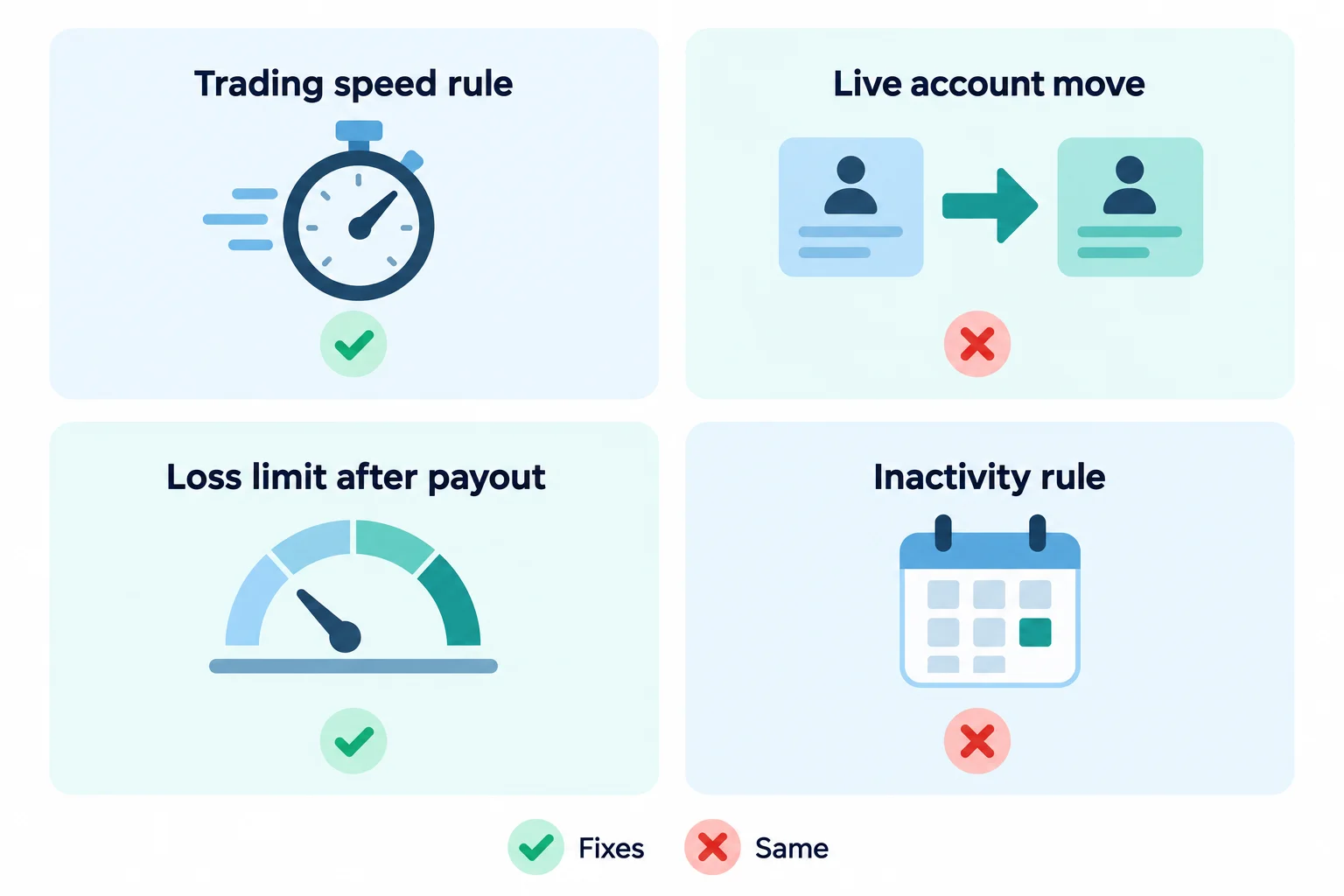
Topstep’s own current rules pages, read October 3, 2026, name four specific problems that drive traders to look for an alternative:
- An unscoped speed or high-frequency trading ban. its Terms of Use §27 and Prohibited Trading Strategies page both ban “short term or high frequency trades”, described only as “usually hundreds or thousands of trades per day, with average durations measured in seconds, not minutes”, with no numeric trade-count, order-rate, or hold-duration threshold, and no language scoping the ban to automated execution only.
- A discretionary, non-declinable live call-up. Topstep’s Risk Team can move a trader from the Express Funded Account to a Live Funded Account at any time on its own criteria. “Can I decline the invitation to move to Live and stay in my XFA? No. Once the Risk Team determines you’re ready, your options are to move to Live or close your Express Funded Account.” Any XFA balance above the account size is forfeited outright, and the remainder splits 20% tradable, 80% held in a non-tradable Reserve. Topstep publishes a concrete rate: 0.71% of 2025 XFA participants were called up.
- The loss limit resets to exactly $0 after the first payout. Topstep’s Payout Policy states plainly: “After each Payout: Your Maximum Loss Limit (MLL) resets to $0 permanently, and your 5-day count restarts.” The entire remaining balance becomes the loss floor at the exact moment a trader starts getting paid.
- A 30-day rolling inactivity closure. Both the Express Funded Account and the Live Funded Account parameters state: “XFAs/Live Funded Accounts with no trading activity for more than 30 days may be closed,” and accounts “can’t be put on hold.”
Every alternative in this post is tested against the same four points, quoting the alternative firm’s own current pages, never Topstep’s pages and never a third-party review site.
How we tested these Topstep alternatives
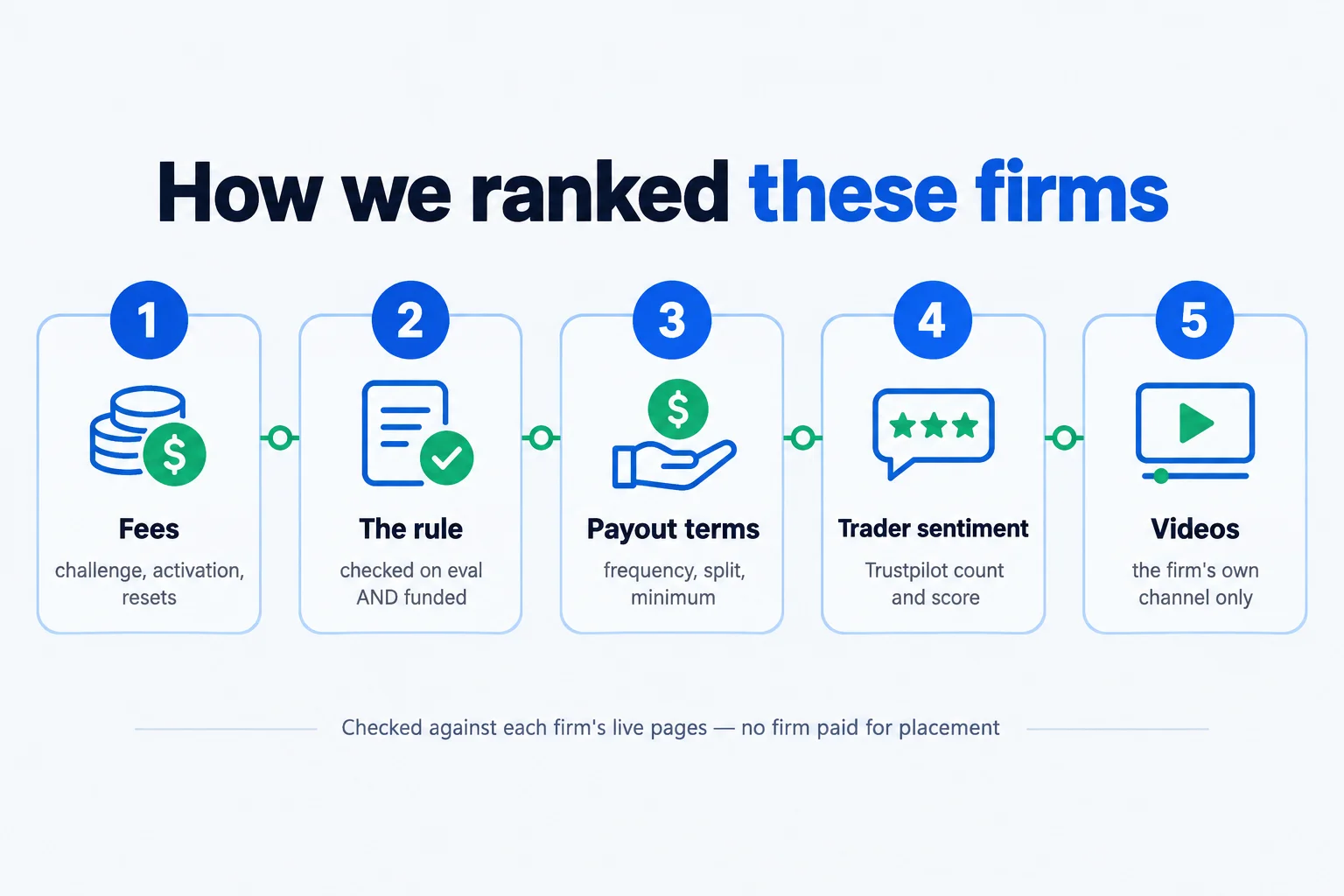
- Sources: each firm’s help centre, FAQ, rules, and terms pages, read October 3, 2026; never a bot vendor’s list or a competing roundup.
- Per product: we grade the specific product (not the whole brand) against each of Topstep’s own four named pain points, quoting the alternative firm’s own current pages.
- Classification: each point is scored fixes (the firm’s own current pages genuinely solve the problem), partly (a real, nameable difference that is not a clean fix), or same as Topstep (the firm’s own pages replicate the identical shape).
- Ranking rule: firms with no serious watch-out beyond the four tested points rank first, then watch-out firms ordered by how many of the four they fix, then by cost per $1,000 of loss room at the $50K size, using the list price plus activation fee, never a coded, promotional, or ES-commission figure.
- Arms: a forex/CFD arm and a futures arm of the same brand are separate listings; only the futures arm of each brand is checked here.
A live call-up is a fact to weigh, never a reason to rank a firm lower on its own: several ranked firms in this post have one. Nothing in this post replaces reading the firm’s own current rules before you buy; firms change terms without notice.
Topstep alternatives compared, checked October 3, 2026
| Rank and firm | HFT rule | Live move | Post-payout floor | Inactivity rule | Cost/$1,000 | Trustpilot |
|---|---|---|---|---|---|---|
| Phidias Express to Live | Fixes: scoped, manual carve-out | Fixes: no call-up stage exists | Fixes: $650 static, never trails | Fixes: no rule published | $656.92† | rating hidden (“breach of our guidelines” banner), 336 reviews |
| Bulenox Momentum Qualification 50K, Option 2 EOD | Fixes: scoped, bots/copiers allowed | Partly: declinable, closes either way | Fixes: locks at $50,100 pre-payout | Fixes: no rule published | $63.56 | 4.7/5 on 1,801 reviews |
| Purdia 50K EOD Evaluation | Fixes: scoped, oversight allowed | Fixes: rule-triggered, keeps funds | Fixes: static Temp SFA, no reset | Partly: 14 or 30 days, pages disagree | $154.50‡ | 3.8/5 on 88 reviews |
| AquaFutures Daily 50K | Fixes: 100/day number, scoped | Fixes: no live stage exists | Fixes: locks at $50,100, never $0 | Same: 7 days, no reinstatement | $56.50 | not checked this run for this firm’s futures arm |
| Elite Trader Funding Direct to Funded | Partly: 10-sec floor, all trades | Partly: non-declinable, pays formula | Fixes: locks at $50,100, never $0 | Fixes: login 30 days plus weekly trade | $149.40 | 3.8/5 on 1,154 reviews |
| Take Profit Trader Trading Test 50K | Fixes: all automation banned, scoped | Same: $5,000 frozen on call-up | Fixes: locks at full $50,000 balance | Partly: weekly, no profit required | $150.00 | 4.4/5 on 10,770 reviews |
| BluSky Launch 50K | Fixes: no HFT ban at all | Partly: declinable for a buyout | Fixes: $100 static, never moves | Same: 30 days, same window | $1,580.00* | 4.7/5 on 898 reviews |
| DayTraders.com 50K TRAIL | Same: unscoped, identical wording | Partly: silent, but profit converts | Fixes: stays at start+$2,000 after payout | Same: 30 days, 4 profit days required | $30.00 | 4.6/5 on 495 reviews |
Notes on this ranking: * BluSky carries a high cost-per-$1,000 figure because its Sim Funded stage floor is unusually small relative to its list price (a $100 fixed minimum balance against a $59-per-cycle price plus a $99 activation fee); it still ranks on the strength of fixing or partly fixing three of Topstep’s own named pain points and having no speed rule at all. † Phidias’s cost cell uses the Express to Live Evaluation path ($278 list plus $149 activation on pass, on a $650 floor), the cheaper of Phidias’s two Express to Live variants that pass all four tests above; the Express to Live One-Time Payment path costs $1,112.31 per $1,000 instead, and Phidias’s separate Fundamental plan costs only $46.40 per $1,000 at list but carries a discretionary live-move clause, so it is never the ranking basis. ‡ Purdia’s cost cell uses its 50K EOD Evaluation path (list $179 plus $130 activation, on a $2,000 floor, per this post’s own figures); its 50K EOD Instant Funded path, tested identically, costs $366.00 per $1,000 instead on a $1,500 floor. Purdia’s own pages also disagree on its inactivity window (14 days on the Knowledgebase versus 30 days plus a reactivation period on the Trading Policy); this post ranks on the stricter 14-day figure. Every cost figure uses the firm’s published list price plus any activation fee, never a coded, promotional, or ES-commission figure.
Ranked Topstep alternatives
Eight firms come closest to fixing Topstep’s own four named pain points. Ranked by how many of the four they fix, then by cost per $1,000 of loss room, cheapest first within each group.
Phidias has no call-up stage at all on its Express to Live plan
Verdict: First: this post’s single cleanest structural fix to all four of Topstep’s own named pain points. Phidias’s Express to Live (E2L) plan has no discretionary live-transition stage for the firm to invoke, a static floor that never changes, and no published inactivity rule of any kind. Its Fundamental and Premium plans still carry a discretionary move-to-live clause, so this clean result belongs to E2L specifically, and the ranked cost below is E2L’s own, never a cheaper sibling plan’s price.
Video: “Why You Keep Failing Your Prop Firm Evaluation (50,000 Traders Data),” Phidias official YouTube channel, 2026-07-29. Source type: vendor-produced. Why selected: Phidias’s own explainer of common evaluation failures; no E2L- or inactivity-specific official video exists.
Phidias’s rules state: “3. No Automated / HFT Trading: The use of robots, fully automated trading algorithms, or any other form of automated trading is not permitted. Only semi-automated software is permitted, provided the trader actively monitors and manually adjusts all trades.” No numeric trade-count threshold exists, matching Topstep’s own gap, but the sentence is explicitly scoped to automated execution and names the manually-monitored carve-out Topstep’s page never offers. On the live move, Express to Live accounts bypass a discretionary review entirely: hitting the profit target on the CASH account and clicking “Switch to Live” converts the account immediately, with no payout-count or profit-based review the way Topstep’s Risk Team reviews XFA traders. Phidias’s Fundamental and Premium plans separately keep a clause letting “the Company alone” decide a live move after 5 payouts or $100,000 cumulative profit; that clause does not apply to E2L. On the floor, E2L’s drawdown is static and “never trails” at all, payout or no payout, the opposite of Topstep’s Maximum Loss Limit resetting to exactly $0 right after the first payout. On inactivity, a full read of Phidias’s live rules page found zero mentions of “inactive,” “dormant,” or “30 day.”
- Product: Express to Live (E2L) 50K, Evaluation path ($278 list plus $149 activation on pass, $427 all-in)
- HFT rule: Fixes: scoped to automated execution; manually-monitored software is explicitly allowed.
- Live account move: Fixes: no call-up stage exists; the trader’s own click to switch to live is the only trigger.
- Floor after first payout: Fixes: $650 static floor, never trails, payout or no payout.
- Inactivity rule: Fixes: zero mentions of an inactivity or dormancy rule anywhere on current pages.
- Cost per $1,000 of loss room: $656.92 per $1,000 (($278 list plus $149 activation) / $650 static floor x 1,000, on the Evaluation path, the cheaper of Phidias’s two Express to Live variants that pass all four tests above). The One-Time Payment E2L path costs $1,112.31 per $1,000 on the same formula ($723 list, $0 activation, $650 floor); Phidias’s Fundamental plan costs only $46.40 per $1,000 at list, but it carries a discretionary move to a live account after 5 payouts or $100,000 cumulative profit decided by the Company alone, so it does not fix Topstep’s live-move problem and is never the ranking basis.
- Best for: A trader who wants zero discretionary live-transition risk on either Express to Live entry path.
- Trustpilot: rating hidden (“breach of our guidelines” banner), 336 reviews. No dedicated BestProps profile exists for this firm yet.
Bulenox names bots and copiers as allowed, then locks its floor before any payout is even possible
Verdict: Second: a firm that genuinely improves on Topstep’s automation wording while keeping a near-identical live-transition shape, at the single lowest cost per $1,000 of loss room among every firm ranked in this post, clean or watch-out.
Video: no official Bulenox video addresses the speed rule, the live move, or inactivity specifically.
Bulenox’s FAQ says “Bots, algorithms and trade copiers are permitted” for user-built tools, but its Terms of Use separately ban ‘scalping’ algorithms, the DTC Protocol Bridge API, and opening “hundreds or thousand of rapid trades by using any trading algorithms,” with no numeric threshold: every banned item is explicitly qualified by the words “algorithms” or “automated,” a real automation-only carve-out Topstep’s own wording lacks, but still no satisfiable number. On the live move: “after completing three successful payouts on your active Master Accounts, your accounts may be considered for transition to a Funded Account. The transition is completed at Bulenox’s discretion and is not automatic,” technically declinable unlike Topstep’s forced move, but declining closes the Master-level account with no further reward and the Master-level sim profit never transfers either way. On the floor, the drawdown “becomes permanently fixed when it reaches starting balance + $100,” and that lock happens at a $52,600 balance, before the $53,600 Safety Threshold Reserve needed to even request a payout, so the floor is already locked at a positive $50,100 by the time any payout can happen, unlike Topstep’s reset to exactly $0. No inactivity or dormancy article exists anywhere in Bulenox’s 48-item Help Center or 18-item FAQ.
- Product: Momentum Qualification 50K, Option 2 EOD ($143 one-time, $0 activation)
- HFT rule: Fixes: every banned item is scoped to algorithms or automated trading, and bots/copiers are named as allowed.
- Live account move: Partly: technically declinable, but Master-level sim profit never transfers over either way.
- Floor after first payout: Fixes: locks at $50,100 before a payout is even requestable, never resets to $0.
- Inactivity rule: Fixes: no inactivity or dormancy article exists anywhere on the Help Center or FAQ.
- Cost per $1,000 of loss room: $63.56 per $1,000 ($143 all-in / $2,250 EOD floor x 1,000; the regular Qualification-to-Master path costs $323 all-in on a $2,500 floor, or $129.20 per $1,000, for a trader who wants that differently-named funded account instead).
- Best for: A trader who wants bots and copiers named as explicitly allowed and a floor that locks positive before any payout.
- Trustpilot: 4.7/5 on 1,801 reviews. Bulenox rules, payouts, status, deals.
Purdia’s move to live is rule-triggered, never a discretionary pick the trader can’t refuse
Verdict: Third: the cleanest rule-triggered fix to Topstep’s own live-call-up problem in this post, at a lower cost per $1,000 of loss room on its Evaluation path than on its Instant Funded path. It ties Bulenox on how many of Topstep’s four pain points it fixes, but Purdia’s inactivity result is only a partial fix (its own pages disagree on the window), so it ranks third on cost within the tie.
Video: Purdia’s only official video predates the firm’s current Temp SFA rules and does not cover any of the four tested points.
Purdia’s Risk Management page states plainly: “Semi-automated trading tools may be allowed when traders maintain active oversight, understand the strategy logic, and continuously monitor all trades and positions. Fully automated trading is strictly prohibited.” That carve-out is scoped to automated execution only, unlike Topstep’s unscoped “hundreds of rapid trades… average durations measured in seconds” description. On the live move, the transition is rule-triggered: “Once a trader successfully completes the Sim Funded Account (SFA) stage, they will be prompted through the Purdia Dashboard to begin the Live Funded Account onboarding process,” and if a broker declines the live application, “the trader will remain eligible to request payout of any remaining eligible funds”, never Topstep’s forfeiture of above-size balance. On the floor, once a trader clears the SFA stage, “the Temp SFA… utilizes a static drawdown structure rather than a trailing drawdown model,” with no stated reset-after-payout mechanic. On inactivity, Purdia’s own pages genuinely disagree: the Knowledgebase gives a 14-day absolute window for accounts purchased on or after October 1, 2026, while the Trading Policy gives 30 days to a notice plus 30 more days to reactivate. We rank on the stricter 14-day figure.
- Product: 50K EOD Evaluation ($179/month list + $130 activation on pass = $309 all-in)
- HFT rule: Fixes: semi-automated tools allowed with active human oversight; fully automated trading banned.
- Live account move: Fixes: rule-triggered at SFA completion; a decliner keeps the right to request eligible funds.
- Floor after first payout: Fixes: static Temp SFA drawdown, no stated reset-after-payout mechanic.
- Inactivity rule: Partly: 14 days on the Knowledgebase vs. 30 days plus reactivation on the Trading Policy; the firm’s own pages disagree.
- Cost per $1,000 of loss room: $154.50 per $1,000 (($179 list plus $130 activation) / $2,000 Evaluation-stage floor x 1,000). The 50K EOD Instant Funded path, priced in this post’s own figures and passing the same four tests, costs $366.00 per $1,000 instead (($549 list plus $0 activation) / $1,500 floor x 1,000); the Evaluation path is cheaper and is used for ranking.
- Best for: A trader whose main complaint about Topstep is being forced into live trading without a choice and without being told why.
- Trustpilot: 3.8/5 on 88 reviews. Purdia payouts.
AquaFutures has no live-money stage at all to be called up into
Verdict: Fourth: the cheapest fix in this post’s watch-out group, and the only firm here whose live call-up problem disappears because there is no live-money product to be moved onto in the first place. Its inactivity window is markedly shorter than Topstep’s, the one real trade-off to weigh.
Video: no official AquaFutures video covers this topic this run; time was prioritized on the four pain-point tests and pricing.
AquaFutures’ Prohibited Trading Strategies page states: “The use of fully automated systems, unattended algorithms, trading bots…is strictly prohibited… Semi-automated systems may only be used when the trader remains fully present during execution… AquaFutures also prohibits excessive trading frequency that resembles high-frequency trading behavior. Traders may not execute 100 or more trades within a single trading day.” A concrete number with an automation-only carve-out, better than Topstep’s zero-number ban. On the live move, no live-transition, “live account,” or call-up article exists anywhere in the AquaFutures help centre: its four account models are all simulated-funded, with payouts drawn from firm capital against the simulated account rather than a separate real-money brokerage account the trader is moved onto. On the floor, the Payout Policy states: “After any approved payout or withdrawal, your drawdown floor will automatically lock at: Starting Balance + $100,” for example $50,100 on a $50,000 account, never Topstep’s reset to $0. On inactivity: “If no trade is executed on your account for 7 consecutive calendar days, the account will be considered inactive and will automatically closed… Accounts closed due to the 7-Day Inactivity Rule cannot be reinstated or reset,” a much tighter clock than Topstep’s 30 days.
- Product: Daily 50K ($113 one-time list, $0 activation)
- HFT rule: Fixes: a published 100-trades-a-day number, with manual oversight explicitly carved out.
- Live account move: Fixes: no live-money account product exists across any of AquaFutures’ four models.
- Floor after first payout: Fixes: locks at $50,100 after any approved payout, never resets to $0.
- Inactivity rule: Same: 7 consecutive days, no reinstatement if missed, far tighter than Topstep’s 30.
- Cost per $1,000 of loss room: $56.50 per $1,000 (($113 list plus $0 activation) / $2,000 EOD floor x 1,000) at list price; a 25% Autumn Sale code brings it to $84 ($42.00 per $1,000), shown here only as a secondary figure.
- Best for: A trader specifically leaving Topstep over the discretionary live call-up or the floor resetting after a payout.
- Trustpilot: not checked this run for this firm’s futures arm. No dedicated BestProps profile for the futures arm exists yet; AquaFunded’s own profile covers its separate CFD brand.
Elite Trader Funding’s call-up pays a formula instead of forfeiting the balance outright
Verdict: Fifth: a firm that fixes two of Topstep’s four pain points cleanly and improves materially on a third, at a moderate cost per $1,000 of loss room among this post’s watch-out firms.
Video: “Pay Once for Elite Accounts!,” Elite Trader Funding official YouTube channel, 2023-07-24. Source type: vendor-produced. Why selected: Elite Trader Funding’s own pay-once explainer; no automation-, call-up- or inactivity-specific official video exists.
ETF’s Terms of Service bans “trading strategies that utilize high-frequency trading (HFT)…All trades executed by you on ETF’s platform shall have a minimum duration of ten (10) seconds, no exceptions.” A concrete, verifiable number, better than Topstep’s zero-number ban, though the clause still says “in an abusive manner” with no further definition. On the live move, “ETF reserves the right, at its sole discretion, to convert a Trader to a LIVE ELITE Account at any time,” the same non-declinable shape as Topstep, but “you get 3 business days to accept a LIVE ELITE offer. If you decline, you still get paid for the work: 5% of your earnings up to $12,500, plus 2% of any earnings above $12,500.” On the floor, once a trader earns realized profits equal to the account’s max drawdown plus $100, “the EOD drawdown stops trailing. From that point on, your starting balance plus $100 becomes your permanent minimum allowable balance,” never Topstep’s reset to $0. On inactivity, ETF requires only “a login to elitetraderfunding.com every thirty (30) calendar days” plus one trade per calendar week, with no profit threshold at all.
- Product: Direct to Funded (DTF) 50K ($747 one-time list, $0 activation)
- HFT rule: Partly: a verifiable 10-second hold floor, but the clause still carries an undefined “abusive manner” qualifier.
- Live account move: Partly: non-declinable like Topstep, but pays a 5%/2% earnings formula on decline instead of forfeiting the balance.
- Floor after first payout: Fixes: locks at starting balance plus $100, never resets to $0.
- Inactivity rule: Fixes: a login every 30 days plus one trade per week, no profit threshold required.
- Cost per $1,000 of loss room: $149.40 per $1,000 (($747 list plus $0 activation) / $5,000 DTF floor x 1,000, the cheapest of ETF’s four $50K variants on this metric).
- Best for: A trader who wants a floor that locks well above $0 and an inactivity rule with no profit threshold.
- Trustpilot: 3.8/5 on 1,154 reviews. No dedicated BestProps profile exists for this firm yet.
Take Profit Trader bans all bots outright, then freezes $5,000 on a PRO+ call-up
Verdict: Sixth: no ambiguity exists on the speed rule here since all automation is banned outright, a cleaner if stricter rule than Topstep’s wording, but the live-transition figure is a concrete, worse number worth quoting exactly.
Video: “Prop Talk: Inside our PRO+ Development manual review process – James shows real cases,” Take Profit Trader official YouTube channel, 2026-06-24. Source type: vendor-produced. Why selected: Take Profit Trader’s own PRO+ development review explainer; no automation- or inactivity-specific official video exists separate from this one.
Universal Trading Policies #1 states: “Automated trading systems, bots, or algorithmic execution tools are not permitted,” and PRO Account Rules repeat it: “We do not allow any automated or bot trading of any kind. All trades must be manually executed.” No numeric threshold exists, but the ban’s plain text is scoped exclusively to automated execution, never to manual trade volume. On the live move, once eligible for a PRO+ upgrade, “the decision to upgrade a trader to a PRO+ account is made solely at the discretion of Take Profit Trader,” and “$5,000 in profit from the PRO account will be frozen…The PRO+ account will begin with a $0 balance,” a named figure, more concrete than Topstep’s percentage-of-balance forfeiture, but the same non-declinable shape. On the floor, the PRO floor “stops trailing once the minimum account balance reaches the ORIGINAL STARTING BALANCE,” which happens at the same $52,000 balance needed to start withdrawals, so it is already locked at a full $50,000 by the time any payout can be requested, never Topstep’s reset to $0. On inactivity, traders must “trade at least one day per calendar week,” with no minimum profit required, a shorter check-in cadence than Topstep’s 30 days but a looser bar to clear.
- Product: Trading Test 50K ($170/month list + $130 one-time PRO activation = $300 all-in)
- HFT rule: Fixes: all automation banned outright at every stage, scoped exclusively to automated execution.
- Live account move: Same: $5,000 in PRO profit frozen on a discretionary, non-declinable PRO+ call-up.
- Floor after first payout: Fixes: locks at the full $50,000 starting balance, never resets to $0.
- Inactivity rule: Partly: one traded day per calendar week required, no profit minimum, but a weekly not 30-day cadence.
- Cost per $1,000 of loss room: $150.00 per $1,000 ($300 all-in / $2,000 floor x 1,000).
- Best for: A trader who wants zero bot ambiguity and can accept a concrete, named forfeiture figure on a forced live move.
- Trustpilot: 4.4/5 on 10,770 reviews. Take Profit Trader rules, payouts, status, pulse.
BluSky lets you decline the live move for a cash buyout, but keeps a 30-day inactivity window
Verdict: Seventh: a real form improvement on the live-transition pain point and no speed rule at all, offset by a 30-day inactivity closure that matches Topstep’s own window and by a Sim Funded floor so small that its cost per $1,000 of loss room is the highest in this post’s ranked group.