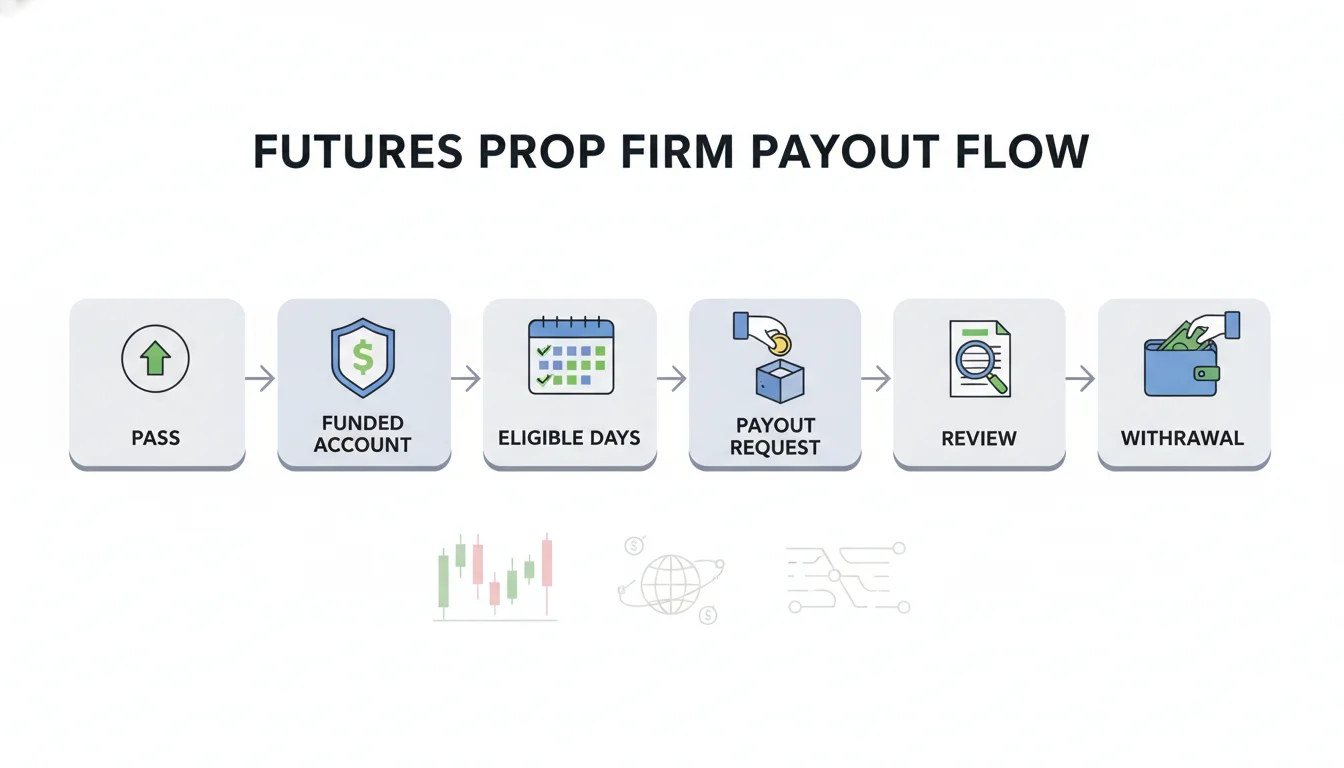
Matched-account buyer comparison · prices and rules checked July 25, 2026
DayTraders.com vs Topstep: Matched 50K Buyer Scorecard
This compares the DayTraders.com 50K EOD evaluation with Topstep’s 50K Trading Combine No Activation Fee path. They share a $3,000 target and EOD-style maximum-loss mechanics, but the billing and payout qualification models are materially different.
| Matched 50K decision point | DayTraders.com | Topstep |
|---|---|---|
| Matched 50K product | 50K EOD evaluation | 50K Trading Combine · No Activation Fee |
| Evaluation price | $70.35 promotional one-time price; $469 reference price shown | $85 promotional monthly price with Responsible Trading Advantage; $95 reference monthly price |
| Funded activation | $130 one-time Pro activation | $0 Express Funded Account activation on this path |
| Profit target | $3,000 | $3,000 |
| Maximum loss | $2,000 EOD trailing drawdown | $2,000 Maximum Loss Limit, calculated from end-of-day account highs |
| Daily loss control | $1,250 hard daily loss limit | Optional in the Trading Combine; the current Responsible Trading checkout can apply a fixed $1,000 Daily Loss Limit |
| Minimum evaluation pace | 2 qualifying days with at least $200 profit on each | No fixed minimum-day rule, but the 55% consistency target can require additional profit/days |
| Consistency | 50% evaluation consistency · 30% Pro payout consistency | Best day should be no more than 50% of total Combine profit; Standard XFA payouts use winning-day criteria |
| Funded payout gate | 8 qualifying Pro days · $500 minimum payout | Standard XFA: 5 winning days of at least $150 · approved payouts use a 90/10 split |
| Cost-risk tradeoff | Known one-time attempt cost, but activation is owed after passing | Lower initial subscription; total cost rises with every rebill before passing |
| Best fit | Trader who prefers a one-time evaluation and can pass the two-day/consistency tests | Trader who prefers Topstep’s narrower rule system and no activation fee, and is comfortable with monthly billing and winning-day payout qualification |
Advanced way to shop this comparison
- Calculate cost to first eligible payout: evaluation charges × expected attempts or rebills + reset + activation—not just today’s coupon.
- Stress-test usable drawdown: subtract commissions and slippage, then divide the remainder by your normal stop loss. For real-time trailing products, model unrealized peaks too.
- Simulate a payout period: run your actual daily P&L distribution through consistency, winning-day, reserve, safety-net, minimum, and cap rules.
- Verify operational trust: confirm the contracting entity, rule-change history, prohibited strategies, support’s written answer for your setup, and a small first withdrawal before buying multiple accounts.
Official sources used for this snapshot
Promotional prices can change without notice. Match the exact account size and drawdown type at checkout, then save the rules and receipt you accepted.
Day Traders vs Topstep searchers are usually not looking for a generic prop firm definition. They want to know which futures funding path is easier to understand, which payout policy is more practical, which rules are most likely to trip them up, and which cost model fits their trading style.
The short answer is that both firms are built around futures trading, but they organize the trader path differently. DayTraders.com has more product branches, including trailing evaluations, EOD evaluations, static evaluations, Straight to Funded accounts, and Straight to Live-style paths. Topstep is more standardized: pass the Trading Combine, move to an Express Funded Account, request payouts if eligible, and potentially progress toward a Live Funded Account.
This comparison uses official DayTraders.com and Topstep pages as primary sources. Pricing, rules, payout windows, country eligibility, and platform details can change, so verify all details with each firm before buying an account. Every price and rules table below should be treated as last checked on June 5, 2026.

Day Traders vs Topstep Quick Verdict
DayTraders.com may be the better fit if you want choice at checkout. Its public product page shows trailing, EOD, static, S2F, and S2L-style account options, each with different drawdown behavior, daily loss limit exposure, and payout rhythm. That makes it attractive for traders who already know whether they prefer no daily loss limit structures, EOD drawdown protection, static drawdown, or a direct simulated funded route.
Topstep may be the better fit if you want a tighter and more familiar path. Its program overview describes a three-stage program: Trading Combine, Express Funded Account, and Live Funded Account. The Trading Combine has a monthly subscription, a profit target, a 55% consistency objective, and one core rule: do not hit or exceed the Maximum Loss Limit. That simplicity is useful for traders who want fewer account types to compare before starting.
If you are a newer futures trader, Topstep may be easier to understand because the program is narrower. If you are experienced and want to fine-tune drawdown type, account size, payout frequency, and path type, DayTraders.com gives you more knobs to choose from.
Day Traders vs Topstep Comparison Table
| Category | DayTraders.com | Topstep |
|---|---|---|
| Main model | Multiple futures account paths, including evaluation, EOD, static, S2F, and S2L-style products | Trading Combine to Express Funded Account to possible Live Funded Account |
| Pricing style | Public site shows one-time promotional checkout prices on account products, checked June 5, 2026 | Monthly Trading Combine subscriptions by account size and path, checked June 5, 2026 |
| Account sizes shown in public rules | Examples include $25K, $50K, $100K, $150K, and $300K depending on account type | $50K, $100K, and $150K Trading Combines |
| Drawdown choices | Trailing, EOD trailing, static, and live account drawdown structures depending on product | Maximum Loss Limit structure, with program-specific parameters |
| Minimum days | Many DayTraders evaluation products show 2 qualifying days to pass | Topstep Trading Combine focuses on profit target, consistency target, and Maximum Loss Limit |
| Funded payout path | Pro and S2F payout rules use QDays, profit targets, balances, and payout minimums | Express Funded Account Standard and Consistency paths have separate payout requirements |
| Profit split | DayTraders states 100% simulated profit split in Pro accounts and 80/20 live account split | Topstep states approved payouts follow a 90/10 split |
| Best fit | Traders who want account-type flexibility and one-time fee options | Traders who want a standardized combine and funded account progression |
Day Traders Account Paths And Rules
DayTraders.com publicly describes several product families. Its help center product overview says evaluation accounts are available with trailing drawdown or static structures. Its public product page also shows EOD evaluations, S2F accounts, and Straight to Live paths.
For evaluations, the public product page checked June 5, 2026 showed several discounted one-time prices, including Trail examples around $25, $38, $70, and $88 for the $25K, $50K, $150K, and $300K sizes. The same page showed a one-time Pro activation fee of $130 on Trail, EOD, and Static evaluation paths. Treat those as time-sensitive promotional prices, not permanent fees.
The key practical difference is drawdown structure:
| DayTraders path | What it is usually trying to solve | Important rule angle |
|---|---|---|
| Trail evaluation | More room as the account grows, but with a dynamic threshold | No daily loss limit shown on the Trail examples, but trailing drawdown is the main constraint |
| EOD evaluation | Drawdown updates at the end of the day instead of intraday | EOD examples show daily loss limits by tier |
| Static evaluation | Predictable fixed drawdown | Lower moving-rule complexity, but less total room |
| S2F | Skip the evaluation and start in a simulated funded account | Uses its own payout cycle and 20% consistency rule on the public product page |
| S2L | Direct path toward live-style trading terms | More serious risk controls and live-account style constraints |
The DayTraders EOD rules page says EOD accounts require 2 qualifying days to pass and use a 50% consistency rule during the evaluation phase. It also states that breaching the daily loss limit on an EOD account results in immediate account termination.
For payout eligibility on Pro and S2F accounts, the DayTraders payout FAQ says traders must complete QDays, reach the required profit target for the account size and cycle, keep the required balance before and after withdrawal, submit at least $500, follow account rules, and set up a payout method. The same payout page says the Pro account minimum QDays between payout requests is 8, while S2F accounts use 10 QDays between requests. The FAQ frames these as simulated funded account payouts, not a promise that every trader will receive a payout.

Topstep Trading Combine And Funded Account Rules
Topstep’s public program overview frames the program in three stages: Trading Combine, Express Funded Account, and Live Funded Account. The Trading Combine is the starting evaluation and requires a monthly subscription. Topstep says the Trading Combine has two objectives and one core rule: reach and maintain the profit target, meet the consistency target, and do not hit or go below the Maximum Loss Limit.
Topstep’s pricing page checked June 5, 2026 showed these Trading Combine prices:
| Topstep Trading Combine size | Standard Path | No Activation Fee Path |
|---|---|---|
| $50K | $49/month | $95/month |
| $100K | $99/month | $149/month |
| $150K | $199/month | $229/month |
Topstep explains the difference this way: the Standard path has a lower monthly cost but a $149 activation fee once an Express Funded Account is earned, while the No Activation Fee path has a higher monthly cost and no fee when the trader passes. The same pricing page says paths cannot be changed after purchase.
Topstep’s Trading Combine parameter page lists maximum position sizes of 5 contracts for $50K, 10 contracts for $100K, and 15 contracts for $150K. It also notes that micros and minis count at a 10:1 ratio in the Trading Combine and Express Funded Account.
For payout eligibility, Topstep splits Express Funded Accounts into Standard and Consistency paths. In the Standard path, Topstep says traders need 5 winning days of $150 or more, net profit greater than $0 since the last payout, and must follow the scaling plan. In the Consistency path, Topstep says traders need at least 3 trading days with at least 1 trade per day and must stay at or below a 40% consistency target.
Topstep’s payout policy also says approved payouts follow a 90/10 split, with traders receiving 90% and Topstep retaining 10%. It lists multiple payout methods, including Wise, ACH, and Wire/SWIFT, with different processing times and fees. For Live Funded Accounts, Topstep says traders can request up to 50% of account balance after 5 winning days, and daily payouts become available after 30 non-consecutive winning days of $150 or more in the Live Funded Account.
Day Traders vs Topstep Payout Fit
The biggest payout difference is not just the split. It is the whole qualification structure.
DayTraders.com is more account-type dependent. Pro accounts, S2F accounts, and live accounts have different rules. The Pro and S2F payout FAQ uses QDays, minimum payout request size, account-specific profit targets, minimum balances, and max per-request limits. Its live account page says live accounts operate on an 80/20 split, require a $1,000 buffer above the initial balance, and allow payout requests once the trailing drawdown has reached the initial account balance.
Topstep is more path dependent. The Standard Express Funded Account path uses 5 winning days of $150 or more, while the Consistency path uses 3 trading days and a 40% consistency target. Topstep’s public payout policy says approved payouts follow a 90/10 split and that payout requests may involve policy, conduct, tax, and payment-method checks.
In practical terms, DayTraders.com may appeal to traders who want to optimize for payout style by product. Topstep may appeal to traders who want a clear progression and are comfortable with a funded account system that keeps payout eligibility tied to winning-day cycles and maximum loss controls.